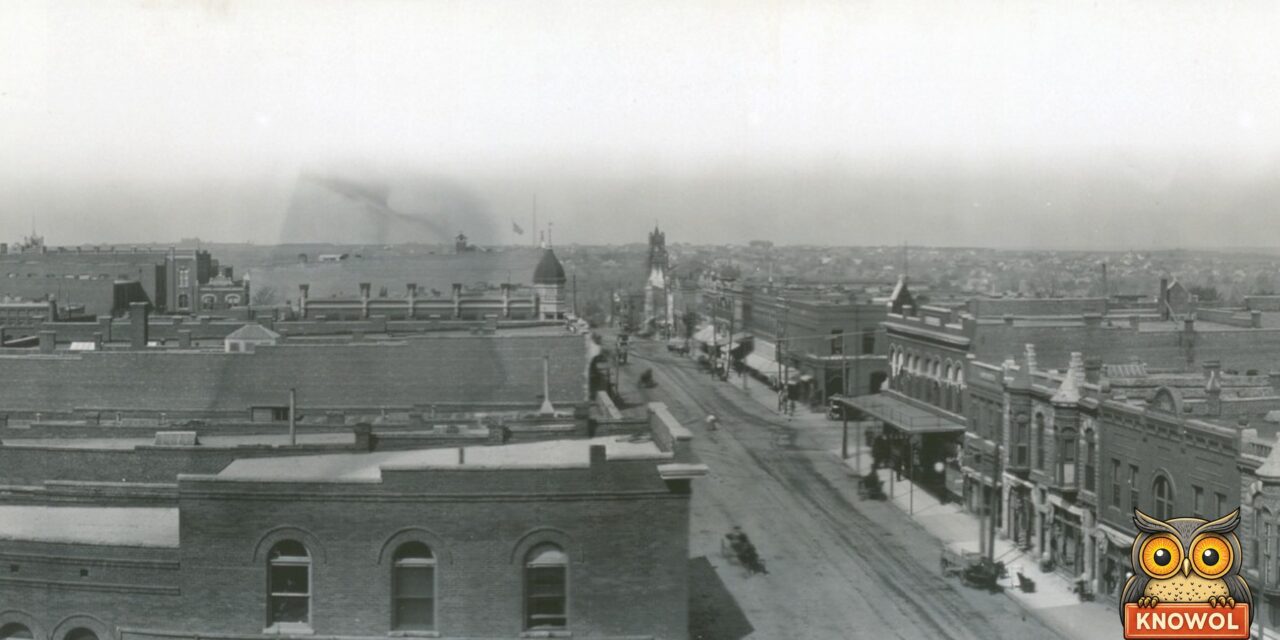
Before he went to bed, Joseph Thompson put $50 on the table. He had lost a bet, and he knew it. All day long his neighbor, Samuel Johnson, had fed him breakfast, lunch and dinner made from things most farmers walked right past: wild plants by the creek, wild fruit, and crops they grew to feed their cows and horses. Thompson had to admit the food was good.
That is the story newspapers all over America told in 1911. It began as a short news item sent out from Guthrie, Oklahoma, at the end of August. Guthrie was a busy brick town, like the rooftop view at the top of this story, taken around 1910. On December 2 it turned up in the Colfax Chronicle of Colfax, Louisiana, under a big, bold headline: “His Meal of Weeds.”
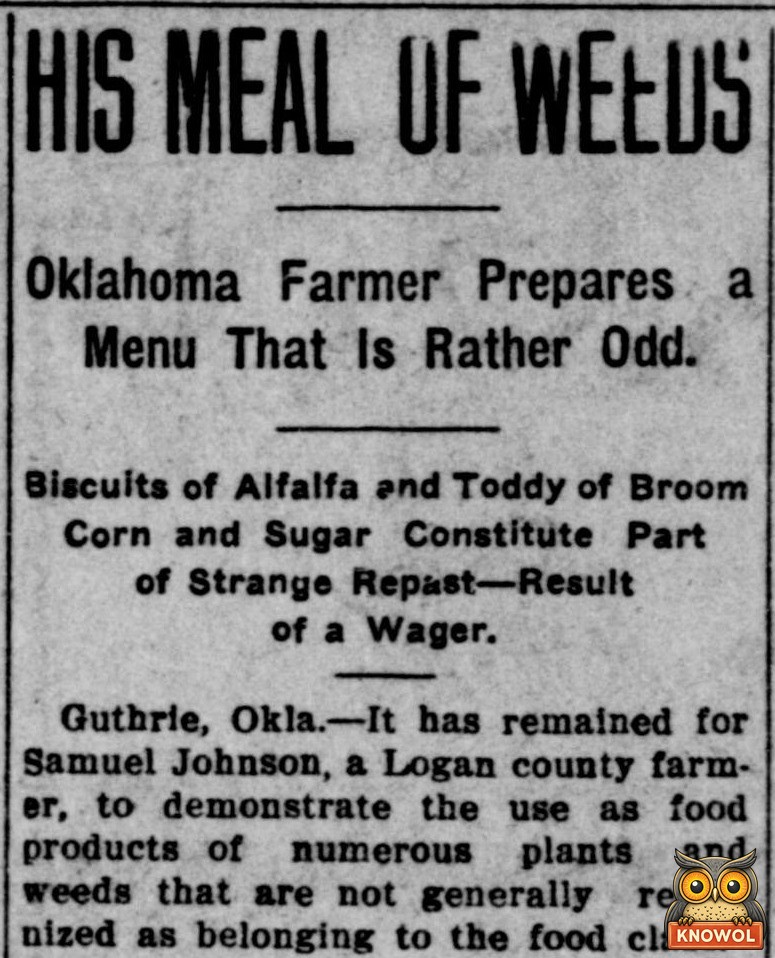
“His Meal of Weeds.” The Colfax Chronicle, Colfax, Louisiana, December 2, 1911, page 2. Library of Congress, Chronicling America. Click the clipping to read it full size.
The bet
The paper called Johnson “a Logan county farmer.” Logan County is the farm country around Guthrie, which had been Oklahoma’s capital city until 1910. Johnson and Thompson had been arguing about a hard question: what should a farm family eat when the main crops fail? Johnson said the answer was growing all around them. Plenty of farm plants, “and even some wild vines and weeds,” could feed a family well. Thompson didn’t believe a word of it.
So they made a bet. Johnson would search “the out-of-the-way places on his farm, along the creeks and valleys,” and his fields too. Then he would cook a whole day of meals. If Thompson said they were “as good as he ever ate,” Johnson would win. “The wager was for $50 and Johnson won,” the Chronicle reported.
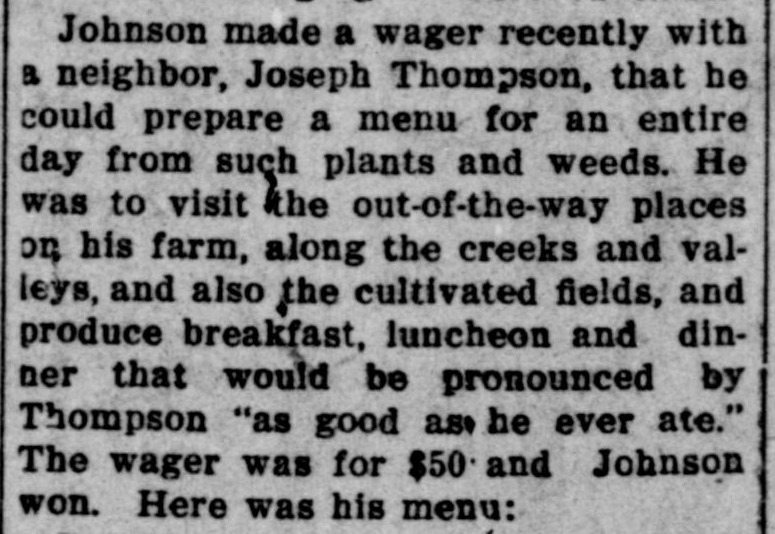
The bet between Samuel Johnson and his neighbor, Joseph Thompson. The Colfax Chronicle, Colfax, Louisiana, December 2, 1911. Library of Congress, Chronicling America. Click the clipping to read it full size.
What was on the menu
Here is most of what Johnson served, in plain words.
- Breakfast: “alfalfa meal flapjacks,” which are pancakes, with syrup made from milo maize, and a hot cereal of boiled sorghum grain.
- Lunch: bread made from sorghum grain, boiled cowpeas, and a young rabbit fried in “cotton lard,” a cooking fat made from cottonseed oil.
- Dinner: alfalfa muffins with peanut butter, baked soy beans, fruit from the farm’s orchards, and wild grape juice.
Alfalfa is a leafy green plant that farmers cut and dry for hay. Alfalfa meal, the paper explained, was “made from the leaves and stems of alfalfa hay ground finely,” and most of it went to feed cattle. Milo maize is a tough grain that grows well on the dry plains. Cowpeas are the bean family that black-eyed peas belong to.
Here is a funny thing the paper never said. Milo maize, broom corn and the grain in that breakfast cereal and bread are all kinds of one plant, called sorghum. So a big part of Johnson’s strange day was one plant cooked several different ways.
The breakfast list had one more item that should have made readers raise an eyebrow. It was a hot “toddy” made with whisky from broom corn. Oklahoma had outlawed liquor when it became a state in 1907, so that was an odd thing for a farmer to brag about in the newspaper.
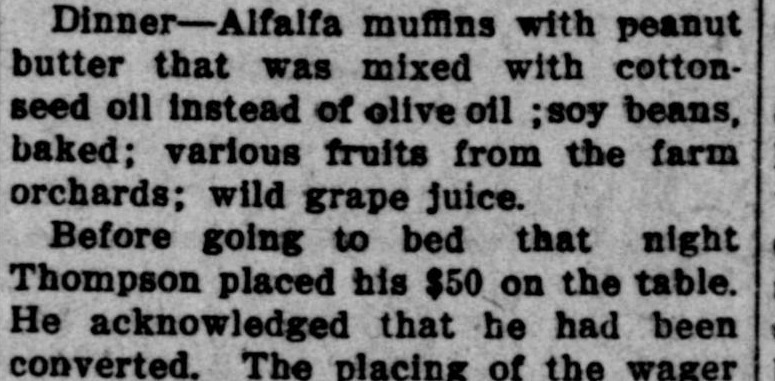
Dinner, and the $50 on the table. The Colfax Chronicle, Colfax, Louisiana, December 2, 1911. Library of Congress, Chronicling America. Click the clipping to read it full size.
Soap from a yucca, a broom from a weed
Johnson didn’t stop at food. “In order, too, just to make the program strong for Mr. Thompson,” he said, “I washed the dishes after each meal with soap made from the yucca plant. I swept the floor with a broom made of the broom weed.” Yucca is the spiky plant that grows wild on the plains. Its roots make a soapy foam when you rub them in water, which is why one kind is called soapweed.
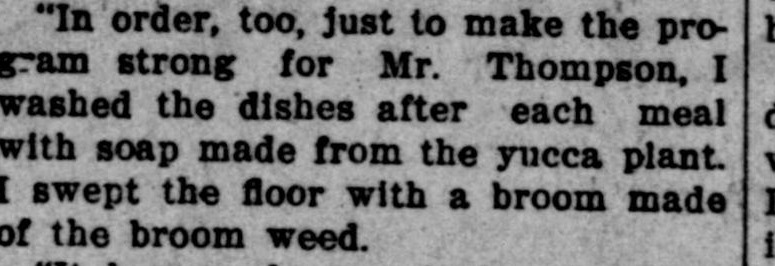
Yucca soap and a broom weed broom. The Colfax Chronicle, Colfax, Louisiana, December 2, 1911. Library of Congress, Chronicling America. Click the clipping to read it full size.
Why go to all that trouble? “My main point, however,” Johnson said afterward, was to prove that crops like alfalfa, milo maize and cowpeas were good “articles of food,” not just animal feed. He said he had known Oklahoma homesteaders who got through their first hard winter on little more than sorghum bread and cowpeas.
One warning the 1911 papers left out: many wild plants are poisonous. Nobody should eat a weed unless a grown-up who really knows plants says it is safe.
Muffins for the alfalfa men
The best side story was about the men who ground alfalfa into cattle feed. “Alfalfa biscuits and muffins have long been the delight of men who are engaged in the manufacture of alfalfa meal for cattle feeding purposes,” the story said. At a meeting of the National Association of Alfalfa Millers, the members “feasted on muffins made of alfalfa meal and pronounced them A No. 1.” That meant first class, the very best. “The muffins were served more as a novelty, but the banqueters ate them with relish.”
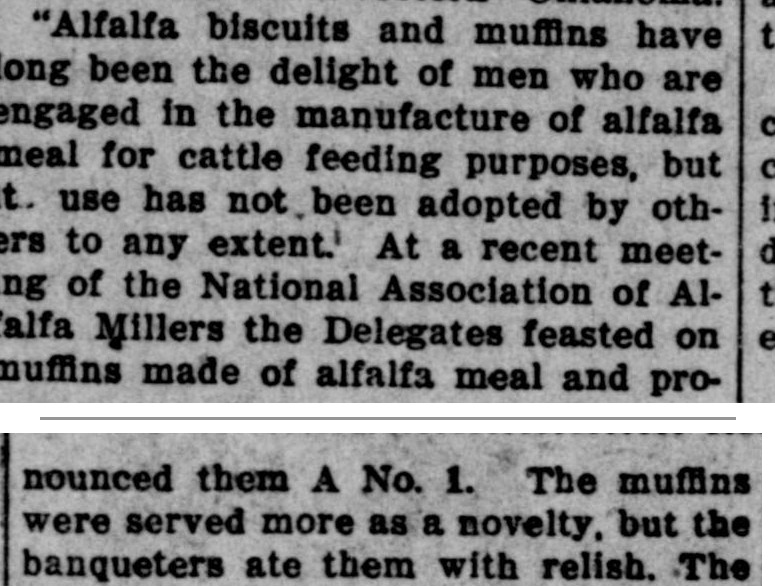
The alfalfa millers’ muffins. The Colfax Chronicle, Colfax, Louisiana, December 2, 1911. Library of Congress, Chronicling America. Click the clipping to read it full size.
The crops on Johnson’s menu were real, and so were the farms that grew them. Around 1904, a photographer near Roswell, New Mexico, took this picture of men and boys cutting a field of sorghum grain on the South Spring Ranch.
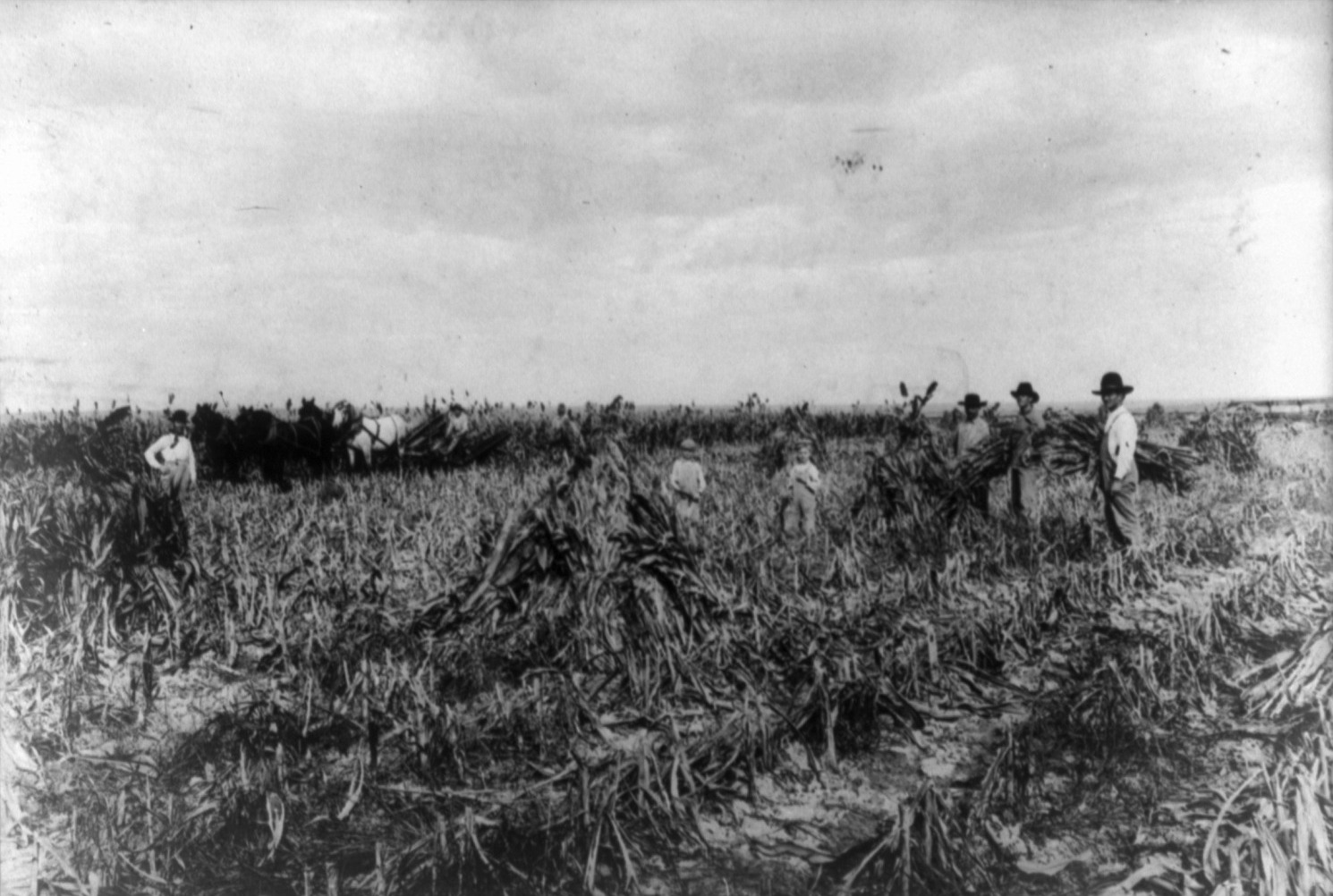
Men, boys and a team of horses cutting a field of sorghum grain on the South Spring Ranch near Roswell, New Mexico, about 1904. Photo by E. H. Wilkinson, copyrighted by A. J. Haddix. Library of Congress Prints and Photographs. Click the picture to see it full size.
The same feast, a different farmer
Here is where the story gets slippery. On September 7, 1911, the Tulsa Daily World in Tulsa, Oklahoma, printed the same story with a new beginning. It opened with a pep talk for local farmers whose corn had been ruined by the hot summer. Then it told the whole tale again, but the cook was now a Tulsa County farmer with a different name. The bet, the $50, the menu and the losing Mr. Thompson were all the same. Only the hero had moved about 80 miles east.
Back in Guthrie, the town the story was supposed to come from, the daily paper was the Guthrie Daily Leader. We searched the text of its August and September 1911 issues and found no sign of Samuel Johnson’s feast.
So was it true?
Nobody can say for sure now. In 1911, small-town papers filled many of their pages with ready-made stories sent out by news services. The Colfax page shows how that worked. Right beside “His Meal of Weeds” sat news from London, England, Pasadena, California, and Berlin, Germany. The editors in Colfax had no way to check on a farmer about 400 miles away in Oklahoma.
The story does name one Guthrie man. “It is believed that Fred L. Wenner of Guthrie, former private secretary to several Oklahoma territorial governors,” it said, was the first to show that one of the sorghum grains made good food. Whether Mr. Wenner had a hand in sending the story out, the papers never said.
Here is what we do know. From North Dakota to Georgia to Washington State, readers in 1911 learned that alfalfa, cowpeas and sorghum could feed people, not just cows. And in every version, a doubting neighbor laid his $50 on the table and went to bed a little poorer.
Where we found it
The story ran in many papers. These are the ones we found, by the date of the paper:
- Bismarck Daily Tribune, Bismarck, North Dakota: August 30, 1911 (“Farmer Contends Weeds Are Edible”).
- Americus Times-Recorder, Americus, Georgia: September 1, 1911 (“Oklahoma Farmer Has Proved Weeds Edible”), datelined Guthrie, August 26.
- The Yakima Herald, North Yakima, Washington: September 6, 1911.
- Tulsa Daily World, Tulsa, Oklahoma: September 7, 1911 (the Tulsa County version).
- Wood County Reporter, Grand Rapids, Wisconsin: November 9, 1911.
- Dakota Farmers’ Leader, Canton, South Dakota: November 10, 1911.
- The Colfax Chronicle, Colfax, Louisiana: December 2, 1911.
- The Oskaloosa Herald, Oskaloosa, Iowa: December 28, 1911.
- Tensas Gazette, St. Joseph, Louisiana: May 3, 1912.
Sources
- The Colfax Chronicle (Colfax, Louisiana): December 2, 1911, page 2 (“His Meal of Weeds”). Every quote in this story is read off this page scan unless another paper is named.
- Americus Times-Recorder (Americus, Georgia): September 1, 1911, page 6 (“Oklahoma Farmer Has Proved Weeds Edible,” Guthrie, August 26).
- Bismarck Daily Tribune (Bismarck, North Dakota): August 30, 1911, page 5 (“Farmer Contends Weeds Are Edible”).
- Tulsa Daily World (Tulsa, Oklahoma): September 7, 1911, page 4 (“All Meals Right From the Ground”), read in the Library of Congress text only. Its page scan would not open for us, so nothing from it is quoted.
- The other papers in the list above were found in the Library of Congress text of Chronicling America through our own newspaper index.
- Cover: Panoram #1 of Guthrie, Okla., Haines Photo Co., about 1910 (a slice from the middle of the panorama). Library of Congress Prints and Photographs, Panoramic Photographs. No known restrictions on publication.
- Harvest photo: South Spring Ranch, Roswell, New Mexico, about 1904 (the lettering printed along the bottom is trimmed off). Library of Congress Prints and Photographs. No known restrictions on publication.
- Newspaper pages: Library of Congress, Chronicling America. Published 1911 and 1912, public domain.