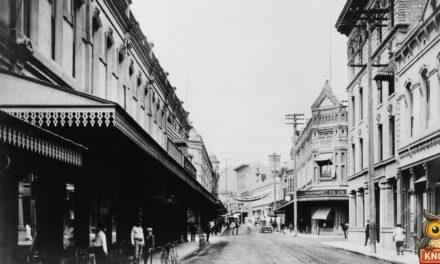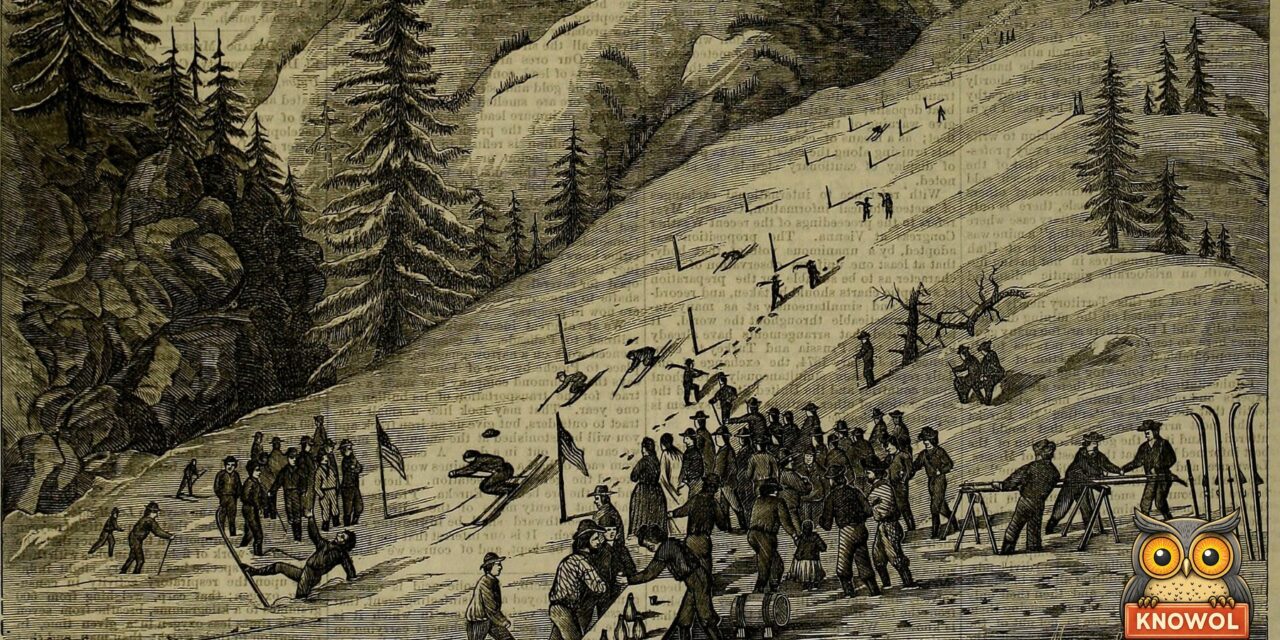
In August 1883, the Post Office was packing up its history for the big Louisville Exposition in Kentucky. Out west, H. J. McKusick ran the mail trains of the Pacific Coast, and he picked something odd to send. It was “an old pair of snow-shoes of the Norwegian style, about twelve feet in length, two inches thick and six inches wide.” Today we would call them skis. The Sacramento Daily Record-Union said they “were the first pair of snow-shoes ever used in the mail service in the State.” They had belonged to a farmer named John A. Thompson, and the story of how he used them is one of the best mail stories in America.
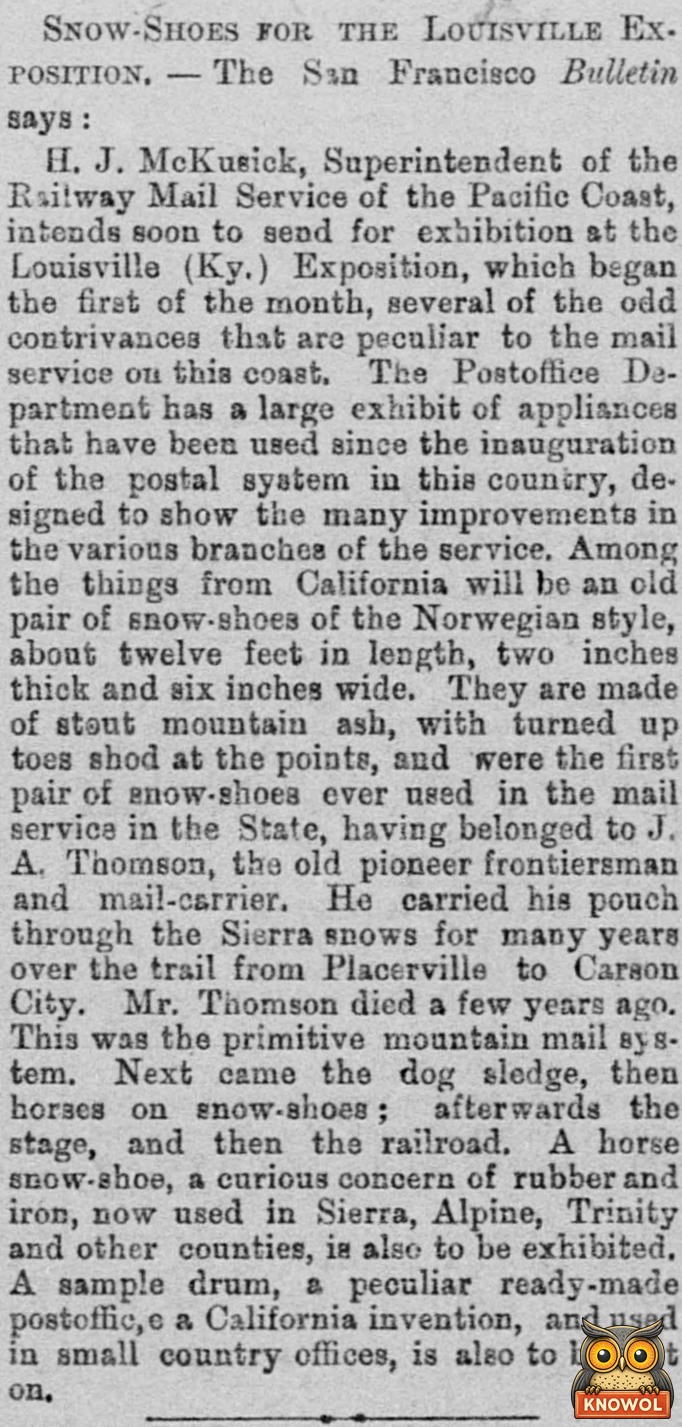
“Snow-Shoes for the Louisville Exposition.” Sacramento Daily Record-Union, Sacramento, California, August 14, 1883, page 2. Library of Congress, Chronicling America. Click the clipping to read it full size.
A farmer remembers Norway
Thompson was born in Norway in 1827 and came to America when he was ten. In 1851 he crossed the plains to California. He mined at Placerville, California, then ranched at Putah Creek in the Sacramento Valley.
Every winter, the same problem came back. Snow buried the road from Placerville over the Sierra Nevada mountains to Carson Valley, on the Nevada side. Wagons couldn’t get through, and carrying the mail across was a hard, slow job. Thompson remembered the long wooden boards people rode on back in Norway. In the winter of 1856 he made his own. The San Francisco Bulletin said “he accordingly constructed a pair ten feet long and four inches wide.” (The pair sent to Louisville in 1883 measured about twelve feet.)
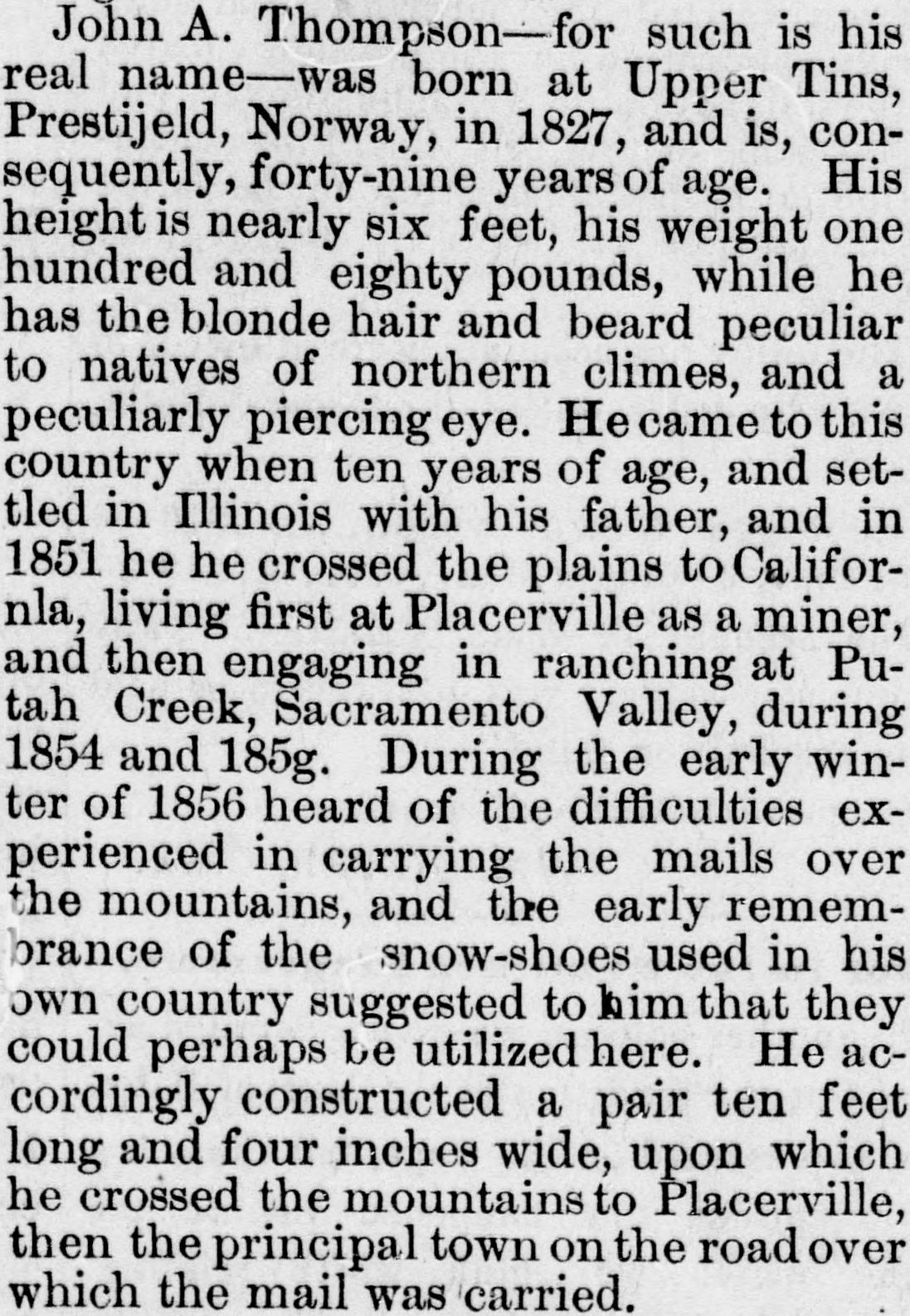
Thompson’s life story, from the San Francisco Bulletin. Watertown Republican, Watertown, Wisconsin, March 15, 1876, page 6. Library of Congress, Chronicling America. Click the clipping to read it full size.
Ninety miles with the mail on his back
His first trip was in January 1856. He went from Placerville to Carson Valley, ninety miles, “gliding on his long Norwegian snow-shoes over fields of snow from ten to fifty feet deep.” The mail bags rode on his back. They weighed “generally from sixty to eighty pounds, but sometimes more than one hundred pounds.” That’s about as heavy as a big kid.
It took him three days going, because most of it was uphill, and two days coming back. There wasn’t a house on the way. The Bulletin called it “a perfect Siberia of snow.” Here is the part that makes people shake their heads: “He never carried blankets or wore an overcoat, while all his food was prepared so that he could eat it as he ran.” He drank from mountain streams or ate a handful of snow.
At night he built a fire and slept on a bed of hemlock branches, “with his head pillowed upon the mailbags.” Near Strawberry Valley he had a favorite spot, “a cavern in the shape of an oven,” with a fire at its mouth.
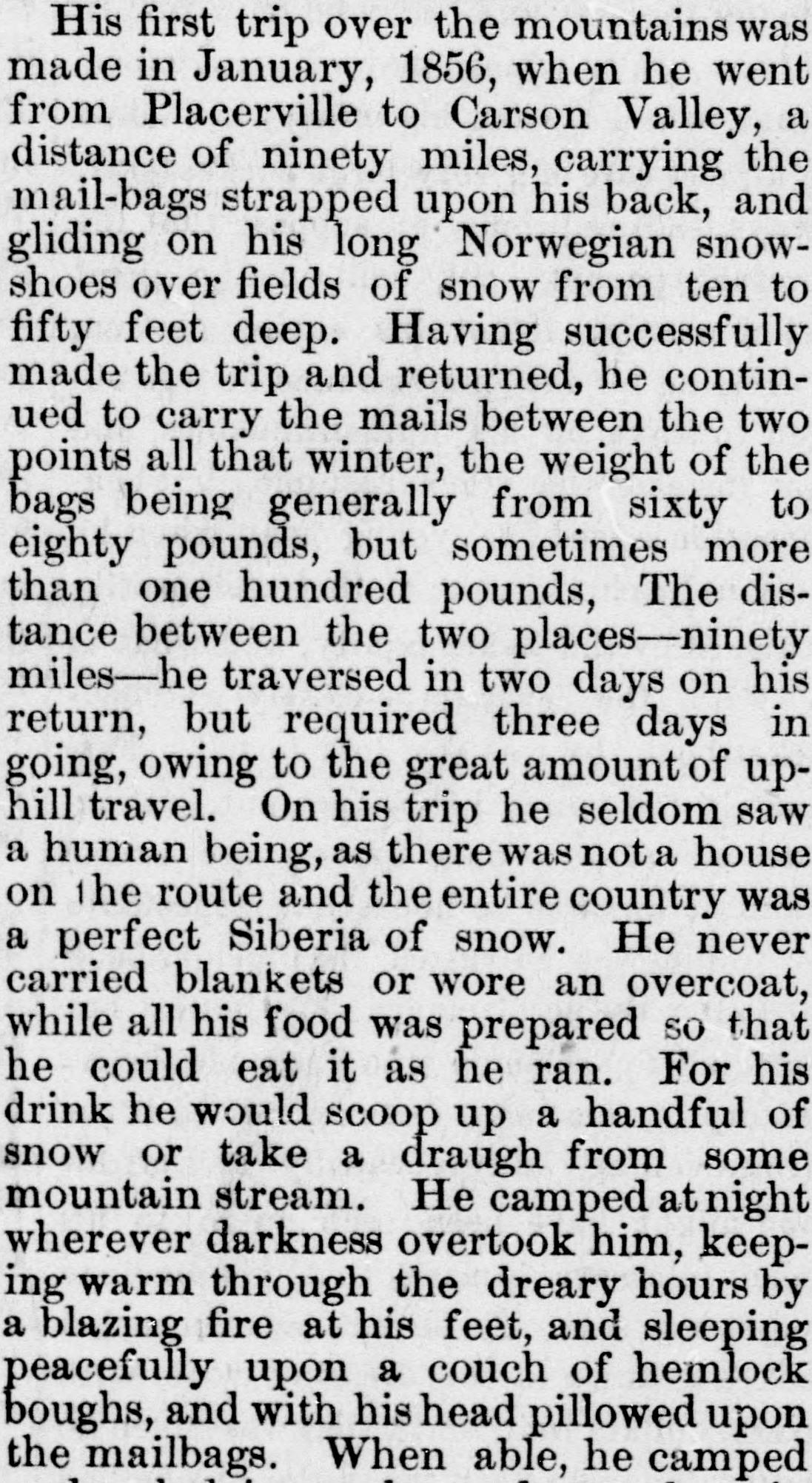
His first trip, January 1856. Watertown Republican, Watertown, Wisconsin, March 15, 1876, page 6. Library of Congress, Chronicling America. Click the clipping to read it full size.
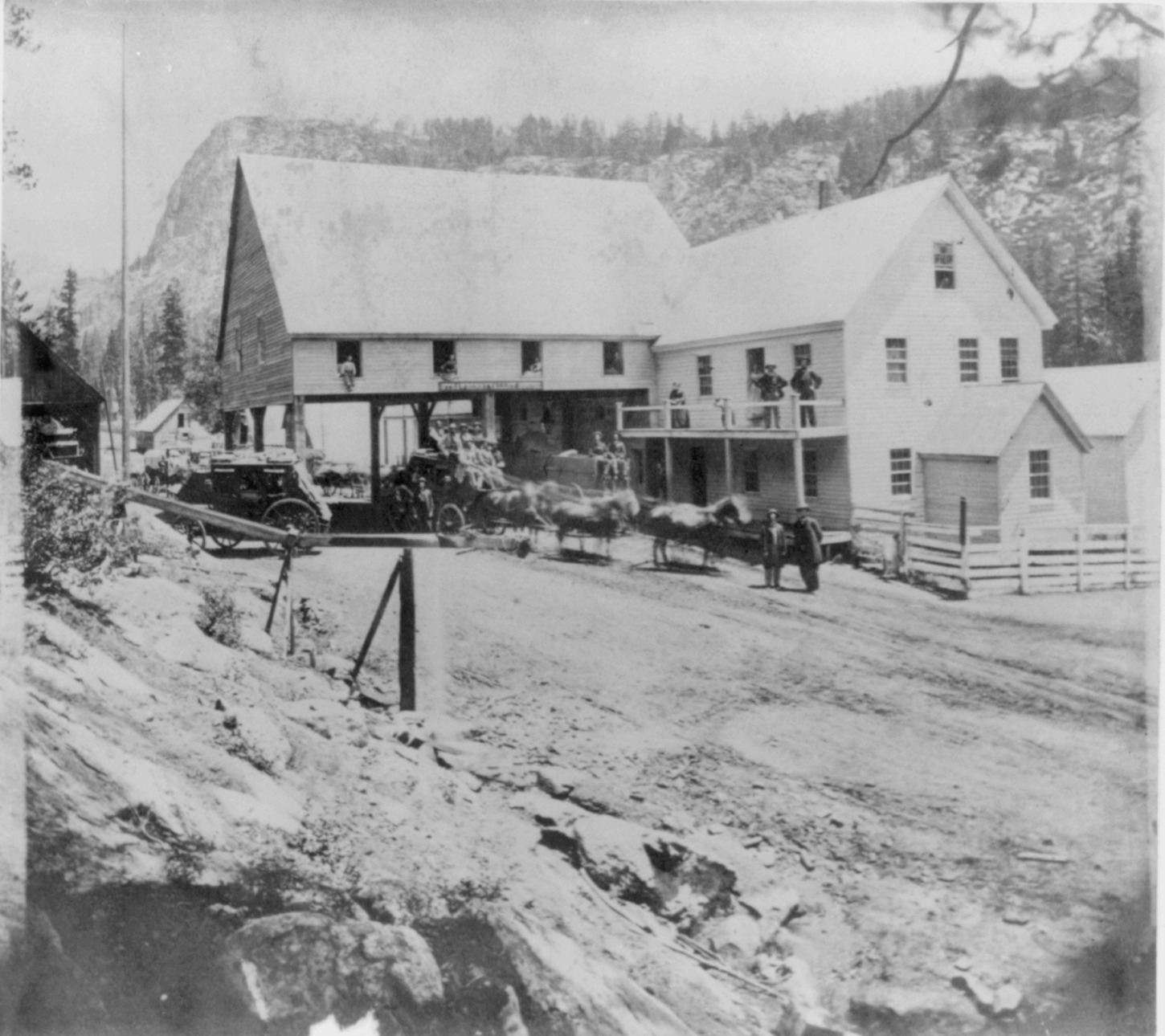
Strawberry Valley Station on the Placerville route over the Sierra, about 1866, in summer. Thompson’s oven-shaped cave was about six miles from Strawberry Valley. Lawrence & Houseworth. Library of Congress, Prints and Photographs Division. Click the picture to see it full size.
How the long snow-shoes worked
Today the word snowshoe usually means a short frame with webbing that you walk on. Thompson’s were different. They were long, smooth boards with toes that turned up, so they slid over the snow instead of sinking in. You didn’t step. You glided.
Californians back then called them snow-shoes, not skis. In 1874 the Mining and Scientific Press of San Francisco explained that in deep snow, travel was only possible on the “Norwegian snow-shoes,” or “Norway skates.” The paper said the snow up there could get so deep that “people can only make their exit from their houses through the upper windows.” Sometimes, it said, a person had “to climb out through his chimney.”
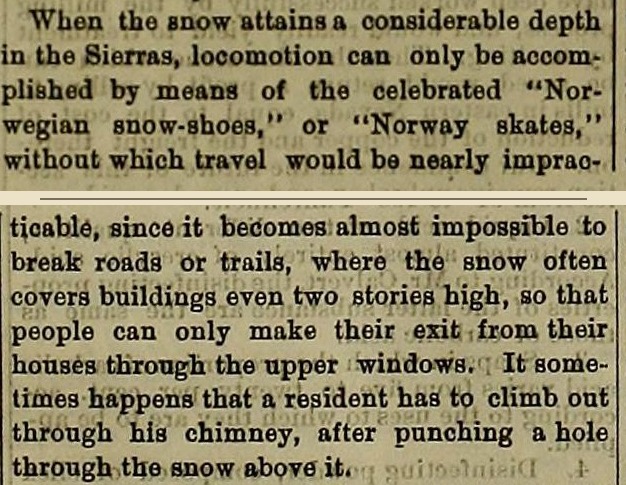
Mining and Scientific Press, San Francisco, California, January 3, 1874, page 1. Two pieces of one column, joined. Internet Archive, public domain. Click the clipping to read it full size.
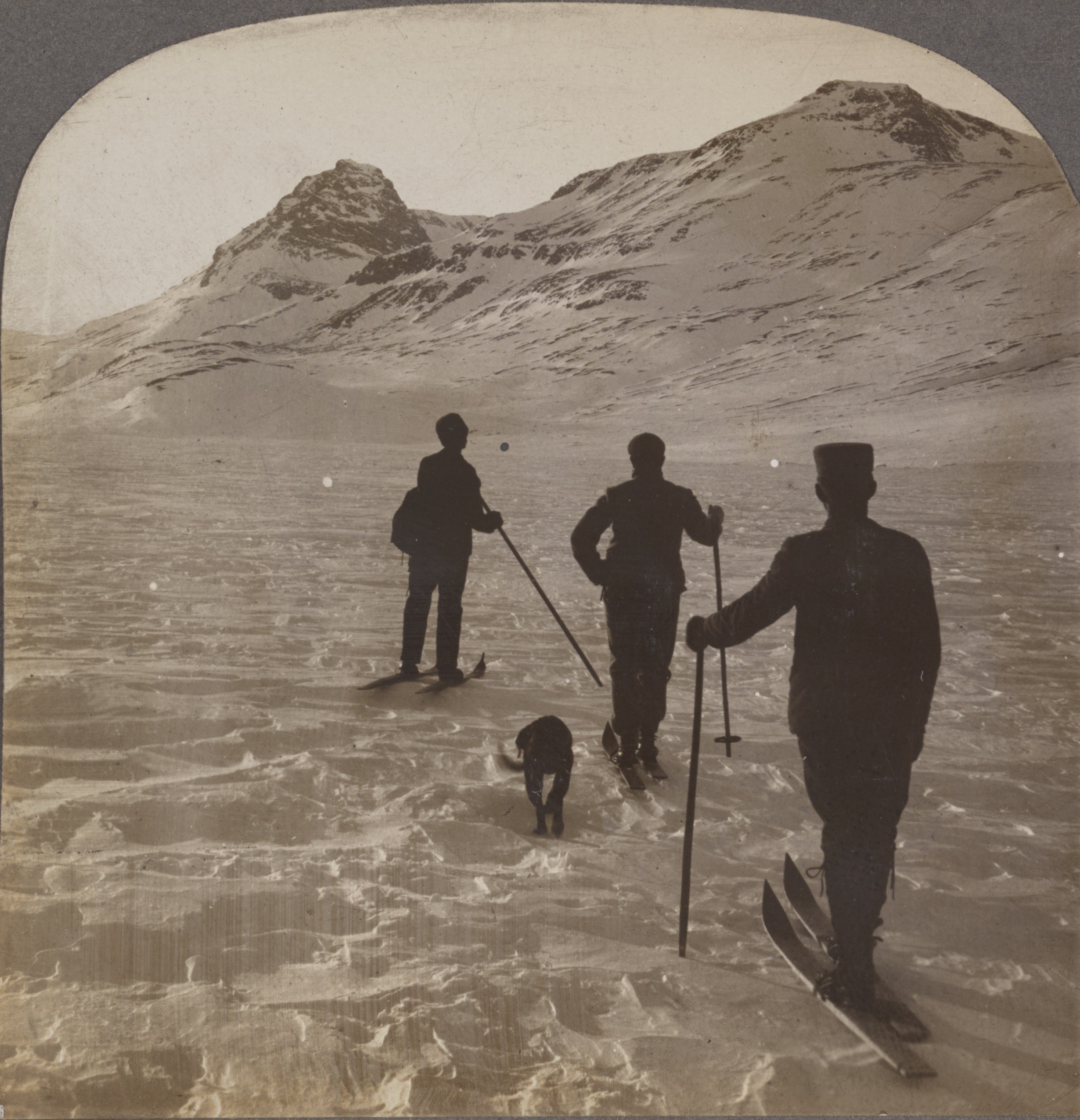
Ski runners on Lake Bygdin, Norway, 1906. A stand-in: Thompson remembered snow-shoes like these from Norway. Keystone View Company stereograph. Library of Congress, Prints and Photographs Division. Click the picture to see it full size.
The champion of the coast
Thompson kept carrying the mail for twenty winters. The papers loved him. In 1876 the Bulletin said, “Everybody in this state has heard of ‘Snow-Shoe Thompson.'”
That same winter he left the mining town of Monitor at seven o’clock one night with a bag of mail and “a large lantern strapped on his chest.” He went eight miles to Silver Mountain “in the face of a heavy gale and blinding snow” and got there at midnight. The paper called him “the best snow shoe traveler on the coast.” It also said that in the winter of 1869 to 1870 he raced 1,600 feet down Silver Mountain in twenty-one seconds. That’s about 50 miles an hour, on wooden boards.
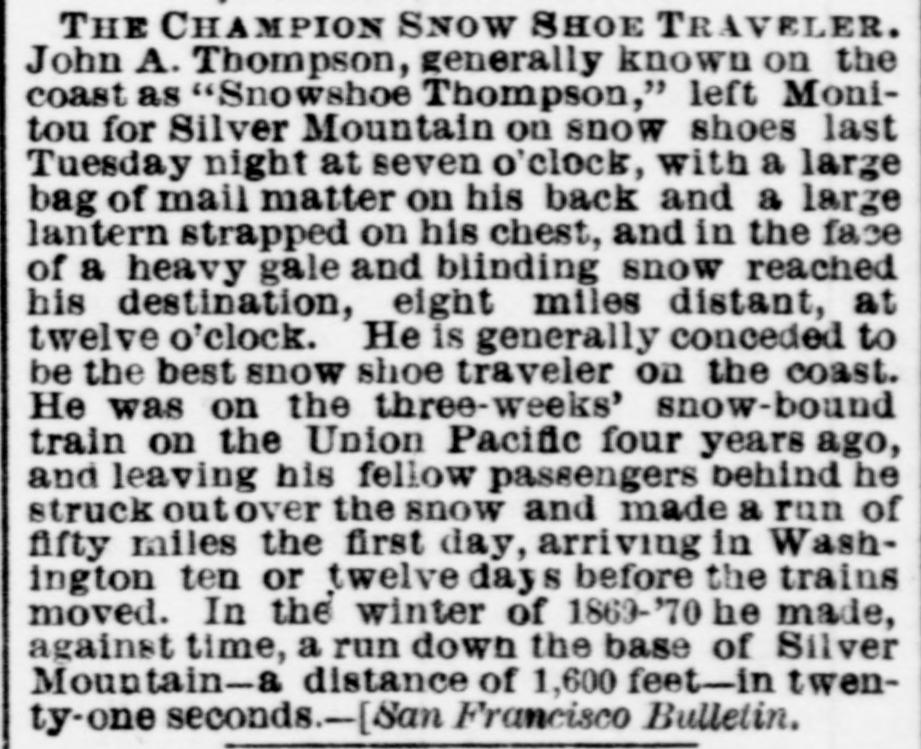
“The Champion Snow Shoe Traveler,” from the San Francisco Bulletin. Evening Star, Washington, D.C., March 1, 1876, page 3. Library of Congress, Chronicling America. Click the clipping to read it full size.
By then he was tired. His friends passed around a petition “asking the government to pay him $6,000 for his past services.” Thompson died not long after, in 1876. When the Record-Union wrote about his snow-shoes in 1883, it said simply, “Mr. Thomson died a few years ago.” (The paper spelled his name without the p.)
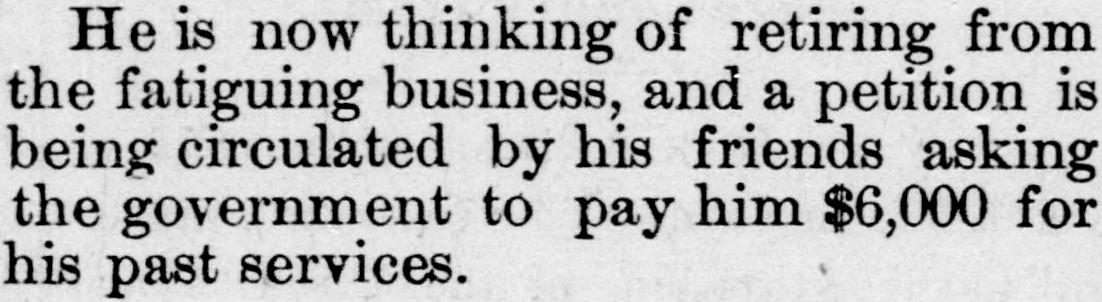
Watertown Republican, Watertown, Wisconsin, March 15, 1876, page 6. Library of Congress, Chronicling America. Click the clipping to read it full size.
Horses on snow-shoes
The 1883 story listed what came after Thompson. “This was the primitive mountain mail system. Next came the dog sledge, then horses on snow-shoes; afterwards the stage, and then the railroad.” McKusick planned to send a horse snow-shoe to Louisville too, “a curious concern of rubber and iron.”
Horse snow-shoes were real, and the horses liked them. In 1897 a mine owner from Plumas County told the San Francisco Call how his worked. Each was “a thin steel plate eight inches in diameter,” fastened to the hoof with a steel spring and a nut, with rubber on the bottom so snow wouldn’t stick. The horses got so used to them that “they don’t like to walk without them.” Then came the best line: “They will put up their feet to have the snowshoes put on.”
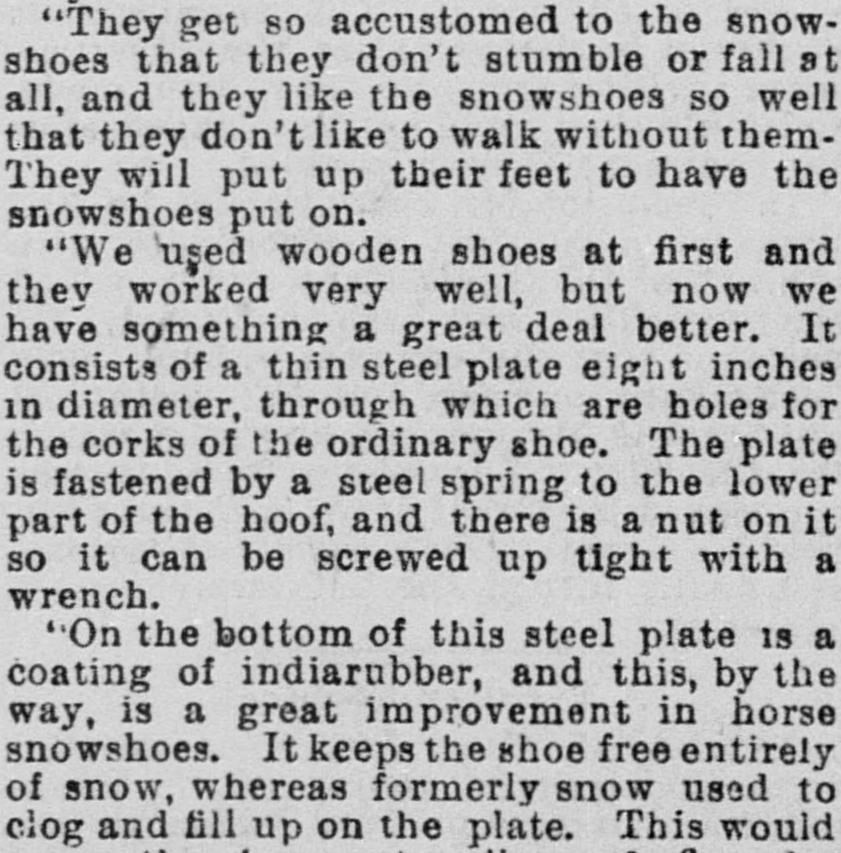
The San Francisco Call, San Francisco, California, January 9, 1897, page 10. Library of Congress, Chronicling America. Click the clipping to read it full size.
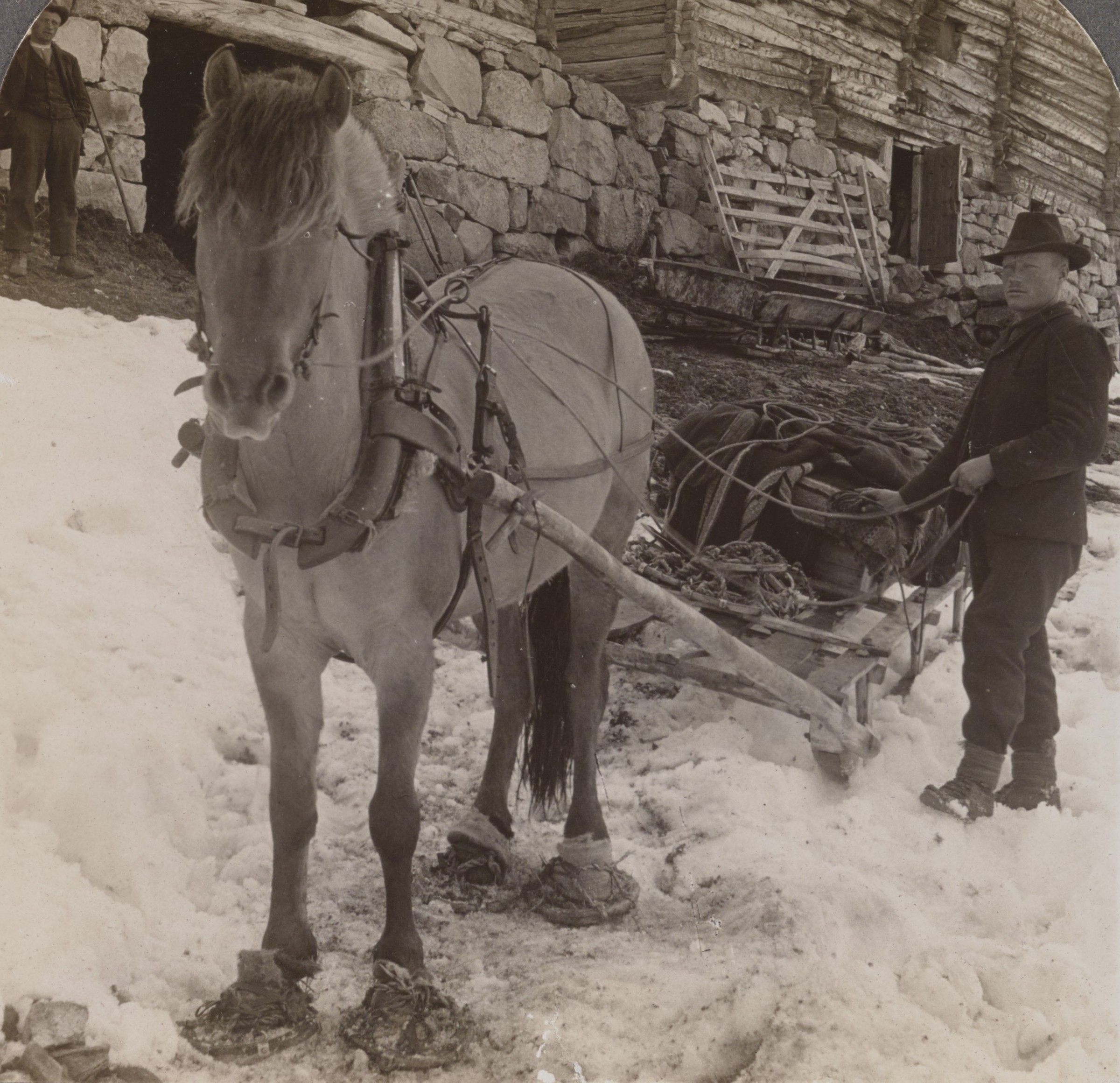
A horse on snowshoes, ready to climb the Haukelid mountains in Telemark, Norway, 1906. A stand-in from Norway, not California. Keystone View Company stereograph. Library of Congress, Prints and Photographs Division. Click the picture to see it full size.
Racing with secret recipes
Thompson’s kind of snow-shoes turned into a sport. The cover of this story is a drawing from that 1874 Mining and Scientific Press called “Snow-Shoe Racing in the Mountains of California.” Every year, four mining towns, including La Porte, California, held races together. In 1890 the Record-Union said “there is just as much excitement and betting there as at a horse race below.”
The racers rubbed a mix called “dope” on the bottom of their boards, a lot like ski wax today. Each town had its own recipe and “guards it carefully against outsiders.” A winning recipe was “worth its weight in gold.” It made the bottom “as slick as ice.”
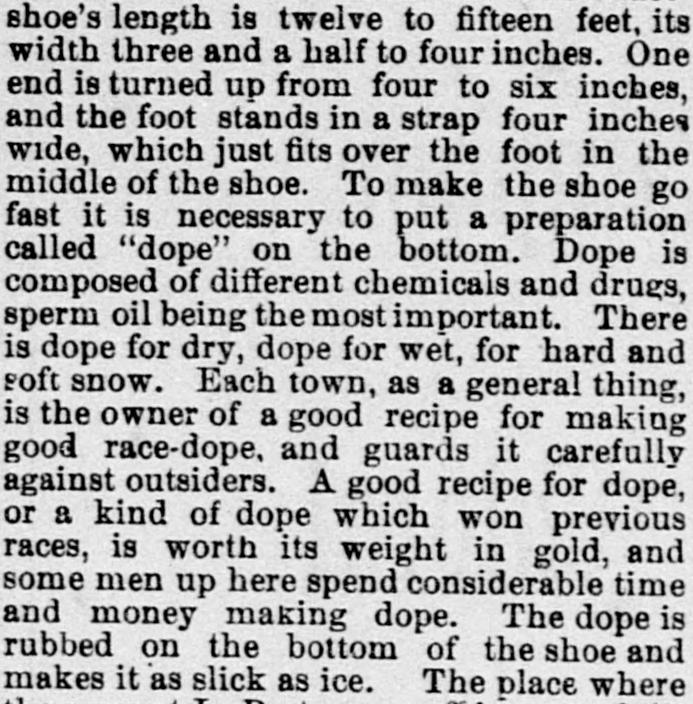
Racing dope. Sacramento Daily Record-Union, Sacramento, California, April 3, 1890, page 3. Library of Congress, Chronicling America. Click the clipping to read it full size.
So in 1883, when the Post Office wanted to show how far the mail had come, California sent something from the very beginning: two old boards of mountain ash, “with turned up toes shod at the points.” Before any of the rest, there was a farmer from Norway, a bag of letters on his back, gliding over the Sierra in the snow.
Sources
- Sacramento Daily Record-Union (Sacramento, California): August 14, 1883, page 2 (“Snow-Shoes for the Louisville Exposition,” from the San Francisco Bulletin) and April 3, 1890, page 3 (“Racing on Snow-Shoes”).
- Watertown Republican (Watertown, Wisconsin): March 15, 1876, page 6 (“Snow-Shoe Thomson,” from the San Francisco Bulletin).
- Evening Star (Washington, D.C.): March 1, 1876, page 3 (“The Champion Snow Shoe Traveler,” from the San Francisco Bulletin).
- The San Francisco Call (San Francisco, California): January 9, 1897, page 10 (“All the Horses Wear Snowshoes”).
- Mining and Scientific Press (San Francisco, California), January 3, 1874, page 1, “Snow-Shoeing in the Sierras” and the drawing “Snow-Shoe Racing in the Mountains of California,” Internet Archive, public domain.
- Photos: “Ski-Runners on Lake Bygdin, Jotunheim Region, Norway,” Keystone View Company, 1906, Library of Congress; “Horse on Snowshoes Ready to Climb Haukelid Mountains, Telemarken, Norway,” Keystone View Company, 1906, Library of Congress; “Strawberry Valley Station, Placerville Route,” Lawrence & Houseworth, 1866, Library of Congress. No known restrictions on publication in the U.S.
- All newspaper images: Library of Congress, Chronicling America, published 1876 to 1897, public domain.
- Cover: “Snow-Shoe Racing in the Mountains of California,” Mining and Scientific Press, January 3, 1874, Internet Archive, public domain.