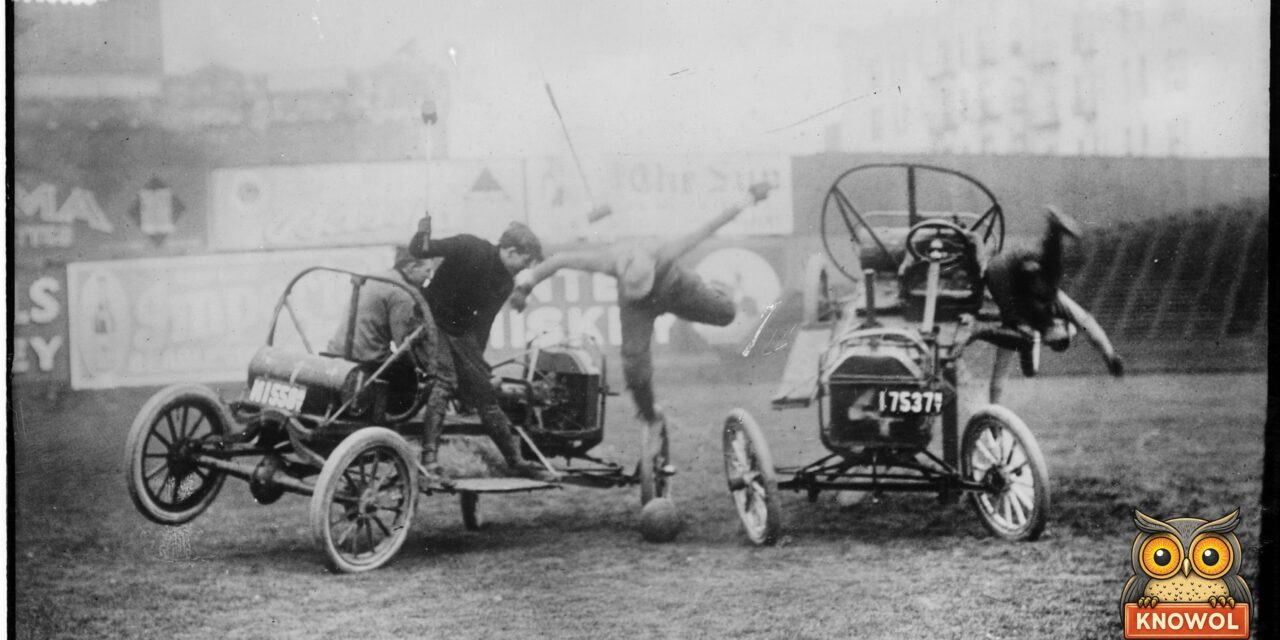
On the evening of Saturday, August 16, 1913, a crowd filled the state fair grounds in Fargo, North Dakota. Two Ford cars rolled onto the field. They had no bodies, no doors and no roofs. Each one was stripped down to its frame, its engine and four wheels, with a steel hoop curving over the driver’s seat. Next to each driver stood a second man holding a long wooden mallet. On the ground between the cars sat a basketball painted white. Fargo was about to see its first game of auto polo.
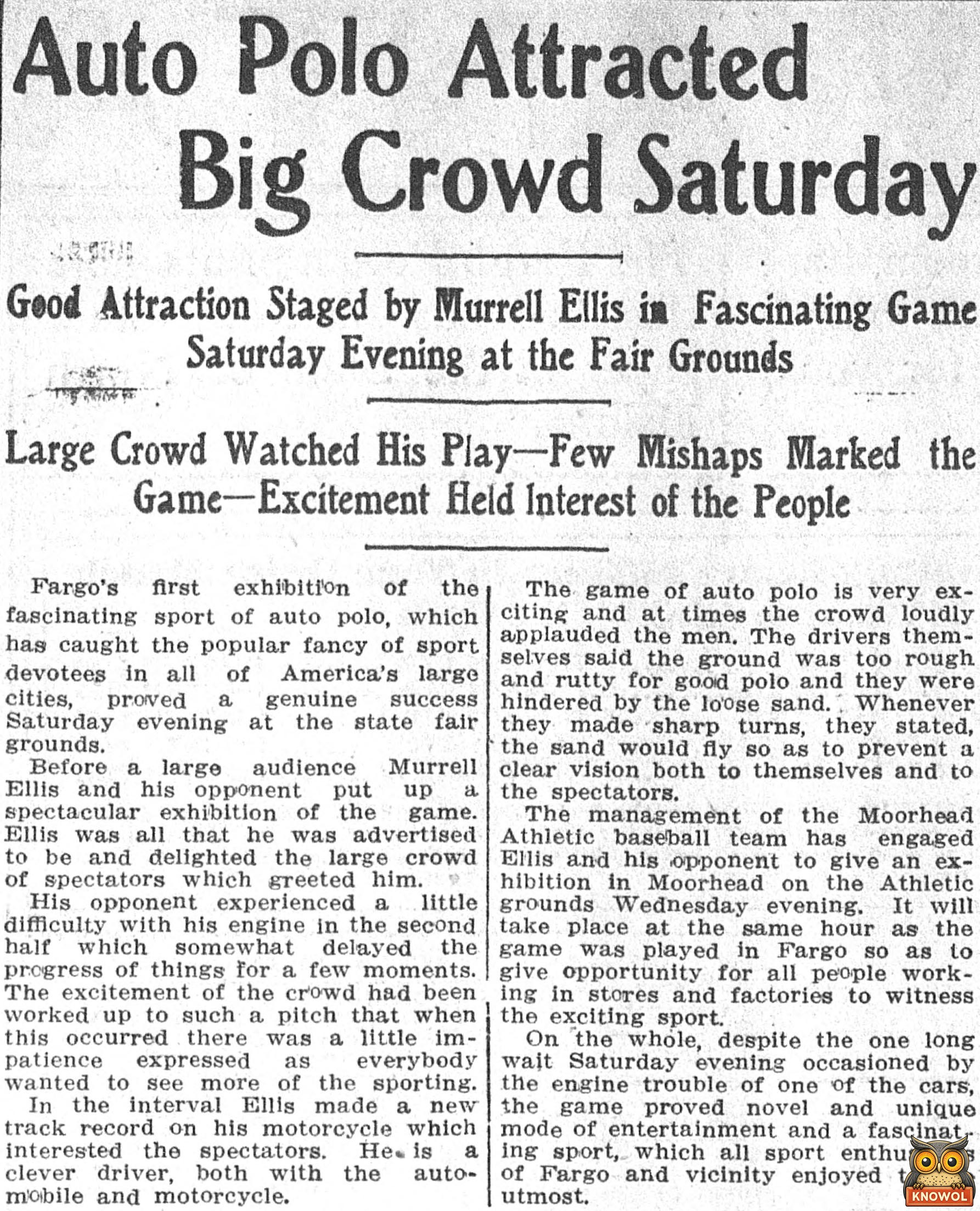
“Auto Polo Attracted Big Crowd Saturday.” The Fargo Forum and Daily Republican, Fargo, North Dakota, August 18, 1913, page 8. Library of Congress, Chronicling America. Click the clipping to read it full size.
Polo, but with Fords
Regular polo is played on horseback. Riders swing long mallets and try to knock a small ball through the other team’s goal. Auto polo kept the mallets and the goals and swapped the horses for cars. The Fargo Forum explained the rules ten days before the game. “In playing auto polo a field 200 yards long and about 100 yards wide is used,” it said. That is about two football fields long. “There are just two autos used in the game, each having a driver and a mallet man. The object of the game is to drive a basketball, painted white, between the goal posts of the rival side using a long-handled mallet to strike the ball.”
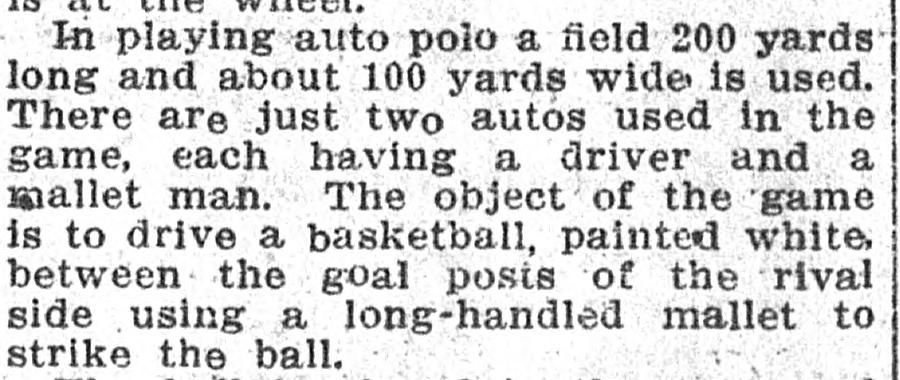
How the game worked. The Fargo Forum and Daily Republican, Fargo, North Dakota, August 6, 1913, page 10. Library of Congress, Chronicling America. Click the clipping to read it full size.
The cars took a beating, so they were built for it. “In playing auto polo the machine is stripped down to the bare chassis and the engine,” the Forum said. A chassis is the bare frame a car is built on. “A circular steel bow is placed over the seat so that if the car turns turtle the machine will not be hurt.” To turn turtle means to flip upside down, like a turtle on its back. Notice what the hoop was for. It kept the car safe. The men had to look out for themselves.
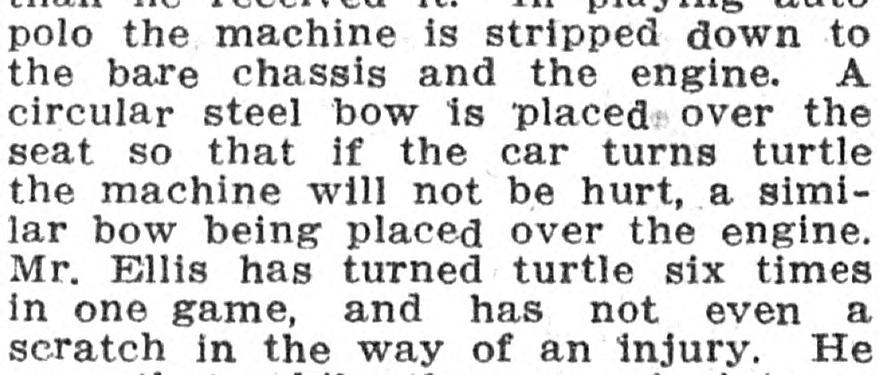
The steel bow over the seat. The Fargo Forum and Daily Republican, Fargo, North Dakota, August 6, 1913, page 10. Library of Congress, Chronicling America. Click the clipping to read it full size.
The man who brought it to town
The game came to Fargo with a traveling showman named Murrell Ellis. He arrived on August 6 “accompanied by his mallet man,” the Forum reported, and he challenged Grand Forks, Devils Lake, Minot, Bismarck, Jamestown and Valley City to games. Ellis did not even bring his own cars. “Mr. Ellis uses any Ford car,” the paper said. He would pay a Ford’s owner “25 per cent of what he makes out of the games for the use of the car,” and he promised to hand it back “in better condition than he received it.” That was a bold promise for a car about to be rammed on purpose.
Ellis said he had “turned turtle six times in one game, and has not even a scratch in the way of an injury.” The game, he said, “is really not dangerous when an expert driver is at the wheel.” A Fargo man named D. B. Burton agreed to drive the second car against him. Burton’s mallet man was “a prominent local enthusiast, who requests that his name be withheld.” Maybe he did not want his mother to find out.
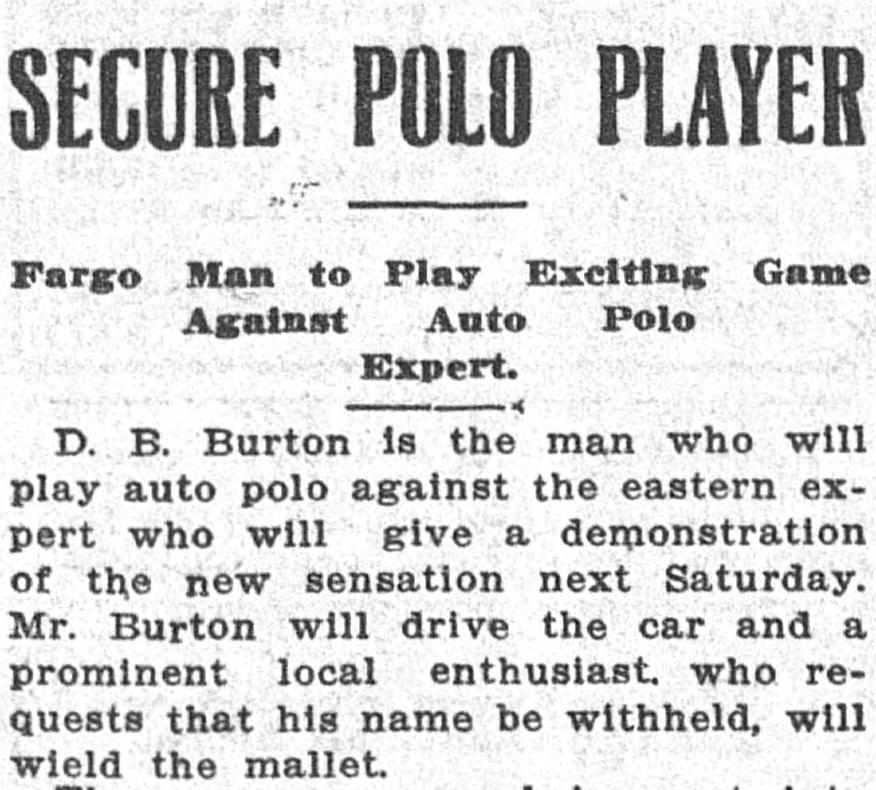
“Secure Polo Player.” The Fargo Forum and Daily Republican, Fargo, North Dakota, August 9, 1913, page 3. Library of Congress, Chronicling America. Click the clipping to read it full size.
Fifty cents a ticket
The Forum ran a big advertisement. “First Time in the Northwest,” it shouted. “Hair Raising—Blood Stirring—Sensational.” It called Ellis “The most daring Auto Driver and Aviator in the U. S.” and said the game had drawn 77,000 people in New York and 55,000 in Chicago. Tickets cost 50 cents.
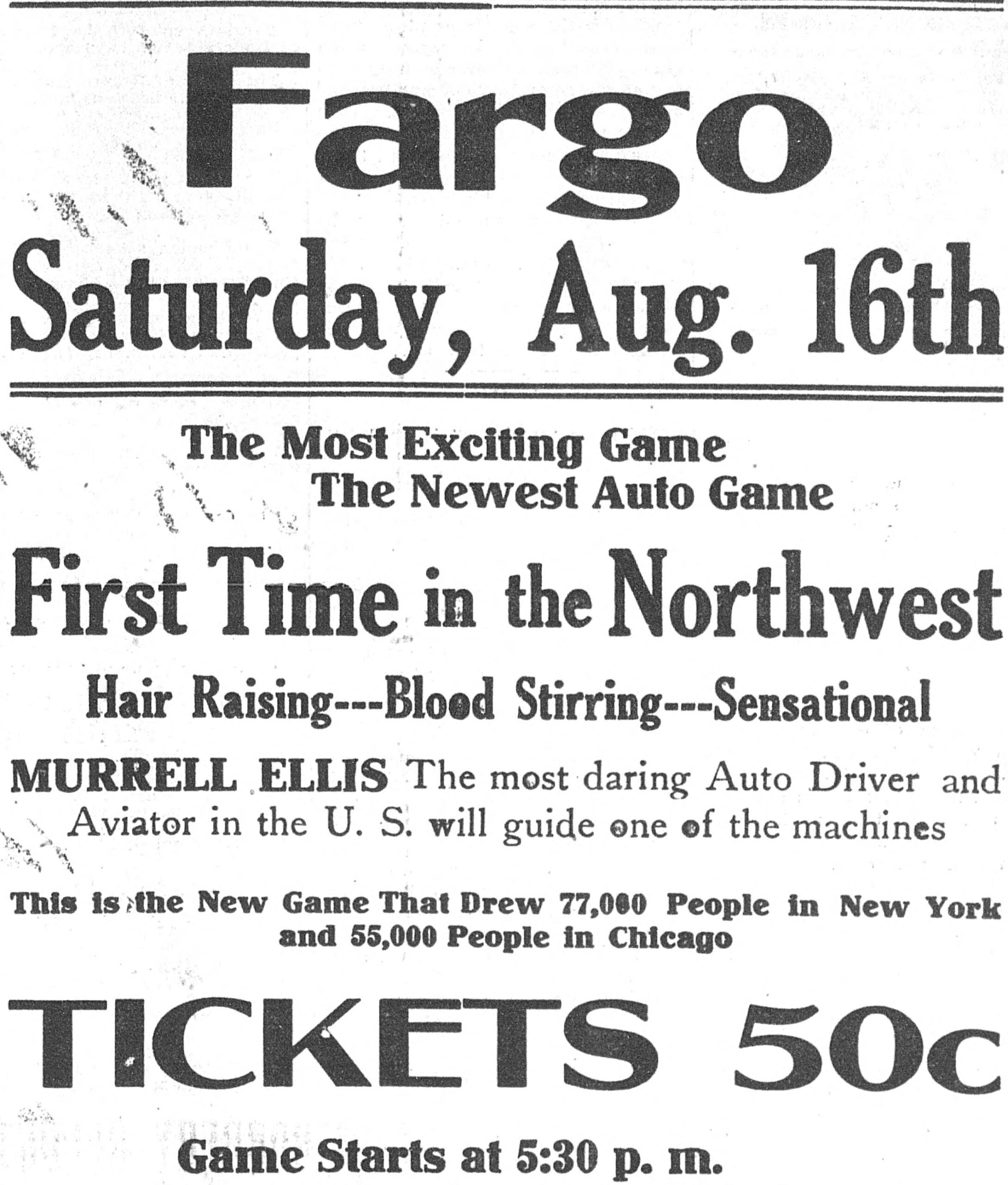
The advertisement for the game. The Fargo Forum and Daily Republican, Fargo, North Dakota, August 9, 1913, page 3. Library of Congress, Chronicling America. Click the picture to see it full size.
“In red ink on every engagement pad”
By Friday, August 15, the town could talk of little else. “Auto polo tomorrow,” the Forum’s front page began. “In red ink on every engagement pad in the two cities this phrase is conspicuously to the front.” An engagement pad is a little appointment book. The two cities were Fargo and Moorhead, Minnesota, its neighbor just across the Red River.
The polo game was only the main event. Ellis also promised an “automobile frontier day relay race,” with “the driver jumping from one to the other and carrying his bag of mail in record time for a distance of five miles.” Then came “Roman auto riding.” At the circus, a Roman rider stands with one foot on each of two horses. Ellis would do it with two cars, “standing with one foot in each car and guiding both steering wheels” around the track. After that he would race his motorcycle ten miles at “better than a mile a minute.”
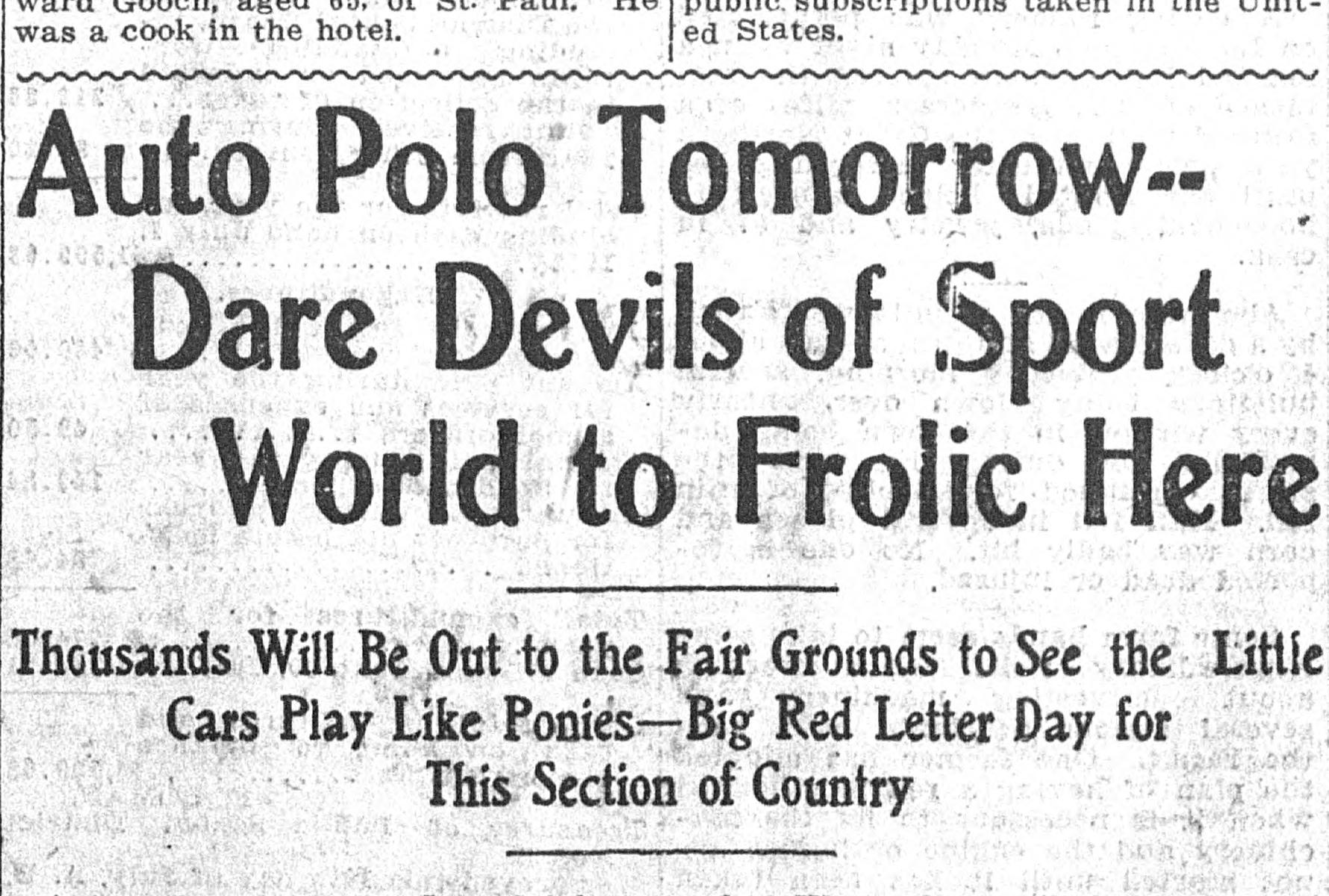
“Dare Devils of Sport World to Frolic Here.” The Fargo Forum and Daily Republican, Fargo, North Dakota, August 15, 1913, page 1. Library of Congress, Chronicling America. Click the picture to see it full size.
For the polo itself, “three cars will be used, two playing while the third is being cooled.” The paper told readers exactly what to expect. “Crashing at a speed of twenty miles an hour, backing away, then going again, perhaps tipping over, sometimes both tipping at once.” The gates opened at 3 o’clock. The night before, Ellis warmed up the town by driving “in front of the Gardner,” a downtown hotel, where he “attracted a great crowd.”
Game night
Fargo’s first auto polo game “proved a genuine success Saturday evening at the state fair grounds,” the Forum reported on Monday. “Ellis was all that he was advertised to be.” There was one hitch. In the second half his opponent’s car “experienced a little difficulty with his engine,” and the crowd, “worked up to such a pitch,” grew impatient during the wait. Ellis filled the time by setting “a new track record on his motorcycle.”
The drivers had a complaint of their own. The fair grounds were “too rough and rutty for good polo,” they said, and on sharp turns “the sand would fly so as to prevent a clear vision both to themselves and to the spectators.” Still, the headline counted “Few Mishaps.” Moorhead’s baseball club booked Ellis and his opponent for the next Wednesday evening, at the same hour, “so as to give opportunity for all people working in stores and factories” to come.
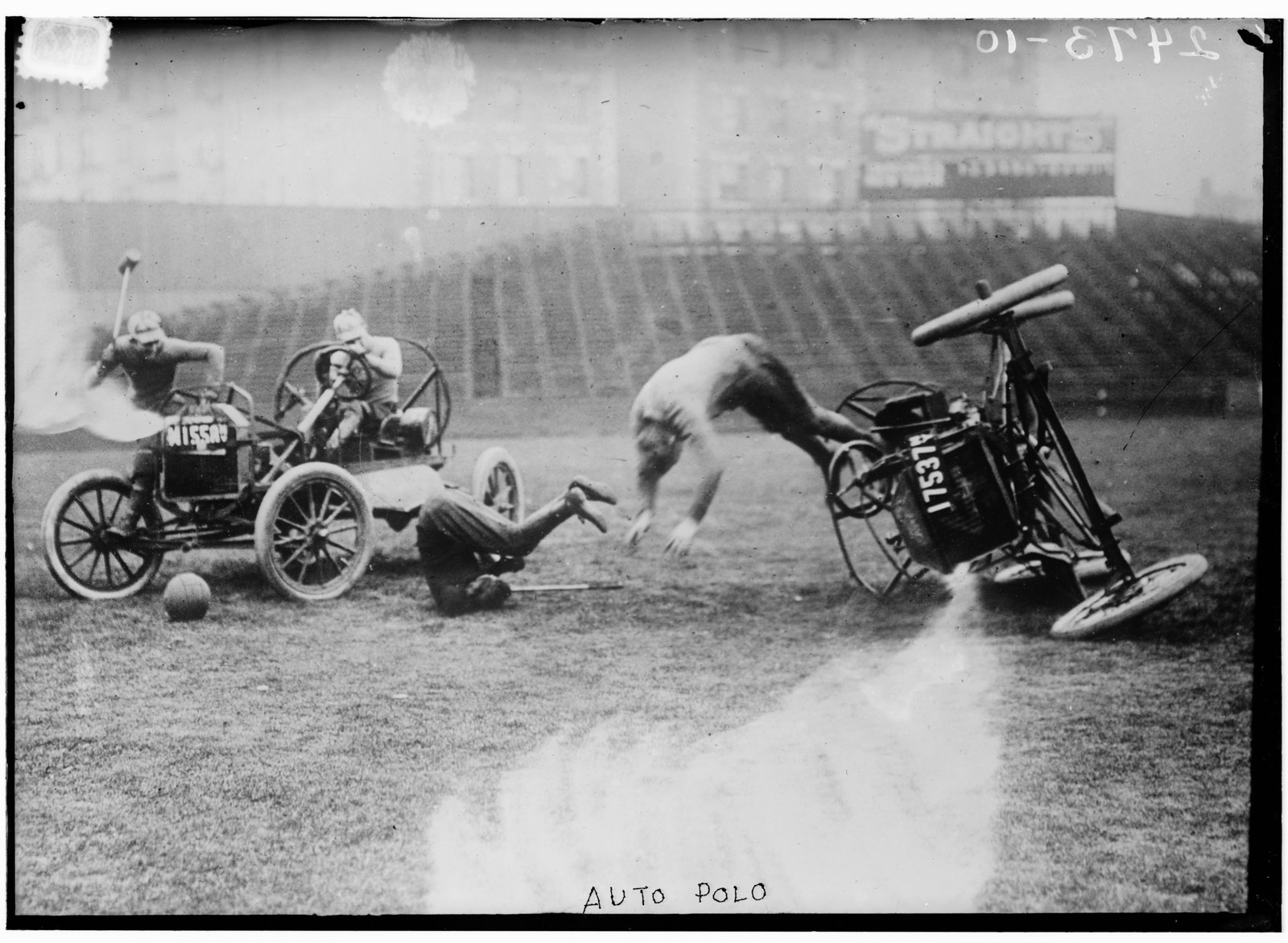
An auto polo car on its side and its mallet man in the air, in New York between about 1910 and 1915. Bain News Service, Library of Congress. Click the picture to see it full size.
The critics weigh in
The show moved on to Devils Lake, North Dakota, where Ellis played a driver named Percy Cooper, “who has won fame throughout Canada.” The game was part of the town’s Chautauqua, a summer festival of lectures and shows. The Devils Lake Inter-Ocean decided the town had seen “all the thrills that usually accompany such a contest, even to the machine tipping over.” It added that nobody in town “would care to put their cars through such a test.”
A writer for the Bismarck Daily Tribune was not impressed. Auto polo, the Tribune said, “is about as interesting from the standpoint of a sporting event as croquet would be with your hands tied behind you. The ‘amusing’ part of the game appears to be how many times a driver can spill his car without breaking his neck.” Even the ground let the show down. The field “was so soft,” the Tribune said, “that considerable of the spectacular element was eliminated, it being practically impossible to skid.”
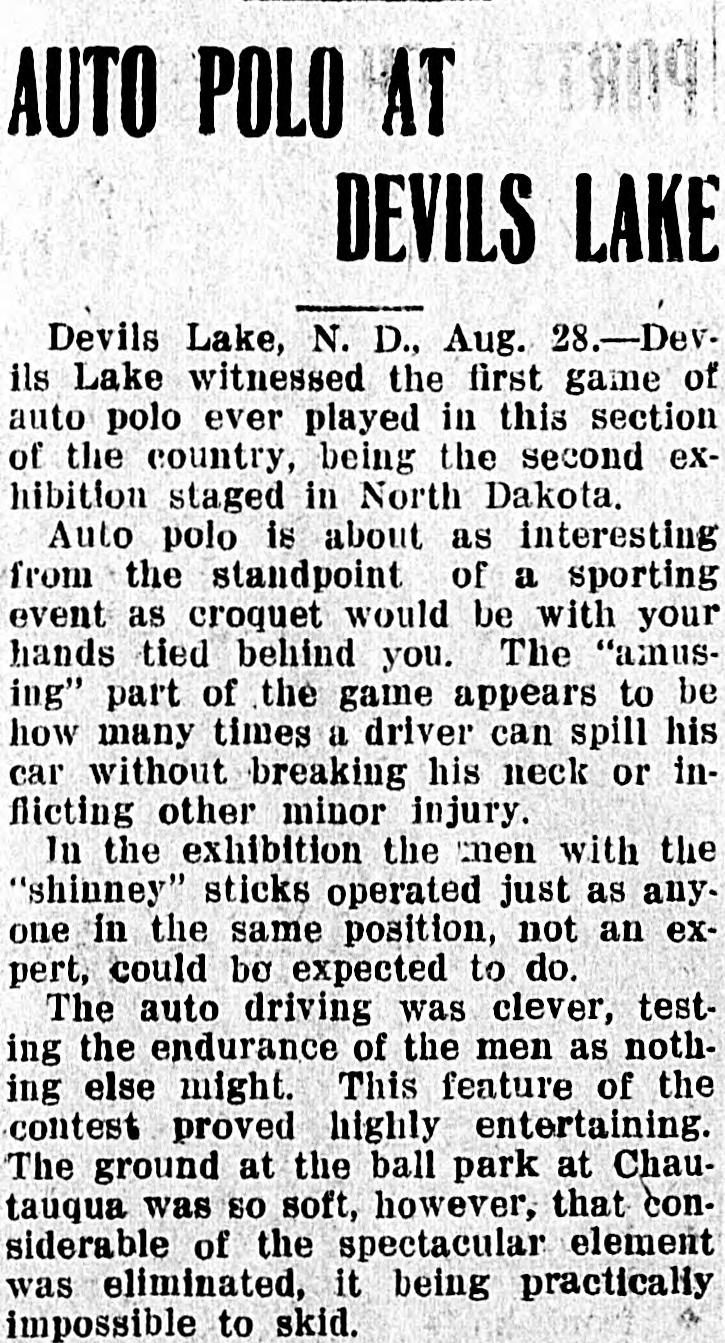
“Auto Polo at Devils Lake.” The Bismarck Daily Tribune, Bismarck, North Dakota, August 29, 1913, page 1. Library of Congress, Chronicling America. Click the clipping to read it full size.
Where it came from, and where it went
Auto polo was barely a year old. It was “originated last summer by the Ford representatives at Wichita, Kan.,” a wire story in the Forum said in January 1913, and it had already been played at Madison Square Garden in New York. Some fans predicted that “within the next three or four years each town will have its auto polo team,” the way towns had baseball teams. “Perhaps this is a bit too sanguine,” the story admitted, “but certain it is the game that has come to stay.” Sanguine means hopeful.
It did not stay. Nobody plays auto polo now, and polo ponies still have their jobs. The picture at the top of this story shows a game in New York from about the same years, with the mallet man flying between the two cars. The Library of Congress notes that one was staged for the camera. In Fargo, on one sandy August evening in 1913, it was the real thing.
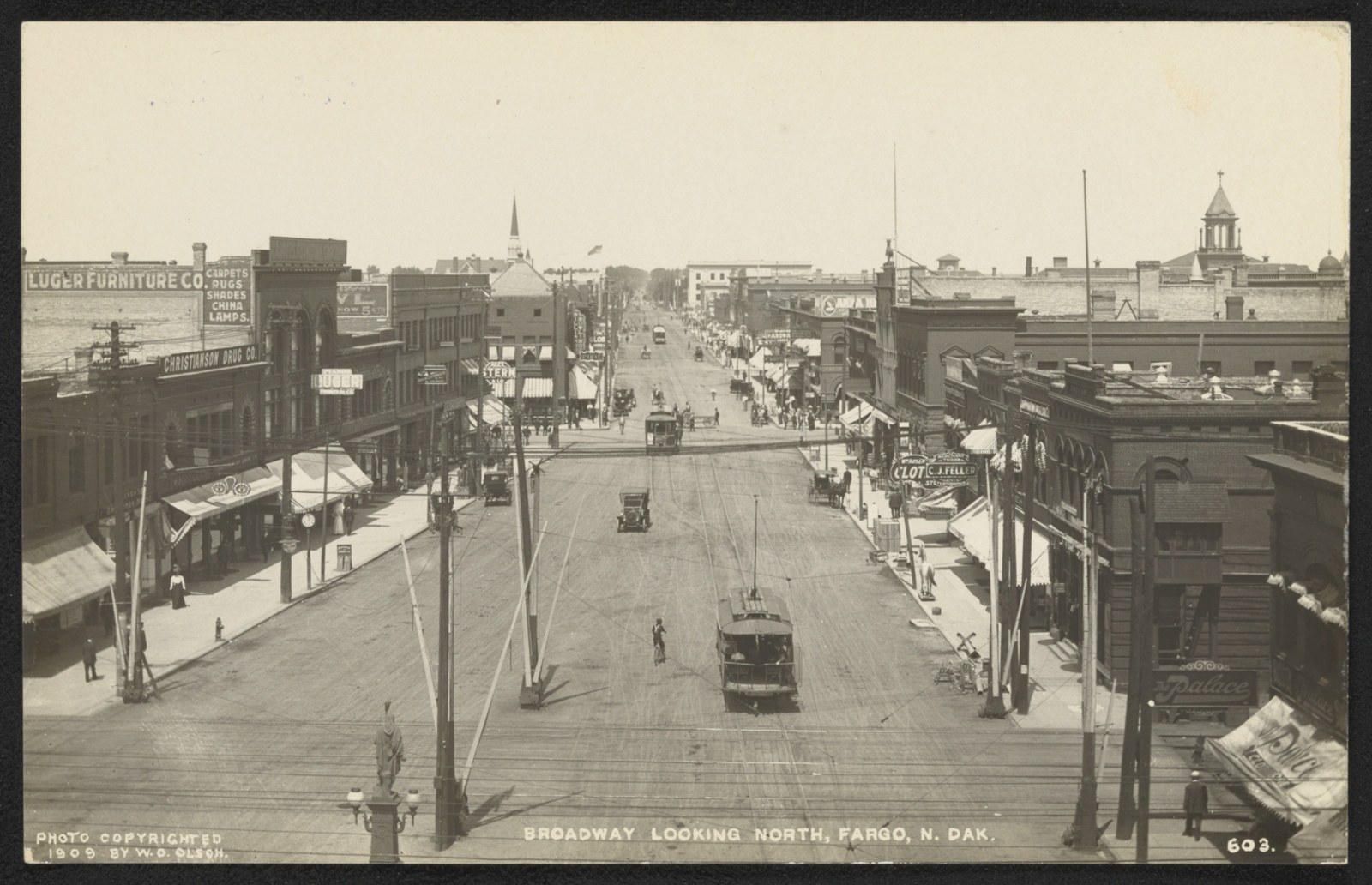
Broadway in Fargo, North Dakota, in 1909, four years before the game. Photo copyrighted 1909 by W. O. Olson. Library of Congress. Click the picture to see it full size.
Sources
- The Fargo Forum and Daily Republican (Fargo, North Dakota): August 6, 1913, page 10 (“Auto Polo League Is Planned for N. Dakota”); August 9, 1913, page 3 (“Secure Polo Player” and the advertisement); August 15, 1913, page 1 (“Auto Polo Tomorrow”); August 18, 1913, page 8 (“Auto Polo Attracted Big Crowd Saturday”); January 11, 1913, page 15 (a Detroit wire story on the new game).
- Devils Lake Weekly World (Devils Lake, North Dakota): August 22, 1913, page 1.
- Devils Lake Inter-Ocean (Devils Lake, North Dakota): August 29, 1913, page 3.
- The Bismarck Daily Tribune (Bismarck, North Dakota): August 29, 1913, page 1 (“Auto Polo at Devils Lake”).
- Bain News Service, “Auto polo,” glass negatives, between about 1910 and 1915: the cover photo, Hilltop Park, New York and the car on its side. George Grantham Bain Collection, Library of Congress, no known restrictions on publication.
- W. O. Olson, “Broadway looking north, Fargo, N. Dak.,” photo postcard, 1909: Library of Congress.
- All newspaper images: Library of Congress, Chronicling America. Published 1913.