On Sunday morning, September 18, 1904, readers in Louisville, Kentucky, opened the Courier-Journal to a page called “With the Inventors.” Near the bottom was a drawing of a young woman with her hair pinned up. A strap ran around the back of her head. A patch of cloth was stuck to her cheek, right in front of her ear. The caption said the thing she wore “stretches the skin to the desired tension.”
It was a wrinkle remover. The man who dreamed it up lived clear across the country in Colfax, Washington, the county seat of Whitman County in the wheat hills of eastern Washington. His name was William B. Hargrave. Two months earlier, the United States Patent Office had given him patent No. 765,361 for a “Device for Eradicating Facial Wrinkles.” Eradicating means wiping out.
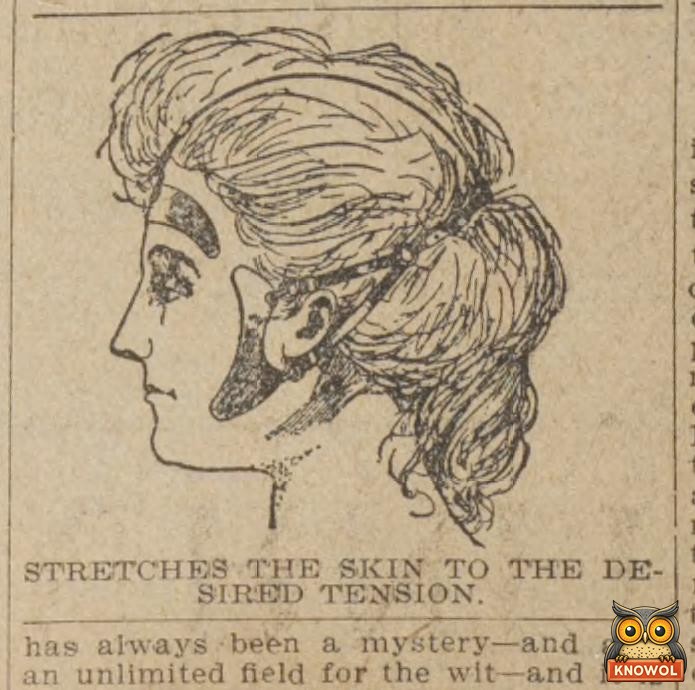
“Stretches the skin to the desired tension.” The Courier-Journal, Louisville, Kentucky, September 18, 1904, page 24 (printed as Section 3, page 8). Library of Congress, Chronicling America. Click the clipping to read it full size.
How it worked
Hargrave’s idea was simple. Pull the skin of the face smooth, hold it there, and keep doing it night after night. He believed the wrinkles would fade.
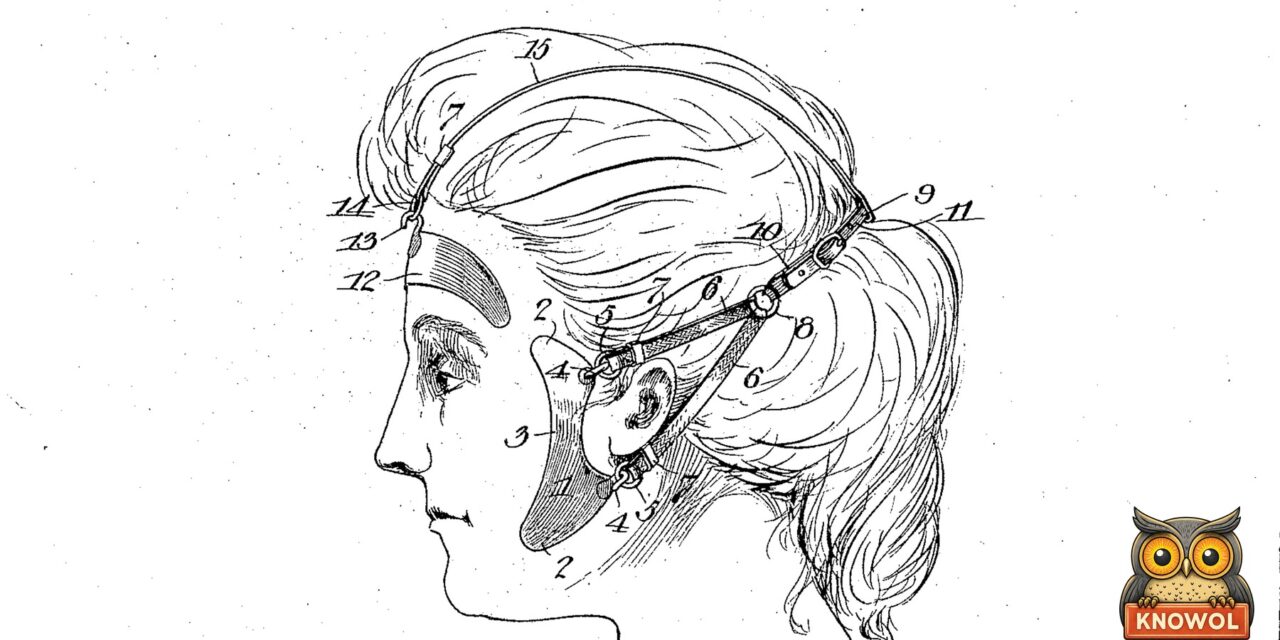
Here is what you got. Two pieces of sticky cloth, “surgeons’ adhesive plaster or linen,” each one wide at the ends and narrow in the middle. You stuck one to each cheek, just in front of the ear. One end pointed down toward your chin and the other up toward your forehead. Little hooks on the back edge of each patch caught the rings of two short straps. The straps had slides, like the ones on suspenders, so you could make them longer or shorter. They ran back to a ring, and from the ring an elastic band with a buckle went around the back of your head. Buckle it snug, and both cheeks were drawn back and held.
For forehead wrinkles there was one more piece, shaped like a crescent moon. It stuck across the forehead. A hook and eye joined it to an elastic strap that ran up over the top of the head to the band in back.
The best part, Hargrave wrote, was that nobody had to see you in it. The device “may be applied before going to bed and may be worn during sleep without inconvenience to the wearer.”
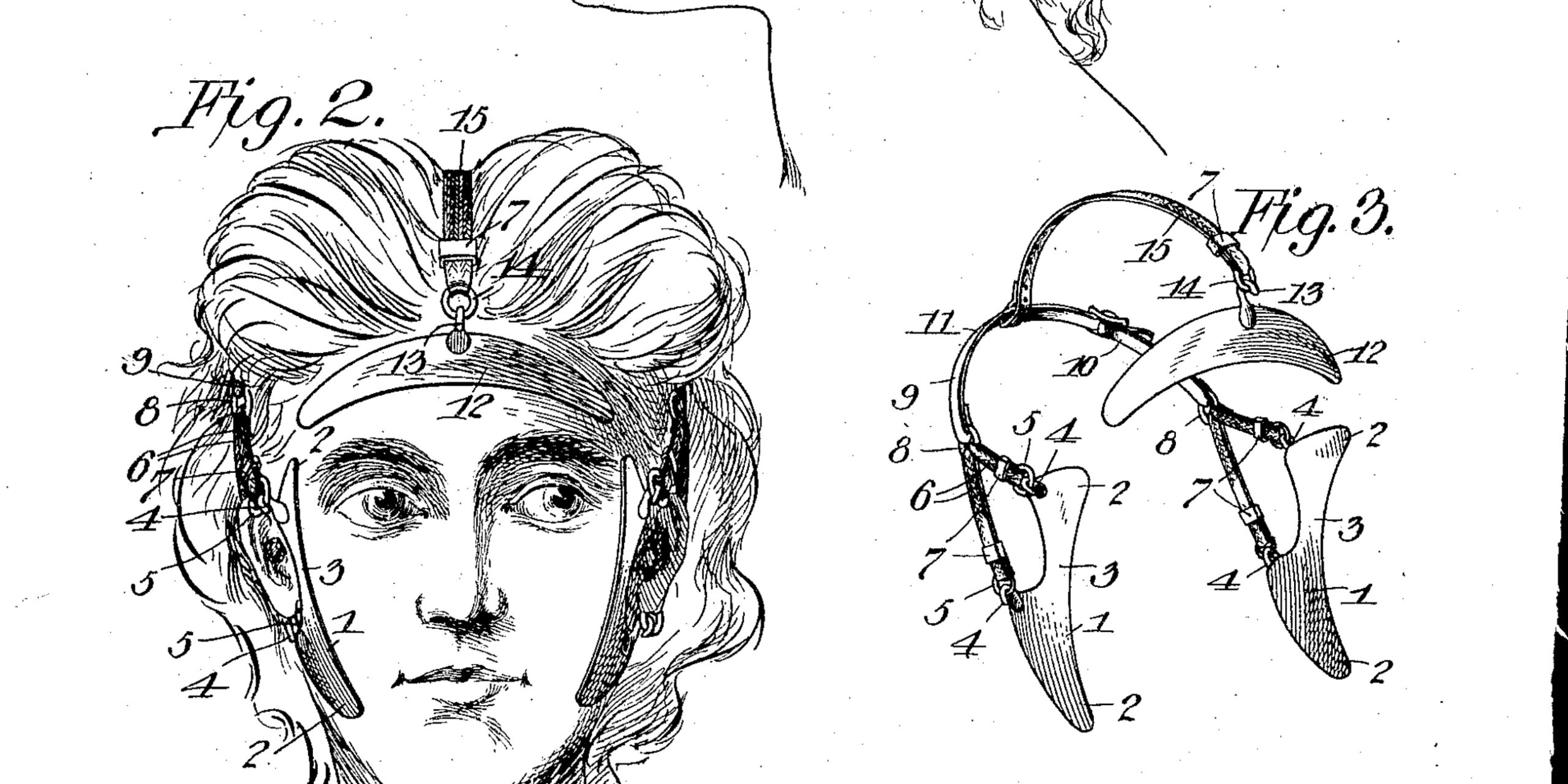
Figures 2 and 3 from patent No. 765,361: the harness on, and the harness by itself. United States Patent Office, July 19, 1904. Google Patents. Click the picture to see it full size.
He also had a theory about why it would work. Other wrinkle gadgets, he said, pressed down on the skin. His pulled from the sides instead, so blood could keep flowing under the stretched skin. “As free circulation aids very greatly to build up tissue,” he wrote, the wrinkles “will be eradicated by the building up of the tissues beneath them.”
The Patent Office did not have to believe that. Its job was to decide whether the device was new. On July 19, 1904, it said yes. Two women, Emma Kalisher and Nellie Doolittle, had signed the papers as witnesses.
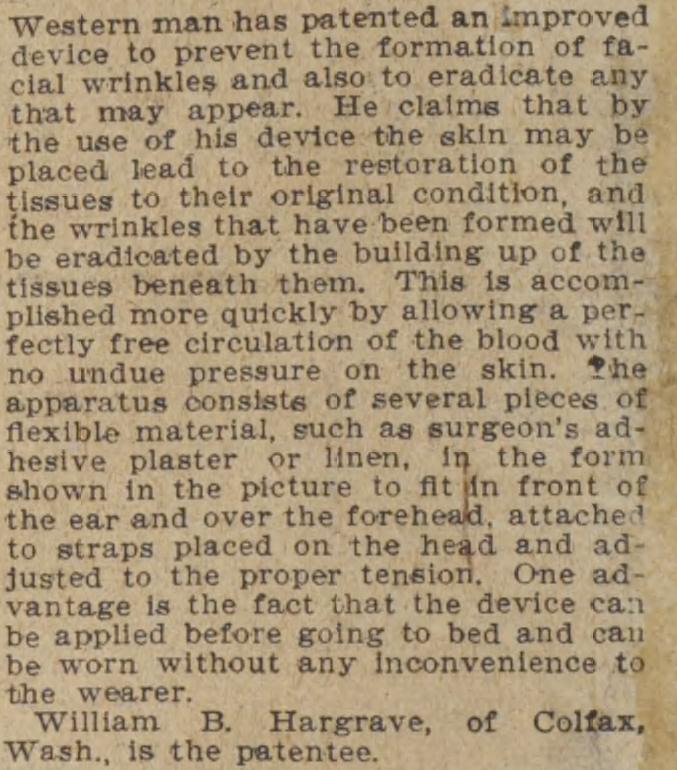
The Courier-Journal’s description of the device, ending “William B. Hargrave, of Colfax, Wash., is the patentee.” Louisville, Kentucky, September 18, 1904. Library of Congress, Chronicling America. Click the clipping to read it full size.
Bert Hargrave of Colfax
In Colfax, people called him Bert. In January 1901 the Colfax Gazette reported that “W. B. Hargrave went along as a candidate for enrolling clerk of the senate” when the county’s lawmakers left for Olympia, the state capital. A week later it said “Bert Hargrave of Colfax has been appointed enrolling clerk of the state senate.” An enrolling clerk writes out the clean, final copy of each bill the lawmakers pass.
That spring he did something bigger. He wrote the words to a three-act comic opera called “The Alchemist,” and a music teacher, Prof. L. C. Read, wrote the tunes. Colfax people sang and acted every part. The Gazette said it “met with flattering success and received unstinted praise from a house with standing room only.” The story was set in Revolutionary War days. It had a Colonel Sneeze, “commander of minute men,” and a Major Snuff, “a braggart but cowardly British officer.” There was even a “Ghost of Captain Kidd,” whose solo “in the ghost scene” was “especially well rendered.”
So the wrinkle harness came from a man who liked to put on a show. He filed his patent papers in November 1903, and the drawing of the woman in the straps went to Washington, D.C., along with them.
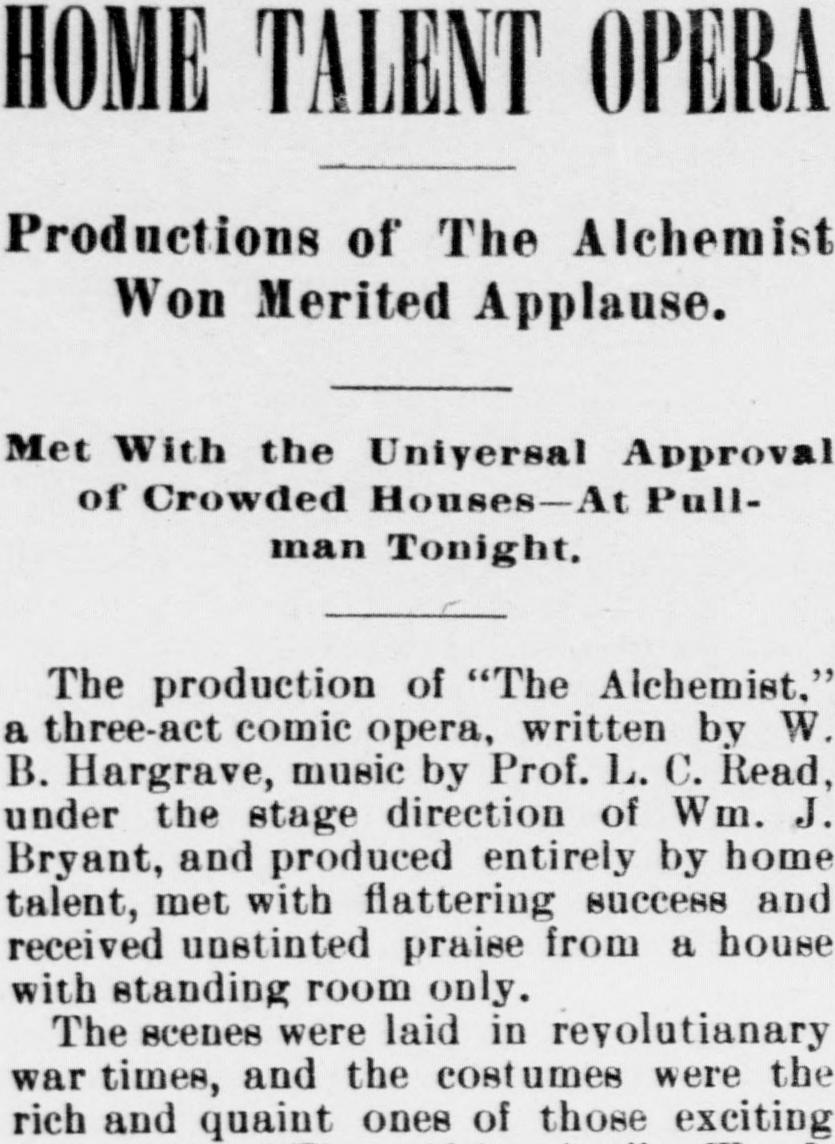
“Home Talent Opera.” The Colfax Gazette, Colfax, Washington, June 7, 1901, page 2. Library of Congress, Chronicling America. Click the clipping to read it full size.
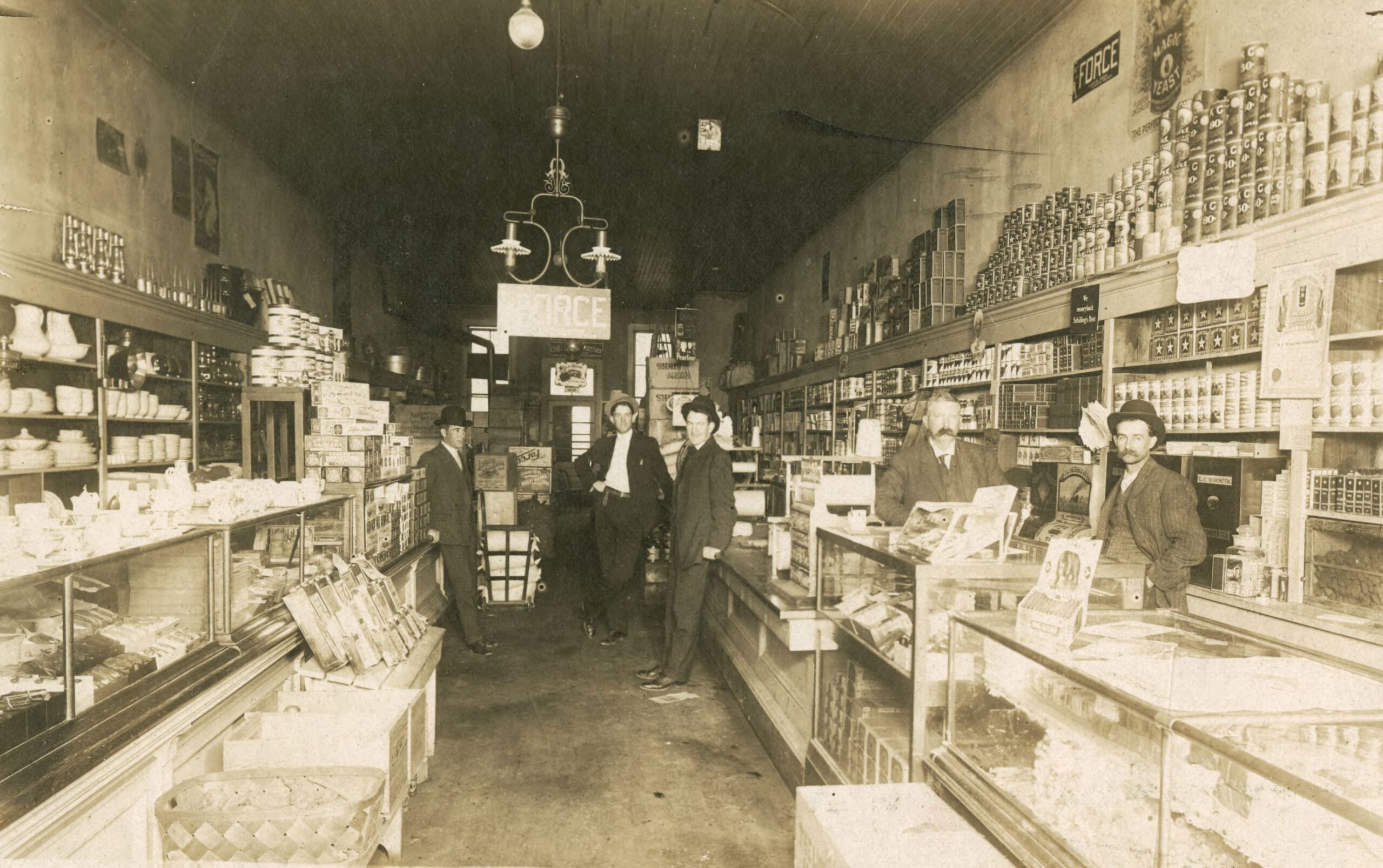
Inside Kimbrough Grocery on Main Street in Colfax, Washington, around 1900. Whitman County Library, Washington Rural Heritage (private collection of Larry Hubbard), via Wikimedia Commons. Click the picture to see it full size.
The papers have some fun
The Courier-Journal started out serious. “Wrinkles are one of the things that all women dread,” it said. Then the type got tangled. A few lines of the patent’s own wording, about “any desired degree of tension,” landed in the middle of that first paragraph, and the sentence turned into a riddle. Even so, the writer managed a joke. Why women keep their age a secret, he said, “has always been a mystery.”
The rest of the column was clear. The straps went “in front of the ear and over the forehead,” and “One advantage is the fact that the device can be applied before going to bed and can be worn without any inconvenience to the wearer.”
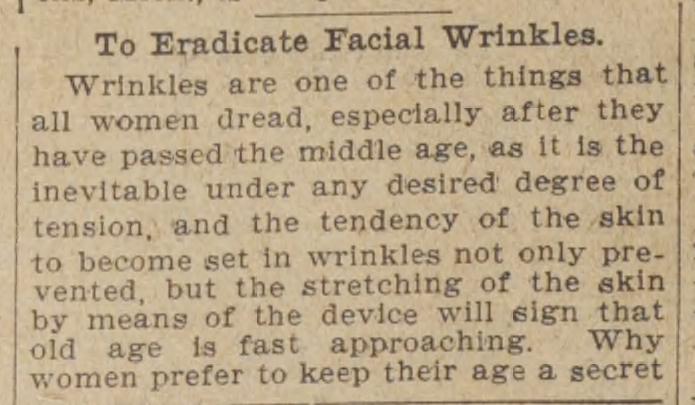
The tangled first paragraph. The Courier-Journal, Louisville, Kentucky, September 18, 1904. Library of Congress, Chronicling America. Click the picture to see it full size.
Ten months later the Washington Times, in Washington, D.C., filled a whole Sunday page with odd patents. There was a milking machine, a flea trap, a trick nest that hid each egg so the hen would lay another, and a whiskey flask hidden inside a fake law book. Hargrave’s harness got the biggest joke of all. “The country is saved, even though the Panama canal cave in and China boycotts American goods,” the paper wrote. “A device for eradicating facial wrinkles has been perfected by a man ‘way out in the State of Washington. He has constructed a head harness, which stretches the skin smooth over the places where the wrinkles are found.” The Panama Canal was just being dug that year, and a Chinese boycott of American goods was in the news. The joke was that a wrinkle harness mattered more than either one.
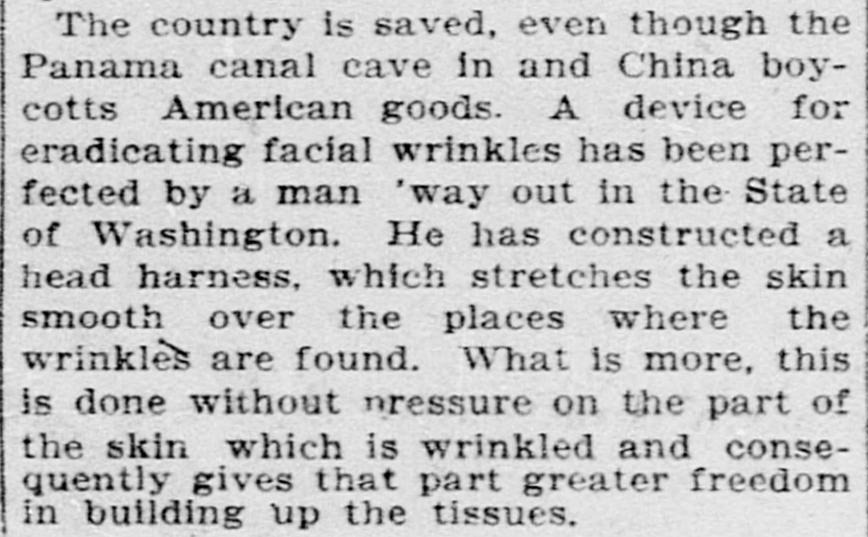
“The country is saved.” The Washington Times, Washington, D.C., July 16, 1905, page 43 (printed as page 7). Library of Congress, Chronicling America. Click the picture to see it full size.
What happened to the harness
We found no advertisement for the harness, and no sign that it was ever sold, in any of the old newspapers we searched. Hargrave stayed in Colfax. In 1908 the Gazette listed “W B Hargrave, soc, Colfax” among the candidates for state representative, running as a Socialist.
The patent ran out long ago. The drawing is still on file in Washington, D.C., though, and anyone can look it up. The woman is still there, hair pinned up, straps buckled, cheeks pulled smooth, ready for bed.
Sources
- The Courier-Journal (Louisville, Kentucky): September 18, 1904, page 24 (printed as Section 3, page 8; “With the Inventors”: “To Eradicate Facial Wrinkles”).
- The Washington Times (Washington, D.C.): July 16, 1905, page 43 (printed as page 7; the Sunday page on odd patents).
- The Colfax Gazette (Colfax, Washington): January 11, 1901, page 2 (enrolling clerk), January 18, 1901, page 2 (“Bert Hargrave”), June 7, 1901, page 2 (“Home Talent Opera”) and August 14, 1908, page 1 (list of candidates).
- William B. Hargrave, “Device for Eradicating Facial Wrinkles,” United States Patent No. 765,361, filed November 12, 1903, patented July 19, 1904: Google Patents. The patent’s drawings and text are a United States government publication, public domain.
- “Kimbrough Grocery, Colfax, Washington, circa 1900,” Whitman County Library, Washington Rural Heritage, rights statement “No Copyright – United States”: Wikimedia Commons.
- All newspaper images: Library of Congress, Chronicling America. Published 1901 to 1905.
- Cover: Figure 1 of United States Patent No. 765,361 (1904), “a profile view of the head and face of a woman wearing the device.” United States Patent Office drawing, public domain.