On Monday afternoon, November 28, 1864, a Boston man named Joshua Hobart stood on the Great Bridge in Providence, Rhode Island. He had a wheelbarrow. In the wheelbarrow sat a barrel of oysters that weighed about 300 pounds. At three o’clock he took hold of the handles and started walking toward Boston, Massachusetts, 40 miles away. “There was so great a crowd present that it was difficult to move about the streets,” the Pawtucket Gazette and Chronicle reported.
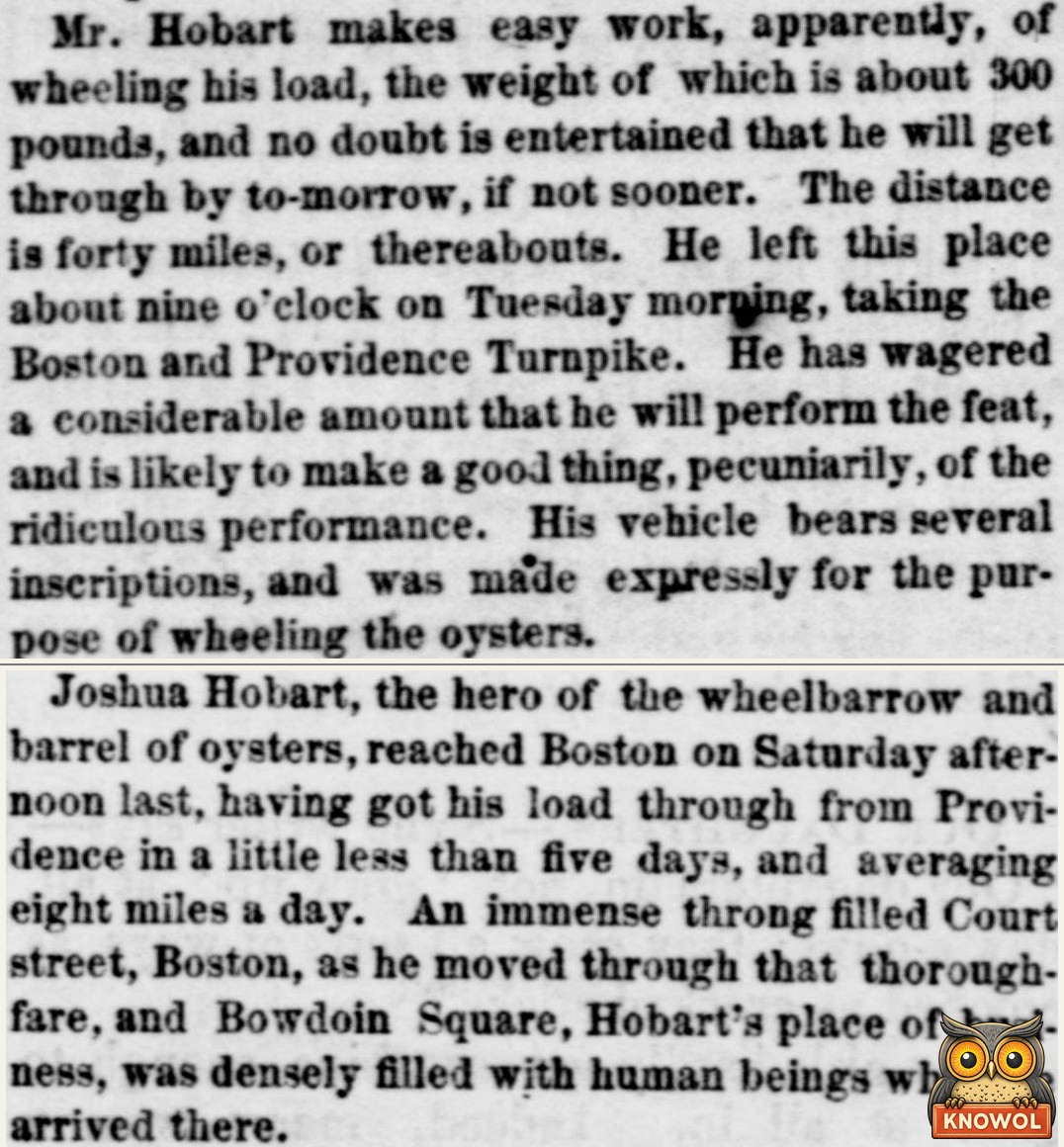
The load and the finish. Pawtucket Gazette and Chronicle, Pawtucket, Rhode Island, December 2, 1864 (top) and December 9, 1864 (bottom), page 2 in both issues. The two items are joined here. Library of Congress, Chronicling America. Click the clipping to read it full size.
The bet
Hobart ran an eating house at Nos. 8 and 9 Bowdoin Square in Boston. The paper called it a saloon. In 1864 that word could mean a place that served oysters and suppers, not just drinks. He was a Democrat, and that fall he bet that General George McClellan would beat Abraham Lincoln for president. The man on the other side was Mr. Wright, a Boston oyster dealer. The stakes were not money. The loser had to wheel a barrel of oysters from Providence to Boston.
On November 8, Lincoln won. Twenty days later, Hobart was on the bridge.
Bets like this were a New England habit. In 1856 a newspaperman named Ben Perley Poore lost a bet on the vote in Massachusetts. He wheeled a barrel of apples 36 miles from Newbury, Massachusetts, to Boston. A music publisher printed “The Wheelbarrow Polka” in his honor. Its cover says “at least 30,000 enthusiastic spectators” watched him arrive. Everyone in Boston knew that story.
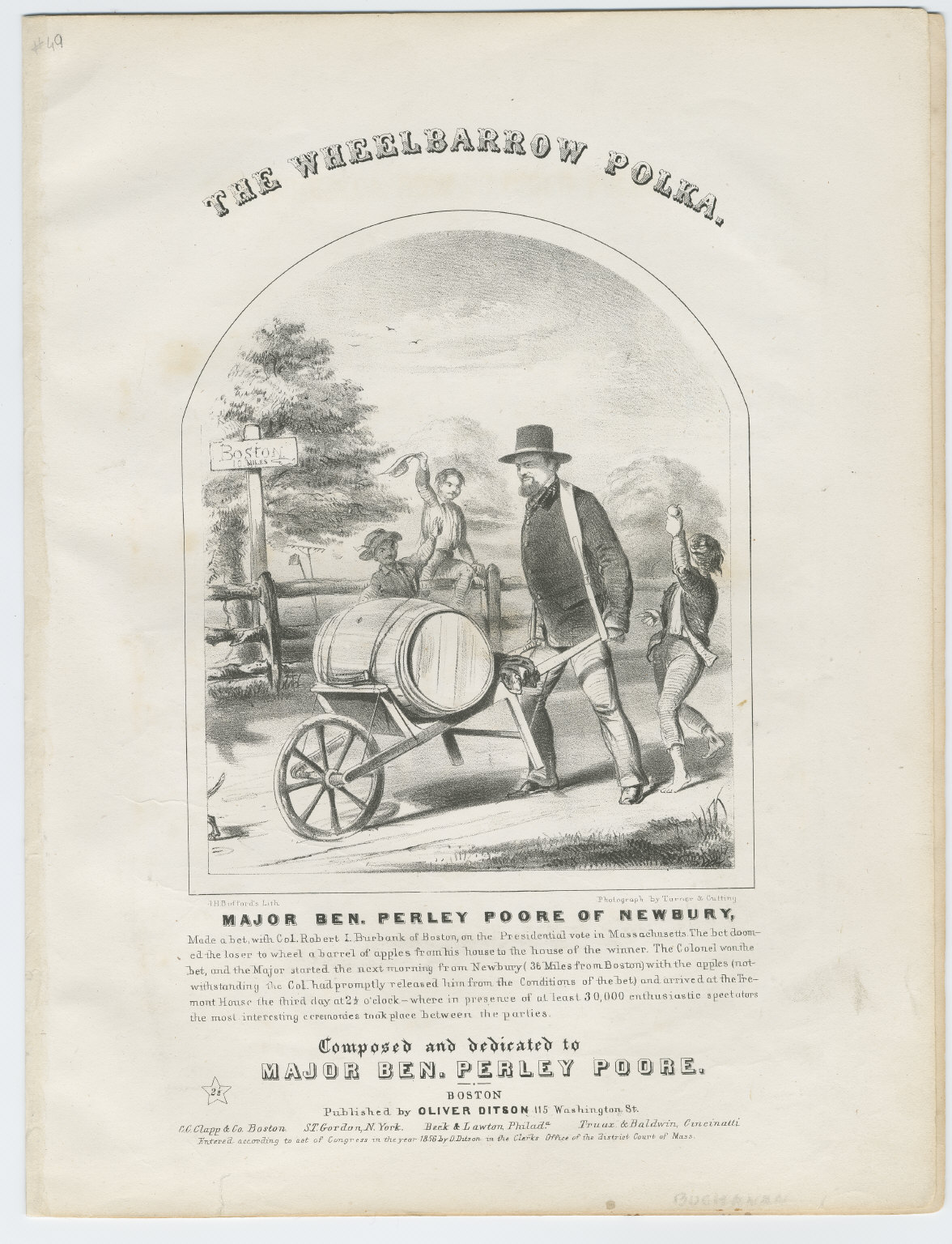
“The Wheelbarrow Polka,” sheet music published by Oliver Ditson, Boston, 1856, with Major Ben Perley Poore and his barrel of apples on the cover. Cornell University Library, Susan H. Douglas Political Americana Collection. Click the picture to see it full size.
Forty miles in five days
The first stop was Pawtucket, Rhode Island, four miles up the road. Hobart made it “in about an hour and forty-five minutes,” with a crowd of Providence people walking along beside him. He spent the night at Mr. Haynes’s hotel. A Pawtucket grocer who had lost his own election bet, and had paid it by selling candy on the bridge in his shirt sleeves, met him with a big gift of candy.
Hobart could not give him any oysters back. For one thing, the bet did not allow it. For another, the oysters were already spoken for. He had sold “500 of the 750 bivalves in his barrel at one dollar each” to people in Boston before he left. He expected to sell the other 250 on the way. Bivalves is the fancy word for oysters and clams. A dollar for one oyster was a silly price, and that was the point. People were paying for a piece of the stunt.
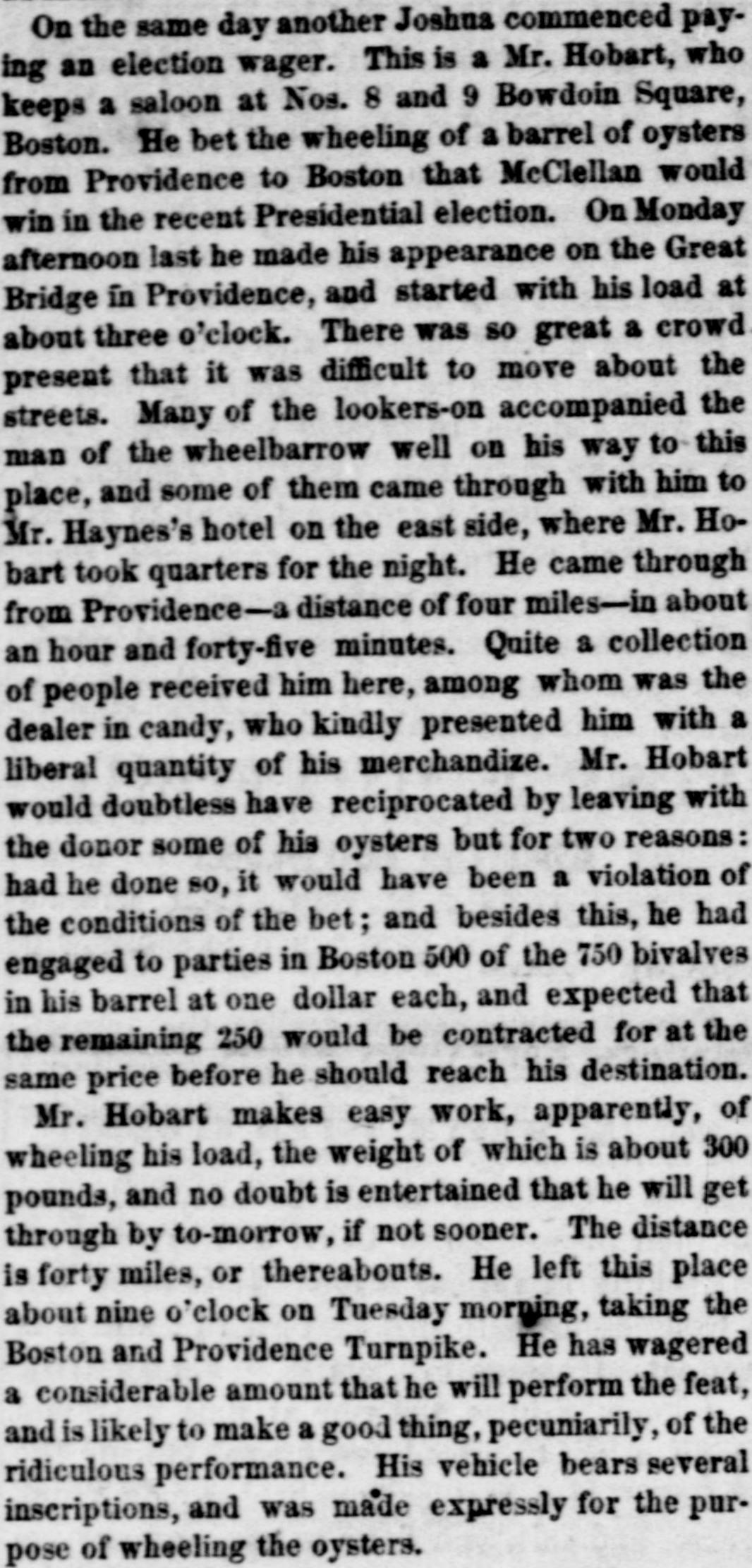
“On the same day another Joshua commenced paying an election wager.” Pawtucket Gazette and Chronicle, Pawtucket, Rhode Island, December 2, 1864, page 2. Library of Congress, Chronicling America. Click the clipping to read it full size.
On Tuesday morning at nine he set off up the Boston and Providence Turnpike. His barrow “was made expressly for the purpose of wheeling the oysters” and “bears several inscriptions,” the Gazette said. It had two wheels instead of one. A Boston cavalry company called the National Lancers had given it to him. He reached Boston on Saturday afternoon, December 3, “in a little less than five days, and averaging eight miles a day.” “An immense throng filled Court street,” the Gazette reported, and Bowdoin Square “was densely filled with human beings when he arrived there.” A Vermont paper claimed the oysters “were served up at $10 for a stew.”
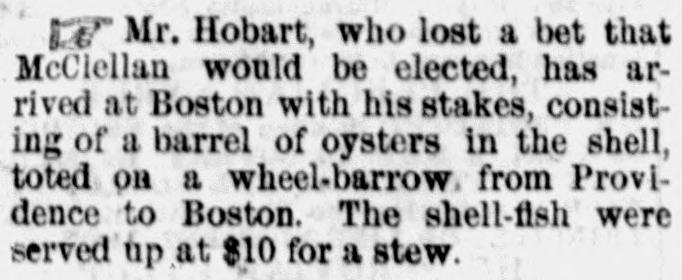
Rutland Weekly Herald, Rutland, Vermont, December 8, 1864, page 8. Library of Congress, Chronicling America. Click the picture to see it full size.
Was it even a wheelbarrow?
Then came the argument. A wheelbarrow has one wheel. Hobart’s had two. Boston bettors put money on “whether the wheelbarrow used was really a wheelbarrow,” the Portland Daily Press remembered years later. Referees ruled for Hobart. From then on, every time he bet, he wrote into the deal that the same two-wheeled barrow would be used. People came to call it “the old Democratic wheelbarrow of 1864.”
He kept betting, and he kept losing
Hobart moved to Somerville, Massachusetts, and went into the milk business. He also kept betting on Democrats, who kept losing. The 1876 election was so close that the country argued over it until March 1877. When it was settled, Hobart paid a bet to a man named A. Caswell “by wheeling a barrel of apples weighing 205 pounds from East Lexington to Union Square, Somerville, in one hour and thirty-eight minutes.” East Lexington is part of Lexington, Massachusetts.
In 1878 he finally won one. A Somerville newspaper editor named Stone had to trundle the old barrow, loaded with a barrel of apples, from Union Square to the Quincy House hotel in Boston. This time Hobart got to watch.
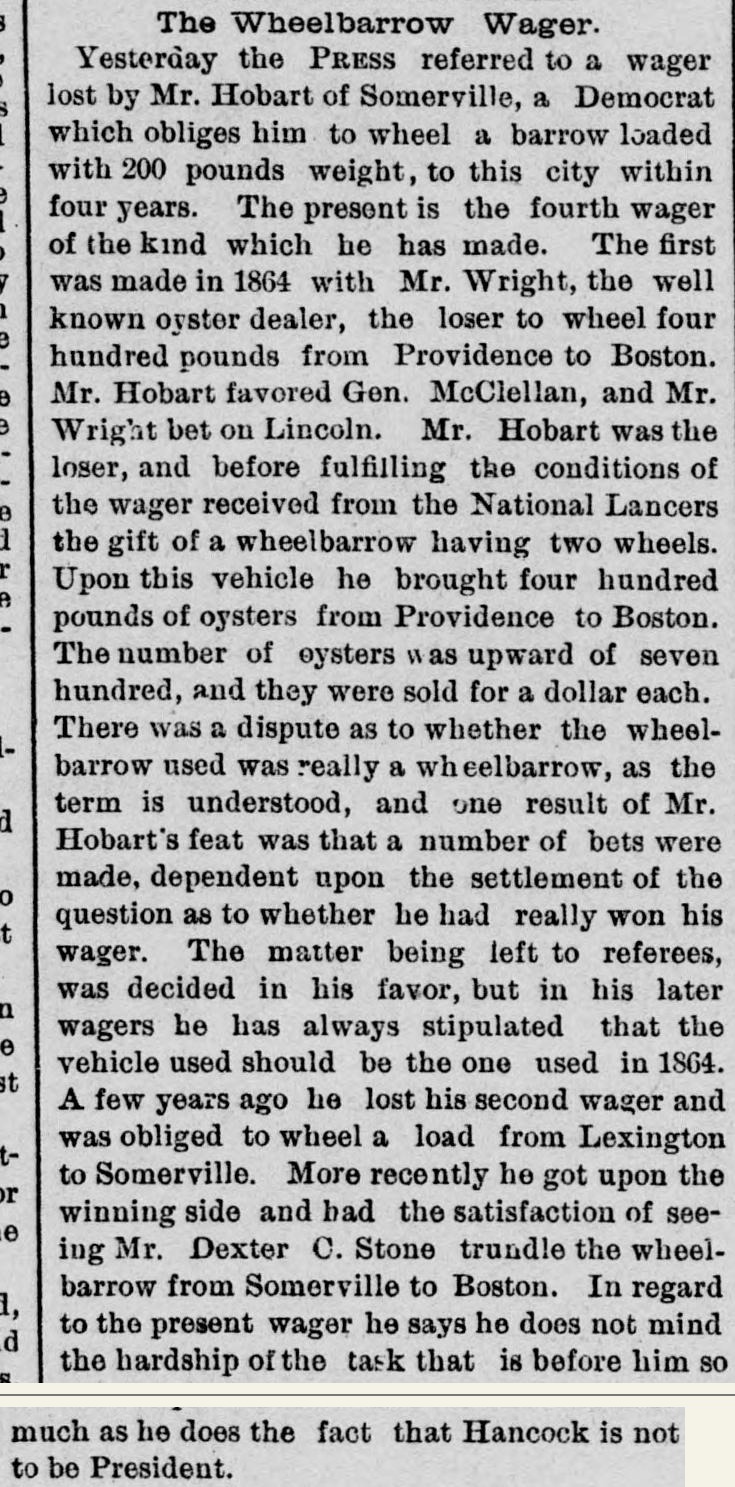
“The Wheelbarrow Wager.” The Portland Daily Press, Portland, Maine, November 18, 1880, page 3. The item ran over into the next column, so the two pieces are joined here. Library of Congress, Chronicling America. Click the clipping to read it full size.
In 1880 he bet on Winfield Scott Hancock against James Garfield. Garfield won. This time the loser had to push 200 pounds from Somerville to Portland, Maine. That is a trip of more than 100 miles. He had four years to do it, or pay a $50 forfeit. The Boston Journal called him “a well known milkman” and “a Democrat of the most pronounced type,” a man “of more than 50 years of age, and is in good health.” He said “he will certainly do the wheeling.” What bothered him was not the walk. He minded “the fact that Hancock is not to be President.”
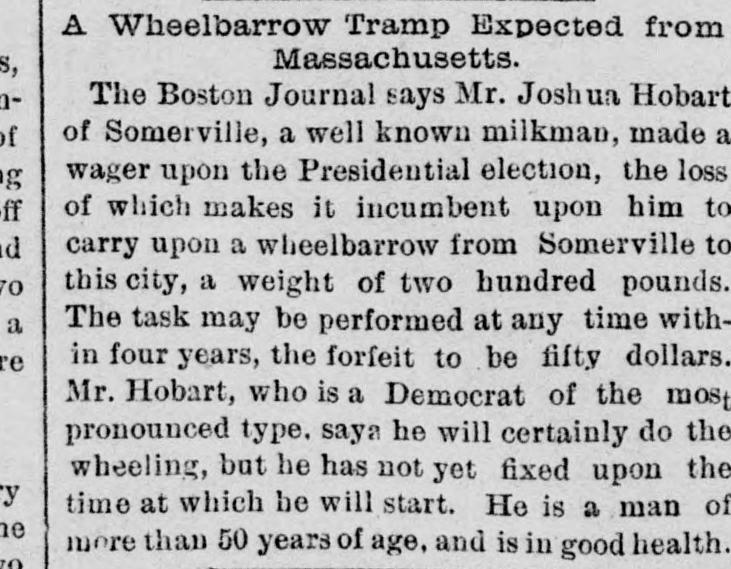
“A Wheelbarrow Tramp Expected from Massachusetts.” The Portland Daily Press, Portland, Maine, November 17, 1880, page 3. Library of Congress, Chronicling America. Click the picture to see it full size.
In 1884 he was at it again, this time against T. E. Hill of Roxbury, Massachusetts. Hobart took Grover Cleveland. Hill took James G. Blaine. The loser would wheel the winner from Union Square, Somerville, to State Street, Boston. In November, Cleveland won. For the first time since Hobart started betting, a Democrat was headed to the White House. If the bet was paid, Joshua Hobart was the one who got to ride. We could not find a report of that ride, or of the long push to Portland. By then his wagers were news from Boston, and the papers printed them as far away as Connecticut and Rhode Island.
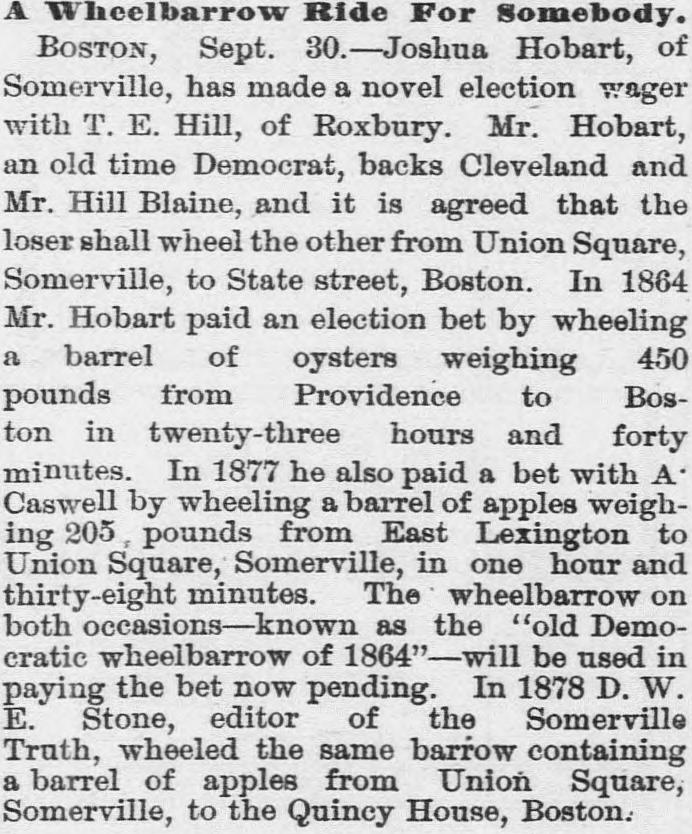
“A Wheelbarrow Ride For Somebody.” Morning Journal and Courier, New Haven, Connecticut, October 1, 1884, page 3. Library of Congress, Chronicling America. Click the clipping to read it full size.
Wheelbarrow season, 1880
Hobart was not alone. After the 1880 election, losers all over the country paid up with wheelbarrows, and the whole town came out to watch.
- In Keokuk, Iowa, C. Limburg wheeled John Nagle “from Fourteenth and Main streets to the Post-Office and return,” over a mile, with Nagle “occupying an elevated position on the barrow.” The parade “created about as much excitement as a circus among the juveniles,” the Chicago Tribune reported. Juveniles means kids.
- In Eureka, Nevada, Bob Thomas wheeled Hi Crowell the whole length of Main Street behind a band made of “a cracked flute” and “a ‘busted’ drum, which was beat furiously by Israel.” Everyone ended up at the Silver Brick Hotel for refreshments “at Bob’s expense.”
- J. Hill of Marietta, Ohio, pushed a wheelbarrow full of wood shavings 12 miles to the courthouse in Parkersburg, West Virginia, “through the mud and rain,” with a brass band waiting for him. His barrow was painted and hung with small flags. Each side carried one word: “defeated.”
- Charles Nichols and Sanford Densmore of Unity, New Hampshire, agreed that whoever lost would wheel the other to Claremont, New Hampshire. They rolled into the village “with wheelbarrow, motto and banner,” having covered “5 1-2 miles in 2 1-4 hours.”
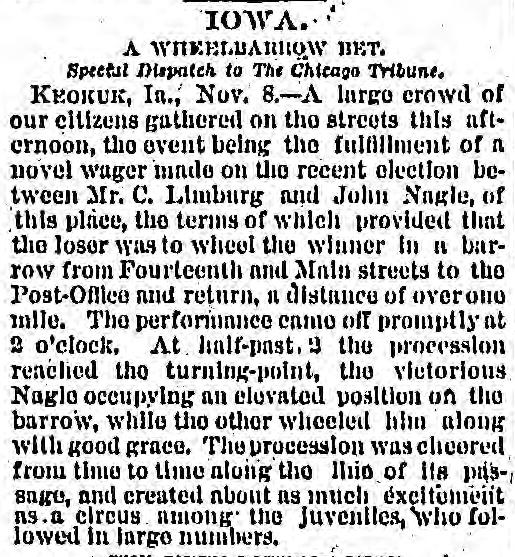
“A Wheelbarrow Bet.” Chicago Daily Tribune, Chicago, Illinois, November 9, 1880, page 2, a dispatch from Keokuk, Iowa. Library of Congress, Chronicling America. Click the clipping to read it full size.
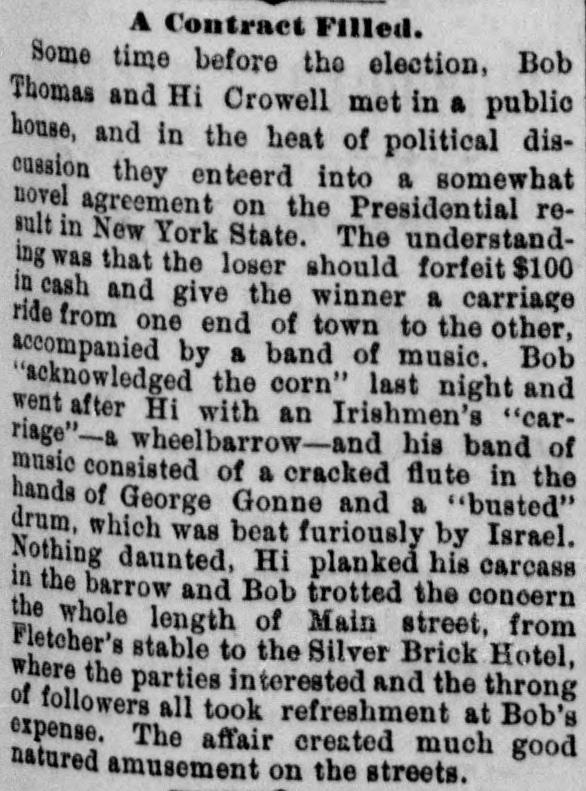
“A Contract Filled.” Eureka Daily Sentinel, Eureka, Nevada, November 5, 1880, page 3. Library of Congress, Chronicling America. Click the clipping to read it full size.
The custom lasted. In 1893 a Chicago artist named Joseph Klir made a big color print called “The Lost Bet.” It shows a Chicago, Illinois, street after the 1892 election, with a brass band, a crowd of kids, and a banner for Grover Cleveland hanging over the loser’s parade.
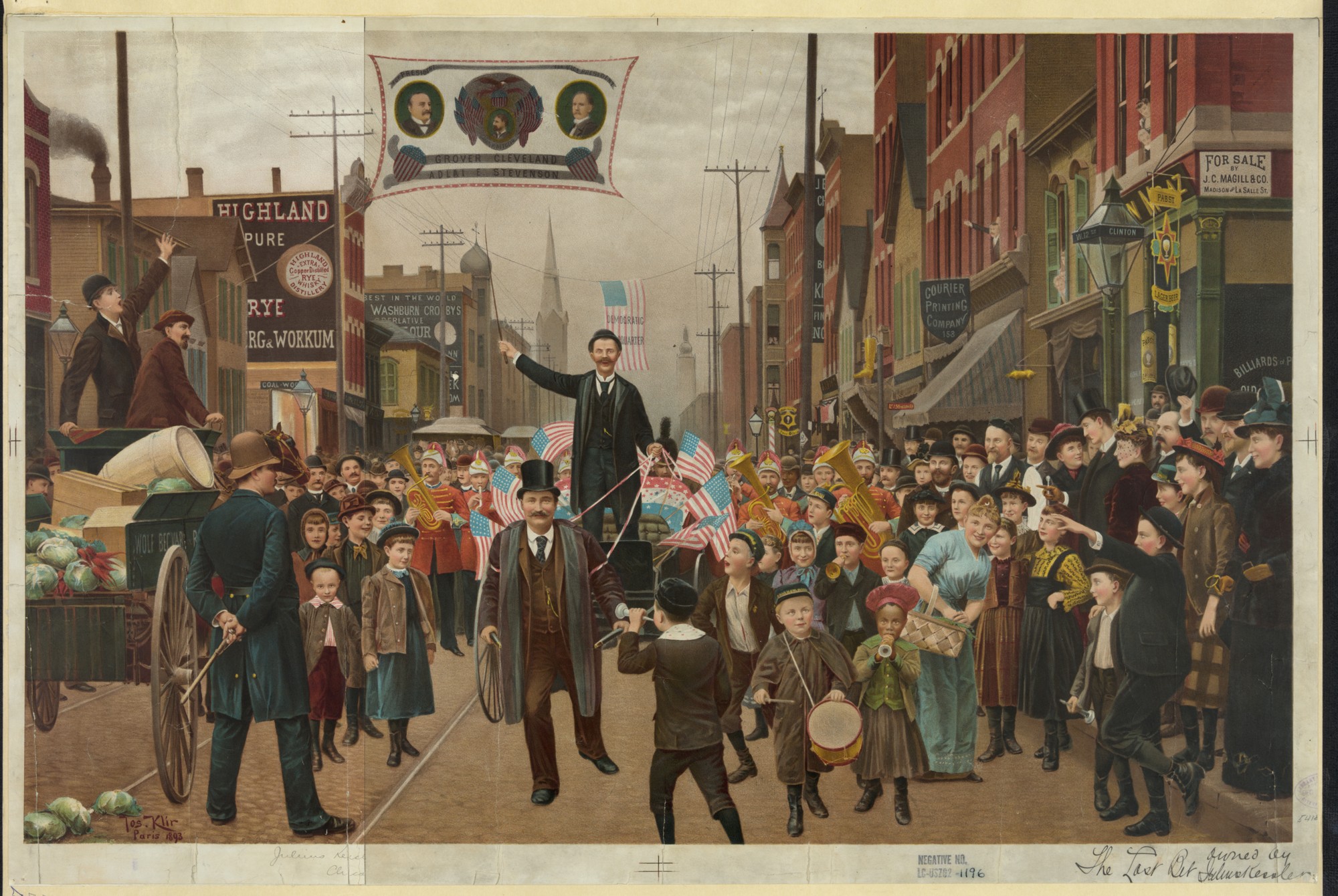
“The Lost Bet,” by Joseph Klir, 1893, a Chicago election bet paid in the street after the 1892 election. Library of Congress, Popular Graphic Arts Collection. Click the picture to see it full size.
By the numbers
- 40 miles from Providence to Boston, “or thereabouts.”
- 300 pounds in the barrel in 1864, by the Pawtucket paper’s count. By 1880 the Portland paper said 400 pounds. By 1884 it was 450. The barrel got heavier every time the story was told.
- 750 oysters, at a dollar each.
- 8 miles a day, and five days on the road.
- 205 pounds of apples in 1 hour and 38 minutes, in 1877.
- 200 pounds to Portland, 4 years to do it, and $50 if he didn’t.
The man and the barrow
Three times Joshua Hobart bet on the wrong man. Three times the price was the same: a barrel, a barrow, and a long road with the whole town watching. He never tried to get out of it. The oysters were sold before the first mile, and the old Democratic wheelbarrow of 1864 outlasted four presidential campaigns.
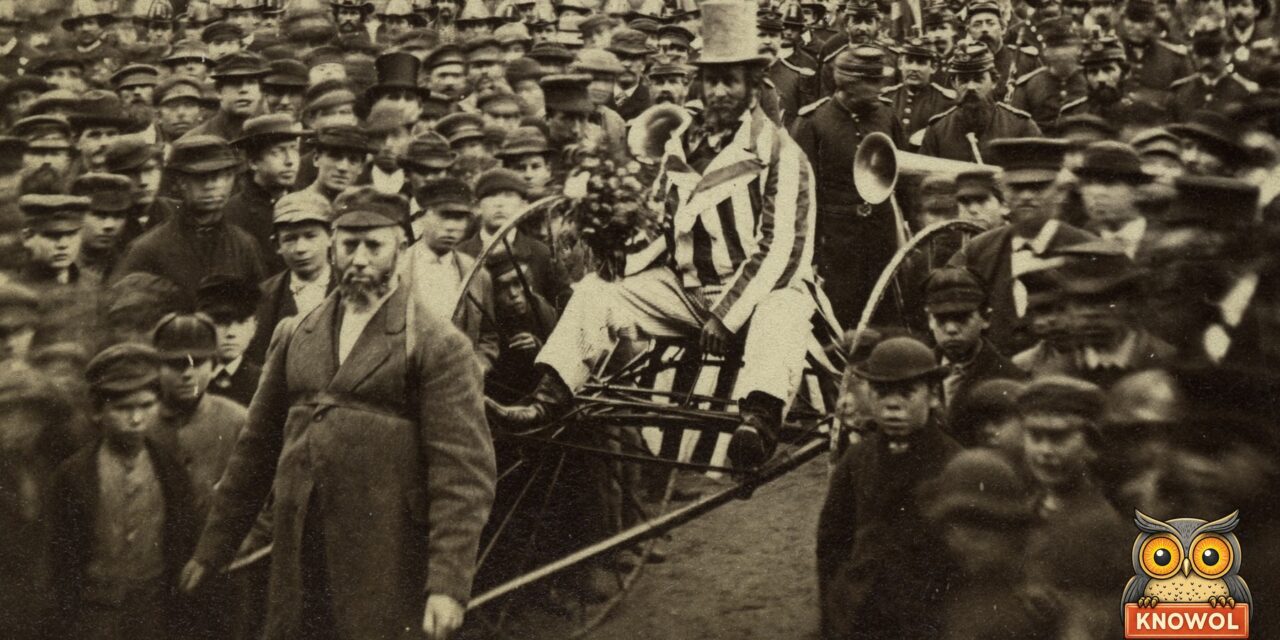
The cover picture shows the same custom in Keene, New Hampshire. On November 14, 1872, a crowd filled Central Square to watch the loser of an election bet pull the winner through the square in a two-wheeled cart, with a brass band marching behind. The winner wore stars and stripes and a tall hat. The loser wore a long coat and a very straight face.
Sources
- Pawtucket Gazette and Chronicle (Pawtucket, Rhode Island): December 2, 1864, page 2 (the start in Providence, the oysters at a dollar each) and December 9, 1864, page 2 (the arrival in Boston).
- Rutland Weekly Herald (Rutland, Vermont): December 8, 1864, page 8 (the $10 stew).
- The Portland Daily Press (Portland, Maine): November 17, 1880, page 3 (“A Wheelbarrow Tramp Expected from Massachusetts,” from the Boston Journal) and November 18, 1880, page 3 (“The Wheelbarrow Wager”: the 1864 bet with Mr. Wright, the National Lancers, the two-wheel argument, the 1877 and 1878 bets).
- Morning Journal and Courier (New Haven, Connecticut): October 1, 1884, page 3 (“A Wheelbarrow Ride For Somebody”) and The Burrillville Gazette (Pascoag, Rhode Island): October 24, 1884, page 4 (“A Wheelbarrow Bet”).
- Chicago Daily Tribune (Chicago, Illinois): November 9, 1880, page 2 (Keokuk).
- Eureka Daily Sentinel (Eureka, Nevada): November 5, 1880, page 3 (“A Contract Filled”).
- Wheeling Register (Wheeling, West Virginia): November 9, 1880, page 3 (Marietta to Parkersburg).
- The People and New Hampshire Patriot (Concord, New Hampshire): November 18, 1880, page 3 (Unity and Claremont).
- The Cambridge Directory for 1866-1867 (Hobart’s eating house on Bowdoin Square, in our own words): Internet Archive.
- “The Wheelbarrow Polka” (Boston: Oliver Ditson, 1856): Cornell University Library, Susan H. Douglas Political Americana Collection, via Wikimedia Commons. No known copyright restrictions.
- “The Lost Bet,” Joseph Klir, 1893: Library of Congress, Popular Graphic Arts Collection. Published 1893, public domain.
- All newspaper images: Library of Congress, Chronicling America. Published 1864 to 1884, public domain.
- Cover: “Paying the Election Bet, Nov. 14, 1872,” stereograph by J. A. French, Keene, New Hampshire. New York Public Library, Robert N. Dennis Collection of Stereoscopic Views, via Wikimedia Commons. The Keene Public Library holds another copy and names the square. Public domain. It shows Keene, not Boston or Somerville.