At 8:35 on the night of Wednesday, October 13, 1915, a small airplane rolled down the race track at the Virginia State Fair in Richmond, Virginia. Every seat in the grandstand was taken. That was 5,000 seats, the Richmond Times-Dispatch said, and “hundreds of eager faces watched the daring bird-man from the space between the grand stand and the race track.” Governor Stuart sat in a box seat. The pilot was a young man from Fort Wayne, Indiana, named Art Smith. As his machine lifted off the far end of the track, fire began to stream out behind it.
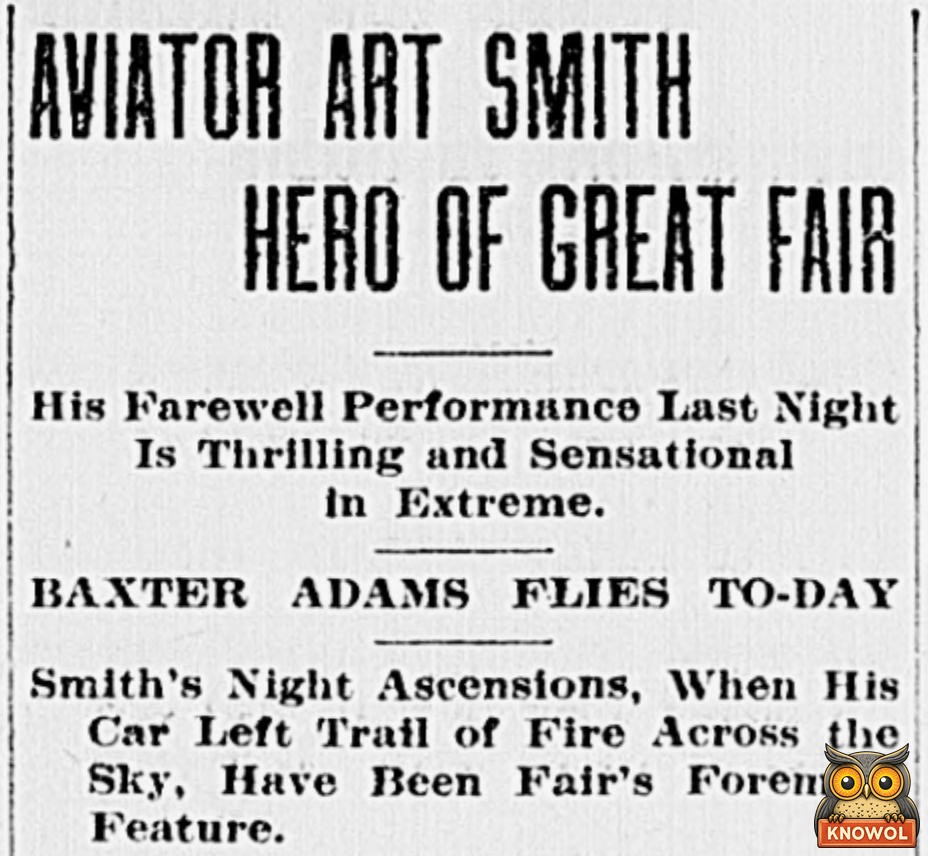
“Aviator Art Smith Hero of Great Fair.” Richmond Times-Dispatch, Richmond, Virginia, October 14, 1915, page 11. Library of Congress, Chronicling America. Click the clipping to read it full size.
A comet over the race track
Smith had flown the same way on Monday, the fair’s opening night. Here is how the Times-Dispatch described it. “Intermittent streams of fire blazed out from the rear of the machine as it sped along its course. After circling the race track twice, the flames became continuous, and, comet-like, the machine blazed its way into space.” Then came the tricks. The paper said he “flew upside down, and did all kinds of ‘stunts'” while the people in the grandstand held their breath.
On Tuesday night the lights on the machine made it look like “a great, gaudily bedecked butterfly.” Bedecked means dressed up. On Wednesday night, his last, the paper wrote: “Comet-like he blazed the sky, and with artistic grace the speeding aeroplane obeyed the will of the dare-devil aerial performer. Time after time the blazing machine turned complete somersaults; for minutes it glided sidewise through space; several times the gazing throng caught its breath in tense excitement.”
A somersault in an airplane is a loop. The plane climbs, rolls up and over onto its back, and comes all the way around in a circle. In 1915 a loop was still a rare sight. Other flyers had done it, the Times-Dispatch admitted, “but no other airman has given Richmond spectators so thrilling an exhibition.” Smith did nine in a row on Monday afternoon, and eight on Tuesday after a trip over Chimborazo Hill on the east side of town.
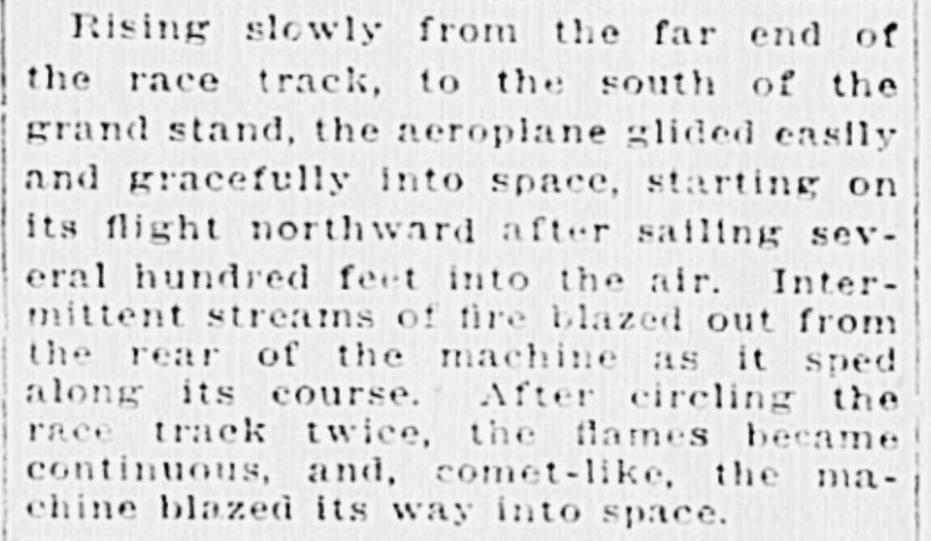
Fire from the rear of the machine on opening night. Richmond Times-Dispatch, Richmond, Virginia, October 12, 1915, page 10. Library of Congress, Chronicling America. Click the clipping to read it full size.
How the fire worked
Smith explained the trick himself in a little book printed that year, “The Story of Art Smith.” The idea came from his wife, Aimee. One evening in Fort Wayne “she suggested the picture of the night sky, full of aeroplanes brightly lighted.” Smith tried flying at night with lights outlined along the machine. Then, he wrote, “it occurred to me to use fireworks, which would leave a blazing trail of light across the sky.” He “found a Chicago firm which would make me a special brand of fireworks, suitable for the purpose,” and wired them to the plane.
In the air he had buttons to press. One started “the white glare of the magnesium lights.” Magnesium is a metal that burns with a bright white flash, the same stuff photographers used for flash powder back then. Another button lit “the trailing ‘comet tail.'” The Richmond Virginian, the city’s other daily paper, saw both versions. In the afternoon there burned on his plane “a combustible that left a dull yellow trail of smoke behind.” At night “the trail was of white fire. It stood out against the darkness as a meteor pursuing an almost horizontal or as a gigantic corkscrew descending upon the earth.”
It was not safe. On his very first night flight in San Francisco that spring, the fireworks went off wrong, one after another. “The fireworks were wrecking the aeroplane,” he wrote. “Fire blazed in my face; my coat was in flames.” He landed the burning machine on the field. “Billy Bastar came running, tearing off his overcoat. He flung it over the blazing machine and smothered the flames.” Billy was his manager, and his first words were “Quick, hide the machine! Don’t let the papers get hold of this!” They kept it secret until Smith told it himself in the book.
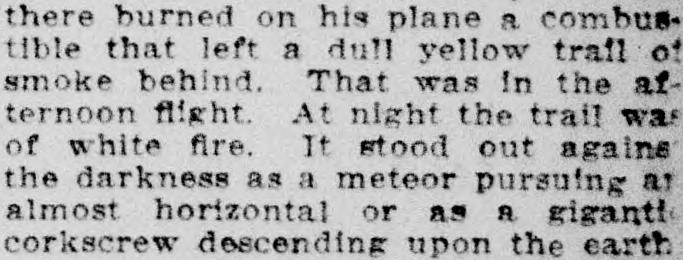
A dull yellow trail by day, white fire by night. The Richmond Virginian, Richmond, Virginia, October 14, 1915, page 1. Library of Congress, Chronicling America. Click the clipping to read it full size.
His name on the roof
Smith flew in the daytime too, and for the day shows he had a trick with his name. The top of his machine was red, and his name was painted across it in big white letters. When he rolled over and flew upside down, the crowd could read it. The Virginian described the plane “after being flown upside down, presenting to view in great white letters on the red ‘roof’ of the machine the name ‘Art Smith.'” Then it “drops as a plummet until within a few yards of the ground.” A plummet is a lead weight on a string. After that fall the plane “is suddenly righted, and glides easily to the alighting space.”
He landed with the same care. After his nine loops on Monday, the Times-Dispatch said, the machine “alighted precisely in the middle of the track, the spot Smith had selected for his return before he went up, and so light was the contact with the road the pinions of the aircraft were barely shaken.” Then “Art Smith smiled the smile of the man who knows that he has performed a wonderful feat and then faces an appreciative audience.”
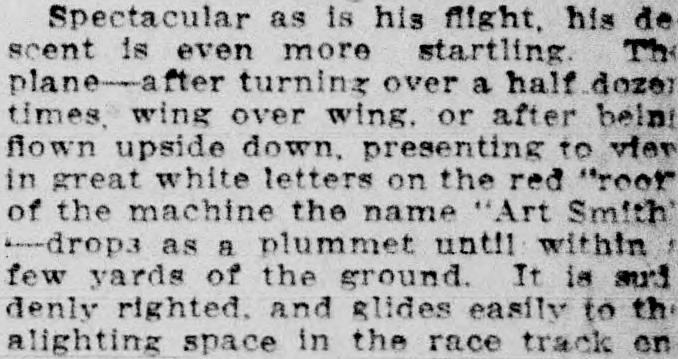
The name on the red “roof.” The Richmond Virginian, Richmond, Virginia, October 14, 1915, page 1. Library of Congress, Chronicling America. Click the clipping to read it full size.
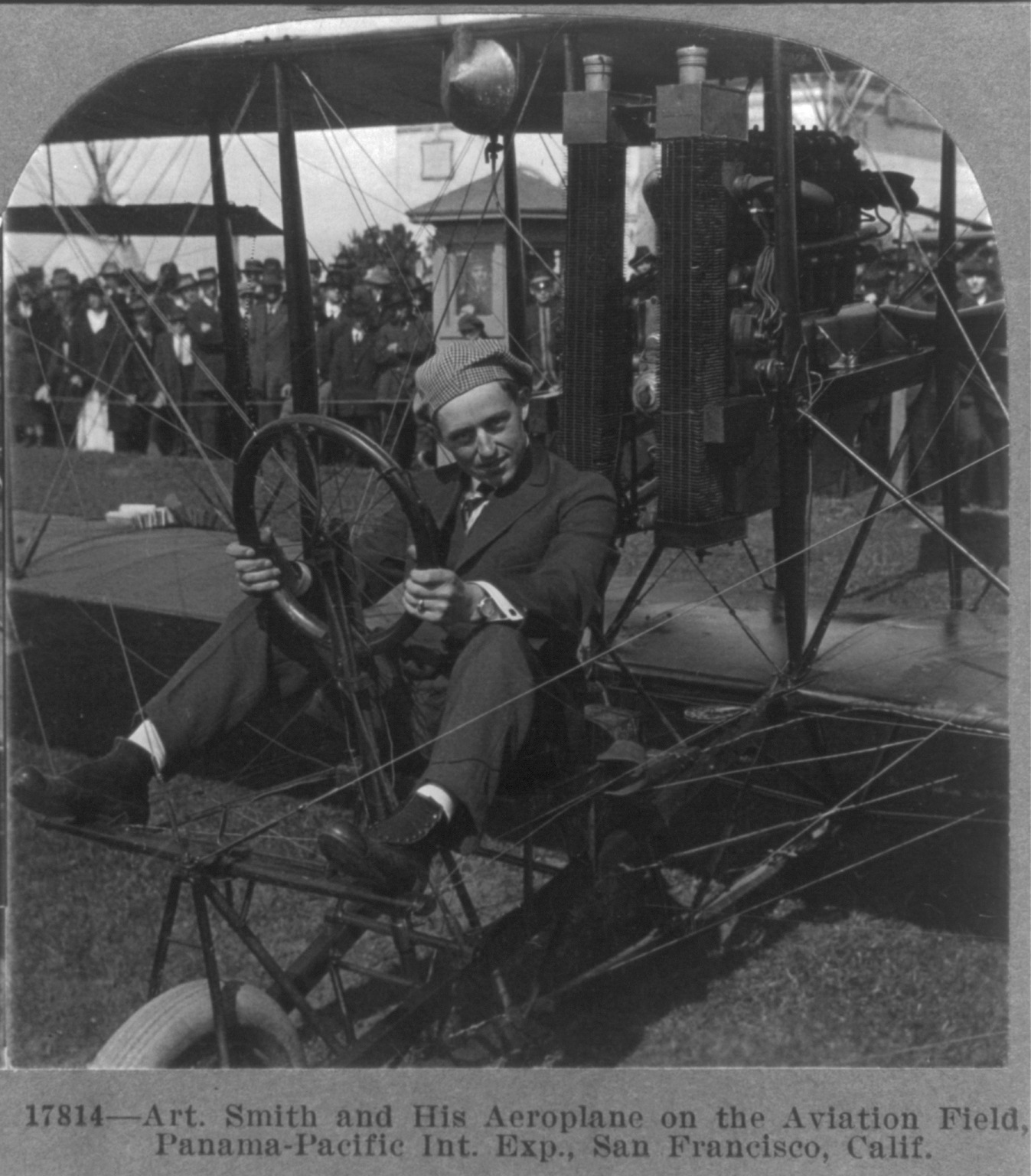
Art Smith in his aeroplane on the aviation field at the Panama-Pacific International Exposition, San Francisco, 1915. Keystone View Company stereograph, Library of Congress. Click the picture to see it full size.
The boy from Fort Wayne
Art Smith grew up in Fort Wayne, Indiana, and built his first flying machine himself. His parents paid for it. The Fort Wayne Sentinel told that story in 1915, and a small paper in Berne, Indiana, reprinted it: “Art Smith’s blind father and his sweet little mother slaved with him, and gave up the little fortune that was their lifetime savings. They were forced out of their home.” He put the machine together at the old driving park, a horse track, “in an old merry-go-round tent that he had borrowed.”
Then, in October 1912, he did something no pilot had done. He eloped by airplane. He and Aimee Cour took off from Fort Wayne and flew to Hillsdale, Michigan, a town where couples went to get married in a hurry. “The machine came down in a plowed field and when the front wheel struck the ground it sank in the soft earth for several feet,” the Berne Witness reported. The plane flipped over and both of them were hurt. They got married anyway that night, in the parlor of the hotel, wrapped in “bandages and redolent of arnica from the effects of a too sudden descent in a plowed field.” Arnica was a liniment people rubbed on bruises, and redolent means they smelled of it. “That looks awfully good to me,” Aimee told a Detroit Times reporter, showing off her ring. “He always wanted to fly over Niagara Falls or do stunts that had not been done, but the other aviators all seemed to beat him to it and about all there was left to do was to elope and so we did it.”
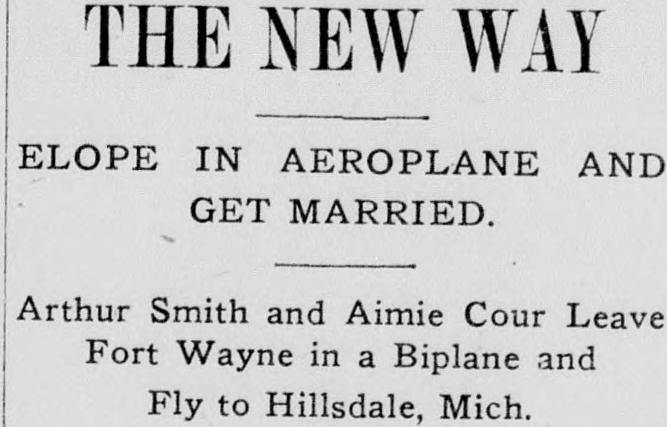
“The New Way.” The Berne Witness, Berne, Indiana, October 28, 1912, page 1. Library of Congress, Chronicling America. Click the clipping to read it full size.
By 1915 he was the star of the Panama-Pacific International Exposition, the world’s fair in San Francisco, California. “He thrilled hundreds of thousands of people at the San Francisco Exposition,” the Virginian told its readers before he came. The San Francisco Bulletin printed his life story as a serial and then as a book. The writer who put it together was Rose Wilder Lane, whose mother, Laura Ingalls Wilder, later wrote the Little House books.
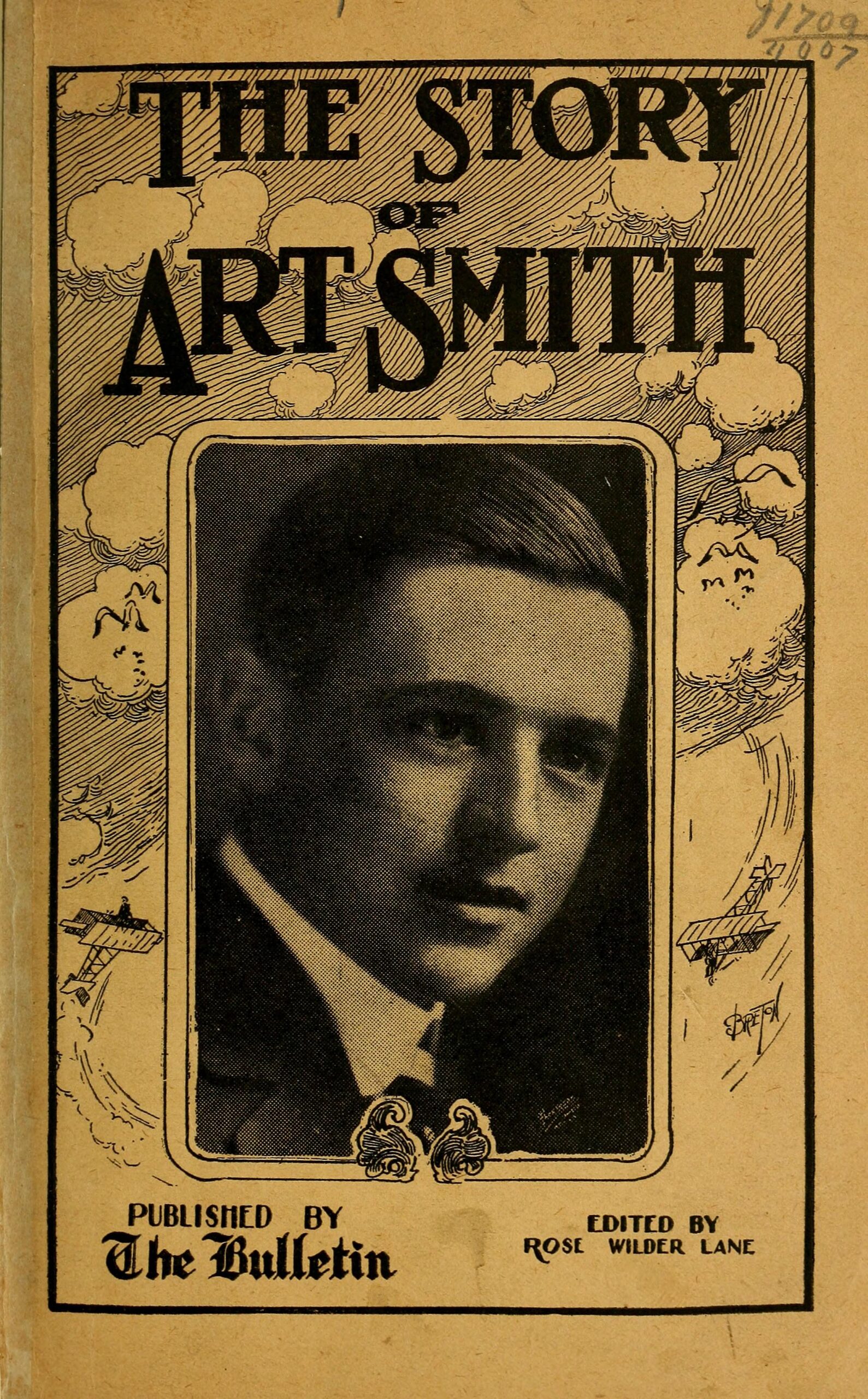
The cover of “The Story of Art Smith,” published by the San Francisco Bulletin in 1915. Internet Archive. Click the clipping to read it full size.
By the numbers
Wednesday was Richmond Day, the big day of the fair, and the Times-Dispatch said it was School Children’s Day too. The papers counted everything.
- Seventy-five thousand people passed through the gates, “according to conservative estimate,” the Virginian said.
- The midway was called Wahoo Lane. The Times-Dispatch counted “50,000 or more who marched the avenue of pleasure” that night, “a good-natured crowd, and a sober one.” Not more than half a dozen were “taken in tow by the bluecoats,” meaning the police.
- Seventy-eight people visited the field hospital. Two cases were serious. “Others had mostly toothache, headache and finger scratches.”
- Ty Cobb, the biggest baseball star of the day, came to the fair on Friday. “The baseball player was the cynosure of all eyes in the grandstand,” the Virginian said. Cynosure means the thing everybody looks at.
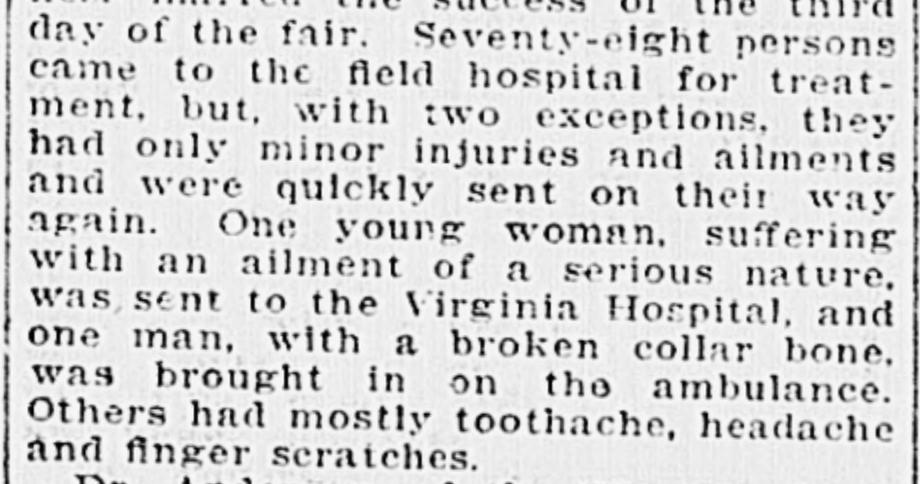
Toothache, headache and finger scratches. Richmond Times-Dispatch, Richmond, Virginia, October 14, 1915, page 11. Library of Congress, Chronicling America. Click the clipping to read it full size.
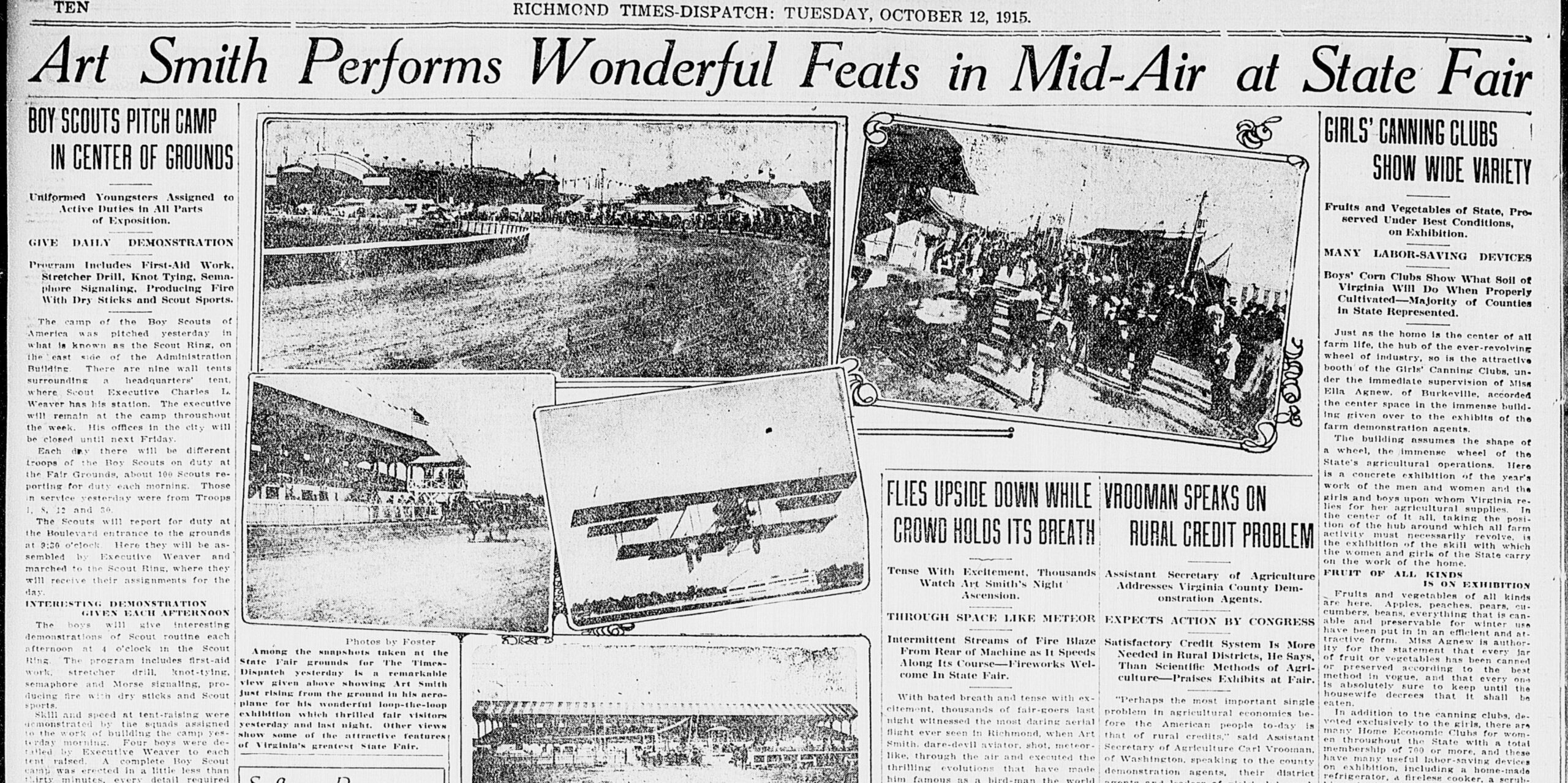
The top of the Times-Dispatch’s fair page on Tuesday, October 12, 1915. The tilted picture shows Art Smith “just rising from the ground in his aeroplane.” Library of Congress, Chronicling America. Click the picture to see it full size.
Good-bye, Art Smith
Smith flew early on Wednesday night so he could pack his airplane onto the night train south. Dallas, Texas, was next. “He left the earth at 8:35,” the Virginian said, “and for more than a quarter of an hour defied the law of gravitation.” The Times-Dispatch sent him off this way: “Thousands of Virginians have been thrilled with his wonderful feats in mid-air, and each one wishes him god-speed in his dangerous profession.”
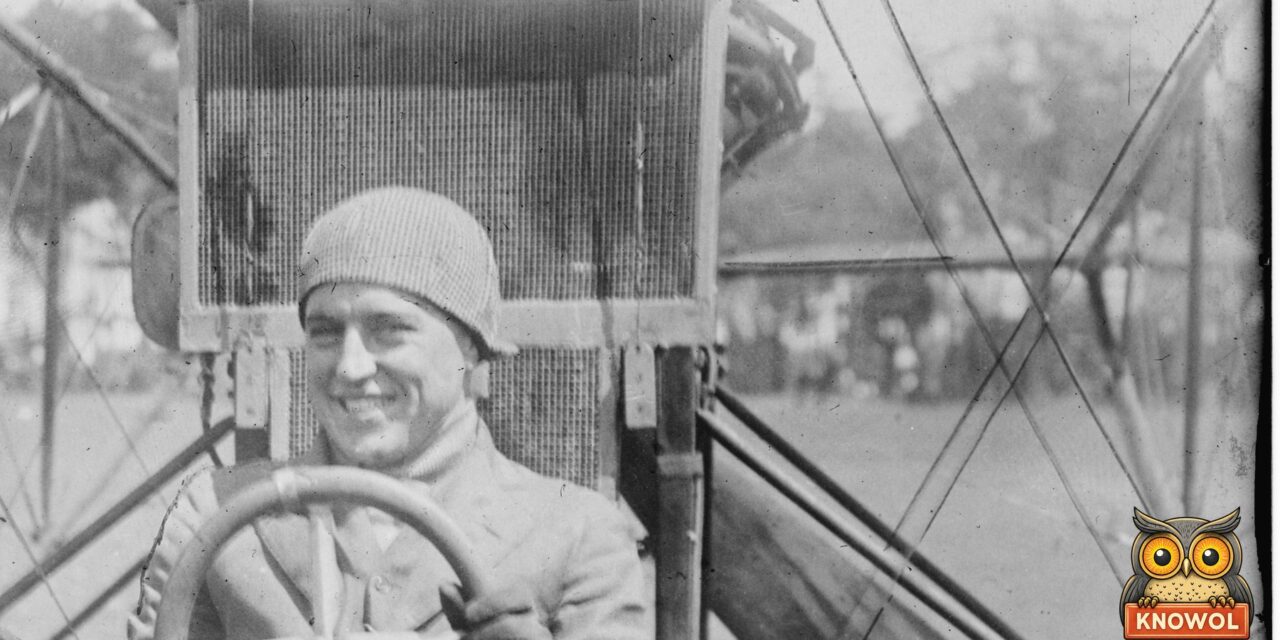
For the rest of the week a flyer named Baxter Adams took his place, afternoons only. He went up 4,000 feet, did a loop, and then “raced at a height of fifty feet above the ground, with a motor-cycle.” The picture at the top of this story shows Smith at the wheel of his biplane in those same years, grinning under a wool cap. It comes from the Bain News Service collection at the Library of Congress. The grin is the one Richmond saw on the race track in 1915, after the loops, when the applause started.
Sources
- Richmond Times-Dispatch (Richmond, Virginia): October 12, 1915, page 1 (“Art Smith Hero of Fair Throng,” the nine loops and the landing); October 12, 1915, page 10 (“Flies Upside Down While Crowd Holds Its Breath,” the fair page with Foster’s snapshots); October 13, 1915, page 1 (“Smith Repeats Dare-Devil Feat by Light of Stars,” Chimborazo Hill, the butterfly, Richmond Day); October 14, 1915, page 1 (“Richmond Day Is Climax of Fair”); October 14, 1915, page 11 (“Aviator Art Smith Hero of Great Fair,” the farewell flight, Wahoo Lane and the field hospital).
- The Richmond Virginian (Richmond, Virginia): October 4, 1915, page 3 (“Coming to State Fair”); October 10, 1915, page 1 (“Art Smith Aviator Arrives Here Today”); October 14, 1915, page 1 (“75,000 Enjoy Big Day,” the white fire, the name on the roof, 8:35); October 16, 1915, page 1 (Ty Cobb, Baxter Adams and the motorcycle).
- The Detroit Times (Detroit, Michigan): October 29, 1912, page 2 (“Elopers Are Happy After Flight in Airship,” Aimee Smith’s words).
- The Berne Witness (Berne, Indiana): October 28, 1912, page 1 (“The New Way”); June 25, 1915, page 1 (“Success After Hard Work,” reprinted from the Fort Wayne Sentinel).
- Art Smith, “Art Smith’s Story: The Autobiography of the Boy Aviator,” edited by Rose Wilder Lane, The Bulletin, San Francisco, 1915, pages 90 to 94, on the Internet Archive.
- Photo: “Art Smith and his aeroplane on the aviation field, Panama-Pacific Int. Exposition, San Francisco, Calif.,” Keystone View Company, 1915, Library of Congress, no known restrictions on publication.
- All newspaper images: Library of Congress, Chronicling America. Published 1912 and 1915.
- Cover: “Art. Smith & Mr. Ozaki,” Bain News Service, between about 1915 and 1920, Library of Congress, no known restrictions on publication. Cropped to Smith at the wheel.