On a pleasant Tuesday night in May 1912, nearly the whole town of Marble, Colorado lined Main Street and waited for a bell. A new tower stood beside the bandstand, and at the top hung what The Marble Booster called “an enormous bell.” Nobody had heard it yet. “Not once, while it was being hung, was it struck.” The first stroke went to “little Eva Brown, daughter of the man who built the tower.”
The crowd went quiet. “Suddenly there came a deep, rich tone, a single tap and the first given in the town from this bell.” More strokes followed, and the fire boys whirled their hose wagon out of the base of the bandstand and into the street.
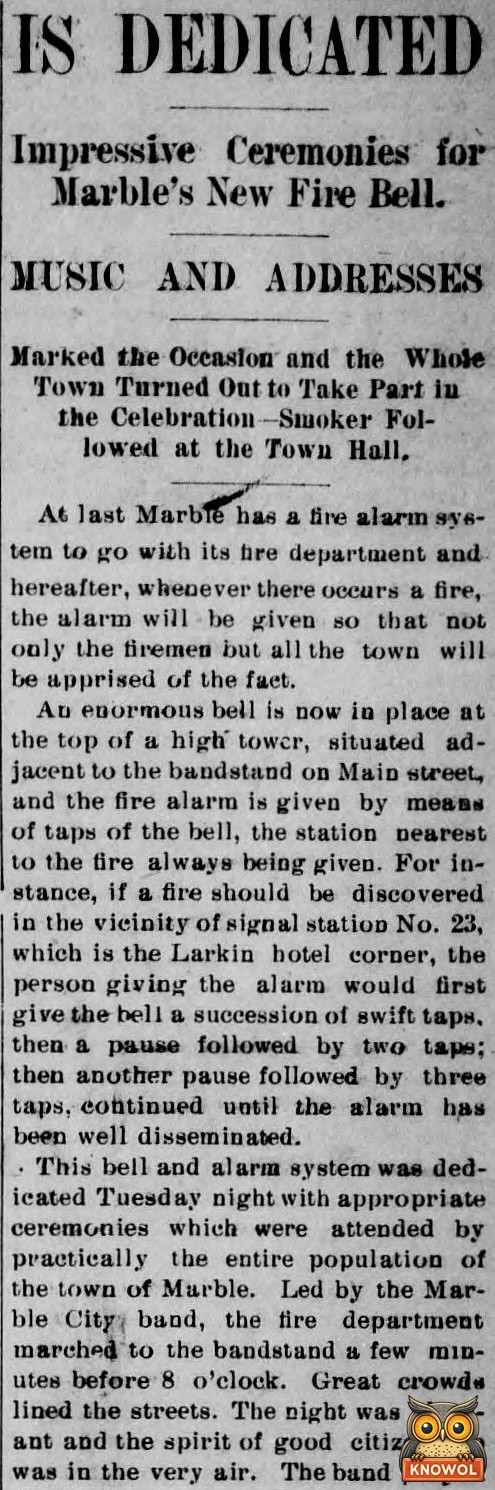
“Is Dedicated: Impressive Ceremonies for Marble’s New Fire Bell,” The Marble Booster, Marble, Colorado, May 11, 1912, page 1. Library of Congress, Chronicling America. Click the clipping to read it full size.
The insurance men wanted a bell
Marble was a quarry town high in the Crystal River valley, and its merchants had been fighting their fire insurance rates for years. In 1909 Kobey’s store paid $4.85 for every hundred dollars of insurance on the building. The insurers blamed Marble’s lack of fire protection, so the town put hydrants along Main Street with pressure “strong enough to rip shingles off a house.” “You have no fire department,” the insurers said next, so the town organized a hose company. Then came the last demand. “Nothing doing,” said the trust, “you haven’t got any alarm system. You must put in a fire bell so that alarms may be given.”
In August 1911 the town board asked Harry Thode to look at “the fire bell at Carbondale with authority to purchase same if found satisfactory.” Every corner of town got a signal number, tapped out on the bell, so that the whole town would know where a fire was.
“These Marble boys”
At the dedication, the fire company called on Col. C. F. Meek, president of the Colorado-Yule Marble Company. Sitting in the Colonel’s motor car was a guest from New York, a former commissioner of the New York fire department, and Meek played to him. “I would be willing to lay a wager that these Marble boys could beat those Dutch lads of Manhattan in all points of the fire fighting game,” he said. The department needed more equipment, he added, “especially when we get all these streets paved with marble, something they haven’t got in New York.”
Nine solemn taps
The bell soon had other jobs. By June, five slow taps meant a practice run and ten meant a meeting of the hose company. By August it rang the curfew. “Every night now, promptly on the stroke of nine, the fire bell gives nine solemn taps, which is a signal for the ‘kids’ to betake themselves home.” The tower itself was a temptation. The week it was dedicated, the Booster warned of “danger for youngsters in climbing up that new bell tower.”
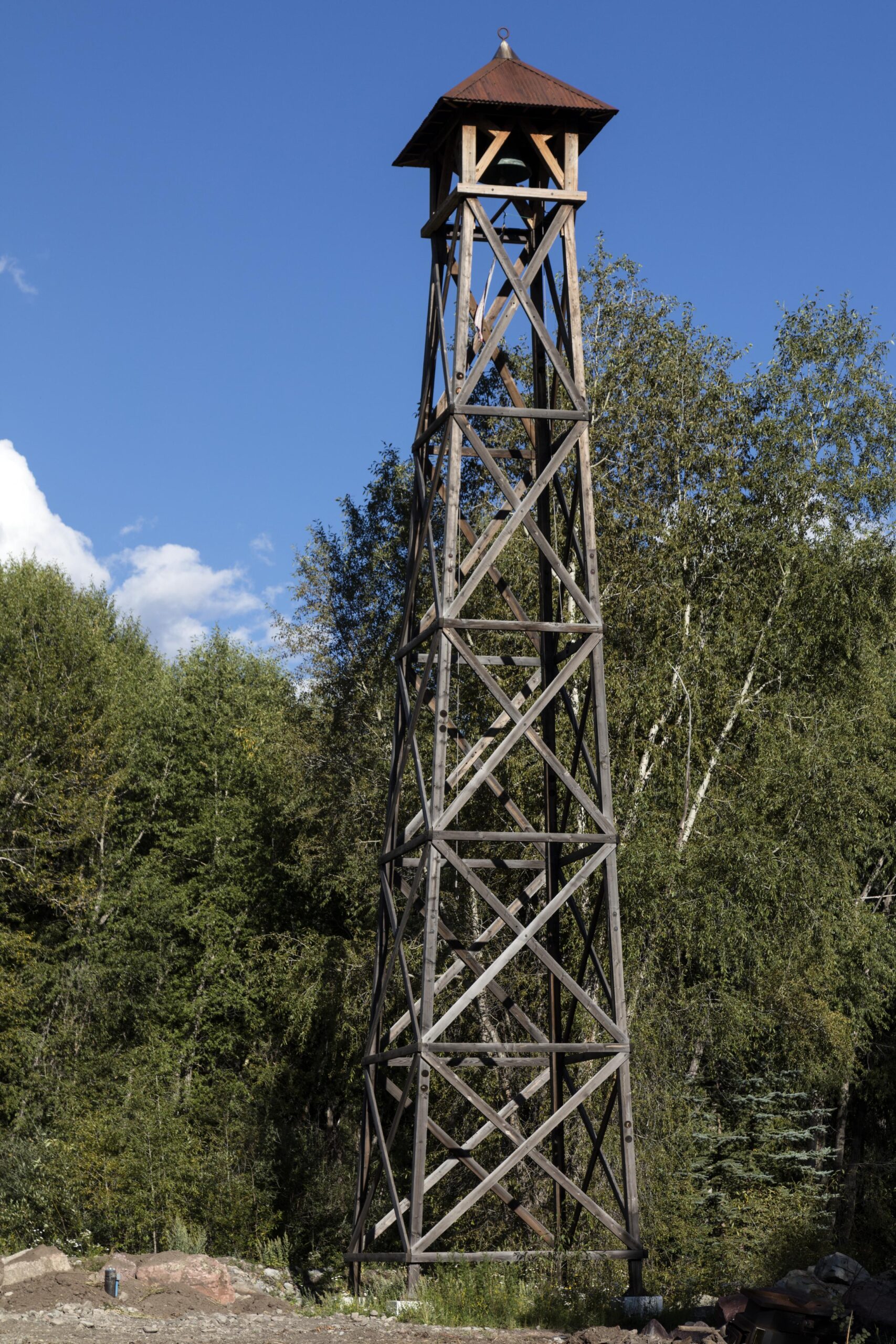
A replica of Marble’s fire bell tower, Marble, Colorado, 2015. Photograph by Carol M. Highsmith, Library of Congress Prints and Photographs Division. Click the clipping to read it full size.
The first real alarm came that October, when hot ashes dumped beside kindling piled against C. Scott’s chicken house started a fire. The bell rang, “the first alarm it has registered since it was installed,” and Hose Company No. 1 ran up the hill. Workmen next door had already put it out with pails of water. “‘Scotty,’ himself, arrived after it was all over.” On the same page, Marble Mercantile Co. offered Glenwood wheat bran at “Two Dollars and a Quarter per 100 lb. sack.”
Rates doubled here
In January 1913 the insurers finally answered. “Notice was served upon all the merchants that the rate had been almost doubled.” Kobey’s building was now $9.92. The Booster’s headline asked, “Want to Feel Plutocratic?” and its story ended, “Wouldn’t that make you sick of trusts?”
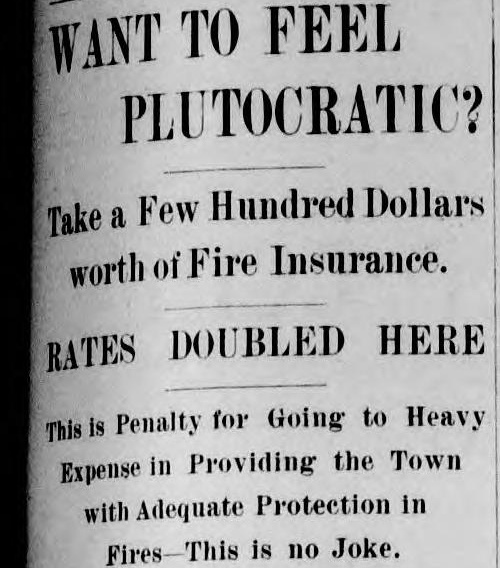
“Want to Feel Plutocratic? Rates Doubled Here,” The Marble Booster, Marble, Colorado, January 11, 1913, page 1. Library of Congress, Chronicling America. Click the clipping to read it full size.
A bell for everything
The bell kept ringing. In September 1913 it rang for an alarm, and the firemen “never did find out just where the alarm came in from.” John Parrish hauled the hose cart behind his delivery wagon, the blaze was out before they got there, and “John got back to town minus one wheel.” When 1914 arrived, “The church bell rang, ditto the fire bell.” The firemen complained that the bell ropes got twisted, and the paper called the alarm system “so complicated that few of us pretend to understand anything about it.”
When a Telluride paper bragged that its fire bell rang only for fires, the Booster answered, “In Marble it’s different. Here they ring the fire bell on all celebration nights like Halloween, New Year’s, etc., and for firemen’s meetings, firemen’s practice runs, and half a dozen other firemen’s doings.” It called that “a darned poor scheme,” but Marble kept ringing. A Library of Congress photo caption says the tower served the town’s fire alarm from 1912 to 1977, and a replica stands in Marble today.
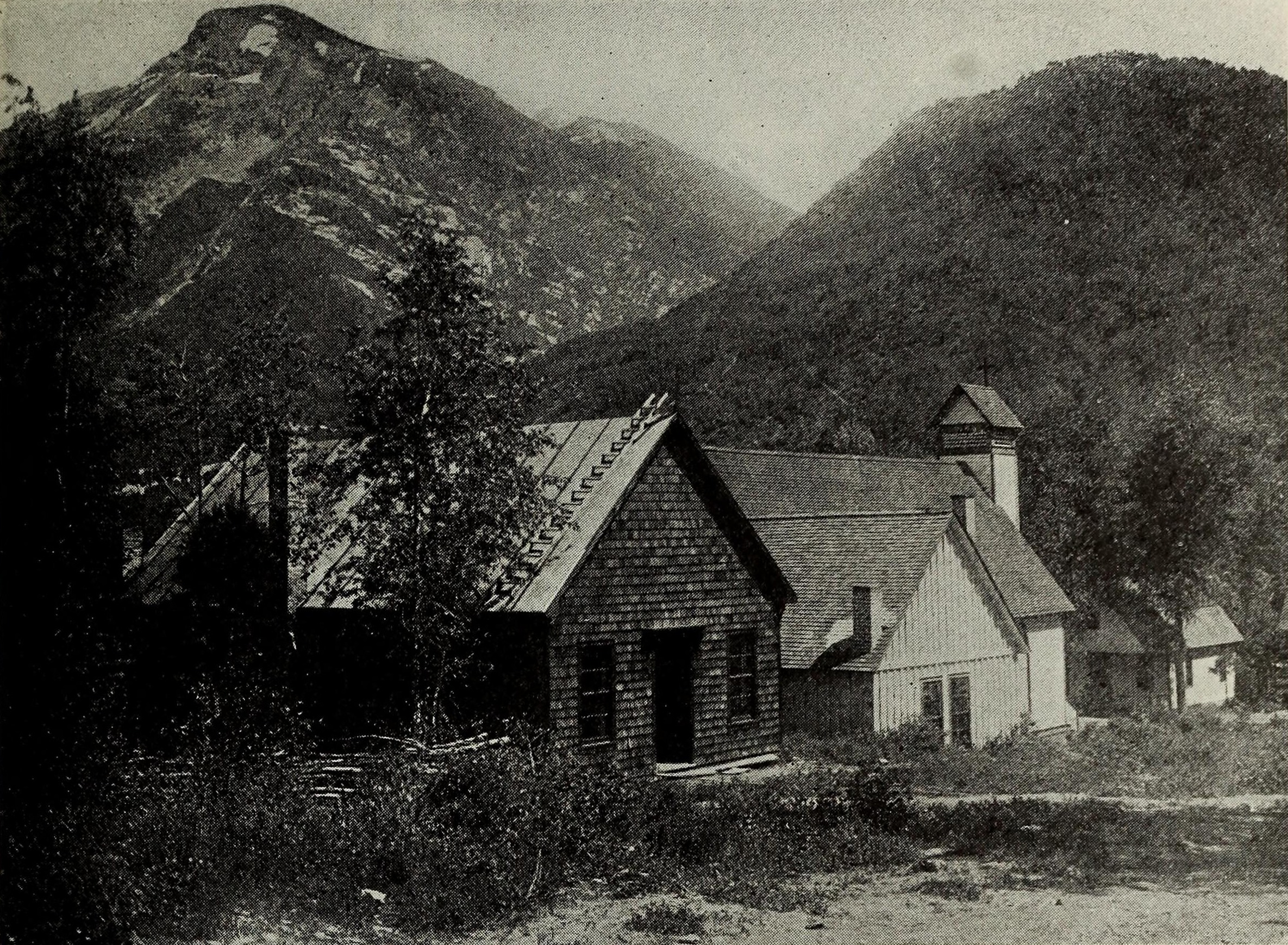
St. Paul’s Church and its boys’ clubhouse in Marble, Colorado, from The Spirit of Missions, 1915. Internet Archive. Click the picture to see it full size.
Sources
- The Marble Booster (Marble, Colorado), August 5, 1911, page 1 (town board and the Carbondale bell), May 11, 1912, page 1 and page 8 (dedication, speeches, the warning about the tower), June 8, 1912, page 1 (new signals), August 3, 1912, page 1 (curfew), August 17, 1912, page 1 (C. F. Meek, president of the Colorado-Yule Marble Company), October 12, 1912, page 4 (“Scotty” has a fire, bran ad), December 28, 1912, page 1 (year in review: “May 7, New fire bell is dedicated”), January 11, 1913, page 1 (insurance rates), September 27, 1913, page 1 (John Parrish’s wheel), January 3, 1914, page 1 (New Year’s and the alarm system) and January 10, 1914, page 1 (“It’s Different Here”).
- All newspaper images: Library of Congress, Chronicling America. Published 1911 to 1914, public domain.
- Carol M. Highsmith, replica of the Marble fire bell tower, 2015, Library of Congress Prints and Photographs, Gates Frontiers Fund Colorado Collection, no known restrictions on publication.
- Rev. Oliver Kingman, “Among the Marble Mountains,” The Spirit of Missions, vol. 80 (1915), pages 334 to 336, Internet Archive, public domain.
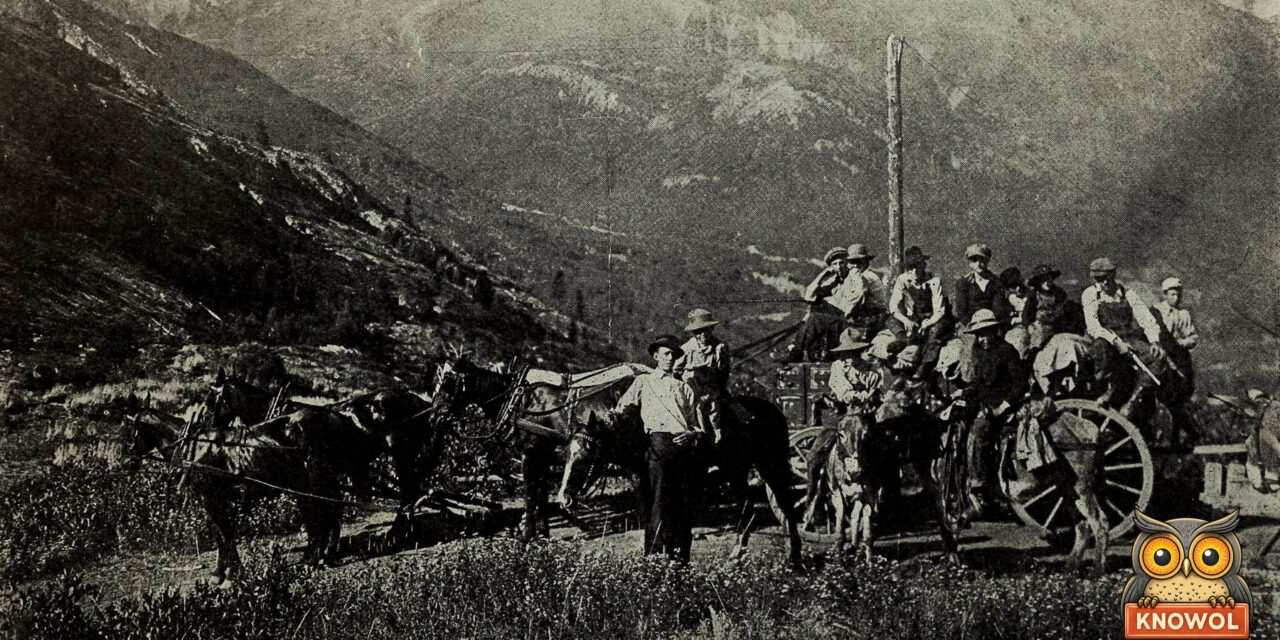
- Cover: “St. Paul’s Boys’ Club on their way to camp,” from Rev. Oliver Kingman, “Among the Marble Mountains,” The Spirit of Missions, vol. 80 (1915), page 334, Internet Archive (cropped). Public domain.