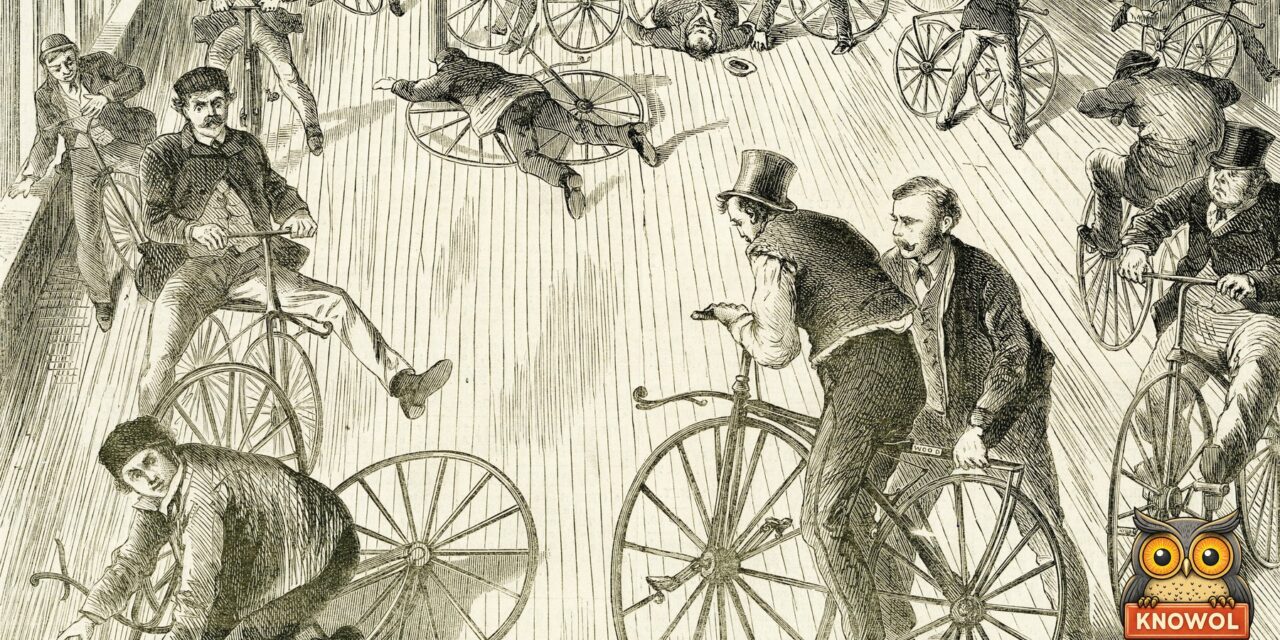
On Tuesday morning, January 19, 1869, W. B. Kinkead climbed onto a strange new machine at the corner of Main and Short streets in Hillsboro, Ohio and rolled downhill to the corner of Main and West. “The veritable ‘Bi-cycle,’ or two-wheeled Velocipede, has made its first appearance in our streets,” the Highland Weekly News announced two days later. Kinkead went “shooting along over the down grade with a swiftness which fully justified the name given to the new vehicle.” Velocipede comes from the Latin words for swift and foot.
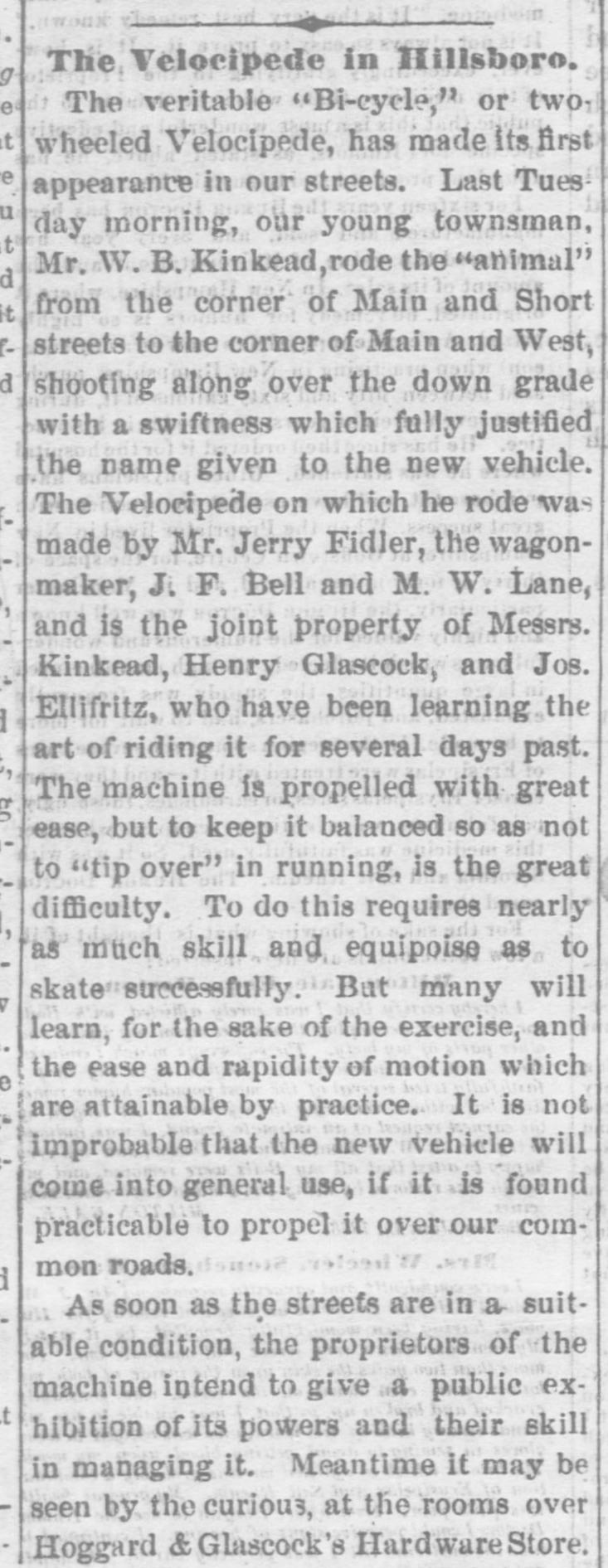
“The Velocipede in Hillsboro,” the Highland Weekly News, Hillsboro, Ohio, January 21, 1869, page 3. Library of Congress, Chronicling America. Click the clipping to read it full size.
Built in Hillsboro
The town’s first bicycle wasn’t shipped in from a big city. It was made by Jerry Fidler, the wagon-maker, with J. F. Bell and M. W. Lane. Three men owned it together, Kinkead, Henry Glascock and Jos. Ellifritz, and they had been learning to ride it for several days before Kinkead’s trip down Main Street.
Pushing the pedals was easy, the paper said. Keeping the thing balanced so it didn’t tip over was the hard part, and it took about as much skill as skating. The owners kept the machine in the rooms over Hoggard & Glascock’s hardware store, where anyone curious could come and look, and they promised a public show as soon as the streets were in good enough shape.
The velocipede winter
All over Ohio that winter, people were talking about velocipedes, the two-wheelers with pedals on the front wheel that had swept Paris. A week after Kinkead’s ride, the News reported a velocipede exhibition at Pike’s Music Hall in Cincinnati, where 9-year-old W. E. Curtis won the prize for fastest time, half a mile in 1 minute and 49 seconds. There were prizes for the slowest time too. In February the paper passed along how a New York riding school sorted its students, from the “Timid Toddlers” up to the “Fancy Few.”
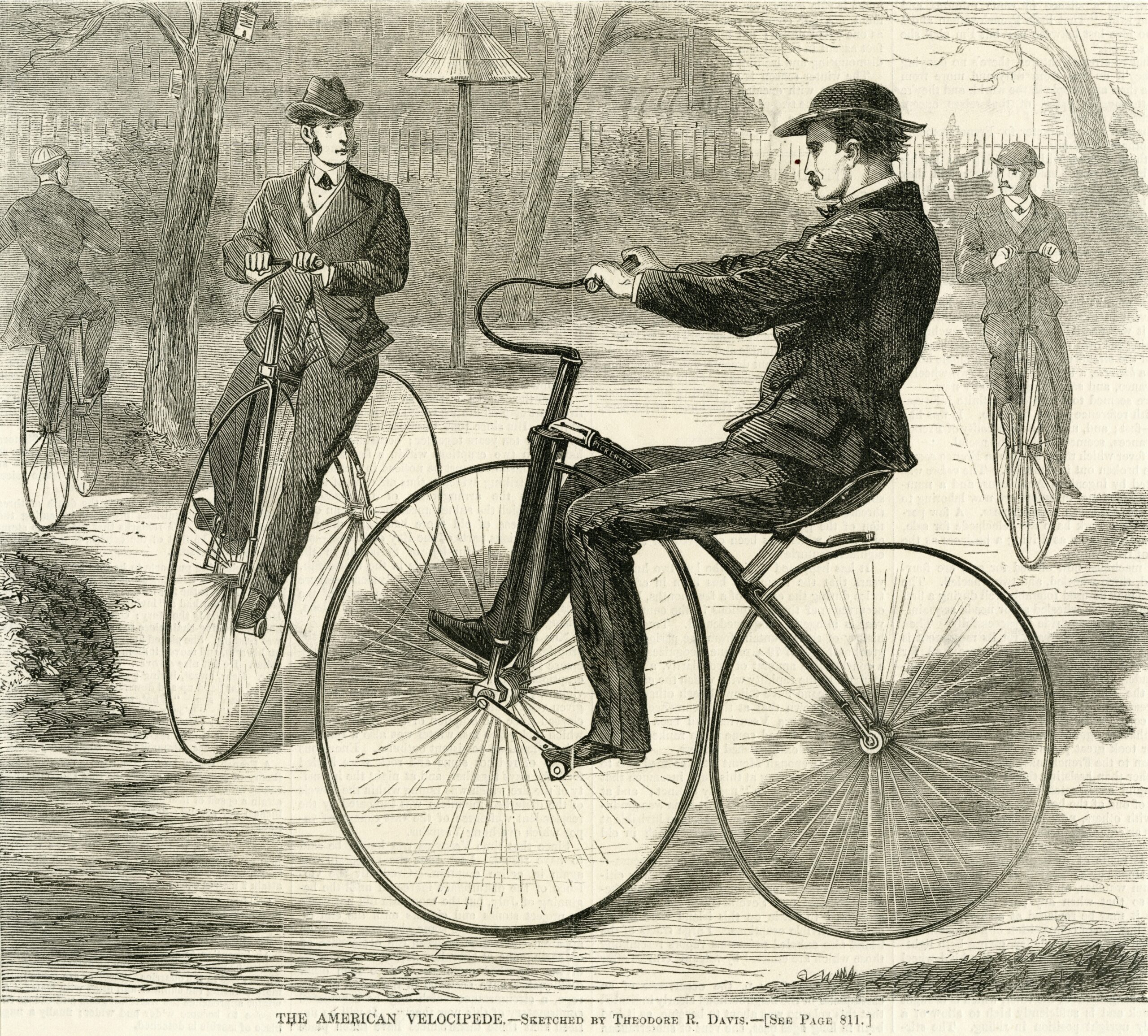
“The American Velocipede,” sketched by Theodore R. Davis, Harper’s Weekly, December 19, 1868. Missouri Historical Society, via the Digital Public Library of America and Wikimedia Commons. No known copyright restrictions. Click the picture to see it full size.
Up north, the Wyandot County Republican wondered who would bring the first one to Upper Sandusky. “Whoever velocipedes upon our streets first, will surely gain a local notoriety,” it wrote. In Hillsboro, Kinkead already had.
$80 to $125, grease-box extra
A velocipede was a big purchase in 1869. The Hancock Jeffersonian in Findlay reported that imported machines cost from $80 to $125. Extras such as a grease-box and India rubber cushions for the bar where the rider’s legs rested were not included.
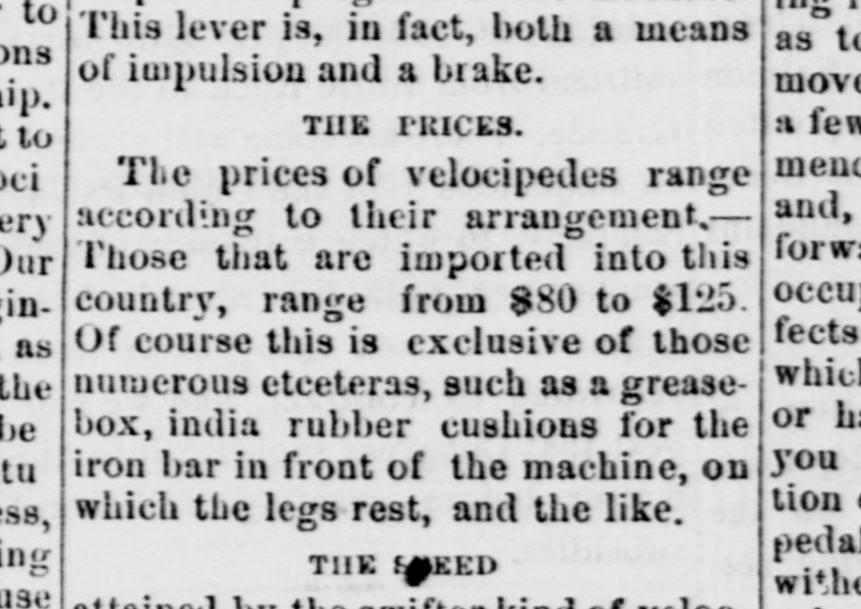
“The Prices,” the Hancock Jeffersonian, Findlay, Ohio, January 22, 1869, page 1. Library of Congress, Chronicling America. Click the clipping to read it full size.
A better machine and a silver pitcher
By April, Hillsboro had another rider. Charley Bell, junior, had learned to ride in good style, the News reported, and his machine was “much more manageable than the first one introduced here, by Kinkead & Co.” The paper had an idea for the county fair. “We think it would draw better than the Tournament.”
The fair did put one on its program. The Highland County Agricultural Society’s twentieth annual fair, held at Hillsborough on September 15, 16 and 17, 1869, planned to close its last day with a velocipede race. Its premium list offered a silver pitcher worth $10 to the best velocipedist, in the same class as silver cups for the biggest collection of Highland County insects and the best speech by a boy under 18.
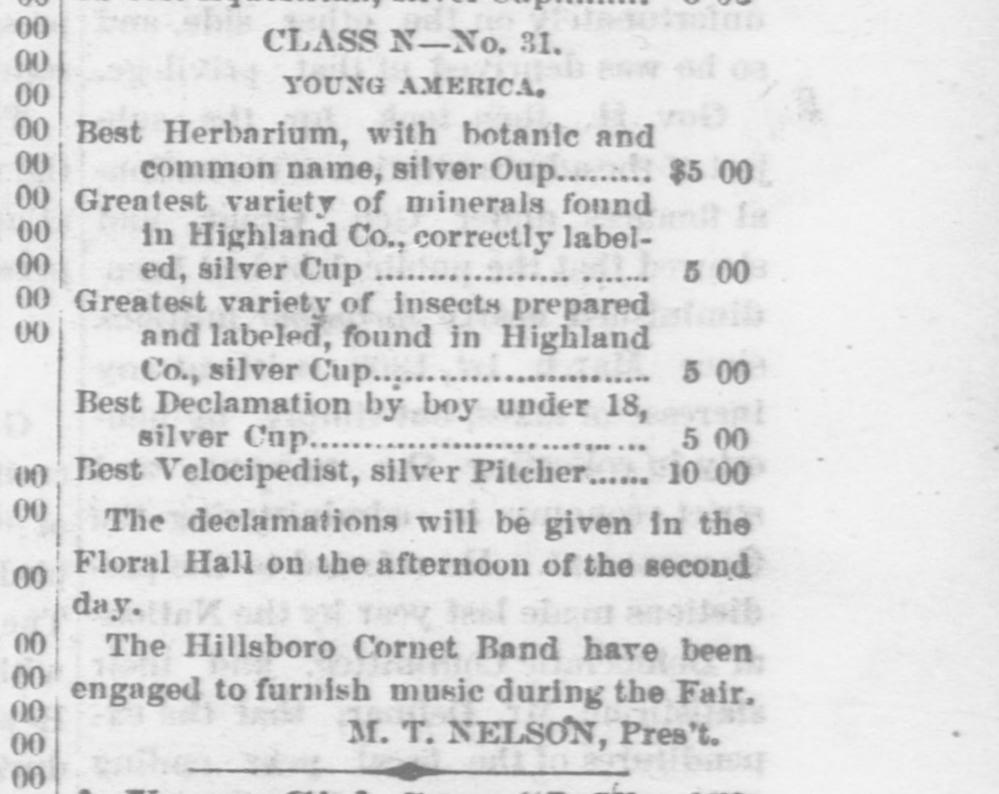
The Young America prizes for the Highland County fair, the Highland Weekly News, Hillsboro, Ohio, August 19, 1869, page 1. Library of Congress, Chronicling America. Click the clipping to read it full size.
The race never happened. The News reported that there was no velocipede race, but two young men rode the machine once around the ring, a third of a mile. One made it in 1 minute and 58½ seconds, the other in 2 minutes and 18 seconds. The paper didn’t print their names.
From street wonder to toy
The craze faded almost as fast as it came. In late May 1869 the Ashtabula Weekly Telegraph reported that 36 velocipedes had been put on sale in Cleveland at $12 to $30 each. In January 1870 the Highland Weekly News summed it up in one line: “The velocipede mania is dying out very rapidly.” By November 1870, velocipedes showed up in an ad for Heistand & Ayres in Hillsboro, in a list of toys between wheelbarrows and locomotives.
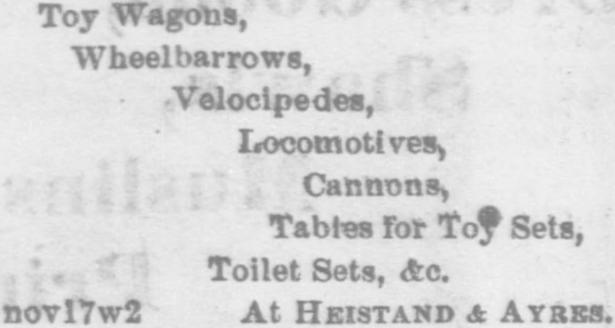
Toys at Heistand & Ayres, the Highland Weekly News, Hillsboro, Ohio, November 24, 1870, page 3. Library of Congress, Chronicling America. Click the clipping to read it full size.
In less than two years, the machine that people once went upstairs over a hardware store to see had become a toy. But on one winter morning in 1869, W. B. Kinkead went flying down Main Street on a bicycle built in Hillsboro.
Sources
- The Highland Weekly News (Hillsborough, Ohio), January 21, 1869, page 3 (“The Velocipede in Hillsboro”), January 28, 1869, page 3, February 25, 1869, page 2, April 22, 1869, page 3, August 19, 1869, page 1 (the fair premium list), September 23, 1869, page 3 (“The Fair”), January 13, 1870, page 1 and November 24, 1870, page 3.
- The Hancock Jeffersonian (Findlay, Ohio), January 22, 1869, page 1.
- Wyandot County Republican (Upper Sandusky, Ohio), January 28, 1869, page 4.
- Ashtabula Weekly Telegraph (Ashtabula, Ohio), May 29, 1869, page 2.
- Newspaper images from the Library of Congress, Chronicling America. Published 1869 and 1870, public domain.
- Engraving: “The American Velocipede,” sketched by Theodore R. Davis, Harper’s Weekly, December 19, 1868, Missouri Historical Society (N44639), via the Digital Public Library of America and Wikimedia Commons. No known copyright restrictions.
- Cover: “Scene in a Velocipede Riding-School, New York City,” Harper’s Weekly, February 13, 1869 (cropped). Missouri Historical Society (N44640), via the Digital Public Library of America and Wikimedia Commons. No known copyright restrictions.