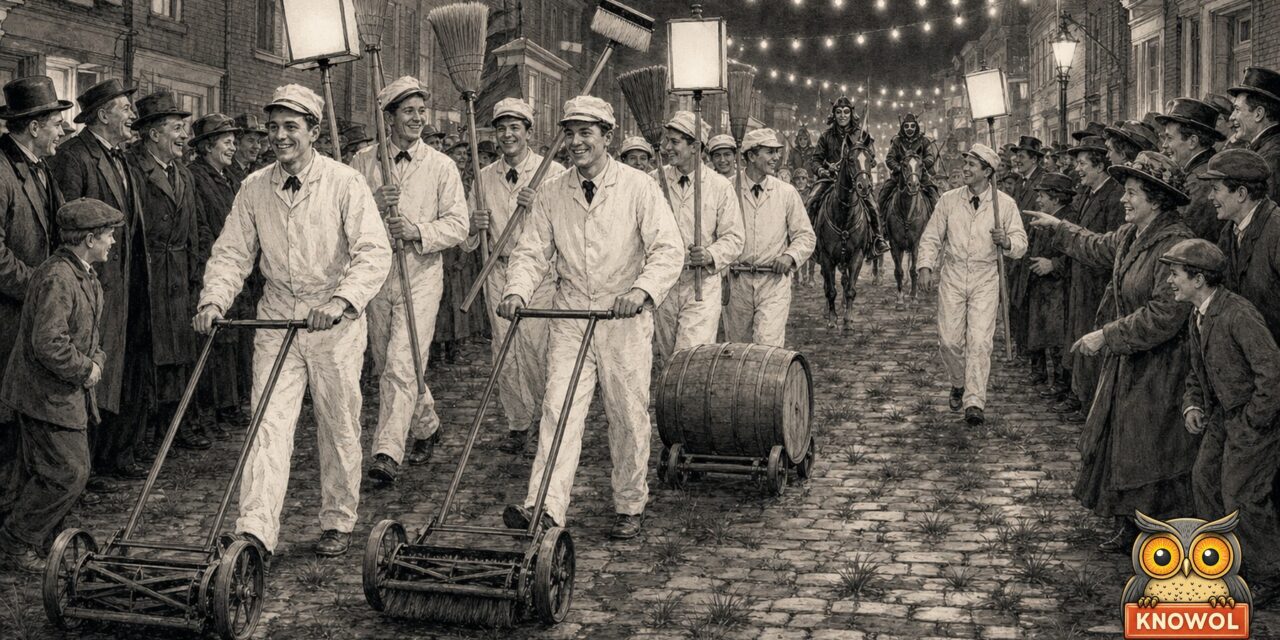
On Halloween night, October 31, 1905, horsemen, maskers and mummers poured into New Castle, Delaware, and by 8 o’clock Delaware Street “was crowded to its utmost capacity.” The paper’s headline counted “over one thousand maskers.” The New Castle correspondent of the Evening Journal, in Wilmington, wrote that “never in the past twenty-five years has the old town been so awakened.” The star of the parade was the town’s own militia company. Its men marched as street sweepers and made fun of the grass growing in New Castle’s streets.
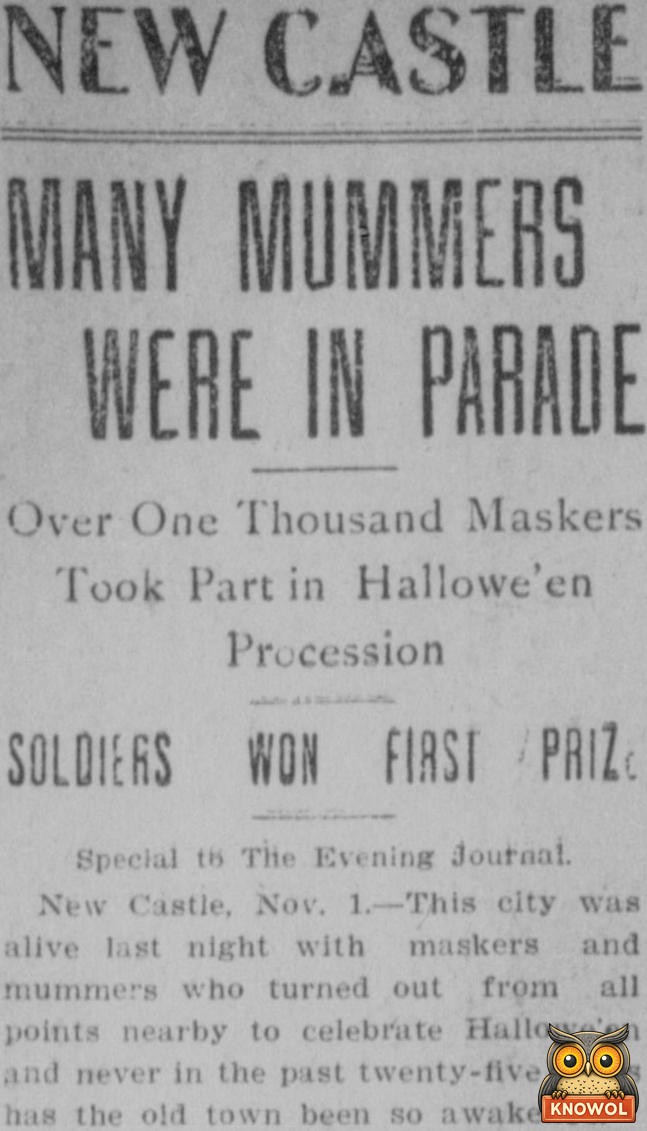
“Many Mummers Were in Parade,” The Evening Journal, Wilmington, Delaware, November 1, 1905, page 6. Library of Congress, Chronicling America. Click the clipping to read it full size.
Weeds like a little woods
The joke had been growing all summer. In August, Dr. William H. Kuntz, president of the town’s Board of Health, told the New Castle Trust Company to cut the weeds on its lot on Delaware Street near Third. The lot had been “a hot bed for all species of rank growth,” the Evening Journal said, and it “has attracted much attention from strangers who pass through New Castle on trolley cars.” The paper explained that germs of catarrh and hay fever were carried from places like that. Dr. Kuntz also decided that “the grass which has been growing during the summer in the city’s streets and about the tree boxes in front of the Court House building must come down.”
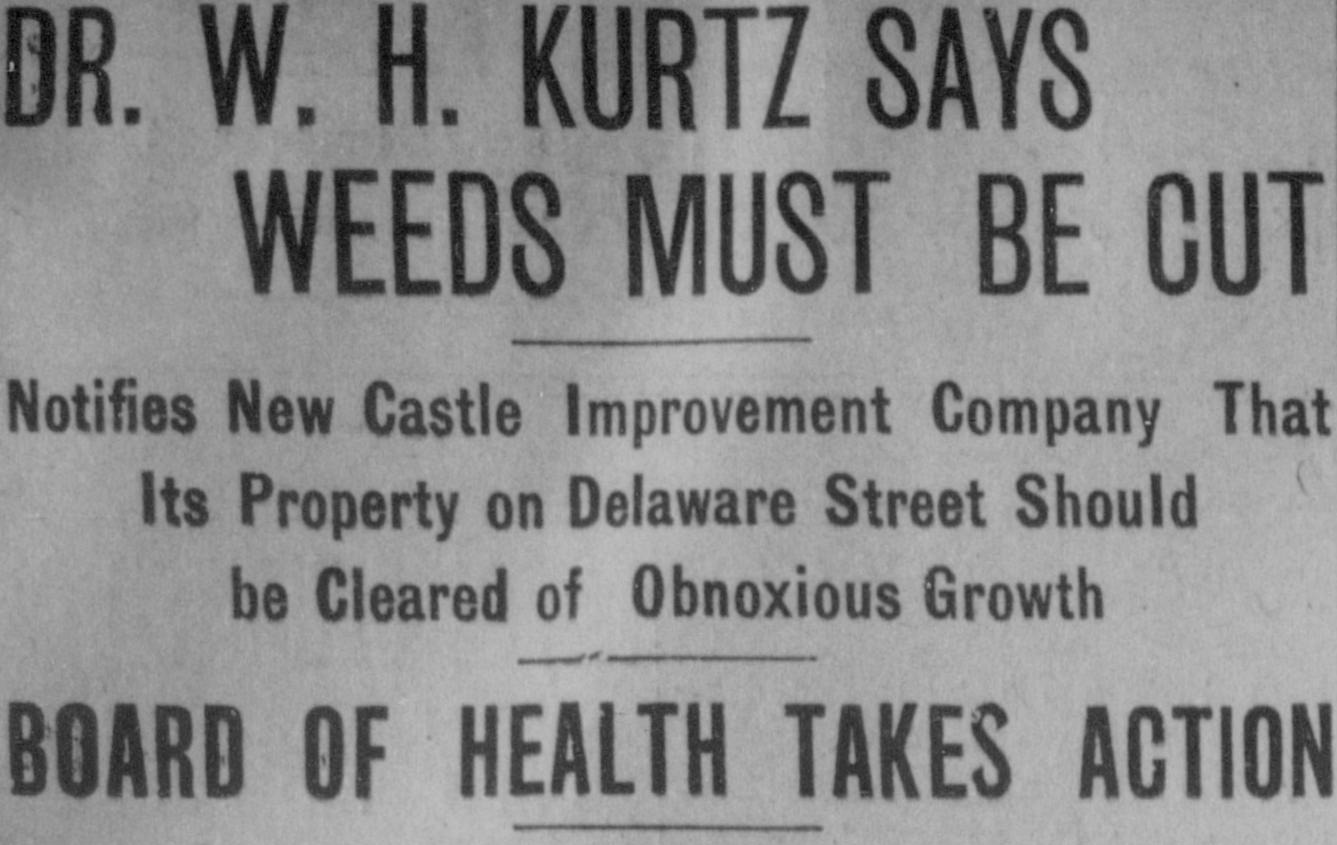
The Evening Journal, Wilmington, Delaware, August 24, 1905, page 2. The headline spells the doctor’s name Kurtz; the story calls him Dr. William H. Kuntz. Library of Congress, Chronicling America. Click the picture to see it full size.
Something doing
In late October a committee got the town ready. “Merchants are awakening to the fact that there will be ‘something doing’ in New Castle on Hallowe’en night,” the paper reported, and prizes from stores in New Castle and Wilmington went on show in the windows of John T. Stoops’ store. The Delaware Water Improvement Company promised arc lights and strings of electric bulbs over the route. C. P. Holcomb, superintendent of the trolley company, planned a searchlight at the foot of Delaware Street, “making that thoroughfare as light as day for several blocks.”
On October 28 the paper dropped a hint. Company H, New Castle’s company of the Delaware National Guard, would put forty men in line under Captain W. E. Myers, and they’d “represent a ‘much needed feature’ in the city.”
The white wings
The parade moved at 8.15. A division of 130 masked horsemen led the way behind the chief marshal, Captain Holcomb. Next came sixty regular soldiers of the Coast Artillery from Fort DuPont in full dress uniform, and their marching “brought forth unstinted applause.” Then came Company H, “the feature of the parade.”
The boys wore “white wing” costumes, the white suits of city street sweepers, and carried shovels, brooms and brushes. A detachment pushed lawn mowers and barrels set on wheels. They also carried transparencies, signs lit from behind, with the joke spelled out. “Our town mower all worn out from cutting grass on Delaware street,” said one. Another read, “Street cleaners needed. You mustn’t think New Castle is a farm with grass on its streets.” One offered a $100 reward for a “lost male child 18 years old, 5 1-4 feet tall, last seen at 9 a. m. Saturday in grass on Delaware street.” Others said “Grass seed for sale, see the grass” and “All grass on Delaware street dying.”
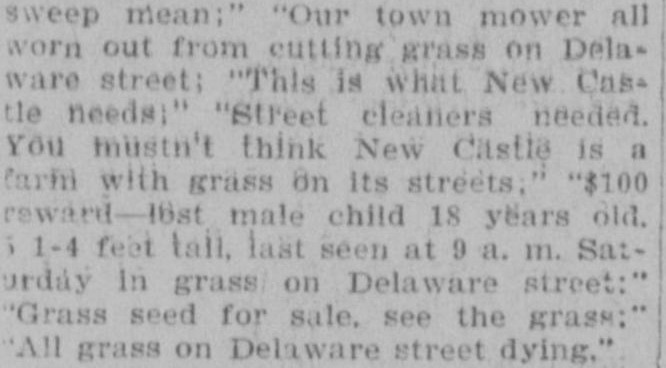
The grass signs, from “Many Mummers Were in Parade,” The Evening Journal, Wilmington, Delaware, November 1, 1905, page 6. Library of Congress, Chronicling America. Click the clipping to read it full size.
Then came the West End Reading Room Marching Club of Wilmington, floats, decorated rigs, individual marchers and two riders who came as “Death on a white horse.” Wilmington held a parade of its own that night, and a big crowd packed its Market Street from end to end.
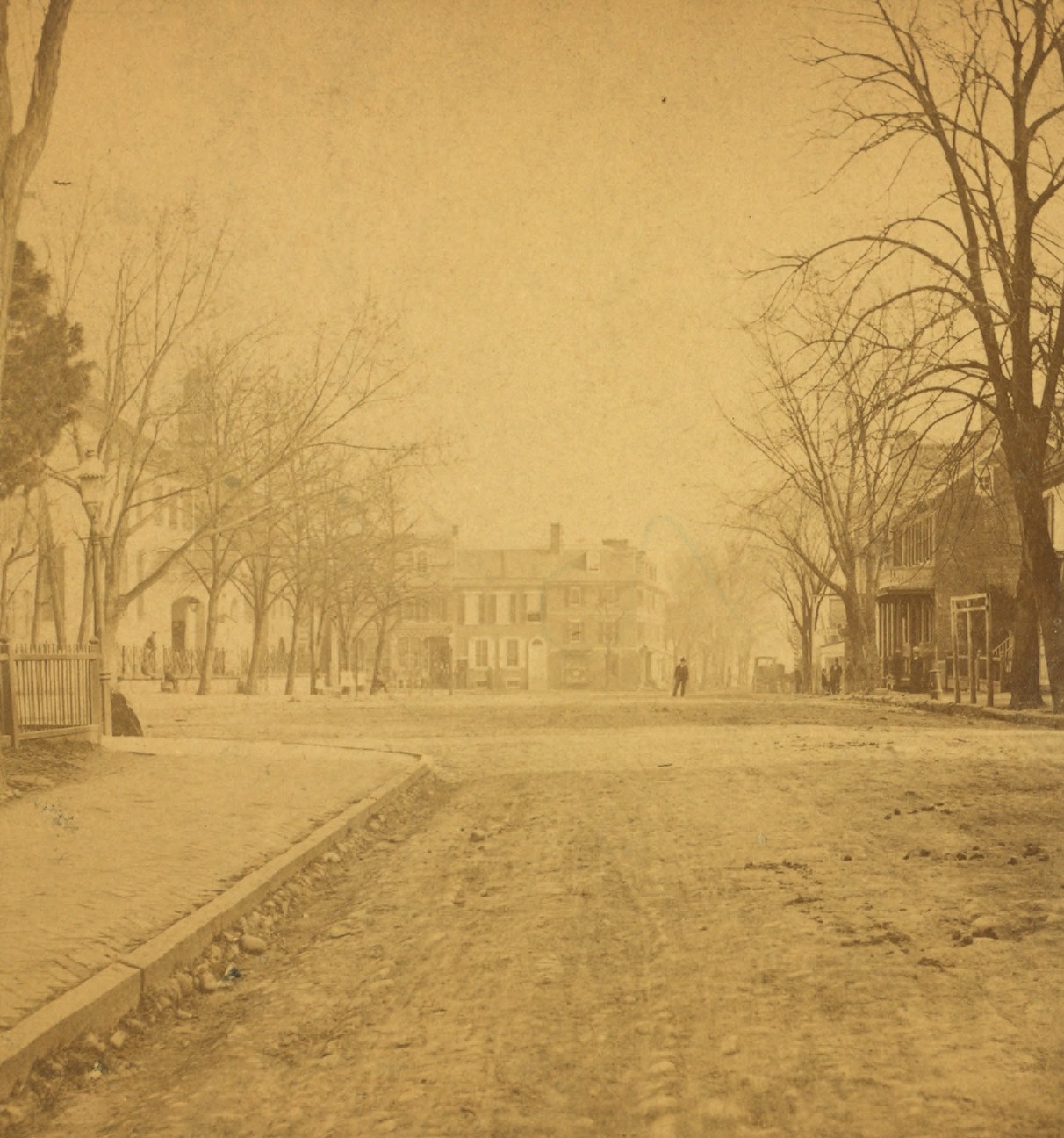
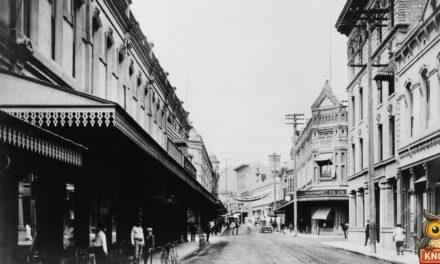
Delaware Street, New Castle, Delaware, from a stereograph card made about 1865 to 1880 (left half). Robert N. Dennis collection of stereoscopic views, New York Public Library, via Wikimedia Commons. Public domain. Click the picture to see it full size.
A ham for the homeliest man
The judges watched from the upper porch of the Gilpin House. When they picked a winner, a messenger boy ran a card to the mummer that said to collect the prize at the Opera House.
The best-lit house won a “barrel best flour” from Childs’ Grocery Company. One home on North Third Street had “200 tallow candles burning” in its parlor. The leanest man in line got a meal ticket, and the homeliest man got “a large ham.” The homeliest woman’s prize was a pair of ladies’ shoes. The committee had first thought of giving the shoes to the woman with the largest feet, but secretary Arthur M. Wise warned that the prize “would never be accepted and the offering of it would create trouble,” so they dropped the idea. The most ridiculously rigged vehicle “drawn by animal of any description (man excepted)” won a sweater.
The soldiers did well. The regulars from Fort DuPont won a parlor lamp as the best-equipped marching club from out of town, and the “White Wing” Brigade took an onyx parlor table for the local club with the most men in line.
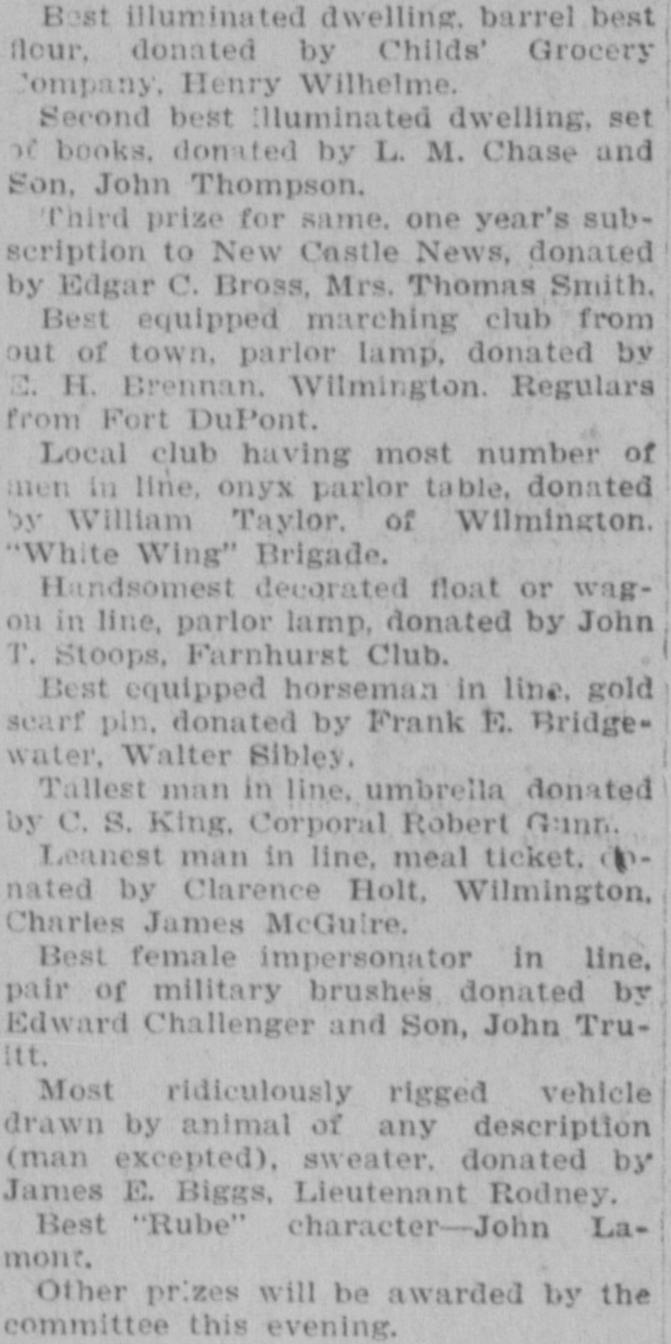
The prize list, The Evening Journal, Wilmington, Delaware, November 1, 1905, page 6. Library of Congress, Chronicling America. Click the clipping to read it full size.
Quiet again
The next night the streets were “practically deserted, everybody being tired out by the festivities of the night before.” As the paper put it, “New Castle has assumed its natural quietude after the ‘hilarity’ of Hallowe’en.” At Stoops’ store the committee handed out the last prizes. James B. Lancaster, Jr., took home the ham, and Company H’s white wings got cash for a second prize “in place of a chair.” The paper never said whether anyone cut the grass on Delaware Street. It did say, “Arrangements are already being made for a big carnival turn out next year.”
Sources
- The Evening Journal (Wilmington, Delaware), February 9, 1905, page 6 (“Inspection of National Guard,” Company H, New Castle), August 24, 1905, page 2 (“Dr. W. H. Kurtz Says Weeds Must Be Cut”), October 26, 1905, page 2 (parade plans, lights and prizes), October 28, 1905, page 2 (Company H’s “much needed feature”), October 30, 1905, page 2 (the prize list), November 1, 1905, page 6 (“Many Mummers Were in Parade” and “Many Candles Burning”), November 1, 1905, page 1 (Wilmington’s parade, “Mummers Had a Great Time”) and November 2, 1905, page 2 (“City Looks Deserted” and “More Prizes Awarded”).
- All newspaper images: Library of Congress, Chronicling America. Published 1905, public domain.
- Photograph: “Delaware St., New Castle, Del.,” stereograph, about 1865 to 1880, Robert N. Dennis collection of stereoscopic views, New York Public Library (digital ID G90F082_024ZF), Wikimedia Commons. Public domain.
- Cover: an illustration made for KNOWOL with AI (OpenAI GPT Image 2), not a historical photograph. The white suits, brooms, lawn mowers, barrels on wheels, lighted signs, electric lights and masked horsemen come from the 1905 Evening Journal reports; the faces and buildings are imagined.