On a Wednesday night in April 1869, a crowd stood around the tables at Foley’s billiard hall in Chicago, Illinois. In the middle of it, a slim Frenchman named A. P. Rudolphe was losing his temper. He was one of the best billiard players alive. He waved his pocketbook and “offered to wager any amount that he could beat any man in America.” Then something happened that he did not expect. “A dozen wallets being whipped out, he was forced to ‘shut up.'” Plenty of men were ready to bet against him. The Chicago Tribune told the whole town about it on Sunday, April 18, under a headline that did not pull its punches: “The ‘Mysterious’ Billiardist in a Bad Way.”
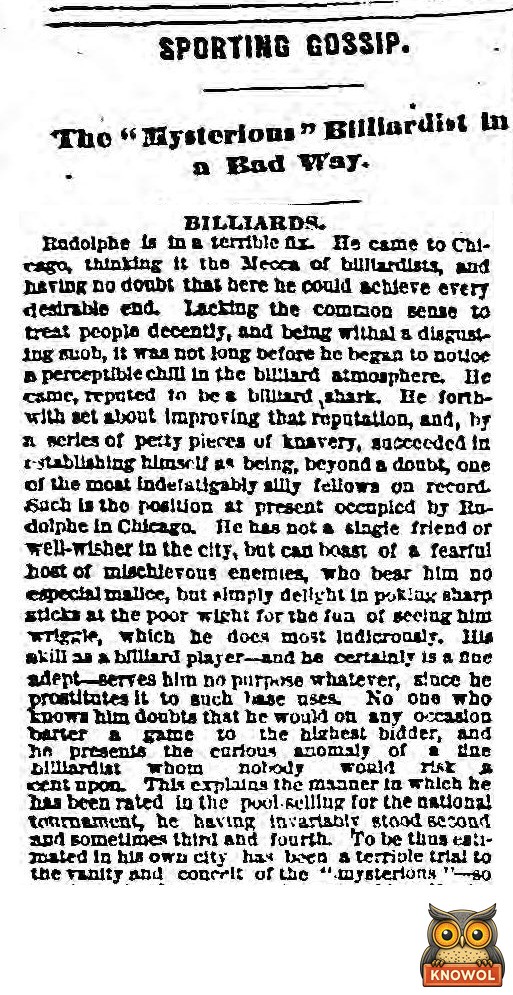
“The ‘Mysterious’ Billiardist in a Bad Way.” Chicago Tribune, Chicago, Illinois, April 18, 1869, page 3. Library of Congress, Chronicling America. Click the clipping to read it full size.
The boy who sneaked off to play
Five months earlier, Chicago had loved him. Rudolphe came to town in the fall of 1868, and the papers called him “the mysterious” Frenchman. The Tribune said he was slender and wiry, careful about his clothes, and “polite and punctilious in his manner.” Punctilious means careful about every little rule of good manners.
His story sounded like a storybook. He grew up in Lyons, France. At six years old he picked up a billiard cue for the first time, “having stolen away from home unknown to his father,” who did not want him near “the spherical ivories.” That was a fancy name for billiard balls, which were carved from elephant ivory back then. He kept sneaking off to play. When he grew up, he played for Louis Napoleon, the ruler of France, for the Sultan in Constantinople, and for the Russian Czar and his court in St. Petersburg.
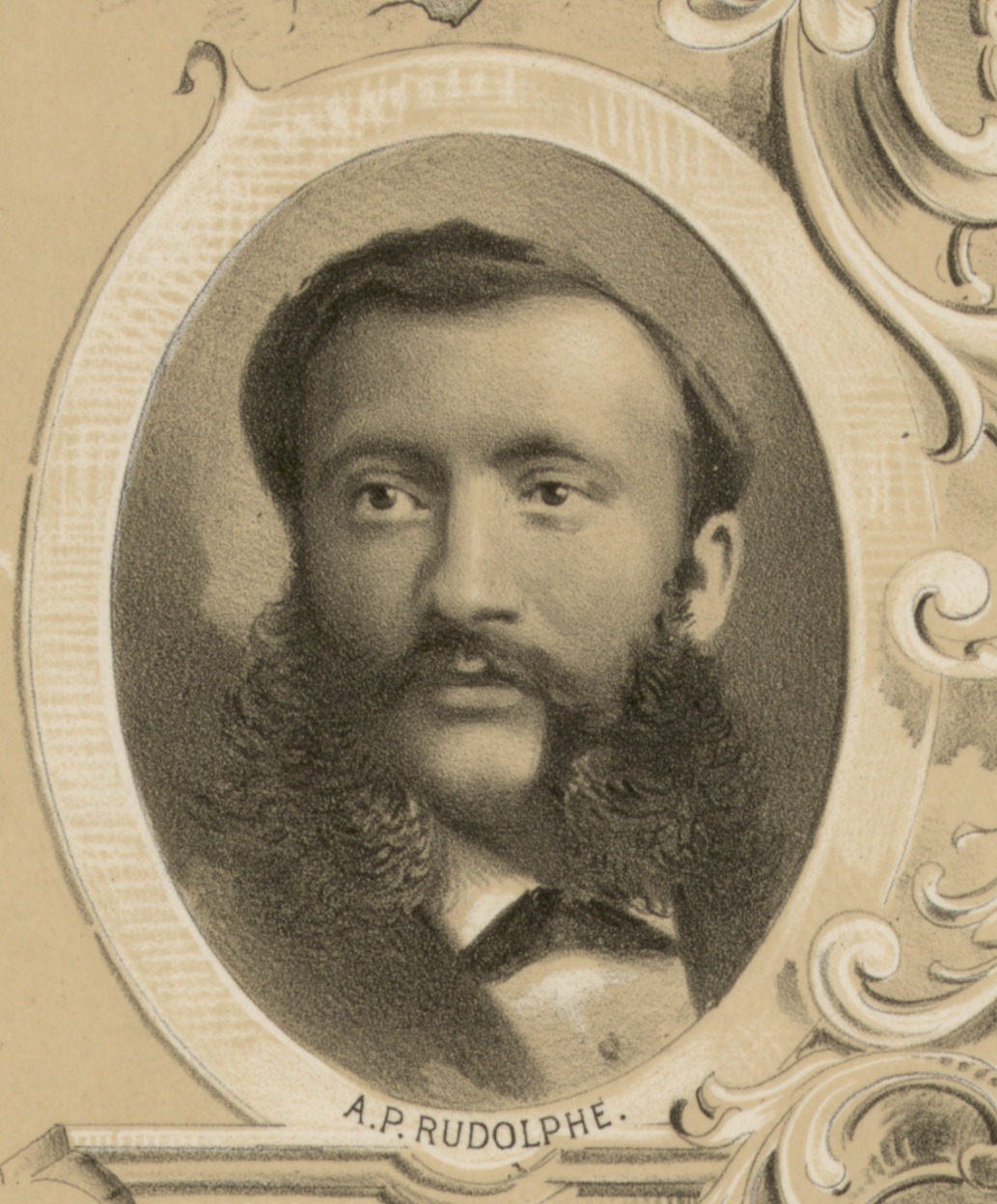
A. P. Rudolphe, from the print “The Billiard Monarchs,” published in 1875. Library of Congress Prints and Photographs, no known restrictions. Click the clipping to read it full size.
A trick with a cue on the floor
In Chicago, Rudolphe put on shows at Crosby’s Music Hall, and ladies and gentlemen came to watch. His best trick began with “laying a cue on the floor, with two balls at the tip.” Then he bounced a third ball on the table so that it jumped down to the floor, rolled along the cue like a little train on a track, and clicked into the two balls at the end. The Tribune said it brought “wonderment and hearty applause.”
Hitting one ball into the others like that is called a carom. Rudolphe’s main game, French caroms, used three balls on a table with no pockets. You scored a point each time your ball touched both of the other balls. The Tribune said his “astonishing feats are nearly all of his own invention.”
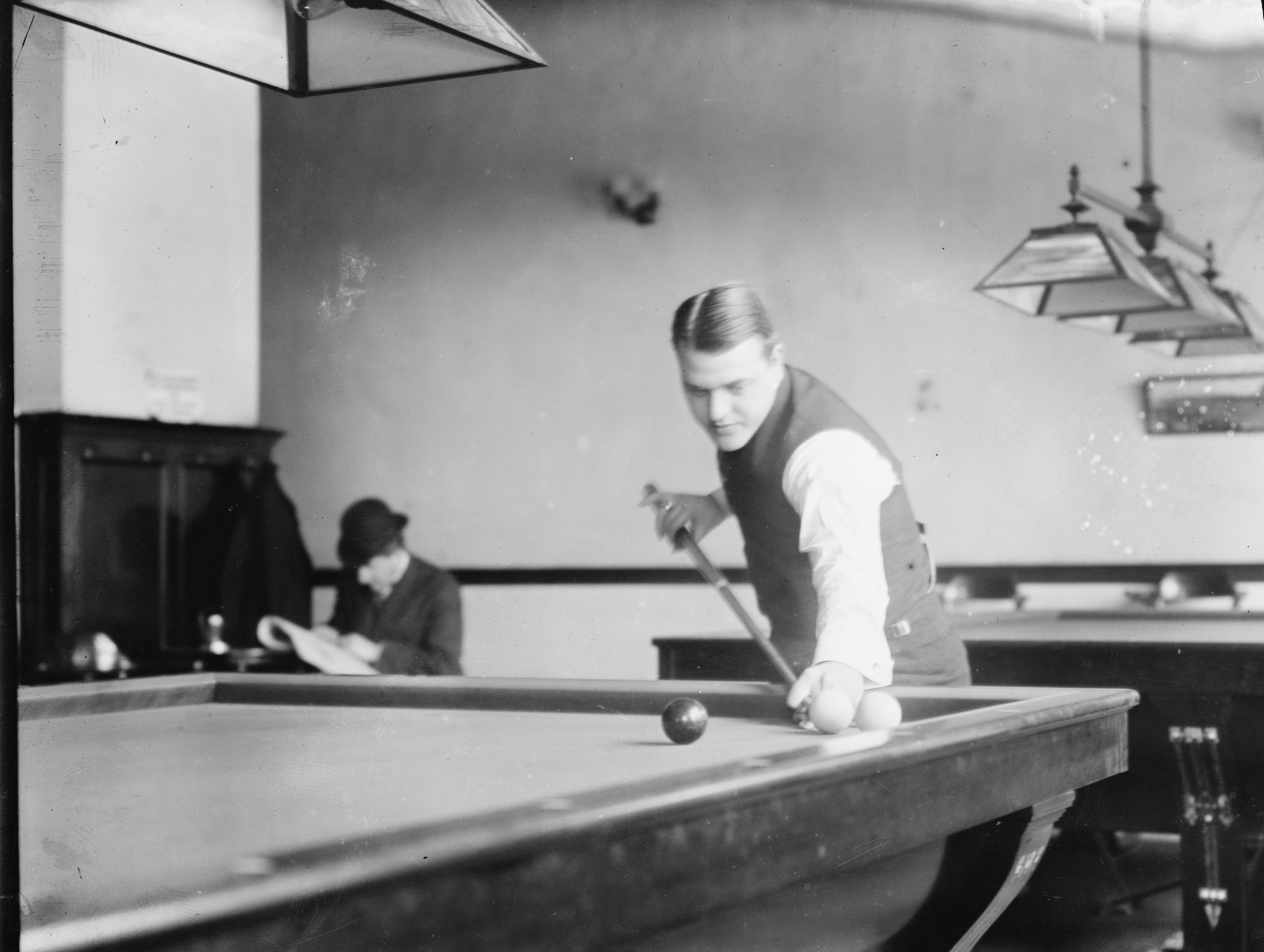
A later champion, Willie Hoppe, lines up a shot in a game with three balls, 1910. Bain News Service, Library of Congress Prints and Photographs, no known restrictions. Click the picture to see it full size.
On November 18, 1868, Rudolphe played Chicago’s own star, Professor Pierre Carme, at Library Hall. Each man put up $1,000, and the first to 500 points won it all. The headline the next morning: “Rudolphe the Winner by 105 Points.”
How a town turns cold
By spring, the shine was gone. The Tribune said Rudolphe was “lacking the common sense to treat people decently.” It said, “He has not a single friend or well-wisher in the city.” Worst of all, people believed he would lose a game on purpose if someone paid him enough. The paper called him “a fine billiardist whom nobody would risk a cent upon.”
That is a hard thing to be. He was great at the game, but nobody trusted him.
Chicago showed it with money. A big national tournament was coming in New York, and at Foley’s, men bid on which player would win. The four favorites were each sold alone. Cyrille Dion, the top choice, went for $40. Rudolphe was not one of the four. He was lumped in with three other players as “the field,” and all four of them together went for just $16. The Tribune could not resist a joke: “fancy his feelings at being assigned to the field!”
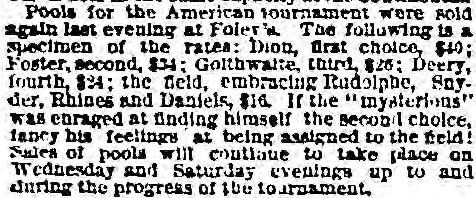
The tournament pools at Foley’s, with Rudolphe lumped into “the field.” Chicago Tribune, Chicago, Illinois, April 18, 1869, page 3. Library of Congress, Chronicling America. Click the clipping to read it full size.
Off to New York
The tournament opened at Irving Hall in New York City in late April 1869. The prize was a diamond-tipped champion’s cue. Rudolphe gave the crowds a show before the games, “dispensing with the cue, and relying wholly upon his fingers.” The New York Times, reprinted in the Tribune, said he moved the balls “seemingly by a mere snap of the fingers” and was “a perfect master of trick shots.”
Not everyone in the seats was a fan. In one game against a New York player named Foster, “some dozen persons” shouted bets and “jeering remarks just as Rudolphe would commence to make a shot.” He got so rattled that he kept putting his cue up and “putting on his coat on two or three occasions.” Finally he quit, and Foster won.
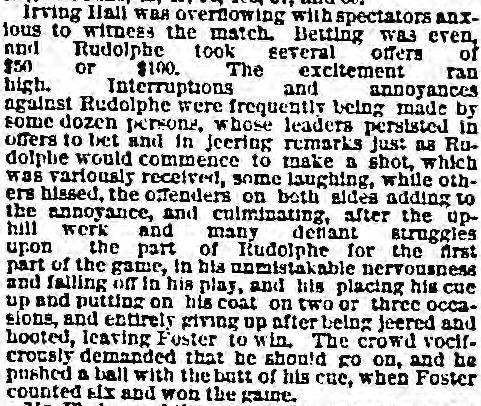
The hecklers at Irving Hall. Chicago Tribune, Chicago, Illinois, May 6, 1869, page 4. Library of Congress, Chronicling America. Click the clipping to read it full size.
The comeback
The champion’s cue went to a player named Deery. But three men were still tied in the race for second prize: Rudolphe, Foster, and Snyder of Chicago. On Saturday, May 8, 1869, Rudolphe beat Snyder in the afternoon. That night he faced Foster again.
This time he did not quit. He needed 16 points to win, and he gathered the balls together and made them, “defeating Foster by 109 points, amid tremendous cheers.” The New York Herald’s report, reprinted in Washington’s Daily National Intelligencer, gave the result: “Rudolphe is consequently entitled to the second prize in the tournament, Deery having won the cue.”
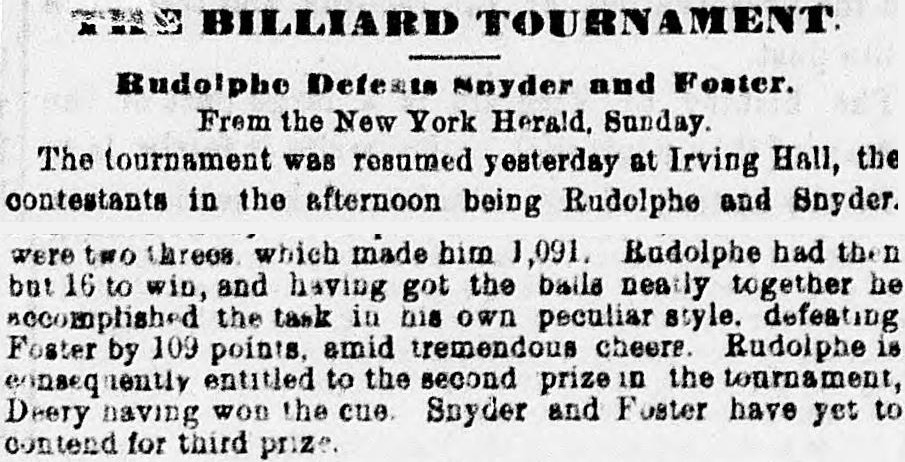
“Rudolphe Defeats Snyder and Foster.” Daily National Intelligencer, Washington, D.C., May 11, 1869, page 1. Library of Congress, Chronicling America. Click the clipping to read it full size.
Second in America
Rudolphe never did bring the champion’s cue home to Chicago, as he had bragged. But the man Chicago sold off with “the field” for $16 finished second in the whole country. His skill had never been the problem. The cheers in New York were for the player. Winning back the trust of a town was a harder shot.
Chicago never lost its love for the game. In May 1906, an all-star tournament filled the seats of Orchestra Hall with fans watching every shot.
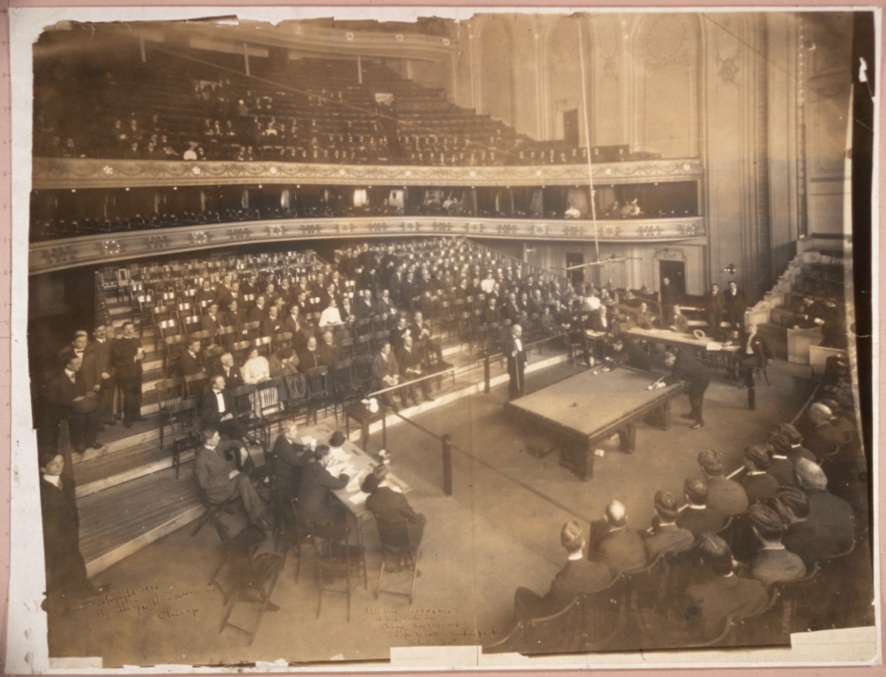
“All Star Tournament, 18 Inch Balke Line, Chicago, May 7-14, 1906, Schaefer and Sutton banking for lead, Orchestra Hall.” Geo. R. Lawrence Co., Library of Congress Prints and Photographs, no known restrictions. Click the picture to see it full size.
About the pictures
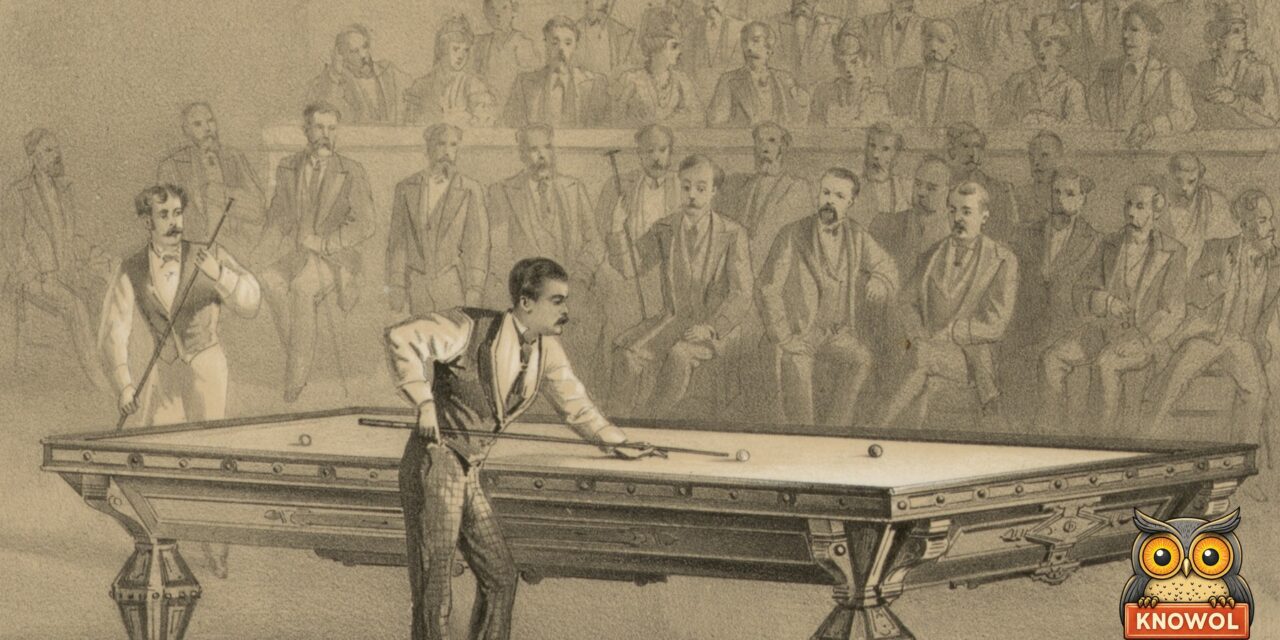
The cover is a drawing from the same 1875 print as Rudolphe’s portrait, “The Billiard Monarchs.” It shows a game at the national billiard tournament in New York in November 1874, between Albert Garnier and Maurice Vignaux, with a hall full of fans watching. Rudolphe was one of the players in that 1874 tournament, but he is not the man at the table. No photo of the 1869 games has turned up.
Sources
- Chicago Tribune (Chicago, Illinois): April 18, 1869, page 3 (“Sporting Gossip”); November 7, 1868, page 4 (the cue-on-the-floor trick); November 8, 1868, page 4 (Rudolphe’s life story); November 19, 1868, page 4 (the Carme match); May 5, 1869, page 3 (from the New York Times); May 6, 1869, page 4 (the hecklers); May 9, 1869, page 3 (the race for second prize).
- Daily National Intelligencer (Washington, D.C.): May 11, 1869, page 1 (“The Billiard Tournament,” from the New York Herald).
- All newspaper images: Library of Congress, Chronicling America. Published 1868 and 1869.
- Cover and portrait: “The billiard monarchs, contestants in the grand national billiard tournament of 1874, for the championship of America,” 1875, Library of Congress, no known restrictions.
- Photos: Willie Hoppe, 1910, Bain News Service, Library of Congress; Orchestra Hall tournament, 1906, Geo. R. Lawrence Co., Library of Congress. No known restrictions on publication.