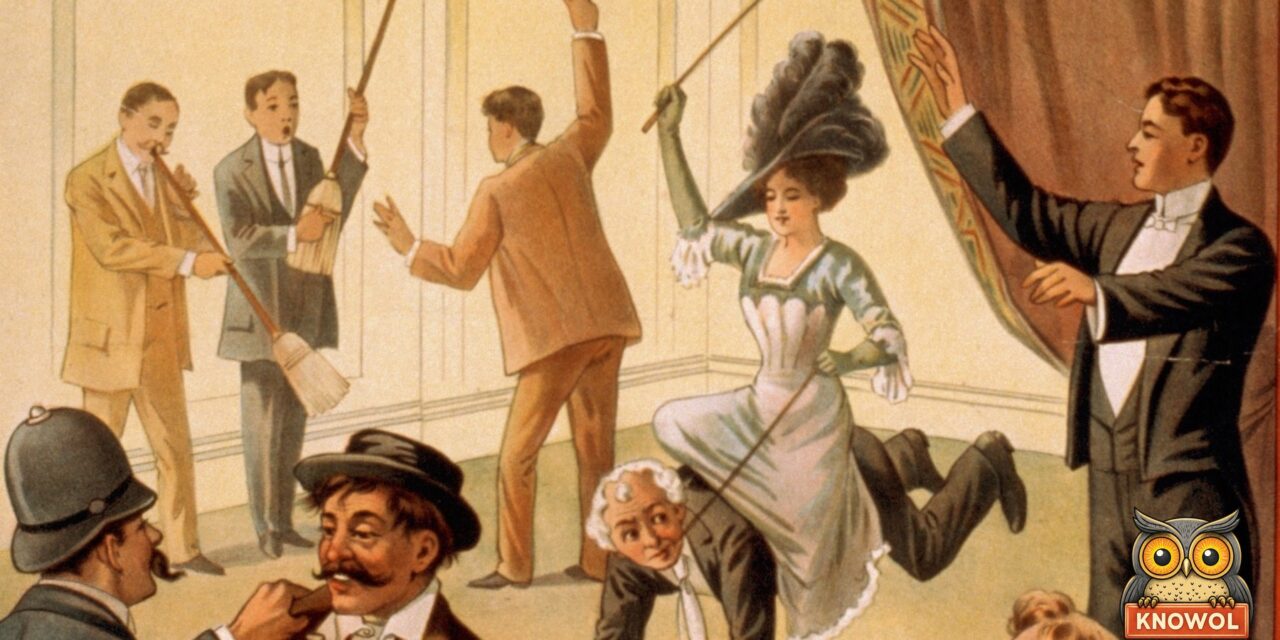
On a spring night in 1871, a showman called Professor Stone stood on the stage of Hancock Hall in Ellsworth, Maine, and asked for volunteers. A few people climbed up from the seats. Then, the local paper said, they did whatever he told them. Their arms went stiff as boards. A sip of plain water tasted hot or cold, sweet or bitter, just as he said it would. The editor of the Ellsworth American went to the show “two or three times,” and he still could not explain it. “His skill is wonderful,” he wrote on May 4, “and the science is a mystery to all.”
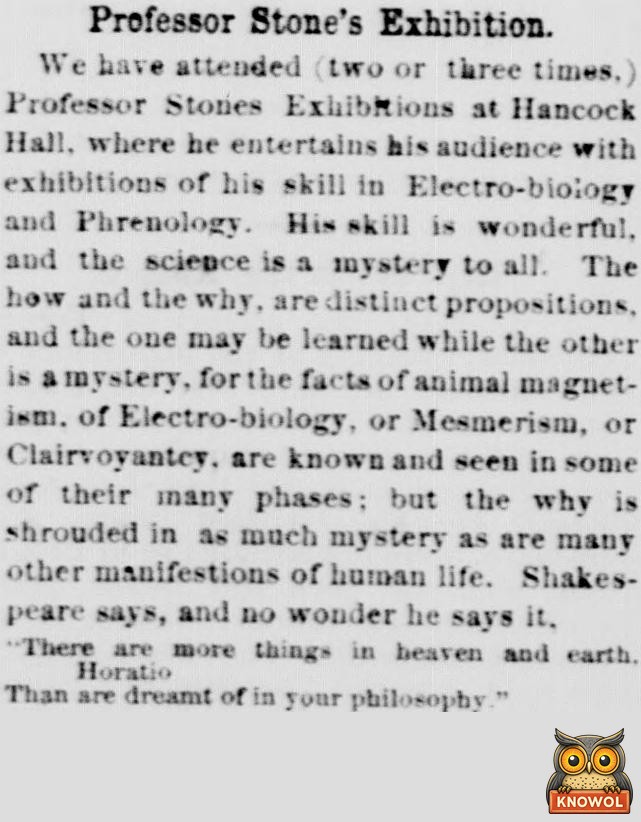
“Professor Stone’s Exhibition.” Ellsworth American, Ellsworth, Maine, May 4, 1871, page 2. Library of Congress, Chronicling America. Click the clipping to read it full size.
Volunteers from the seats
Professor Stone was a traveling showman. His ads called his act “Electro-Biology and Phrenology.” Electro-biology was an old name for what we now call stage hypnosis. Phrenology was the idea that you could read a person’s mind and talents from the bumps on their head.
He had been touring Maine all winter. In January 1871, the Daily Kennebec Journal in Augusta said he had spent “several weeks” entertaining the people of Bangor. His ad bragged about “a season of FORTY NIGHTS in the city of Bangor.” The Journal told readers what to expect: “It seems that he can take young men on the stage, whom he has never before seen, and place them completely under his control.” It went on: “The subjects will sing, dance, play various imaginary instruments, and perform many other diverting feats, all in spite of themselves.” So picture a young man strumming a guitar that isn’t there while the whole hall laughs.
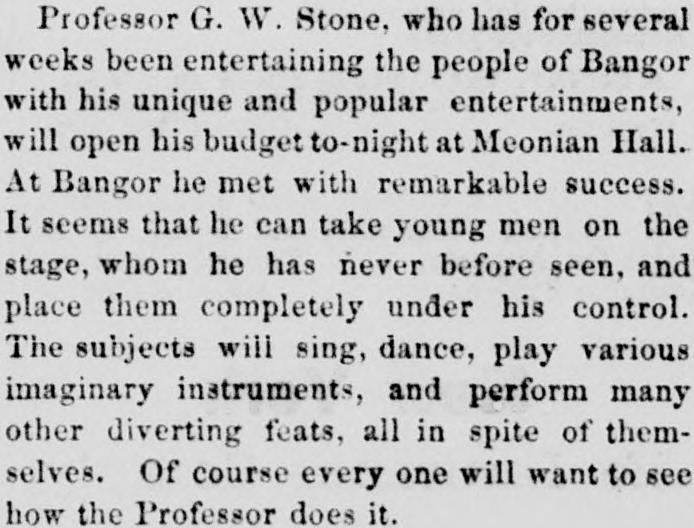
Professor G. W. Stone comes to Augusta after his weeks in Bangor. Daily Kennebec Journal, Augusta, Maine, January 24, 1871, page 3. Library of Congress, Chronicling America. Click the clipping to read it full size.
The Augusta ads named him Prof. G. W. Stone and promised experiments on “Persons in a Perfectly Wakeful State.” That spring, the Ellsworth ads promised shows “upon persons in a perfectly wakeful state,” the very same words. It was almost surely the same man.
Shows like his were common in New England. Fourteen years later, a poster in Attleboro, Massachusetts, promised “the most amusing, instructive and laughable entertainment ever witnessed,” with adults let in for 20 cents.
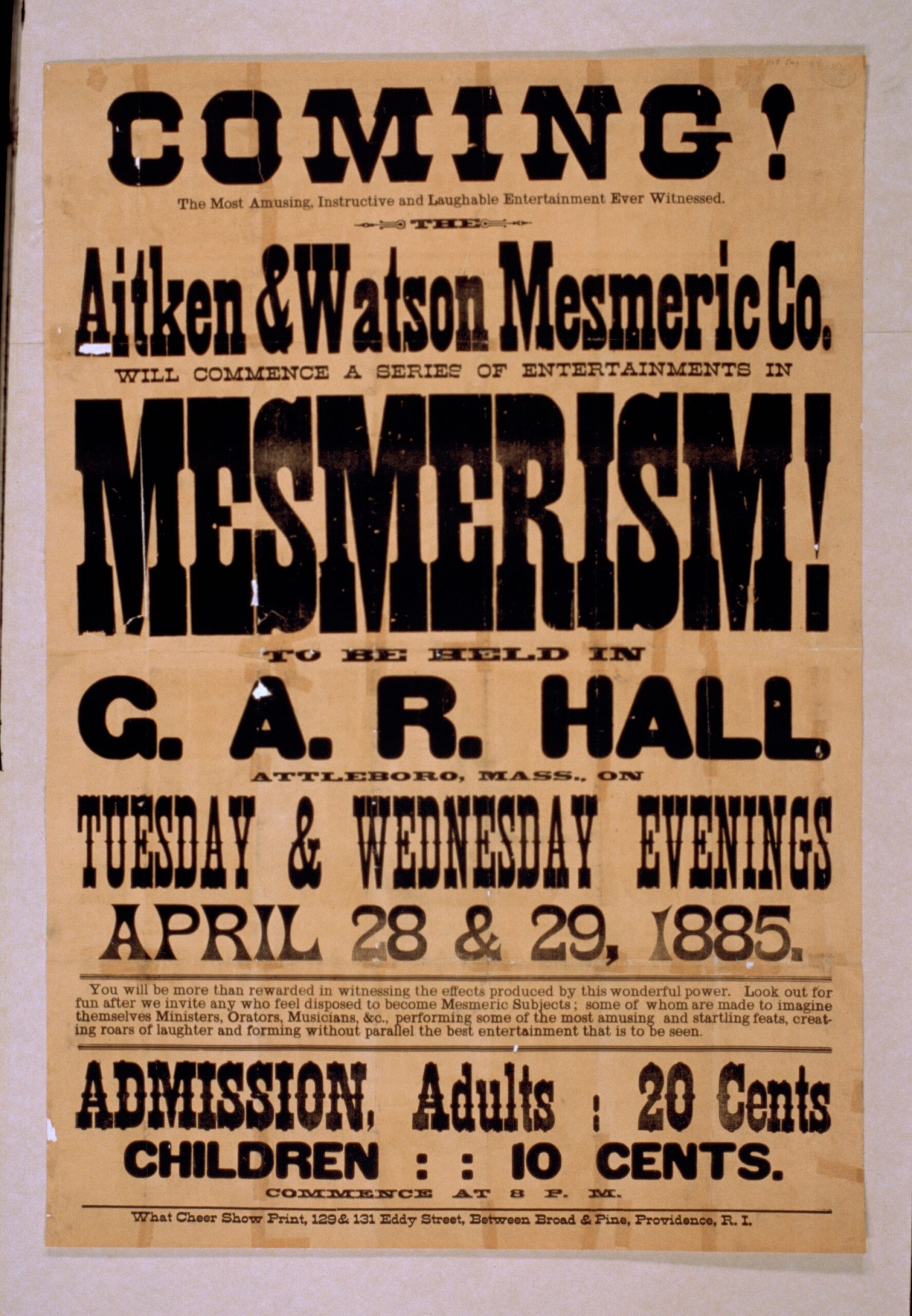
“Coming! Aitken & Watson Mesmeric Co.” A poster for a mesmerism show in G.A.R. Hall, Attleboro, Massachusetts, April 28 and 29, 1885. What Cheer Show Print, Providence. Library of Congress Prints and Photographs, no known restrictions. Click the picture to see it full size.
Water that tasted bitter or sweet
In Ellsworth, the editor wrote down what he saw. “Professor Stone can make the limbs of his subject become rigid, or endowed with unnatural strength; and water to his taste will become hot or cold, bitter or sweet, as he may will.” Rigid means stiff. “As he may will” means however the professor wanted.
The editor believed what he saw. “There can be no doubt of these facts,” he wrote, “but why such facts?” He knew some people faked it. “Now and then a person may attempt to palm himself off as being under this strange influence,” he said. To palm yourself off means to pretend. But he was sure that while one faker was “playing his pranks,” half a dozen others were really under the professor’s control.
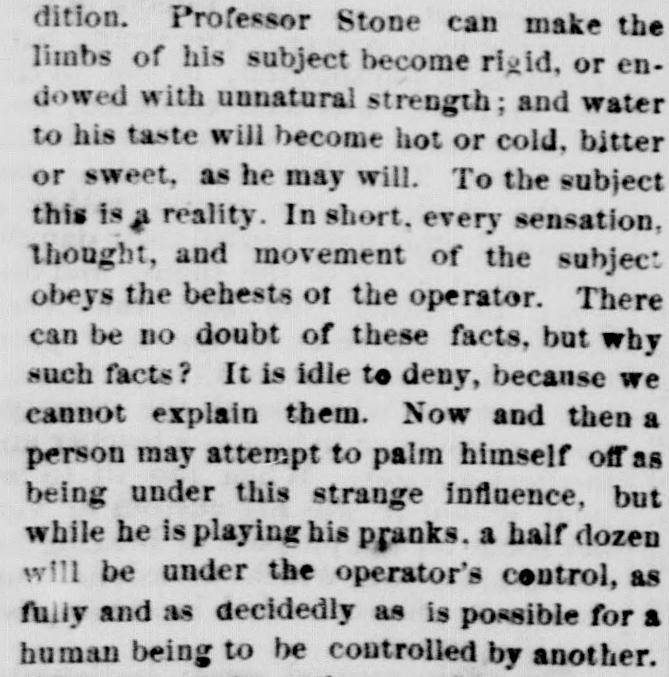
What the Ellsworth editor saw at Hancock Hall. Ellsworth American, Ellsworth, Maine, May 4, 1871, page 2. Library of Congress, Chronicling America. Click the clipping to read it full size.
What Ben Franklin found
The editor did some homework, too. He wrote that the whole idea began with a man “of the name of Mesmer.” That is where our word “mesmerize” comes from. Franz Anton Mesmer was a doctor who said an invisible force, a kind of magnetism, flowed through people and could heal them.
The King of France asked a team of experts to test Mesmer’s claims. One of them was the American Benjamin Franklin, who knew as much about electricity as anyone alive. The Ellsworth paper printed the year as 1785, but the team did its work in 1784. Its answer was that the effects were “produced purely by the imagination.” The Ellsworth editor wasn’t so sure. “This conclusion may not be accurate,” he wrote.
People still argue about stage hypnosis today. How much is real, and how much is play-acting? It is the same question the Ellsworth editor kept asking in his seat at Hancock Hall.
A gold watch, a bedroom set and $40 in gold
There was a second reason people packed the hall. Professor Stone gave away prizes. His ad for Thursday, April 27, 1871, promised a “Fine Gold Hunt’g Case Watch,” and said it “with at least 50 other splendid presents will be GIVEN AWAY to the audience.” A hunting-case watch had a metal lid that snapped shut to protect the glass.
The next night’s big prize was “A MAGNIFICENT CHAMBER-SET OF FURNITURE.” A chamber set was the furniture for a whole bedroom. The night after that, it was “$40.00 in Gold!”
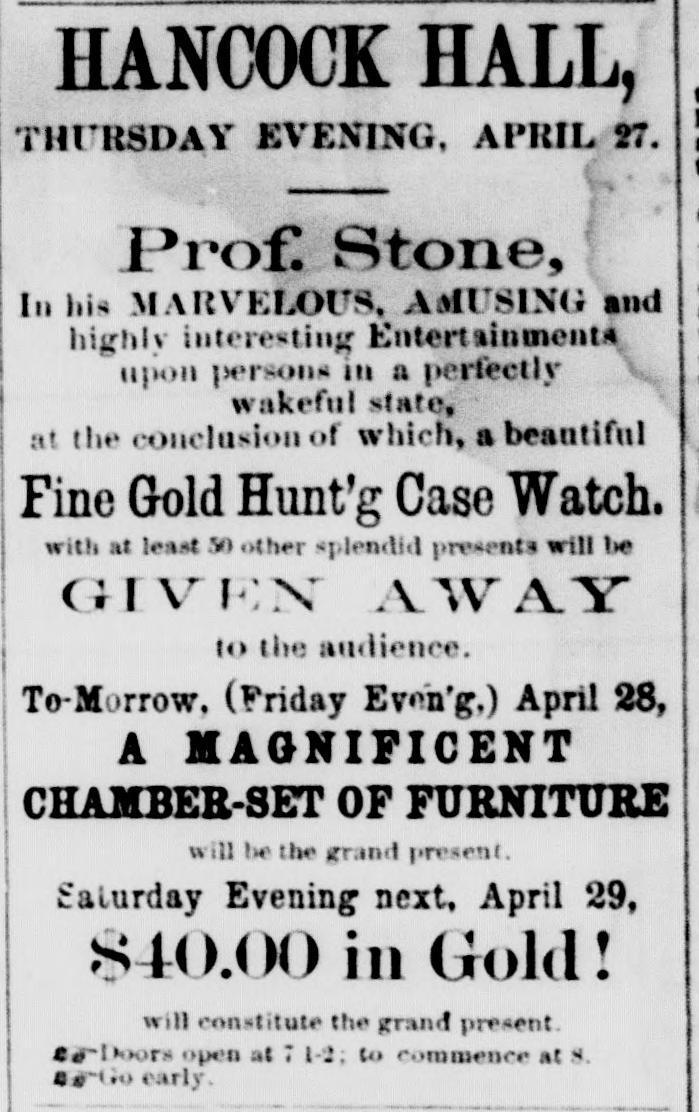
Professor Stone’s ad for April 27 to 29, 1871. Ellsworth American, Ellsworth, Maine, April 27, 1871, page 2. Library of Congress, Chronicling America. Click the clipping to read it full size.
The shows did so well that a week later, a new ad said “Four Nights More.” It offered a purse full of greenbacks (paper money, printed green on the back), “A FINE GOLD WATCH,” a silver watch and another chamber set. Each ticket was an envelope: the ad says “ADMISSION, (1 envelope,)”. The ads don’t say how the winners were picked. Over in Augusta that winter, a plain seat had cost 25 cents.
The prizes puzzled the editor almost as much as the hypnotism. “The Professor distributes his presents with a liberal hand,” he wrote, “and we have wondered how he can afford it.”
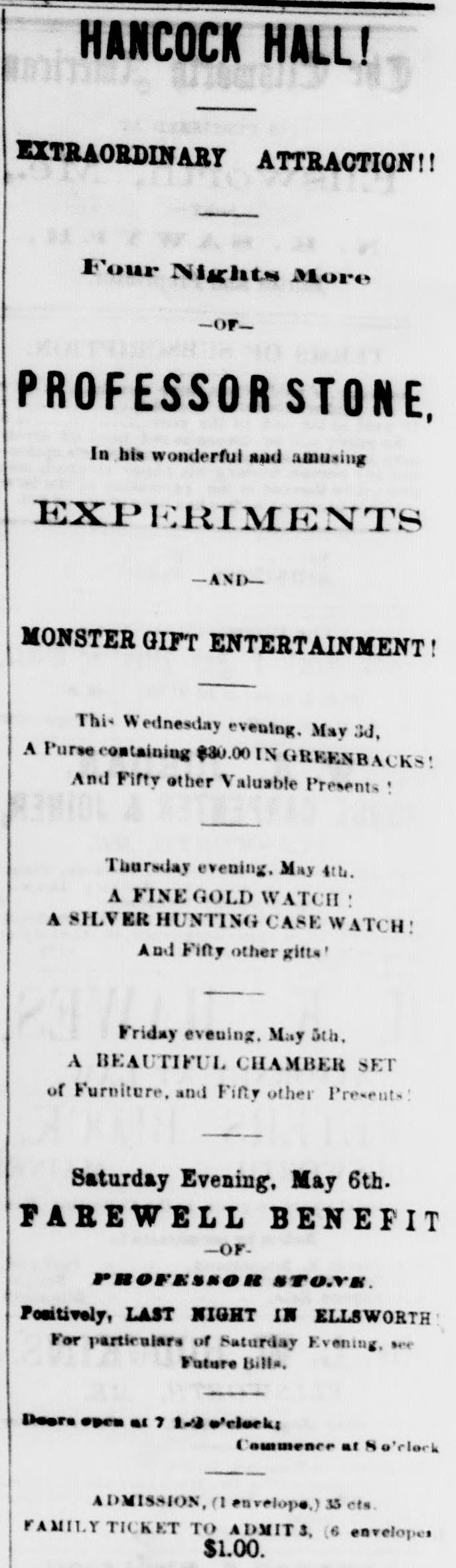
“Monster Gift Entertainment!” Ellsworth American, Ellsworth, Maine, May 4, 1871, page 2. Library of Congress, Chronicling America. Click the clipping to read it full size.
A thousand people on the last night
Saturday, May 6, 1871, was the professor’s “FAREWELL BENEFIT,” and the ad said “Positively, LAST NIGHT IN ELLSWORTH.” A benefit was a show where the money went to the performer.
The next week’s paper told how it went: “Prof. Stone ought to be satisfied with his last night here considering that his audience numbered a thousand or more and that many were unable to get in.” In 1870, Ellsworth had 5,257 people. A thousand in one hall was like one out of every five people in town.
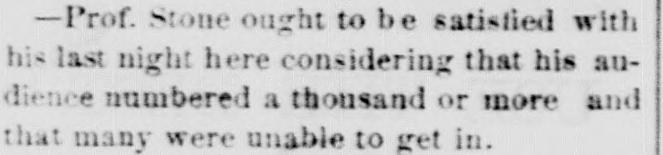
Ellsworth American, Ellsworth, Maine, May 11, 1871, page 3. Library of Congress, Chronicling America. Click the clipping to read it full size.
The how and the why
Professor Stone said he could teach anyone his “modus operandi,” a Latin phrase for the way a thing is done. But, the editor wrote, “the ‘why’ of it he does not profess to elucidate.” In plain words, he could show you how, but he couldn’t tell you why it worked.
So the editor reached for Shakespeare. In the middle of his story, he printed what Hamlet tells his friend Horatio: “There are more things in heaven and earth” than “are dreamt of in your philosophy.” That was his best answer after two or three nights in the seats. The papers never said who went home with the gold watch, and the professor never claimed to know the why.
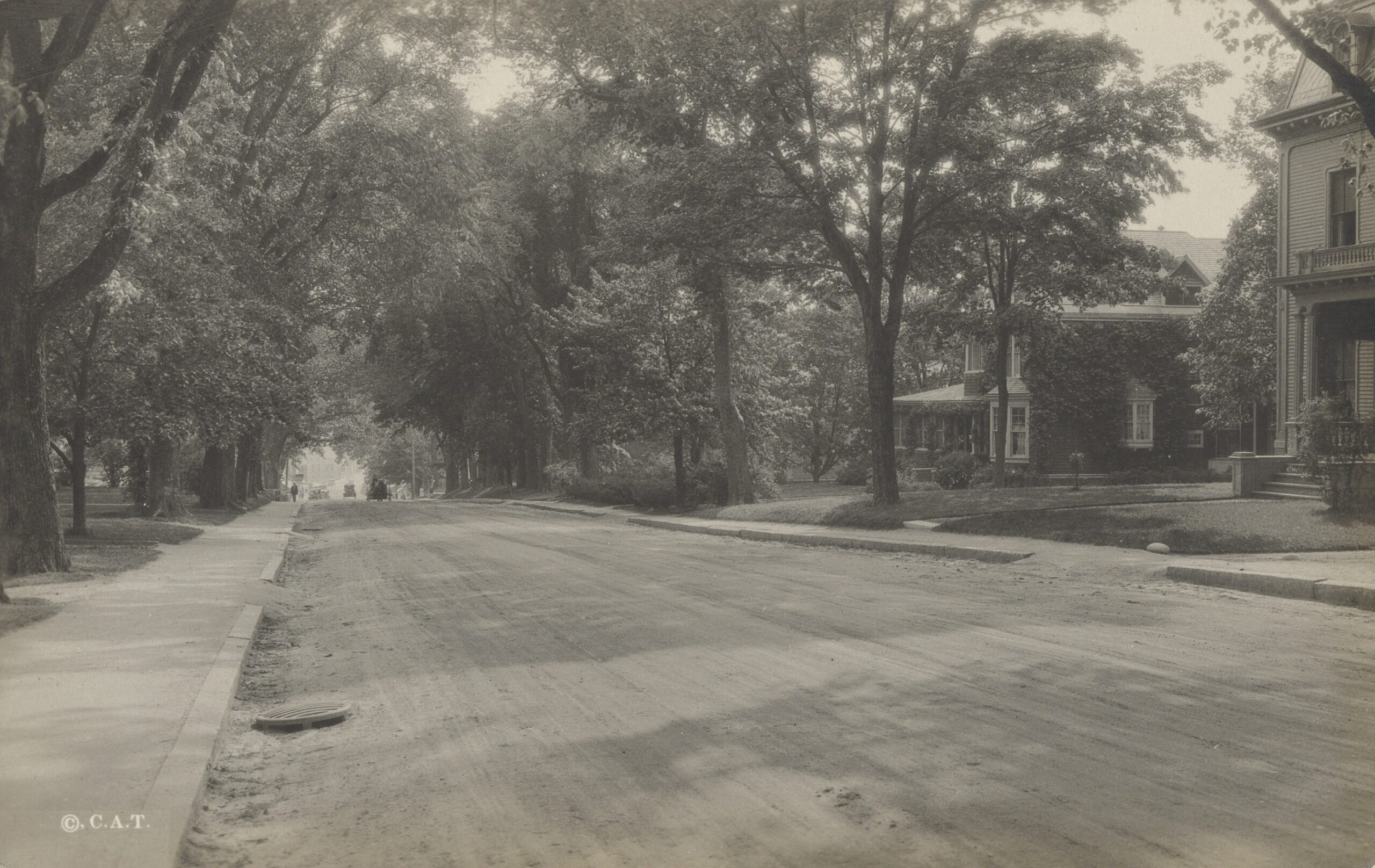
“Looking down Main Street, Ellsworth, Maine,” 1922, about fifty years after Professor Stone’s visit. C. A. Townsend photo postcard, Library of Congress Prints and Photographs. Published 1922. Click the picture to see it full size.
About the pictures
The cover is part of a colored poster printed around 1900 by the Donaldson Litho. Co. of Newport, Kentucky, for a stage hypnotist’s show. Volunteers play brooms like musical instruments while a woman rides a man like a horse. It does not show Professor Stone or Ellsworth. No picture of his 1871 shows has turned up.
Sources
- Ellsworth American (Ellsworth, Maine): May 4, 1871, page 2 (“Professor Stone’s Exhibition” and the “Monster Gift Entertainment” ad); April 27, 1871, page 2 (the gold watch ad); May 11, 1871, page 3 (the last night).
- Daily Kennebec Journal (Augusta, Maine): January 24, 1871, page 3; January 26, 1871, page 3 (news item and ad).
- Ellsworth’s 1870 population: Leading Business Men of Bangor, Rockland and Vicinity (1888), Internet Archive.
- The 1784 Franklin commission: The Two-Hundredth Anniversary of the Birth of Benjamin Franklin (1906), Internet Archive.
- All newspaper images: Library of Congress, Chronicling America. Published 1871.
- Cover: hypnotist poster, Donaldson Litho. Co., about 1900, Library of Congress, no known restrictions on publication.
- Mesmerism poster, Attleboro, 1885: Library of Congress, no known restrictions on publication.
- Main Street photo, C. A. Townsend, 1922: Library of Congress, published 1922.