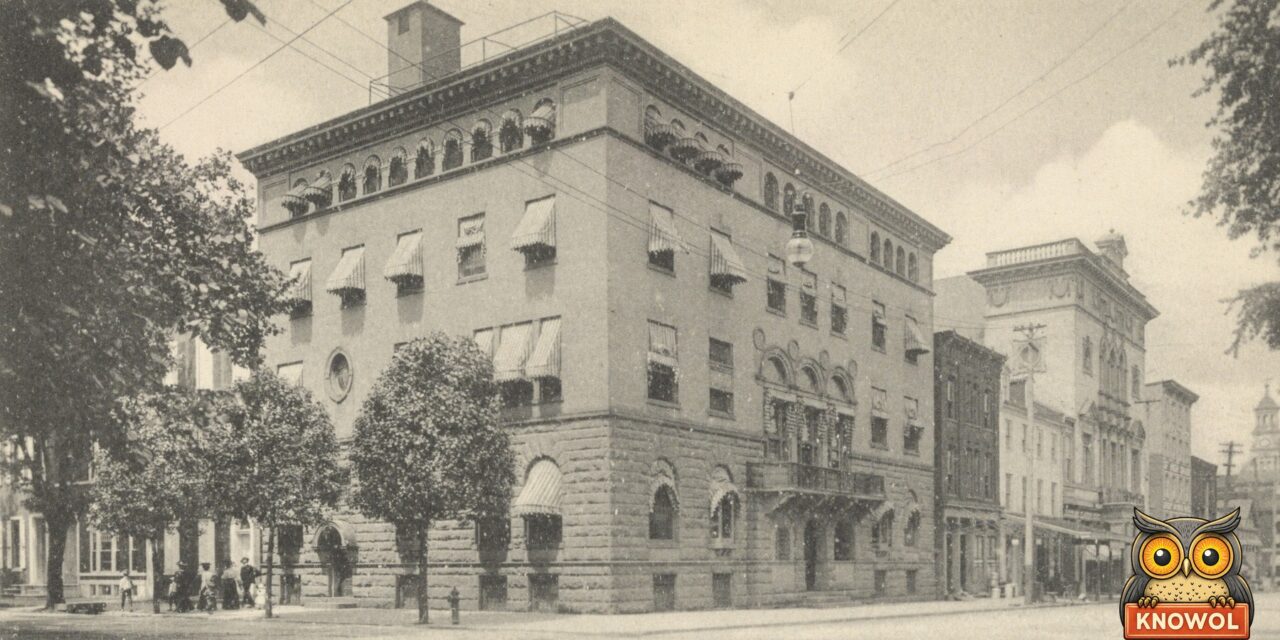
On Tuesday evening, March 7, 1916, about seventy lawyers in Harrisburg, Pennsylvania, pushed back from a big dinner. The plates were cleared. The men were ready to relax. Then the lights went out, and a picture of a little boy filled the wall. “Cigar and coffee time had about arrived when the hall was darkened, a stereopticon buzzed somewhere from above, and on the great screen at the end of the big banquet hall flashed the picture of a very wise, very intense youth of nine years or thereabouts,” the Harrisburg Telegraph reported the next day.
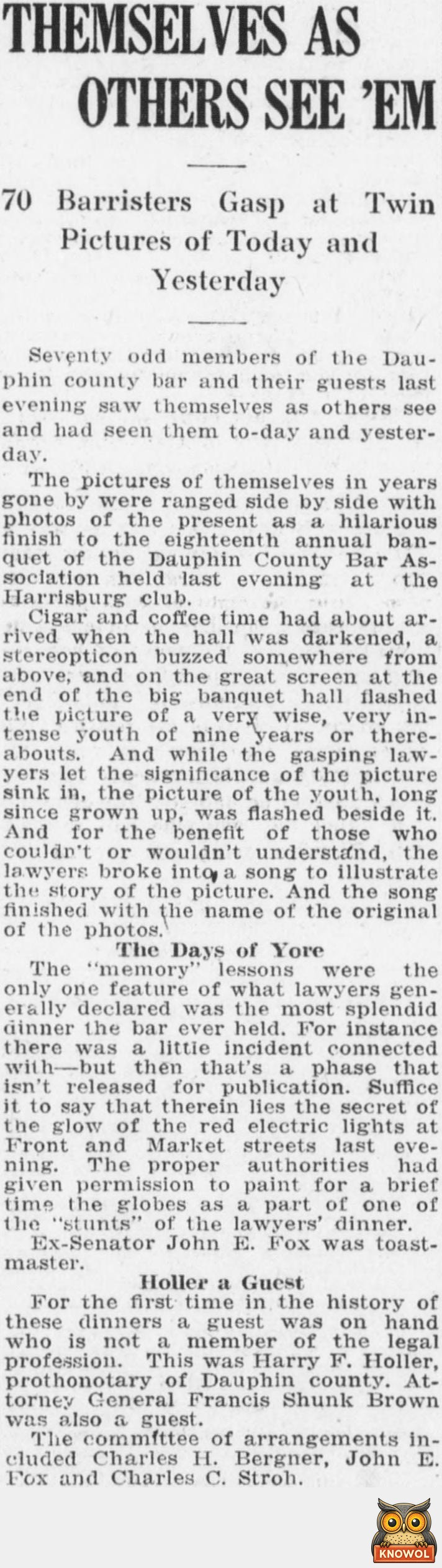
“Themselves as Others See ‘Em: 70 Barristers Gasp at Twin Pictures of Today and Yesterday.” Harrisburg Telegraph, Harrisburg, Pennsylvania, March 8, 1916, page 13. Library of Congress, Chronicling America. Click the clipping to read it full size.
Nobody said the boy’s name. The lawyers stared at him, and he stared right back, as serious as a judge. Then a second picture flashed up next to the first one. It was “the picture of the youth, long since grown up.” The nine-year-old was one of the grown men in the room.
Old pictures on a big screen
The dinner was the “eighteenth annual banquet of the Dauphin County Bar Association.” The “bar” is a name for all the lawyers in a place. This was the club for lawyers in Dauphin County, the county around Harrisburg, Pennsylvania’s capital. They ate at the Harrisburg Club, a big clubhouse downtown. The picture at the top of this story shows that clubhouse on a postcard from 1905.
The show that night was all about the lawyers themselves. “The pictures of themselves in years gone by were ranged side by side with photos of the present.” In plain words, each man’s old picture went up beside a new one, then and now, side by side.
A stereopticon was a kind of slide projector. A bright lamp shone through a photograph printed on a small plate of glass, and a lens threw the picture onto a screen, big enough for a whole room to see. It was how people shared photos with a crowd long before anyone had a phone.
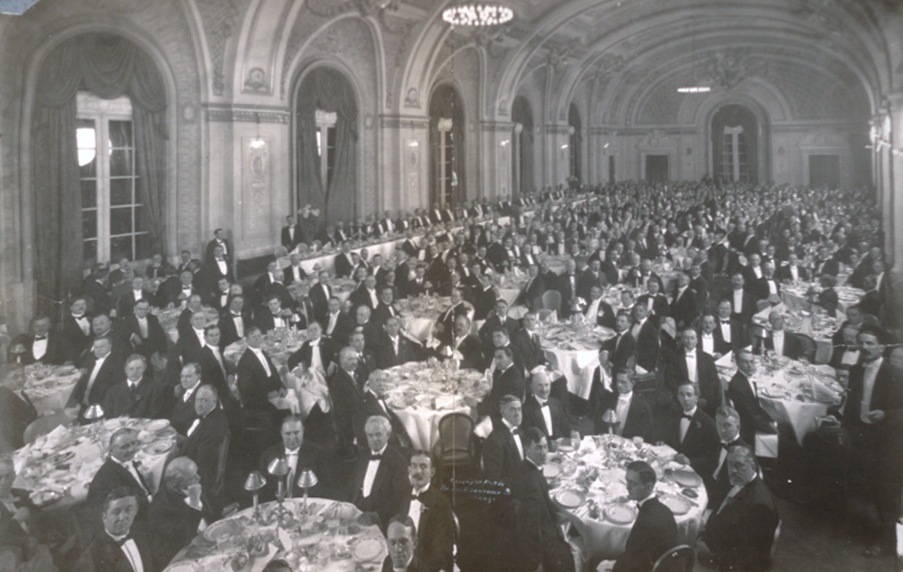
A bar association dinner like Harrisburg’s, in another city: Illinois lawyers honor their state’s Supreme Court justices at the Hotel LaSalle in Chicago, October 30, 1909. Geo. R. Lawrence Co., Library of Congress. Click the picture to see it full size.
Then everybody sang
Some lawyers needed help guessing. So the room helped them. “And for the benefit of those who couldn’t or wouldn’t understand, the lawyers broke into a song to illustrate the story of the picture. And the song finished with the name of the original of the photos.” The “original” means the real person in the pictures. Each song told a little story, and the last word gave away who it was.
The Telegraph called the pictures “a hilarious finish” to the night. Its headline said the lawyers gasped. The words on top, “Themselves as Others See ‘Em,” come from an old idea in a famous Scottish poem by Robert Burns: it would do us good to see ourselves the way other people see us. That night, seventy lawyers got their wish. “Barristers” is just another word for lawyers.
Lawyers spend their days being careful and serious. For one evening, the whole room got to laugh at itself, together. They “generally declared” it “the most splendid dinner the bar ever held.”
A year earlier, the judges got the treatment
The picture show was not brand new. At the 1915 dinner, also at the Harrisburg Club, the lawyers put their judges on the screen. The Star-Independent, another Harrisburg paper, reported that “stereopticon views of Judges Kunkel and McCarrell and Davey Young were thrown on the screen.” Davey Young was David F. Young, the “popular law librarian.”
“Each picture was greeted with loud cheering.” When Judge Kunkel’s picture went up, the lawyers sang his favorite song, “Eyes of Blue.” For Judge McCarrell, they sang “Marching Through Georgia.” For the librarian, they sang a little song called “The Man Behind the Bench,” to the tune of “You’re a Friend of Mine.” It started, “Hello Davey, you’re the Judges’ friend.” In 1915, the pictures were of the judges and the librarian. In 1916, the joke was on everybody.
[IMAGE: clips/B-star-independent-1915-02-16-songs-and-pictures.jpg | “Members of the Bar Make Merry at Annual Dinner: Songs and Pictures Add to the Fun.” The Star-Independent, Harrisburg, Pennsylvania, February 16, 1915, page 10. Library of Congress, Chronicling America.]
## The mystery of the red lights
That same night, something odd happened outside. The streetlights at the corner of Front and Market streets glowed red.
The Telegraph knew why, sort of. It said there was “a little incident” at the dinner, and then it stopped itself: “that’s a phase that isn’t released for publication.” That means the paper wasn’t allowed to tell. “Suffice it to say that therein lies the secret of the glow of the red electric lights at Front and Market streets last evening.” The city had said yes to it. “The proper authorities had given permission to paint for a brief time the globes as a part of one of the ‘stunts’ of the lawyers’ dinner.” The globes were the round glass covers on the electric lights.
Front and Market was not just any corner. The Harrisburg Club stood right on it. A 1910 booklet printed by the club lists its clubhouse at the corner of Front and Market streets, where it had opened on April 1, 1897. So anyone walking past that night saw red lights glowing outside a building full of singing lawyers. As far as we can find, no paper ever printed what the stunt was.
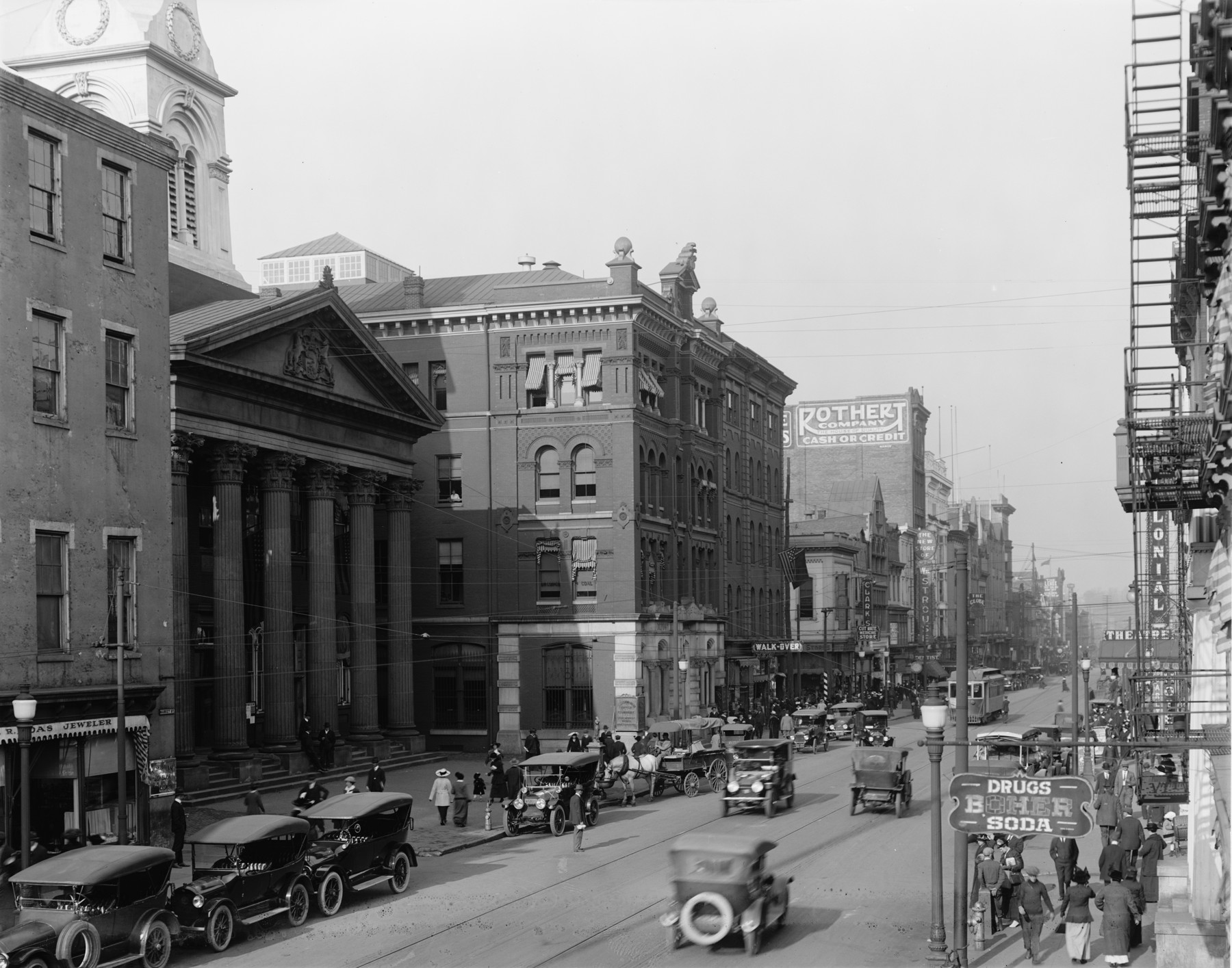
Market Street in Harrisburg, Pennsylvania, sometime between 1910 and 1920, with round electric lamps along the sidewalk. Market Street runs west to Front Street and the Susquehanna River, where the Harrisburg Club stood. Detroit Publishing Co., Library of Congress. Click the picture to see it full size.
Who was there
The host was “Ex-Senator John E. Fox.” He was the toastmaster, the person who introduces the speakers and keeps the evening moving. The dinner was planned by three lawyers: Charles H. Bergner, John E. Fox and Charles C. Stroh.
There was a first that year, too. “For the first time in the history of these dinners a guest was on hand who is not a member of the legal profession.” He was Harry F. Holler, the “prothonotary of Dauphin county.” A prothonotary is the official who keeps a court’s papers and records. It is a long, funny word, and Pennsylvania counties still use it. The state’s attorney general, Francis Shunk Brown, the top lawyer for all of Pennsylvania, came as a guest too.
If a grown-up has ever shown your baby pictures to company, you know how those lawyers felt. Every one of them had once been a kid who sat very still for a camera. In 1916, the whole Dauphin County bar saw those kids again, sang about them, and laughed. Outside, on the corner, the streetlights glowed red.
Sources
- “Themselves as Others See ‘Em,” Harrisburg Telegraph (Harrisburg, Pennsylvania), March 8, 1916, page 13. Library of Congress, Chronicling America.
- “Members of the Bar Make Merry at Annual Dinner,” The Star-Independent (Harrisburg, Pennsylvania), February 16, 1915, page 10. Library of Congress, Chronicling America.
- Harrisburg Club of Harrisburg, Pennsylvania (1910), title page and club history page. Internet Archive.
- Photos: “Harrisburg Club, Harrisburg, Pa.” (the cover; postcard, copyright 1905 by the Rotograph Co.); “Market Street, Harrisburg, Pa.” (Detroit Publishing Co., between 1910 and 1920); “Banquet by Illinois State Bar Association to Justices of Supreme Court of Illinois, Hotel LaSalle, Chicago, Oct. 30, 1909” (Geo. R. Lawrence Co.). Library of Congress Prints and Photographs Division. No known restrictions on publication.