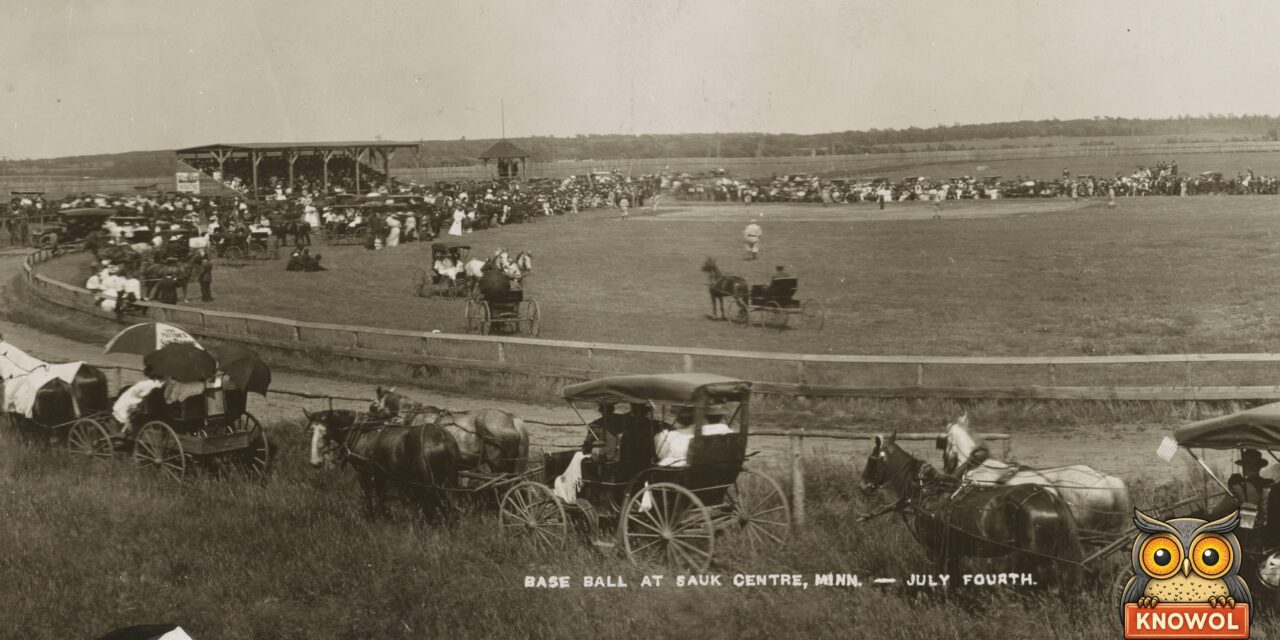
On the last Saturday afternoon of September 1900, a carriage with no horse in front of it came through Sauk Centre, Minnesota. It was a steam car on its way from Minneapolis to a doctor in Wahpeton, North Dakota, and nobody in town had seen one before. The Sauk Centre Herald said so plainly the next Thursday: “The first automobile ever seen in this city passed through on Saturday afternoon.”
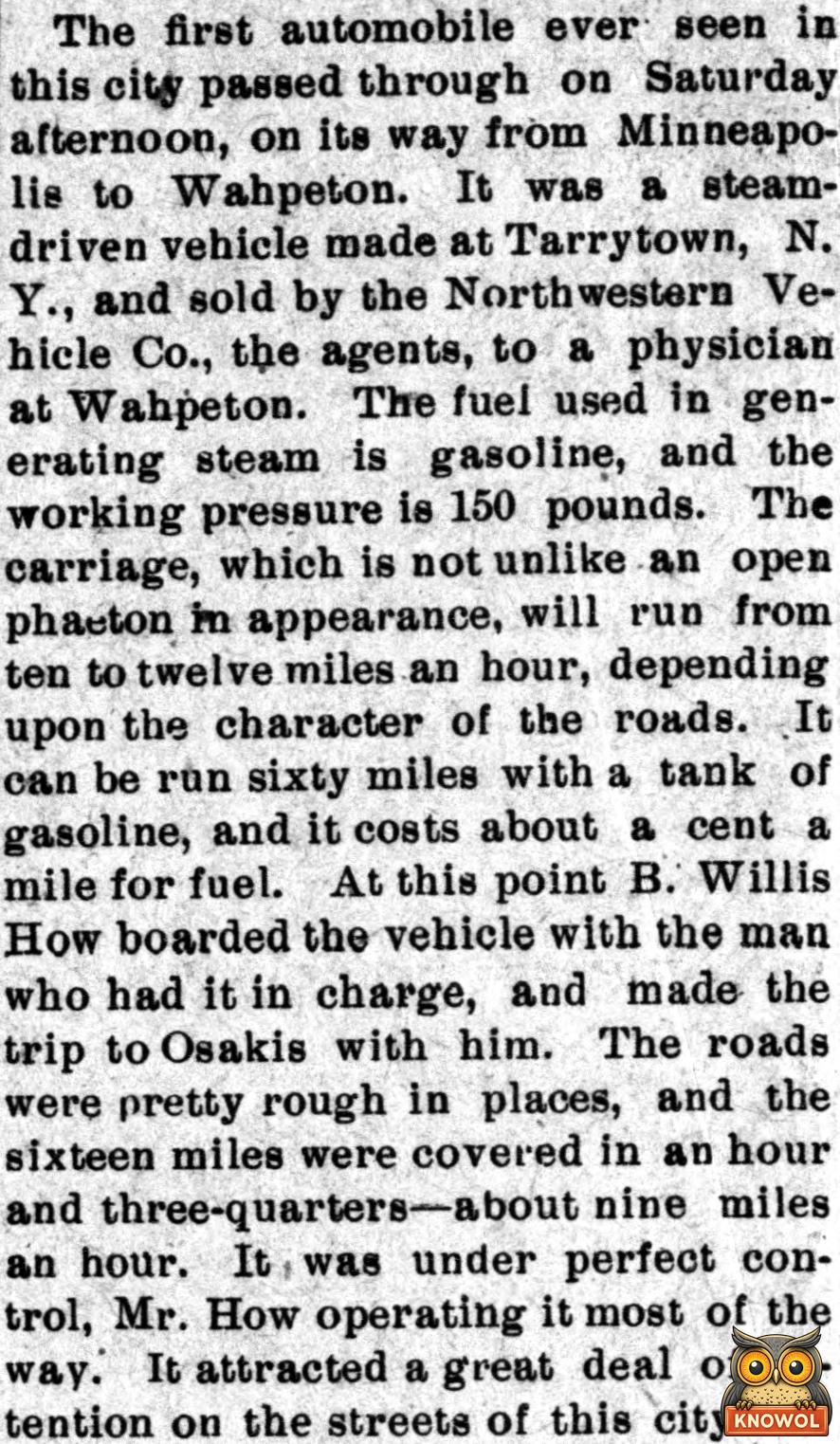
“The first automobile ever seen in this city,” the Sauk Centre Herald, Sauk Centre, Minnesota, October 4, 1900, page 4. Library of Congress, Chronicling America. Click the clipping to read it full size.
About a cent a mile
The Herald gave its readers the details. The car was “a steam-driven vehicle made at Tarrytown, N. Y.,” sold by the Northwestern Vehicle Co. “to a physician at Wahpeton.” It burned gasoline to heat the water for its steam, and it looked “not unlike an open phaeton,” a light open carriage of the horse-and-buggy days. It could go ten to twelve miles an hour, “depending upon the character of the roads.” A tank of gasoline was good for sixty miles, and the fuel cost “about a cent a mile.”
The paper didn’t name the maker. Tarrytown, on the Hudson River, was home that year to the Mobile Company of America, which built light steam carriages and advertised them in national magazines like The Cosmopolitan.
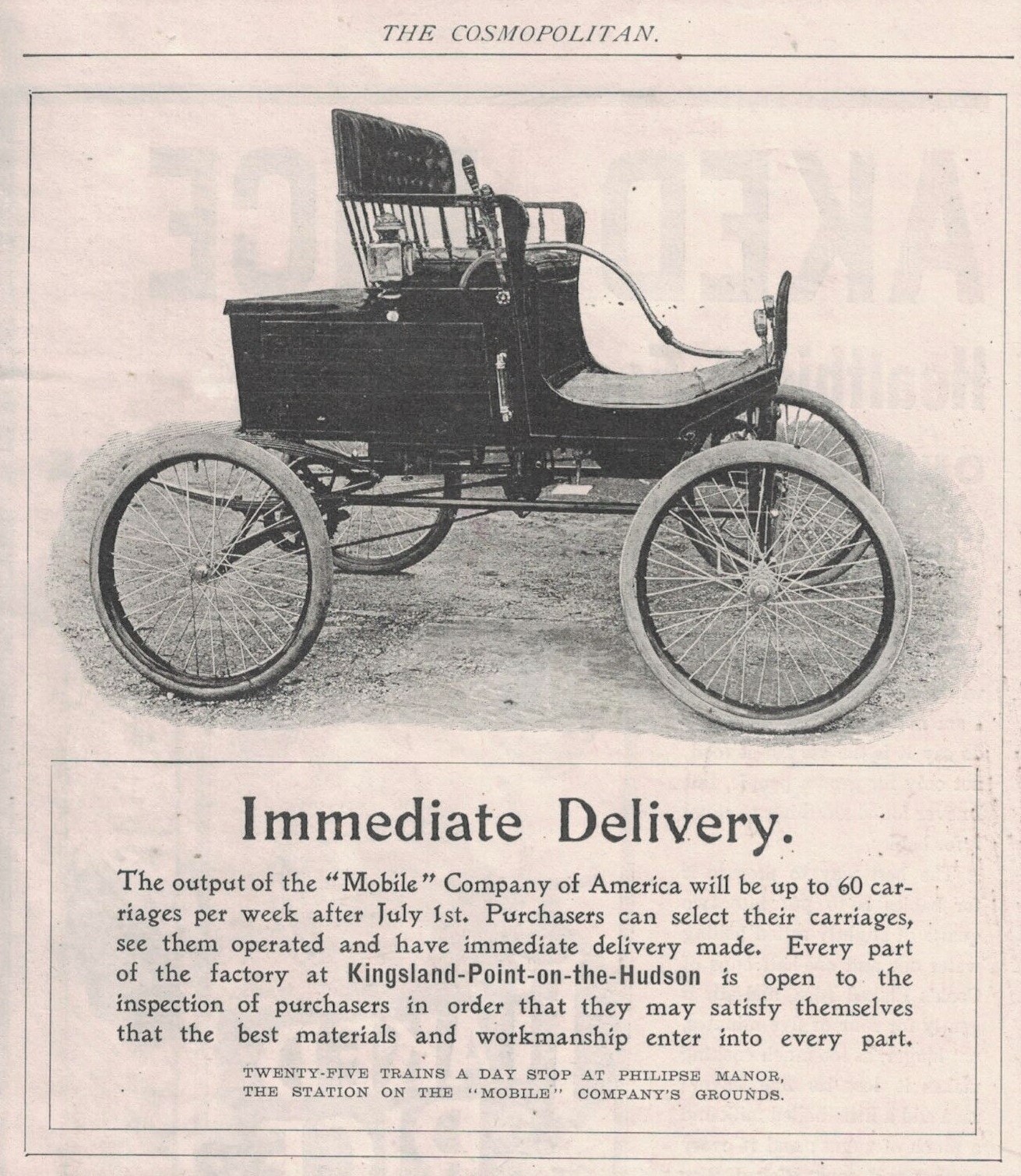
An advertisement for a Mobile Company of America steam carriage in The Cosmopolitan magazine, 1900. The company’s factory was at Tarrytown, New York, but the Herald didn’t name the maker of the Wahpeton doctor’s car. Public domain, via Wikimedia Commons. Click the picture to see it full size.
Sixteen miles to Osakis
Then one of Sauk Centre’s businessmen got a ride. B. Willis How ran what the Herald once called “the great hardware house of How Bros. & Co.” He “boarded the vehicle with the man who had it in charge, and made the trip to Osakis with him,” sixteen miles farther along. “The roads were pretty rough in places,” the paper said, and the trip took an hour and three-quarters, about nine miles an hour. That was slower than the ten to twelve the carriage was supposed to make, but the Herald was impressed anyway. “It was under perfect control, Mr. How operating it most of the way.” And in town, the paper added, “It attracted a great deal of attention on the streets of this city.”
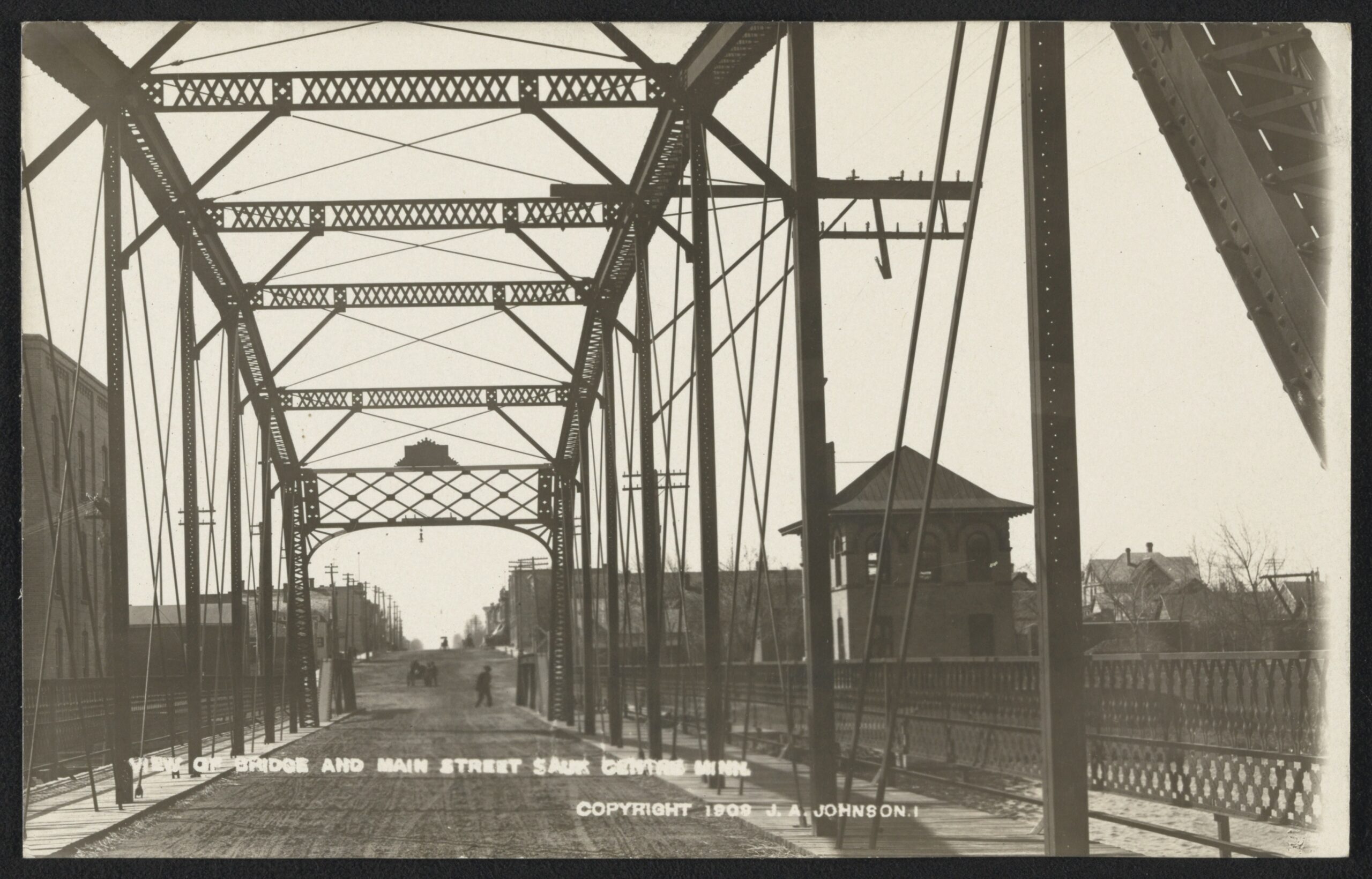
The bridge and Main Street in Sauk Centre, Minnesota, on a 1909 postcard by J. A. Johnson. Library of Congress, public domain. Click the picture to see it full size.
The car reached Wahpeton two days later. The Wahpeton Times ran the news the same Thursday as the Herald: “Dr. O’Brien’s automobile arrived Monday and soon we will see the doctor pushing around faster than ever.”
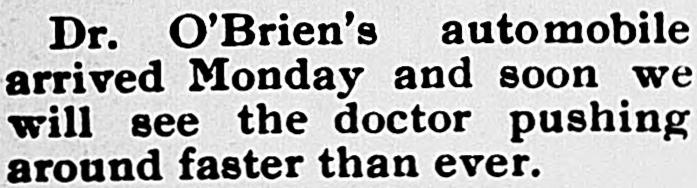
The Wahpeton Times, Wahpeton, North Dakota, October 4, 1900, page 1. Library of Congress, Chronicling America. Click the clipping to read it full size.
The wind wagon got there first
The Herald had actually used the words “first automobile” once before that year. In June it reported, with a perfectly straight face, “The first automobile ever used in this city was seen on Saturday. Glen Cooper and Phil Rich went sailing down Main-st. on a diminutive wagon driven by wind. It was fitted with a sail and made good progress.” The paper even explained why Glen needed it: “Since losing his team of driving-dogs Glen has been sore pressed for a means of locomotion.”
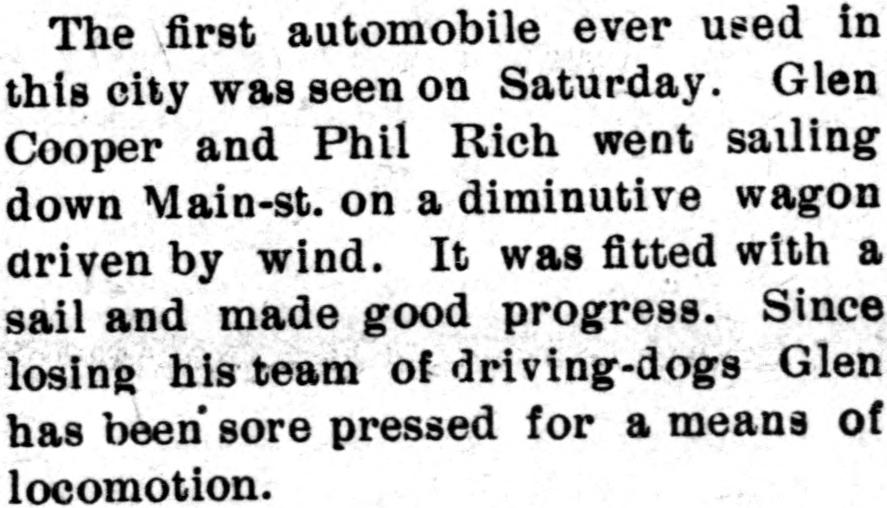
The Sauk Centre Herald, Sauk Centre, Minnesota, June 14, 1900, page 8. Library of Congress, Chronicling America. Click the clipping to read it full size.
Ten days after the steam car, the town saw another new machine. “A railroad automobile went westward over the Great Northern on Tuesday,” the Herald reported. It had three wheels, carried two people and a civil engineer’s outfit, and could be “lifted off the track by two.” On the smooth rails it ran “from fifteen to twenty miles an hour,” faster than the doctor’s car managed on the road to Osakis.
What $750 bought
The Herald never said what the Wahpeton doctor paid. That September, the New-York Tribune described a steam carriage built at Tarrytown, an improved version of the original Stanley carriage, and gave the price: “The cost of the machine is $750 cash,” delivered at the station in Tarrytown. As for fuel, the Tribune promised, “Gasolene is to be found at every crossroads store.”
In Sauk Centre that fall, $750 was a lot of peaches. The week the steam car came through, the Bishop Co. store ran a special sale of peaches and pears for canning, with a warning: “This is your Last Chance this Season.” The next week Bishop’s had cling peaches, “just the thing for pickling,” at 60 cents a box. At that price, $750 would have bought 1,250 boxes. A full tank for the steam car, sixty miles at about a cent a mile, came to about the price of one box. Dahlem’s sold fancy French flannels, “no two alike,” for 75 cents a yard, and O’Gara’s was still selling ice cream and hot weather drinks in October, “the coolest and best.”
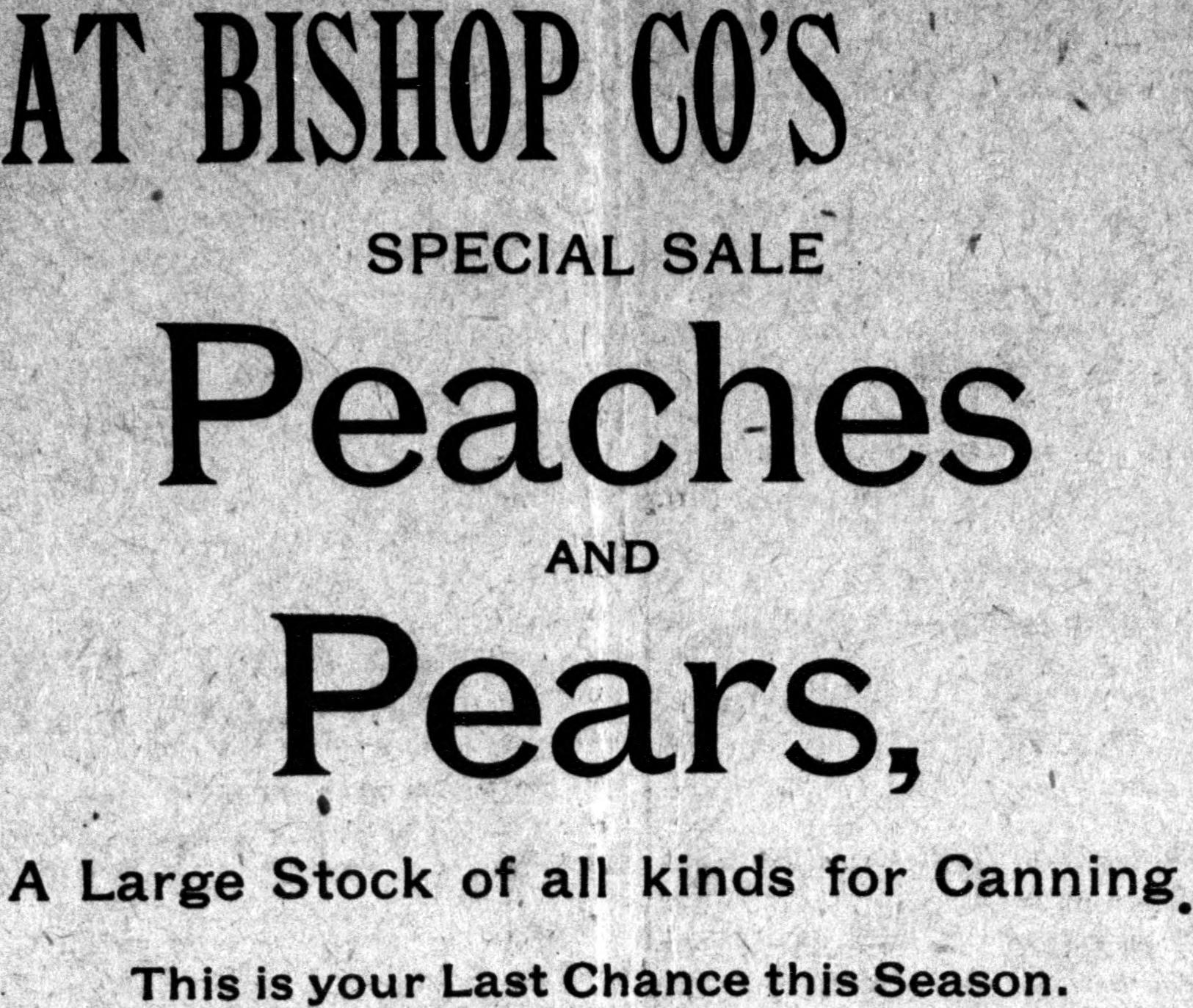
A Bishop Co. advertisement in the Sauk Centre Herald, Sauk Centre, Minnesota, October 4, 1900, page 4. Library of Congress, Chronicling America. Click the picture to see it full size.
That fall, one of the teenagers in Sauk Centre was Harry Lewis, a country doctor’s son. Twenty years later, writing as Sinclair Lewis, he published Main Street, and in 1930 he became the first American to win the Nobel Prize in Literature. The Herald gave the steam car one paragraph on page 4, on the same page as Bishop’s peach sale. People came out on the street to look, and the hardware man drove it to Osakis.
Sources
- The Sauk Centre Herald (Sauk Centre, Minn.), June 14, 1900, page 8 (the wind wagon), October 4, 1900, page 4 (the first automobile; the Bishop Co. advertisement), October 11, 1900, page 8 (the railroad automobile; Bishop’s, Dahlem’s and O’Gara’s) and January 2, 1902, page 1 (“A Large Business Transaction,” How Bros. & Co.).
- The Wahpeton Times (Wahpeton, N.D.), October 4, 1900, page 1.
- New-York Tribune (New York, N.Y.), September 11, 1900, page 7 (the Tarrytown steam carriage, $750).
- The Evening World (New York, N.Y.), November 15, 1900, page 8 (Mobile Company of America, Philipse Manor, Tarrytown-on-the-Hudson).
- Sinclair Lewis: his biographical statement for the Nobel Prize in Literature, 1930, and the Sinclair Lewis Society, Illinois State University.
- All newspaper images: Library of Congress, Chronicling America. No known copyright restrictions.
- Photograph: “View of bridge and street, Sauk Centre, Minn.,” postcard, copyright 1909 by J. A. Johnson, Library of Congress Prints and Photographs. Published 1909, public domain.
- Advertisement: Mobile Company of America, “Immediate Delivery,” The Cosmopolitan, 1900, via Wikimedia Commons. Public domain.
- Cover: “Base ball at Sauk Centre, Minn., July Fourth,” panorama photograph, copyright 1908 by W. O. Olson, Library of Congress Prints and Photographs. Cropped. Published 1908, public domain.