On Saturday, May 25, 1912, four men on John Olson’s ranch, ten miles above Lake Quinault in the Olympic Mountains, tried to start five elk down toward Grays Harbor, where the Elks lodge of Aberdeen, Washington, was waiting for them. The elk didn’t want to go. They had been raised on that ranch, and it was the only home they knew. “When an attempt was made to drive them from the ranch they refused to go and broke back a number of times,” the Aberdeen Herald reported.
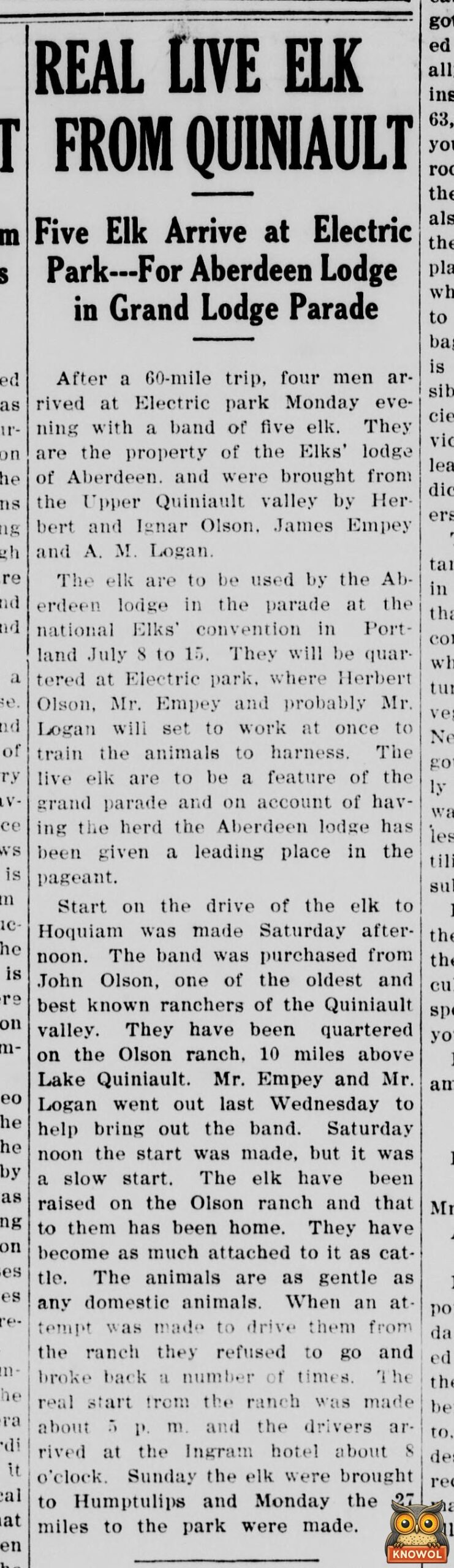
“Real Live Elk From Quiniault,” Aberdeen Herald, Aberdeen, Washington, May 30, 1912, page 1. Library of Congress, Chronicling America. Click the clipping to read it full size.
An Elks lodge wanted real elk
The elk belonged to the Aberdeen lodge of the Benevolent and Protective Order of Elks, a men’s club with lodges all over the country. In July the Elks would hold their national convention in Portland, Oregon, and Aberdeen’s lodge planned to march behind the real animal. On May 23 the Herald introduced the first two, Jim and Jack, already trained to harness. They would come to Aberdeen first to get used to street traffic, and then they would lead the Elks’ parade, with the Aberdeen men behind them.
Sixty miles out of the mountains
Herbert and Ignar Olson, James Empey and A. M. Logan drove the five out of the Quinault valley (the papers spelled it Quiniault). They reached the Ingram hotel the first night, Humptulips on Sunday, and on Monday walked the last 27 miles to Electric Park, where the lodge would keep them. A report from Hoquiam said the elk broke loose 25 miles out and went right back to the ranch where they were raised. Even so, the report said, they were perfectly tame.
At Electric Park the men spent weeks training them for the city, leading them around among cars until traffic didn’t bother them, the Morning Oregonian said later. The lodge spent nearly $10,000 on its parade showing. To pay for it, members formed a Portland Club inside the lodge, with dues of $3 a month.
A baggage car of their own
At 11 o’clock on the night of July 10, about 150 Aberdeen Elks boarded a special train for Portland. “The live elk went along on the special, riding in the baggage car that was especially prepared for them,” the Herald wrote the next morning.
The parade marched the next afternoon, Thursday, July 11, 1912. The Oregonian’s front page counted 10,000 Elks in line and called it the longest parade Portland had ever seen. Montana’s Daily Missoulian reported that Aberdeen’s five elk pulled a phaeton, a light open carriage, driven by a little girl from the Grays Harbor country.
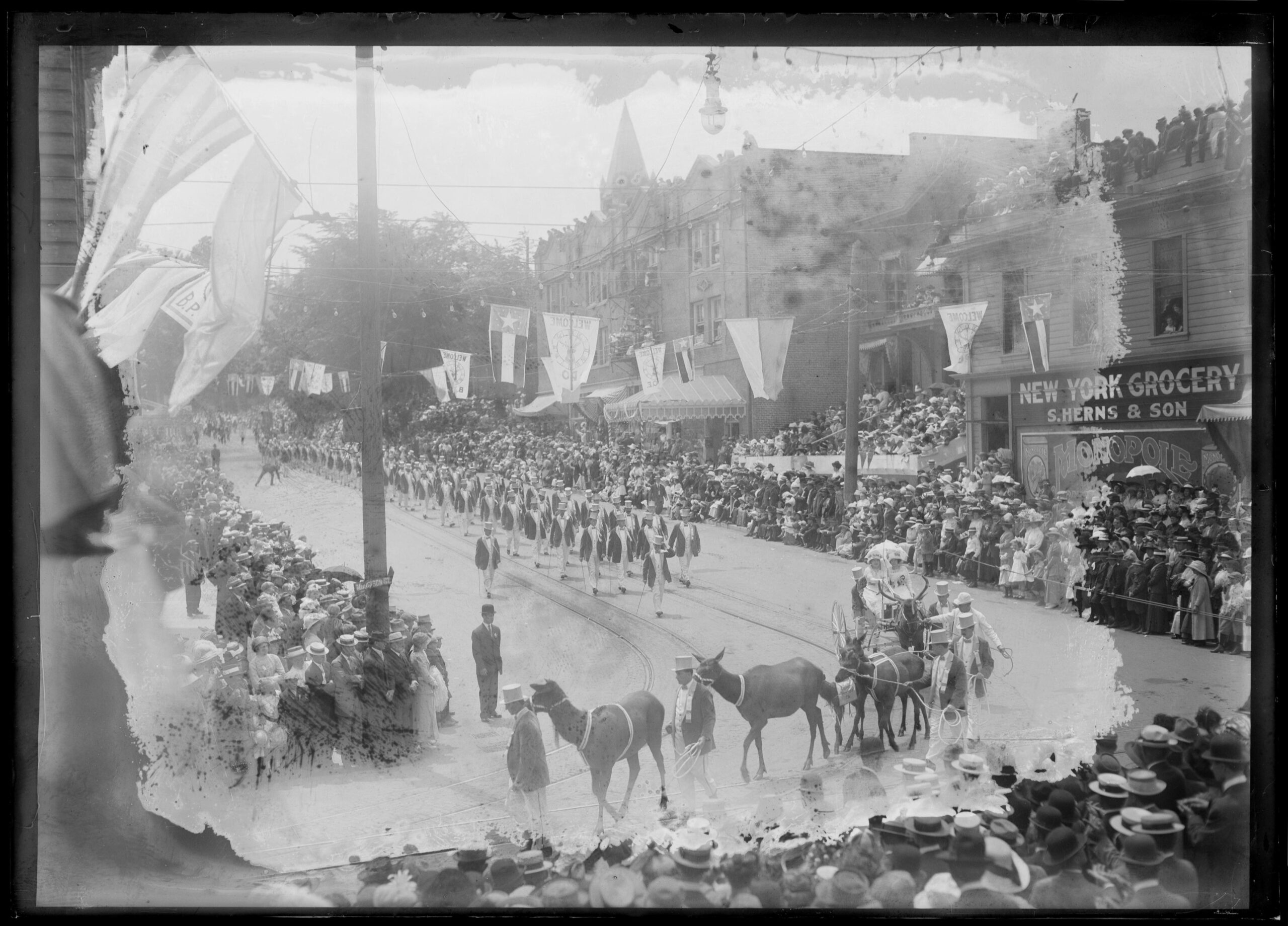
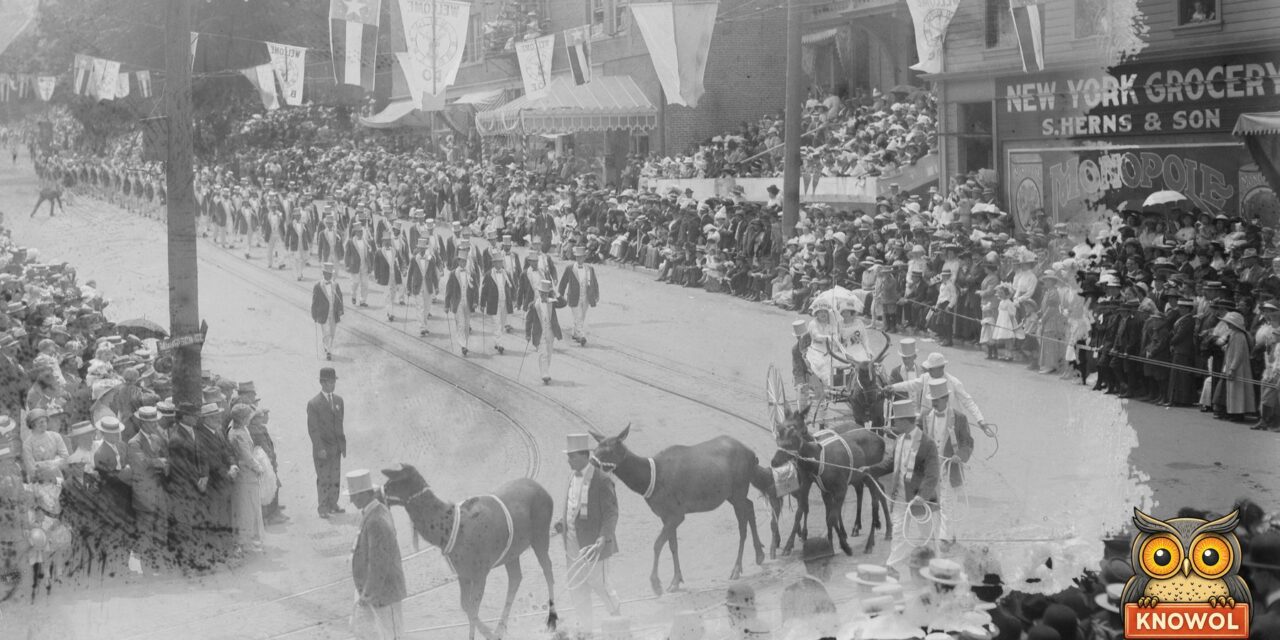
Live elk in the Elks’ grand lodge parade in Portland, Oregon, July 11, 1912: men in tall white hats lead elk on ropes, and women ride in a carriage pulled by elk. The papers name Aberdeen’s lodge as the one that brought live elk. Lee Moorhouse photographs, University of Oregon Libraries, public domain. Click the picture to see it full size.
The baby elk stole the show
The Oregonian said the elk went over the whole long, noisy route without a break, with the big bull pulling a cart driven by a young woman. But the star was the smallest one. “The hit of the piece was the baby elk, born in captivity two weeks ago at Aberdeen. The little fellow paced gingerly along, its mild eyes turning in wonder from side to side, plainly amazed at the unusual sights around it.”
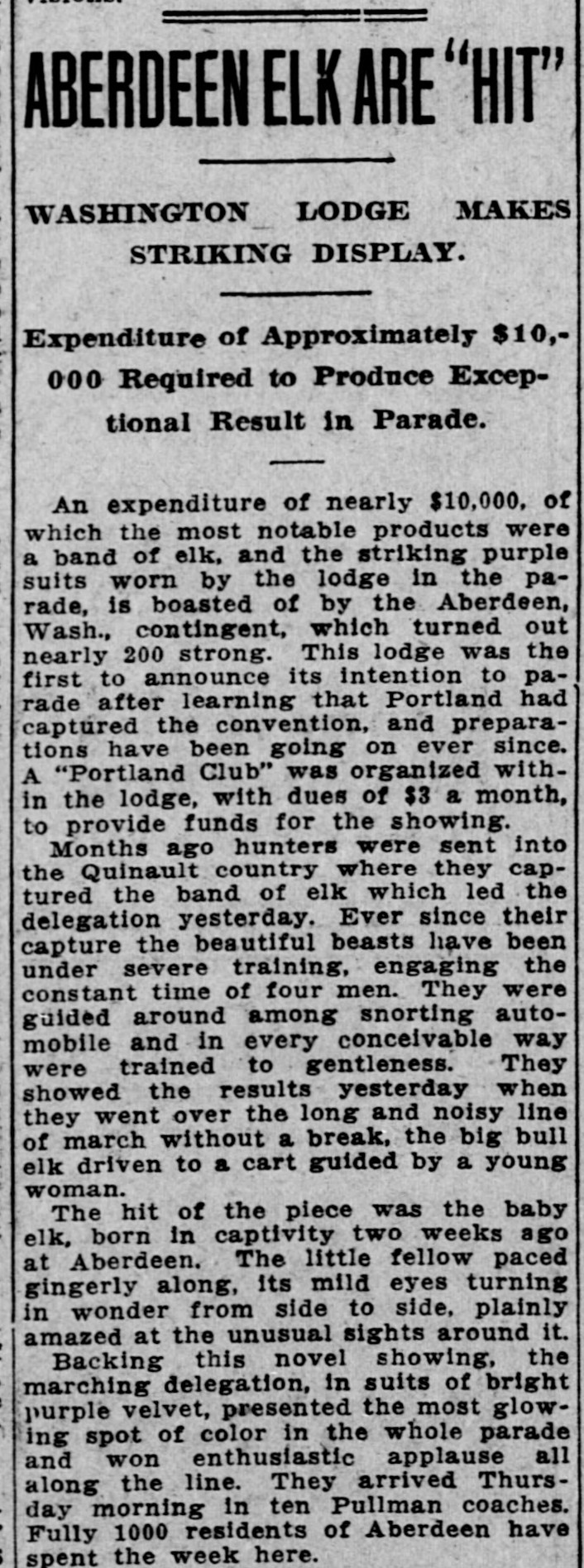
“Aberdeen Elk Are ‘Hit,'” the Morning Oregonian, Portland, Oregon, July 12, 1912, page 10. University of Oregon Libraries, Historic Oregon Newspapers, public domain. Click the clipping to read it full size.
Aberdeen won first prize for the best appearance in line, and the Oregonian called the lodge’s trained bull Big Bill. Its front-page cartoonist drew a top-hatted lodge man holding a bull elk, with a baby elk beside him and an onlooker admitting, “I’ve been an Elk for ten years and never saw a live one before.”
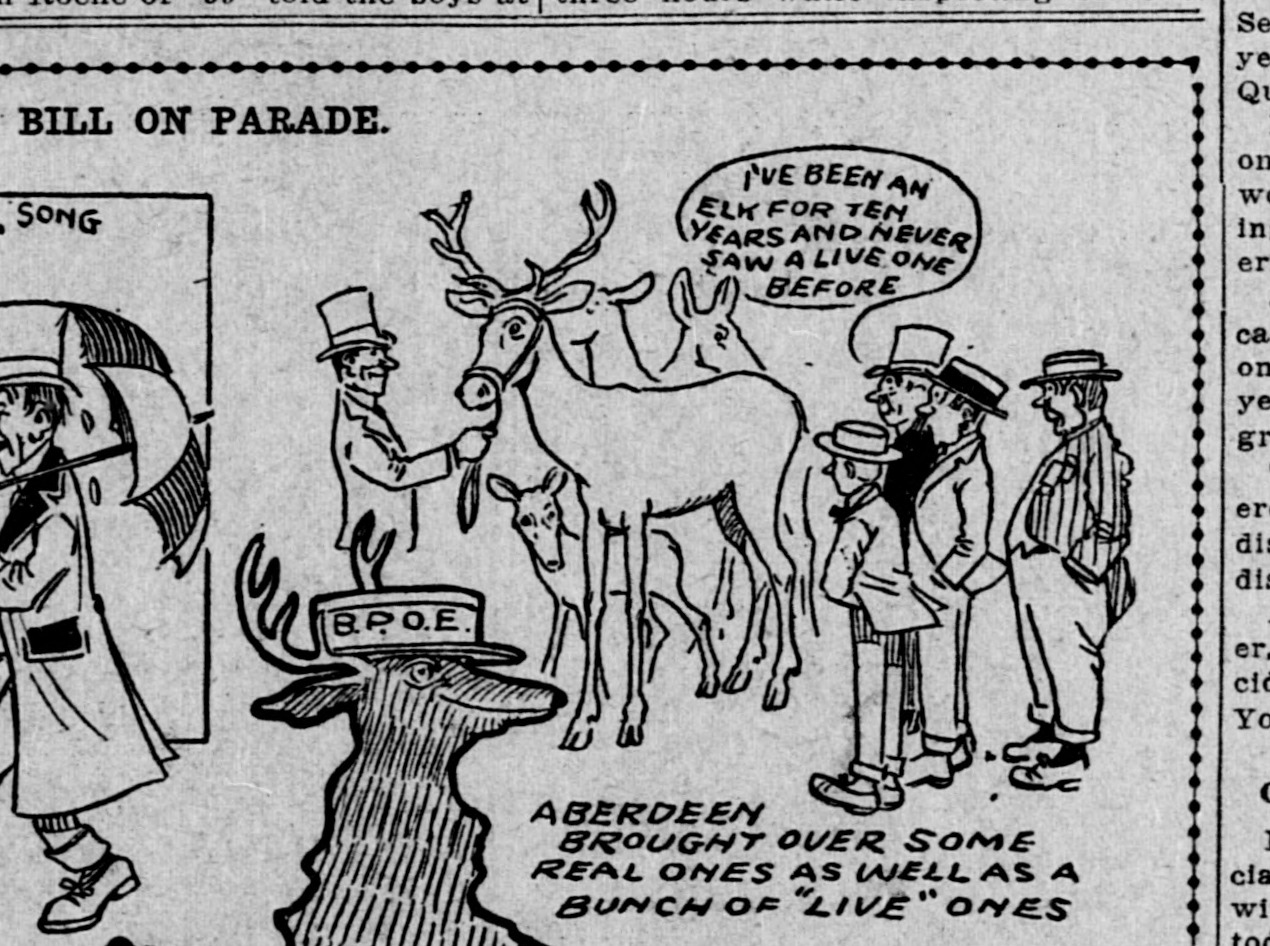
From “Bill on Parade,” the front-page cartoon in the Morning Oregonian, Portland, Oregon, July 12, 1912. University of Oregon Libraries, Historic Oregon Newspapers, public domain. Click the picture to see it full size.
A suit of 4,000 elk teeth
Live elk weren’t the only odd sight at the convention. The same Oregonian page that praised the baby elk ran a photograph of George M. Henry of Steubenville, Ohio, who wore “a suit of clothes covered entirely with the ivory tusks of elk, more than 4000 in number.” He brought it to every grand lodge convention just to show the other members. He also handed out a brass souvenir with his last name spelled as a picture puzzle: “a picture of a hen and another of a bunch of rye.”
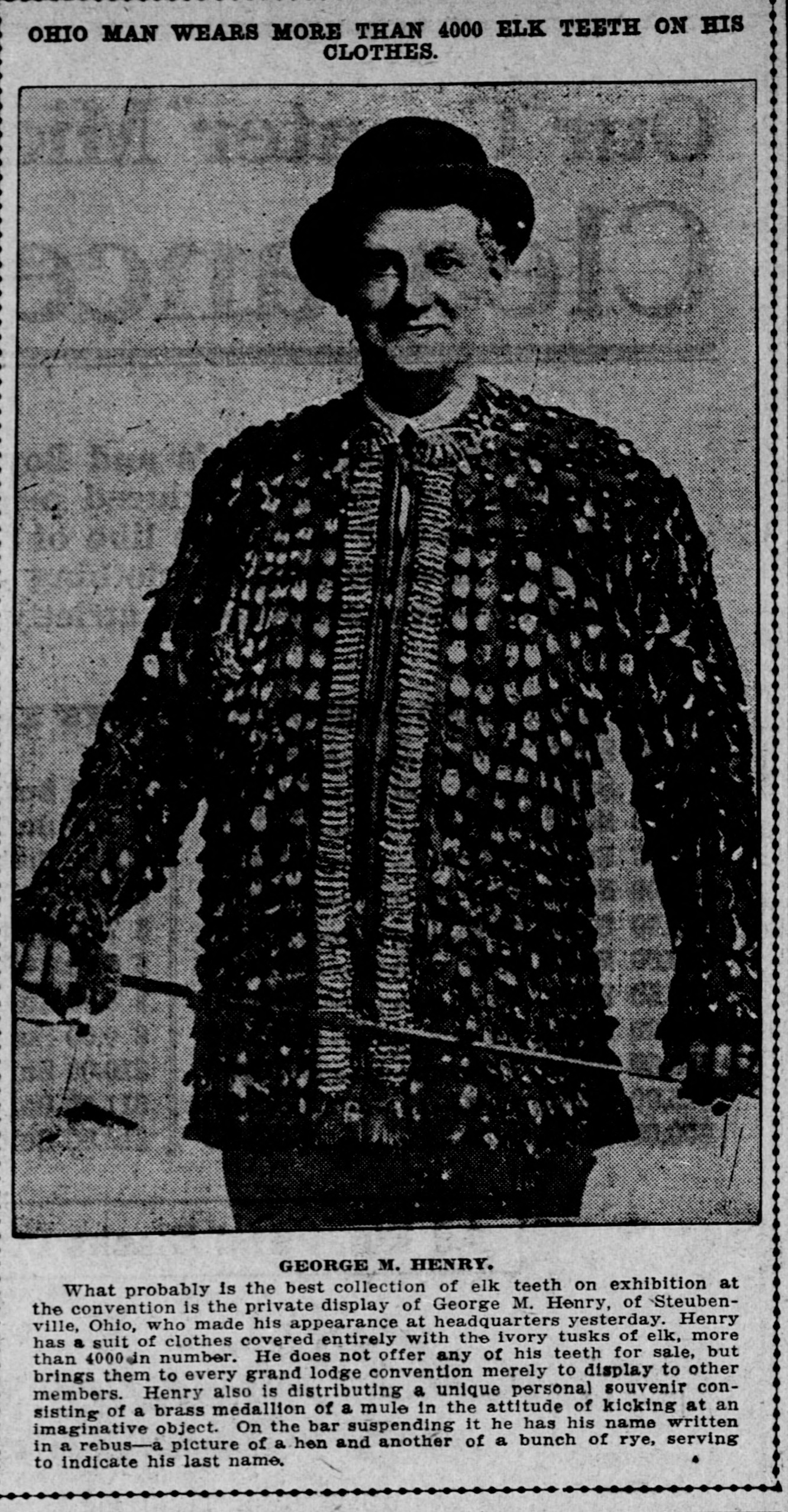
“Ohio Man Wears More Than 4000 Elk Teeth on His Clothes,” the Morning Oregonian, Portland, Oregon, July 12, 1912, page 10. University of Oregon Libraries, Historic Oregon Newspapers, public domain. Click the clipping to read it full size.
From ranch pets to parade leaders
In May the Quinault elk wouldn’t leave the ranch where they grew up. Six weeks later they rode to Portland in a baggage car of their own, walked the whole route of the longest parade the city had ever seen, and won their lodge first prize. And the one the crowds loved most had never seen the Olson ranch at all. It was born in Aberdeen.

Aberdeen, Washington, in 1912, looking west from Dabney Hill toward Grays Harbor. Photograph by Lon Lewis. Library of Congress, Prints and Photographs Division, no known restrictions. Click the picture to see it full size.
Sources
- Aberdeen Herald (Aberdeen, Wash.), May 23, 1912, page 1 (“Parade to Be Led by a Team of Elk”), May 30, 1912, page 1 (“Real Live Elk From Quiniault”) and July 11, 1912, page 6 (“Elks Leave for Portland”).
- The Evening Herald (Klamath Falls, Or.), May 30, 1912, page 1 (the Hoquiam report).
- The Daily Missoulian (Missoula, Mont.), July 12, 1912, page 5.
- East Oregonian (Pendleton, Or.), July 12, 1912, page 1 (the prize list).
- Morning Oregonian (Portland, Or.), July 12, 1912, page 1 (“10,000 Elks Pass in Grand Review,” the awards list and the “Bill on Parade” cartoon), page 10 (“Aberdeen Elk Are ‘Hit'” and George M. Henry) and page 18 (“Big Bill”). Historic Oregon Newspapers, University of Oregon Libraries.
- Newspaper images from the Library of Congress, Chronicling America, and from Historic Oregon Newspapers, University of Oregon Libraries. Published 1912, public domain.
- Parade photograph: Lee Moorhouse photographs (PH036_0089), University of Oregon Libraries, via the Digital Public Library of America and Wikimedia Commons, public domain.
- Aberdeen panorama: Lon Lewis, “Aberdeen, Wash., 1912, looking west from Dabney Hill,” Library of Congress, Prints and Photographs Division, no known restrictions on publication.
- Cover: Live elk in the Elks’ grand lodge parade, Portland, Oregon, July 11, 1912 (cropped). Lee Moorhouse photographs (PH036_0089), University of Oregon Libraries, public domain.