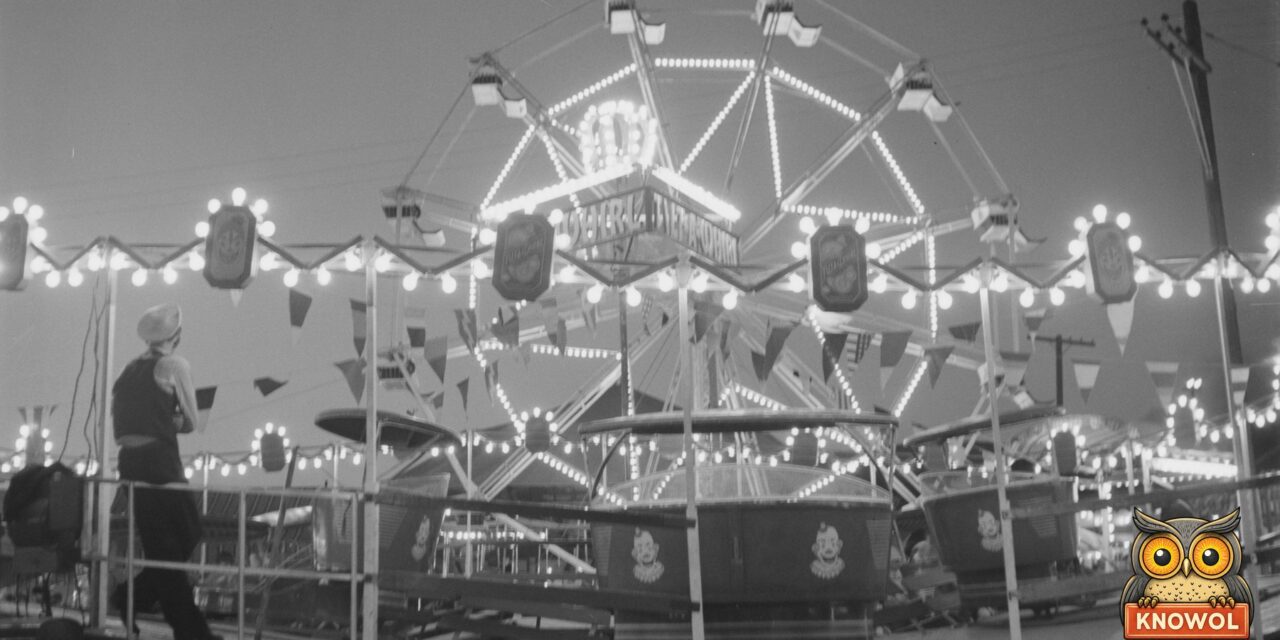
Hundreds of light bulbs glow against a pale night sky. A Ferris wheel stands in the back, outlined in lights like a drawing. In front of it, round little cars with clown faces painted on their sides sit on a wavy wooden track, and a man in a cap and a dark vest stands at the rail, looking up. It’s July 1942, at the circus in Klamath Falls, Oregon. The sign in the middle of the lights reads TILT-A-WHIRL. That ride was only 16 years old. And it hid a secret that scientists wouldn’t figure out for another 52 years: nobody, not even the man running it, could tell you exactly how your car was going to spin.
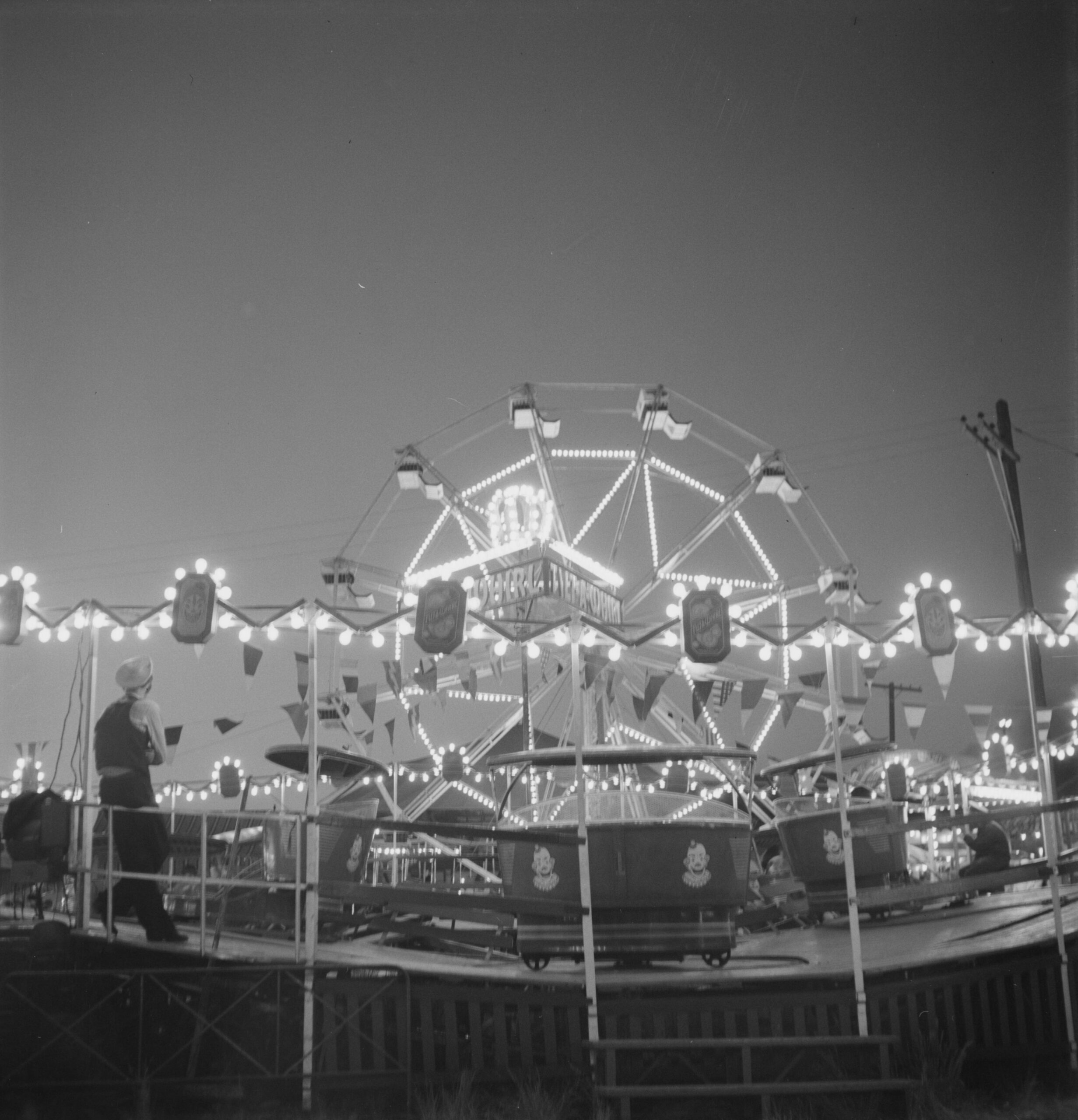
“Klamath Falls, Oregon. Carnival rides at the circus.” Photo by Russell Lee, July 1942. Library of Congress, Prints and Photographs Division, FSA/OWI Collection. No known restrictions. Click the picture to see it full size.
Circus Night in Klamath Falls, Oregon
The photographer in Klamath Falls was Russell Lee, and his caption card is short: “Klamath Falls, Oregon. Carnival rides at the circus.” The Library of Congress dates it July 1942. That was seven months after the attack on Pearl Harbor pulled the United States into World War II.
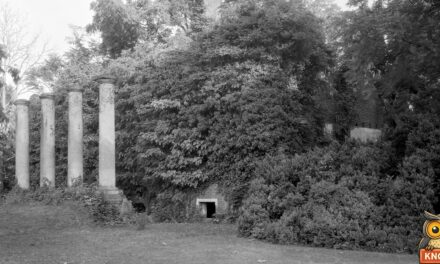
Lee photographed much more of the show. His cards are labeled “Circus day,” “Sideshow barker at the circus” and “Carnival of the circus at night.” A barker is the person out front who shouts to get you inside a tent. One of Lee’s daytime pictures shows a big painted sign that reads WEST COAST CIRCUS, with an elephant standing in the doorway under it. A little girl in a dark dress holds the rail and stares.
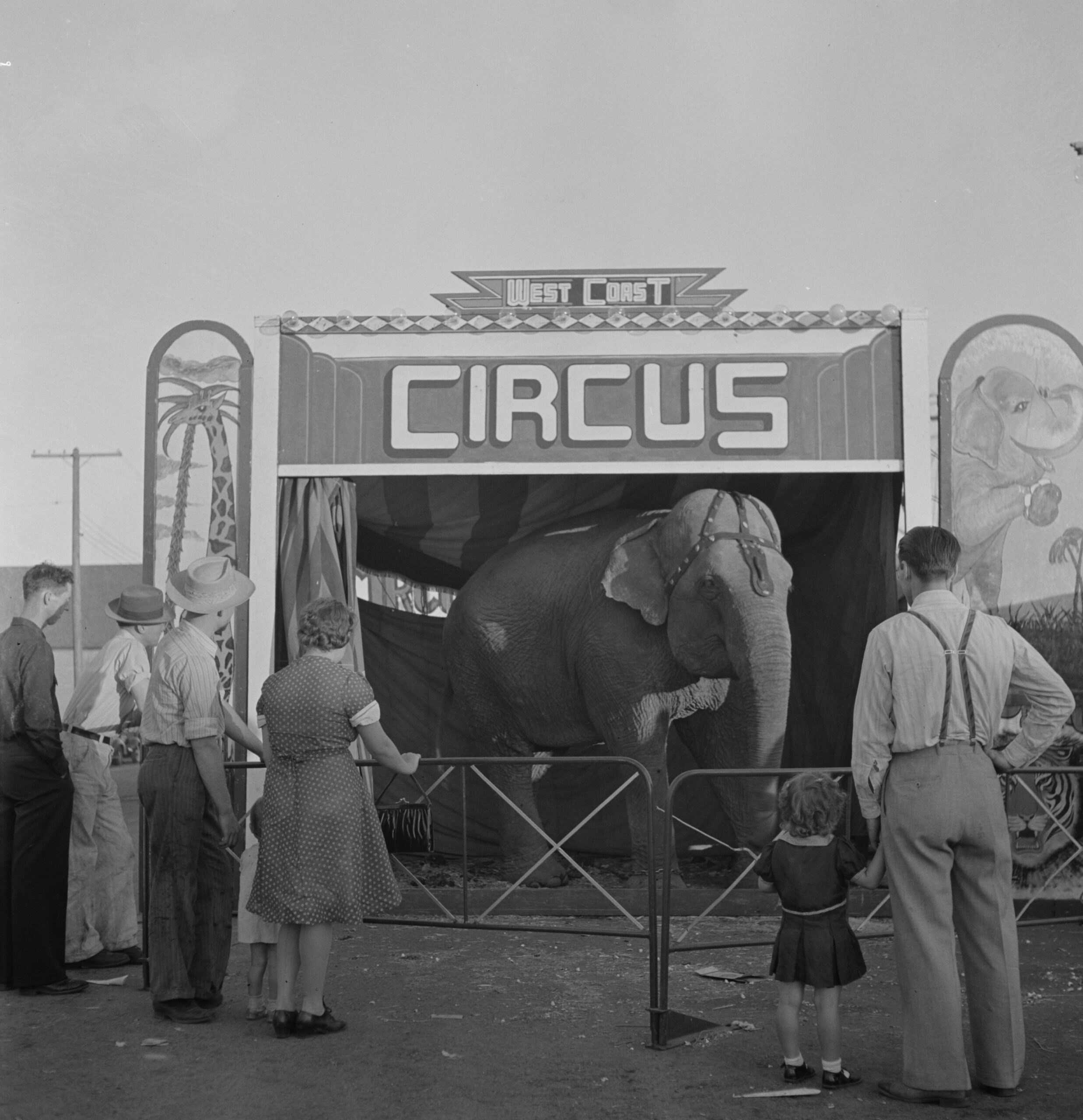
“Klamath Falls, Oregon. Circus day.” Photo by Russell Lee, July 1942. Library of Congress, Prints and Photographs Division, FSA/OWI Collection. No known restrictions. Click the picture to see it full size.
So this was the kind of show that rolled into town with both: a circus with animals and sideshows, and a carnival midway with rides. Klamath Falls, in southern Oregon near the California line, was a working town. Lee’s other cards from that July say so: “Klamath Falls has many lumber mills,” and “Klamath Falls is lumbering and mining country.” People who spent their days at sawmills came out at night to ride under the lights.
The Ride on the Sign: A Tilt-A-Whirl
The Tilt-A-Whirl came from Herbert Sellner, a man in Faribault, Minnesota. On April 24, 1926, he filed a patent for what he plainly called an “Amusement Device.” A patent is the government’s paper that says an invention is yours. Sellner named his device the Tilt-A-Whirl, and the first one ran in 1926 at an amusement park in White Bear Lake, Minnesota. It went on to the Minnesota State Fair, and in 1927 Sellner started building more of them in Faribault. The early ones were made of wood and ran on gas motors.
Here’s how it works. Each car sits on its own round platform. The car is fastened at one point, but it’s free to swing and spin around that point like a door on a loose hinge. Then all the platforms ride around a big circular track that goes up and down over three low hills. As a platform climbs a hill and drops into a valley, it tips. The car swings one way, then gets flung the other way.
You can see all of that in Lee’s picture of Klamath Falls. The track’s curve sweeps across the bottom of the photo, and the cars with the clown faces sit on their platforms, waiting for riders.
Why Nobody Could Predict a Tilt-A-Whirl
Some rides do the same thing every time. A Ferris wheel goes around. A merry-go-round goes around. The Tilt-A-Whirl doesn’t. One trip your car might barely turn. The next trip, with the same ride at the same speed, it might whip around and around until you’re dizzy.
In 1994, two scientists finally explained why. Richard Kautz worked at the National Institute of Standards and Technology, the government’s lab for exact measuring. Bret Huggard was at Northern Arizona University. They wrote math that copied how a Tilt-A-Whirl car moves, then ran it on a computer for 100,000 trips over the hills. The car’s speed and angle never came out the same twice.
Scientists have a word for that: chaos. It doesn’t mean a mess. It means a machine that follows simple rules but can’t be predicted, because the tiniest change at the start grows into a big change later. Kautz and Huggard found the ride is most chaotic near its usual speed, about six and a half turns a minute. Riders had known part of the trick for years. How heavy you are, and where you sit in the car, can make it spin more or less.
The man at the rail in Klamath Falls was probably working the ride. He could start it and stop it all night. But even he couldn’t say which car would get the wild spin.
The Man Behind the Camera in Klamath Falls, Oregon
Russell Lee was born in Ottawa, Illinois, in 1903. He studied chemical engineering and worked as a chemist, then quit to become a painter. He picked up a camera to help with his painting, and it took over.
In the fall of 1936, Lee was hired by the Farm Security Administration, a government office that helped struggling farmers during the Great Depression. It had a small team of photographers whose job was to show how Americans lived and worked. Lee became one of its best known. In 1940 he made a famous set of color pictures of a little town called Pie Town, New Mexico.
In July 1942, with the country at war, Lee was still on the road for that team. Later that year it became part of the Office of War Information, the government office that told the war’s story at home and overseas. The Klamath Falls negatives came to the Library of Congress in 1944 from that office’s Overseas Picture Division.
Lee’s record says this picture was made on a square negative, 2 1/4 inches on each side. That’s why the photo is a square, not a long rectangle like most pictures today.
Watching the Show in Klamath Falls
Lee didn’t only photograph the rides. One of his cards, “At the sideshow of the circus,” shows a crowd at dusk. A young woman with curly hair holds a sweater in her arms. A young man in suspenders stands next to her with his arms folded. An older man in a hat stands behind them. They’re all looking up at something we can’t see, with a lit Ferris wheel behind them.
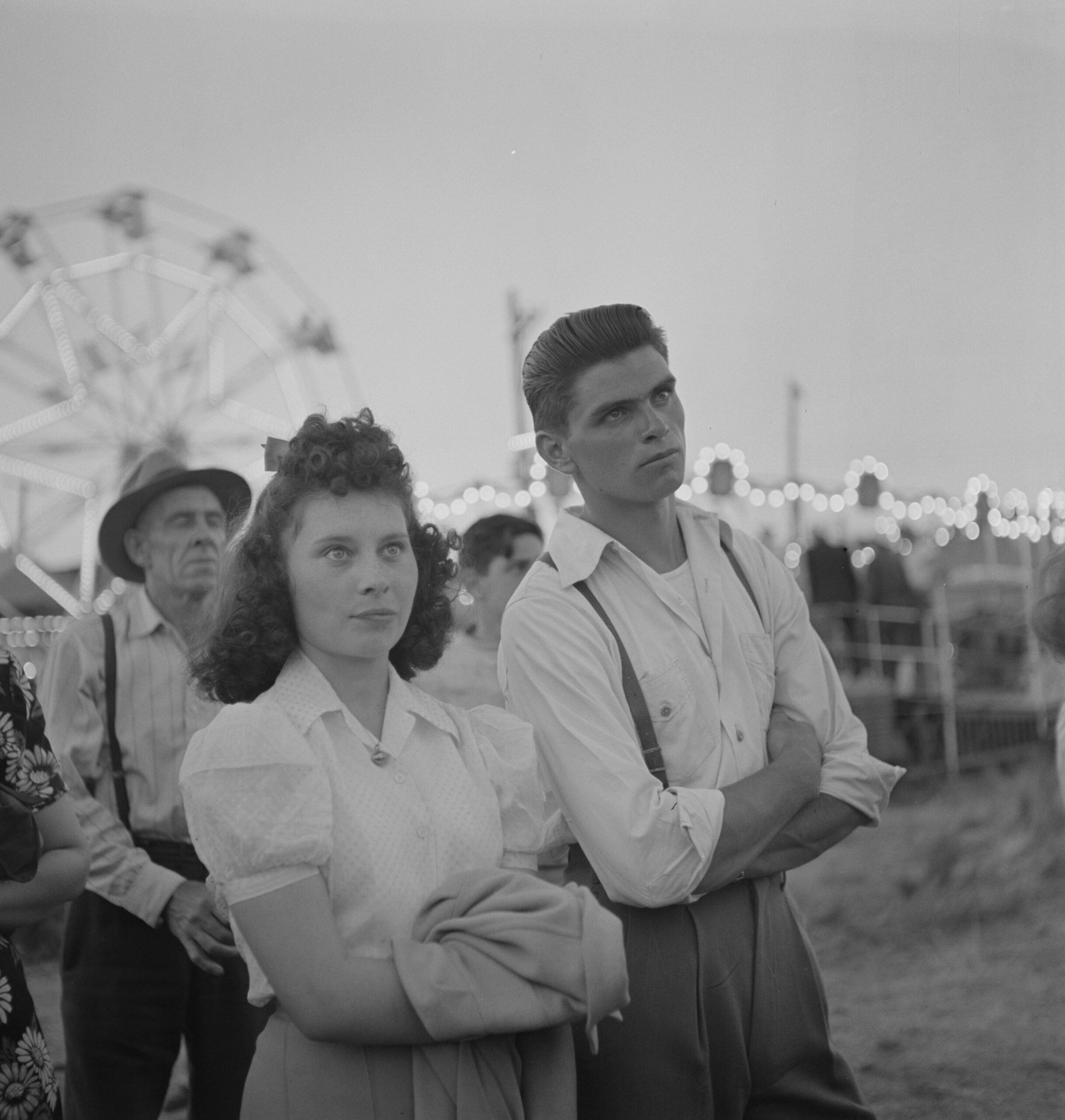
“Klamath Falls, Oregon. At the sideshow of the circus.” Photo by Russell Lee, July 1942. Library of Congress, Prints and Photographs Division, FSA/OWI Collection. No known restrictions. Click the picture to see it full size.
The cards don’t give their names. But the picture says plenty. It was a summer night in a lumber town during a war, and the people of Klamath Falls had come out to look at something amazing.
The Tilt-A-Whirl Today
The Tilt-A-Whirl is still a fair favorite. Sellner’s company in Faribault built them for more than 80 years. In 2011 the business was sold to Larson International of Plainview, Texas, which still makes the ride. This year, 2026, the Tilt-A-Whirl turns 100.
Russell Lee’s picture is still at the Library of Congress, free for anyone to see. Because it was made for the government, it belongs to everyone. Look at it closely and you can count the bulbs on every arm of the Ferris wheel. You’re seeing a ride that nobody could predict, glowing on one July night in Klamath Falls, Oregon.
Sources
- Russell Lee, “Klamath Falls, Oregon. Carnival rides at the circus,” July 1942. Caption card title, record and full-size scan: Library of Congress, item 2017819010 (LC-USF34-073338-E). The record gives the square nitrate negative and the transfer from the Office of War Information, Overseas Picture Division, in 1944. FSA/OWI photographs: no known restrictions.
- Other Russell Lee caption cards from the same July 1942 shoot, quoted word for word from the Library of Congress records: “Circus day,” item 2017818991; “At the sideshow of the circus,” item 2017818997; “Sideshow barker at the circus,” item 2017819002; “Carnival of the circus at night,” item 2017819004; “Railroad underpass. Klamath Falls has many lumber mills,” item 2017818939; “Residential section. Klamath Falls is lumbering and mining country,” item 2017818989.
- Herbert W. Sellner, “Amusement Device,” U.S. Patent 1,745,719, filed April 24, 1926: Google Patents.
- The Tilt-A-Whirl’s history and how it works: Wikipedia, Tilt-A-Whirl and Wikipedia, Sellner Manufacturing.
- The chaos study: R. L. Kautz and B. M. Huggard, “Chaos at the amusement park: Dynamics of the Tilt-A-Whirl,” American Journal of Physics 62 (1994), explained in Science News, “Tilt-A-Whirl Chaos”.
- Russell Lee: Wikipedia. The Office of War Information: Wikipedia.
- About the FSA/OWI photographs and their rights: Library of Congress, FSA/OWI Black-and-White Negatives and rights and restrictions.