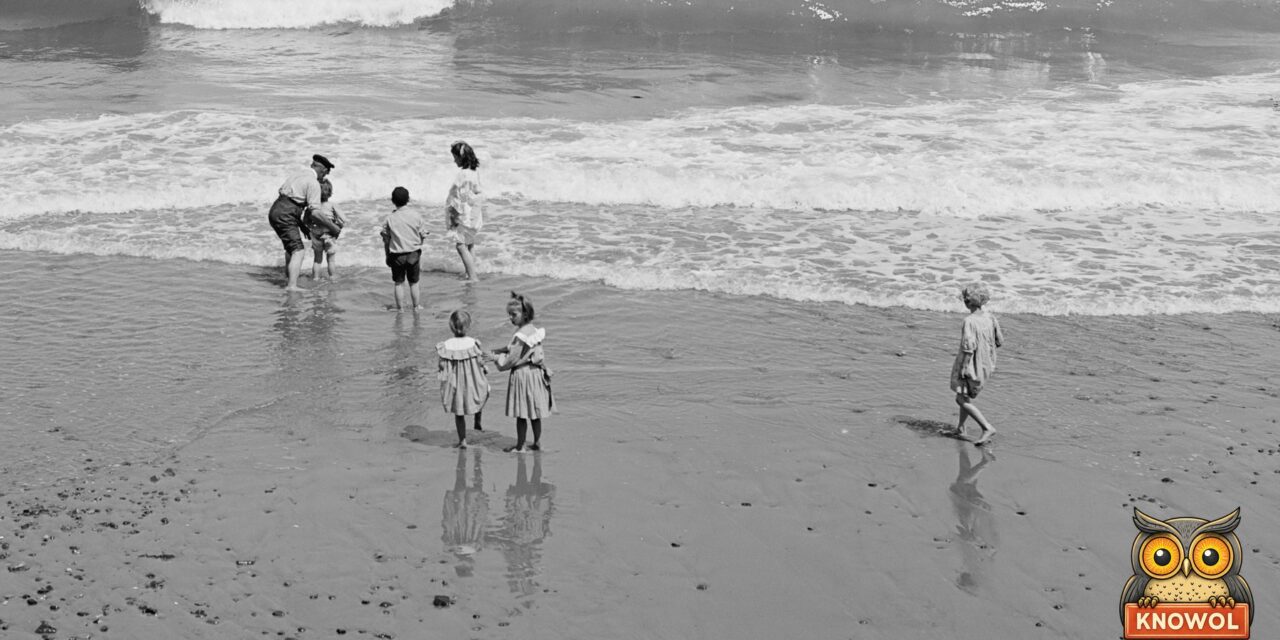
A wave has just come up the sand at Nantasket Beach in Hull, Massachusetts, and it’s running back out in a sheet of white foam. A grown man in a dark cap stands in it up to his ankles. He is bent over, holding a very small child under the arms, and the child’s bare feet are in the cold Atlantic. Around them, five more children are working up their nerve. A boy stands still and watches. A girl in a white dress wades out past him. Two little girls in ruffled collars hold hands at the edge of the water. One curly-haired child walks along alone. Somebody up above them, with a big camera on a stand, is taking the picture.
[IMAGE: photos/first-lessons-nantasket-beach-web.jpg | “[Sea shore, first lessons].” Nantasket Beach, Massachusetts, between 1900 and 1910. Detroit Publishing Co., photographer not named. Library of Congress, Prints and Photographs Division, Detroit Publishing Company Collection. No known restrictions on publication.]
Two Words on a Paper Sleeve
The photo of the children at Nantasket Beach was made on a glass plate 8 by 10 inches, by the Detroit Publishing Company. The company sold pictures of places as prints and postcards. Each glass plate was kept in a paper sleeve, called a jacket, and somebody at the company wrote a title on this one. It says “Sea shore, first lessons.”
That’s the whole caption. It doesn’t name the man or the children. It doesn’t even name the beach. The Library of Congress worked that part out like a detective. The number scratched on the plate is “2829.” The plates with numbers just before it were all made at Nantasket Beach: the Atlantic House hotel, the old Hotel Nantasket, the surf. So the library’s record says the place is “based on negatives with similar numbers.”
One of those neighbor plates, number 2817, shows a new amusement park called Paragon Park. Paragon Park opened in 1905, and the library dates that plate “1905?” with a question mark. So the beach pictures were probably made around 1905. The record for our photo says only “between 1900 and 1910.”
Two Pictures, One Morning at Nantasket Beach
Here’s the best surprise in the library’s files. Number 2828, one number away, is a second plate with the very same title, “Sea shore, first lessons.” And it shows the very same people at Nantasket Beach.
[IMAGE: photos/first-lessons-second-plate-nantasket-beach.jpg | “[Sea shore, first lessons],” the second plate (number 2828 on the negative). Nantasket Beach, Massachusetts, between 1900 and 1910. Detroit Publishing Co. Library of Congress, Prints and Photographs Division, Detroit Publishing Company Collection. No known restrictions on publication.]
In this one, the man in the cap still has the little one by the arms, a bit deeper in the foam. The girl in the white dress has turned around, and she’s smiling right up at the camera. The two girls with ruffled collars have let go of each other. One is in the water now. A girl in a checked dress is crossing the sand in front, looking down at the pebbles. We can’t tell which picture came first. But together they’re like two frames of a home movie, made years before most families had a camera of their own.
Look at the children’s clothes. The girls seem to be wearing ordinary dresses with big collars, not bathing suits. It looks like they took off their shoes and stockings and went in just the way they were. Nobody is swimming. This is wading, and for the smallest one, it might be the very first time.
We don’t know who the man was, or whose children these were. Nobody wrote it down. The company wanted a picture that anyone could see themselves in, and that’s exactly what it got.
Nantasket Beach Became Everybody’s Beach
A few years before these pictures, Nantasket Beach looked very different. Private owners had lined it with old hotels, shops, stands and rides. Then the state of Massachusetts stepped in. Its Metropolitan Park Commission, which ran the parks around Boston, took over most of the beach in March 1900 to make it a public reservation, a park that belongs to everyone.
The commission’s report for 1900 says that between March and the middle of June, workers tore down the old buildings along the beach, “including the unsightly chutes.” Eleven park police officers were sent to watch over the summer crowds. And the report noticed who was coming. It said: “As in the early days at Revere Beach, the increase of women and children was noticeable.” Revere Beach, north of Boston, had become a public beach a few years earlier.
That line is the reason our photo could happen. Families who wouldn’t have come to the old, crowded strip now brought the little ones to the edge of the water.
Nantasket Beach Was “an Ideal Beach for the Children”
A guidebook printed in Boston in 1906, for doctors coming to a big medical meeting, told visitors about Nantasket Beach. It said Nantasket “furnishes an ideal beach for the children,” and that adults liked it too, because of the steamboat from Boston.
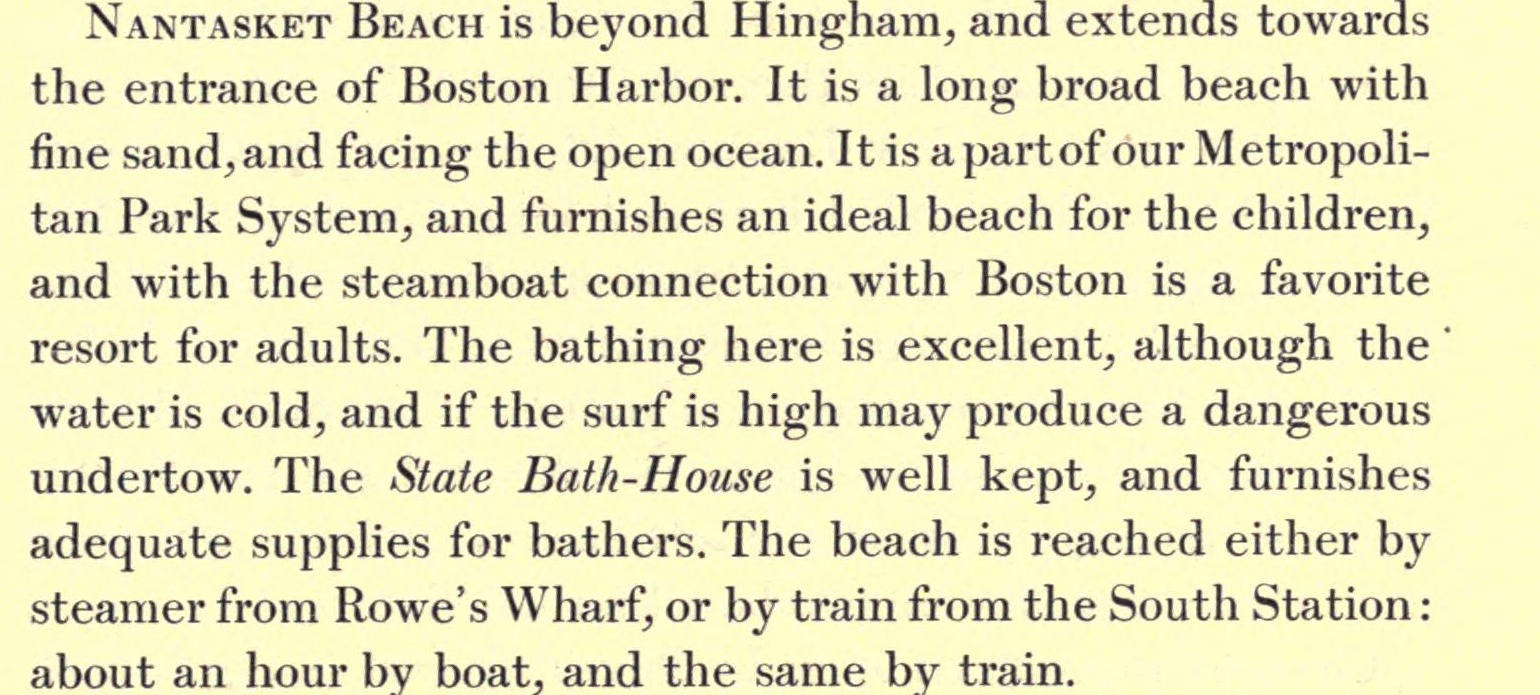
Nantasket Beach in A Guide-Book of Boston for Physicians (American Medical Association meeting, Boston, 1906), page 147. Internet Archive. Public domain. Click the clipping to read it full size.
It gave an honest warning, too: “The bathing here is excellent, although the water is cold.” Anyone who has stuck a toe in the ocean near Boston knows that’s still true. That cold water may explain the faces in our photo. The children are taking it slowly, one step at a time.
Getting there was part of the fun. The guidebook says the beach was “about an hour by boat” from Rowe’s Wharf in Boston, or about the same by train.
What a Day at Nantasket Beach Cost
If you did want a real bathing suit at Nantasket Beach, the state would rent you one. In 1902 the commission opened a brand new bath house at Nantasket Beach, on June 21. It was 335 feet long, longer than a football field. Inside were 392 little dressing rooms. Near the stairs down to the sand were foot tubs with hot and cold showers, for washing the sand off before you went home.
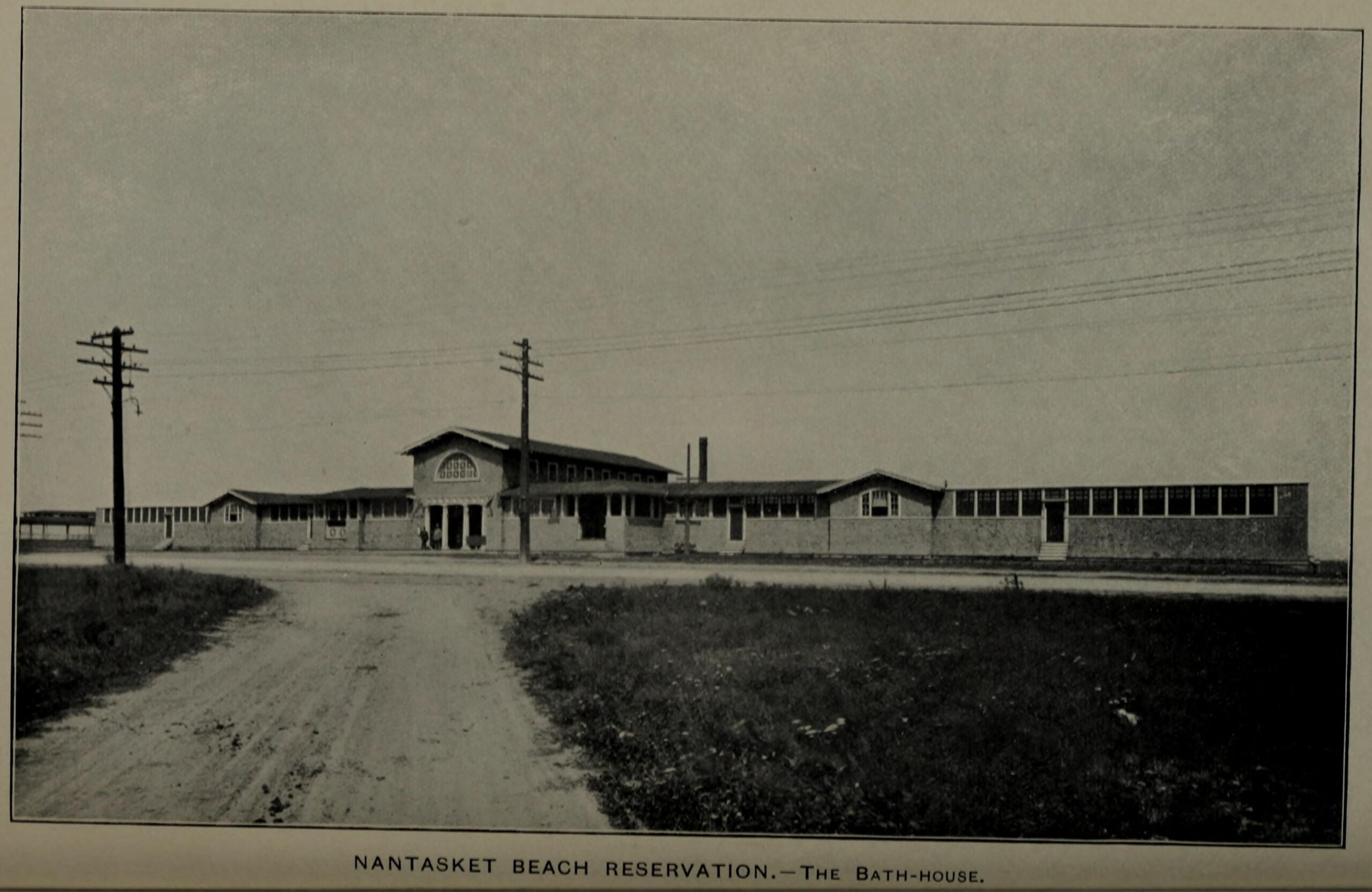
The new state bath house at Nantasket Beach Reservation, from the Report of the Board of Metropolitan Park Commissioners (January 1903), plate after page 32. Internet Archive. Public domain. Click the picture to see it full size.
The commission printed its prices, and they’re the best part:
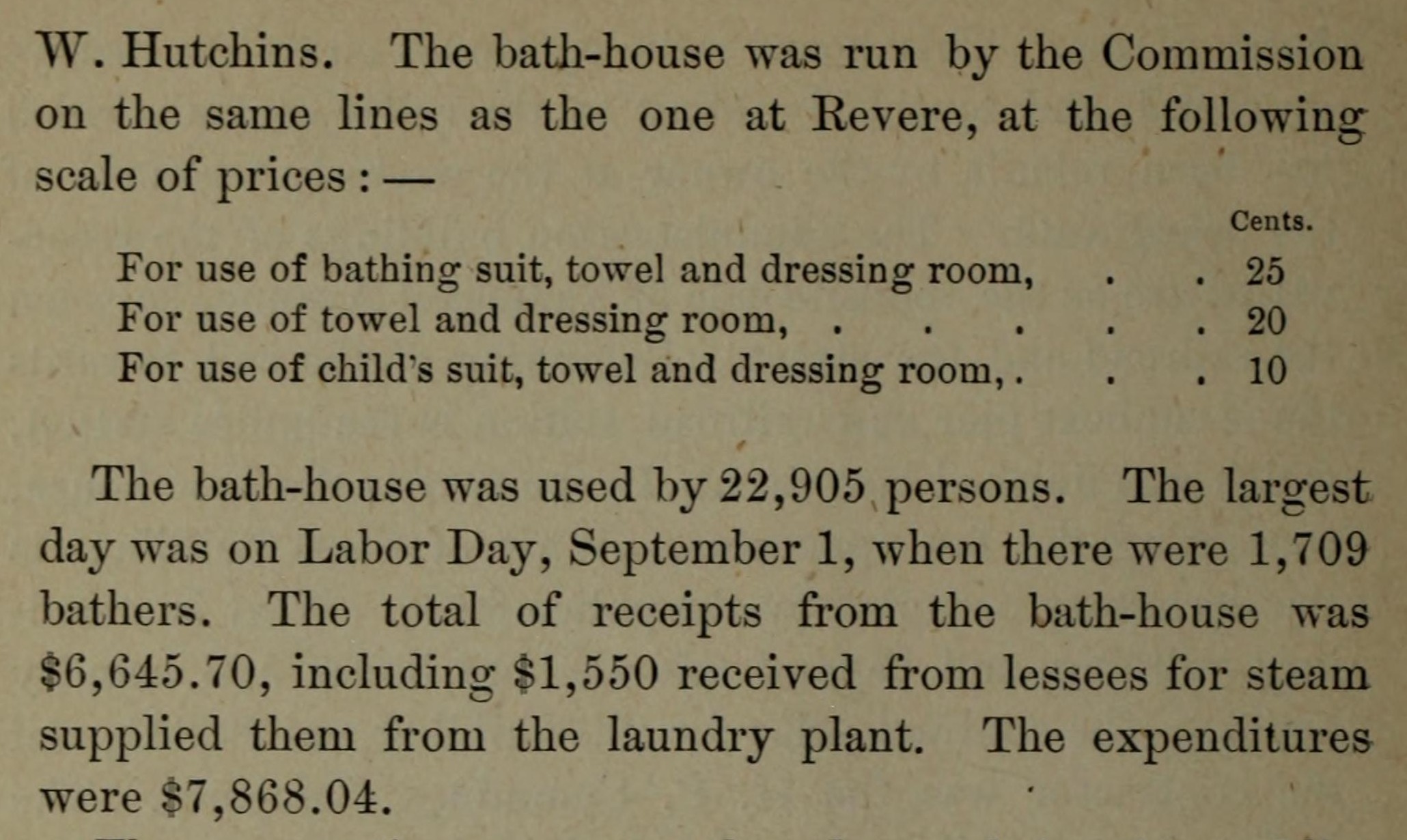
Prices at the new Nantasket Beach bath house, from the Report of the Board of Metropolitan Park Commissioners (January 1903), page 34. Internet Archive. Public domain. Click the clipping to read it full size.
A grown-up paid 25 cents for a bathing suit, a towel and a dressing room. If you brought your own suit, the towel and the room cost 20 cents. And a “child’s suit, towel and dressing room” cost just 10 cents, one thin dime.
That first summer, 22,905 people used the bath house. The busiest day was Labor Day, September 1, with 1,709 bathers. By 1906 the bath house had its best year yet: 35,728 bathers. The biggest day ever up to then was Sunday, August 19, 1906, when 2,188 people came through. That same summer, the state paid for band concerts every afternoon and evening at Nantasket Beach.
Paragon Park, Next Door to the Waves
Just behind Nantasket Beach, Paragon Park opened in 1905 with rides and a tall tower. One of the Detroit company’s plates from the same set of numbers shows it, with low buildings along the beach in front.
[IMAGE: photos/nantasket-beach-paragon-park-1905.jpg | “[Nantasket Beach, Mass.],” which the library notes “Includes Paragon Park amusement park.” Dated 1905 with a question mark. Detroit Publishing Co. Library of Congress, Prints and Photographs Division, Detroit Publishing Company Collection. No known restrictions on publication.]
Paragon Park lasted almost 80 years. It closed in 1984. Its old carousel, built in 1928, still turns on the boardwalk today.
Nantasket Beach Today
Nantasket Beach is still a public beach, still run by the state of Massachusetts, more than 120 years after the state took it over for everyone. On a summer day it is still full of families, and some of them are still standing at the edge of the foam, holding a very small person by the arms.
The man in the dark cap and the six children with him never got their names in the record. But somebody at the Detroit Publishing Company knew exactly what they were looking at. They wrote two words on the jacket that anyone can understand, more than a century later: first lessons.
Sources
- Detroit Publishing Co., “[Sea shore, first lessons],” between 1900 and 1910, Detroit Publishing Co. no. 034117, “2829” on negative, 1 glass negative, 8 x 10 in.: Library of Congress, item 2016809584 (LC-D4-34117). Second plate, no. 034118, “2828” on negative: Library of Congress, item 2016809585. No known restrictions on publication.
- Neighboring plates: “[Nantasket Beach, Mass.],” [1905?], “Includes Paragon Park amusement park,” “2817” on negative: Library of Congress, item 2016809566; “[Nantasket Beach, Mass.],” Atlantic House in background, “2821”: item 2016809567; “[Nantasket Beach, Mass., casino (formerly Hotel Nantasket)],” “2814”: item 2016809569; “[In the surf, Nantasket Beach, Mass.],” “2825”: item 2016809582.
- About the company: Library of Congress, Detroit Publishing Company collection.
- Report of the Board of Metropolitan Park Commissioners, January 1901 (the 1900 season): the takeover, the torn-down buildings and the women and children, page 44 and page 46. Internet Archive.
- Report of the Board of Metropolitan Park Commissioners, January 1903 (the 1902 season): the new bath house, page 31 and page 32, its picture, plate, and its prices and crowds, page 34. Internet Archive.
- Report of the Board of Metropolitan Park Commissioners, January 1907 (the 1906 season): 35,728 bathers, the record day and the band concerts, page 32. Internet Archive.
- A Guide-Book of Boston for Physicians (American Medical Association, Boston, 1906), Nantasket Beach, page 147. Internet Archive.
- Paragon Park, 1905 to 1984, and its carousel: Wikipedia, Paragon Park. Nantasket Beach today: Massachusetts Department of Conservation and Recreation, Nantasket Beach Reservation.