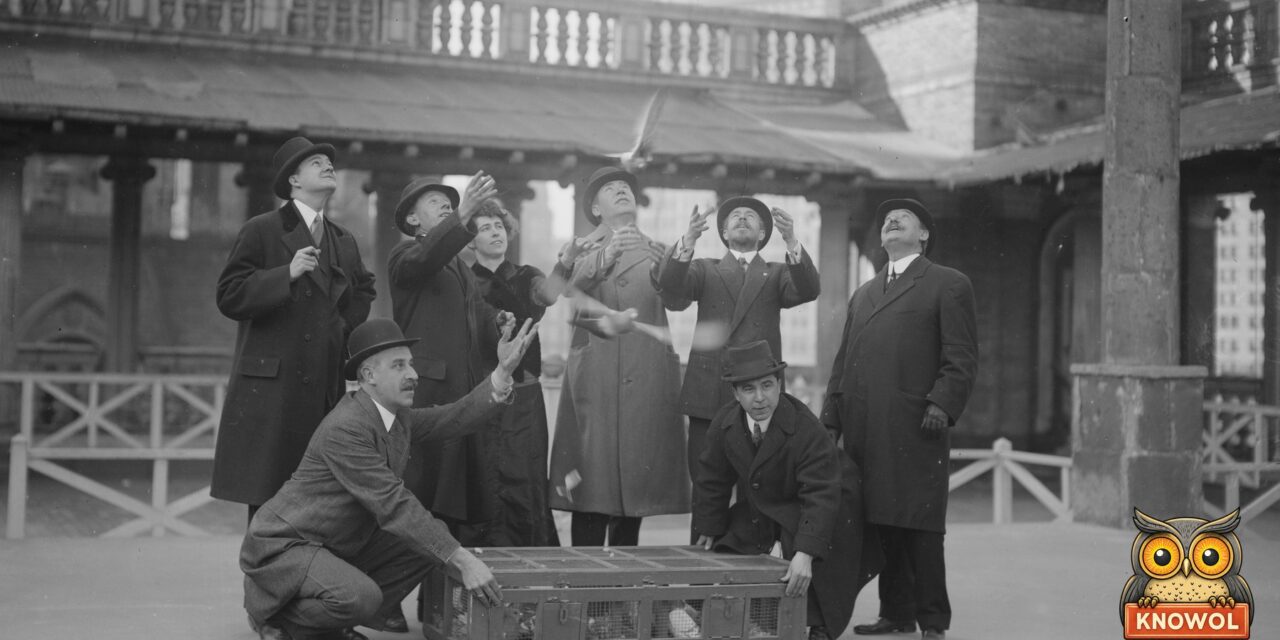
Every summer afternoon in 1895, a crowd gathered in Avalon, California, the little resort town on Santa Catalina Island, to watch a few pigeons fly away. “The flight of the birds is one of the events of the day at Avalon and is always witnessed by an immense throng of spectators,” the San Francisco Call reported that August. When the birds were let go, they circled for a few minutes to get their bearings. Then they shot off “in an airline for the mainland,” which means in a straight line, toward Los Angeles, about 50 miles away. Each of those pigeons was carrying a message.
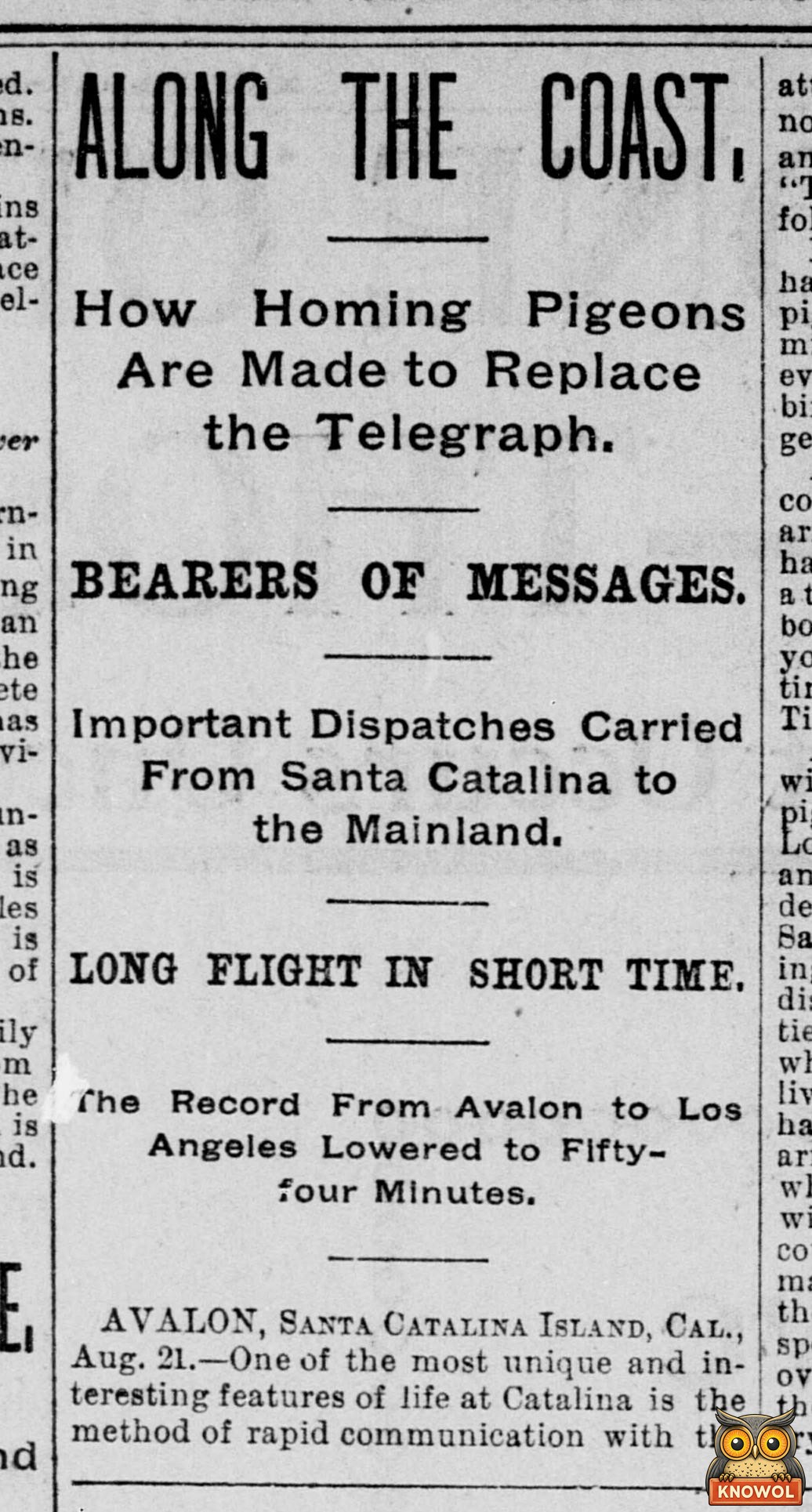
“How Homing Pigeons Are Made to Replace the Telegraph.” The San Francisco Call, San Francisco, California, August 22, 1895, page 4. Library of Congress, Chronicling America. Click the clipping to read it full size.
An island cut off from the world
In the 1890s, Catalina Island had no fast way to send a message to the mainland. A steamer boat ran to the island once a day. A trip to Los Angeles by boat and train took three to four hours, the San Francisco Chronicle said in a story other papers printed that June. For a vacationer with important business, that was a long wait. The Chronicle writer once heard a financier, a man who dealt in big money, say, “I’d give $500 gladly to get a dispatch to Los Angeles; it would be worth $5,000 to me easy.” A dispatch is a quick message.
Two young men from Los Angeles had an answer: Otto and Oswald Zahn. They raised homing pigeons. A homing pigeon is a bird that always flies straight back to its home, even from far away. The brothers tested the idea in January 1894, when four of their pigeons flew news from Catalina to the Los Angeles Herald. By the summer of 1895 they kept a loft of sixty trained birds. A loft is a pigeon house.
How to mail a letter by pigeon
The message was “typewritten on the thinnest of tissue paper,” the Call explained. One bird could carry enough news to fill a whole newspaper column. The paper was rolled up into a tiny tube “as thick as a lead pencil and an inch long,” and it weighed one twenty-second of an ounce, about as much as a paper clip. It was tied loosely to the bird’s leg with a strong cord.
The pigeons flew only in daylight. Messages could go out up to 5 p.m., because after that “the darkness is apt to confuse the birds.” Young pigeons in training carried “bogus messages,” or fake ones, so they could get used to the extra weight.
When a bird reached the loft on Hope Street in Los Angeles, it pushed past a dangling wire as it went in. The wire rang an electric bell inside the Zahn house. Someone hurried out, took off the message, made sure the bird had food and water, and delivered the news. The Los Angeles Times got a story from the island this way every summer day.
Orlando and Missey
The fastest flyer in the loft was a pigeon named Orlando. The trip from Avalon to Los Angeles usually took anywhere from 54 minutes to an hour and a half. Orlando held the record: 54 minutes, more than two hours faster than the boat and the train.
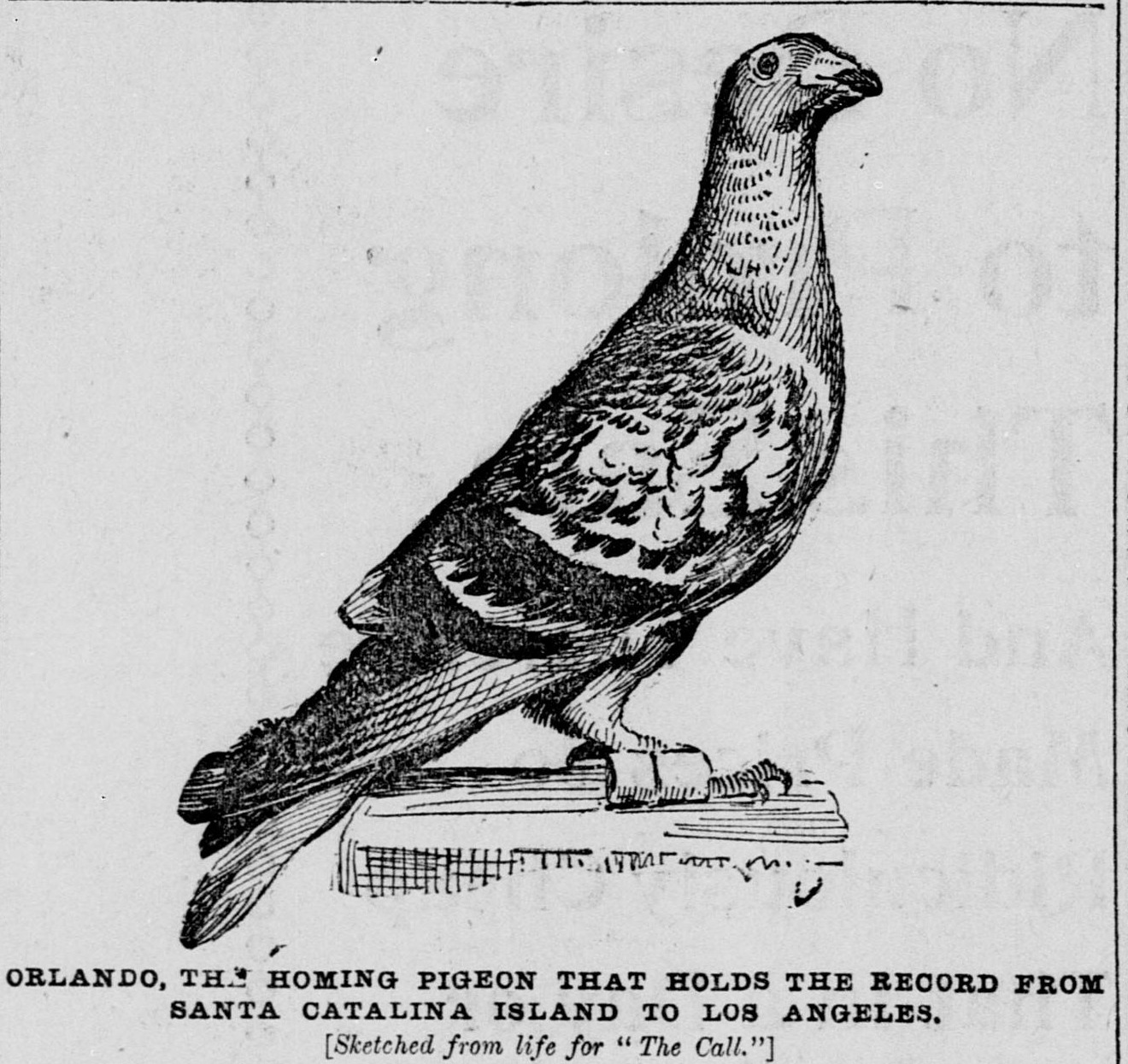
“Orlando, the Homing Pigeon That Holds the Record From Santa Catalina Island to Los Angeles. Sketched from life for The Call.” The San Francisco Call, San Francisco, California, August 22, 1895, page 4. Library of Congress, Chronicling America. Click the picture to see it full size.
The Call liked a young bird named Missey, too. It called her “a pretty, plump little pigeon, with a coquettish eye.” Coquettish means flirty. She was still learning, but she had already carried the Times message twice that season.
The birds were good at their jobs. Since June 1, the Call said, “not a single message has missed its destination.” A few came in a day late after the birds got lost in fog.
The pigeon that surprised a bride
Anyone on the island could send a message by pigeon. Little signs posted around Avalon promised that “private messages and business orders may be forwarded at any hour of the day.” From Los Angeles, a message could go on by telegraph to anywhere in the world.
One pigeon even brought a surprise the other way. Early that summer, a newly married couple from San Francisco were vacationing at Catalina. They had been “posing as an old married pair,” pretending they weren’t newlyweds at all. Then a friend in Los Angeles sent congratulations, tied with white ribbon to a snow-white pigeon, with orders to deliver the message “bird and all” to the happy couple. The bird arrived in the middle of the afternoon, when the porches of the Hotel Metropole were packed with guests.
The secret was out. “A dreadfully conscious blush overspread the fair face of the bride,” the Call reported, while the groom tried hard to look calm. “The couple left the island by the early morning boat.”
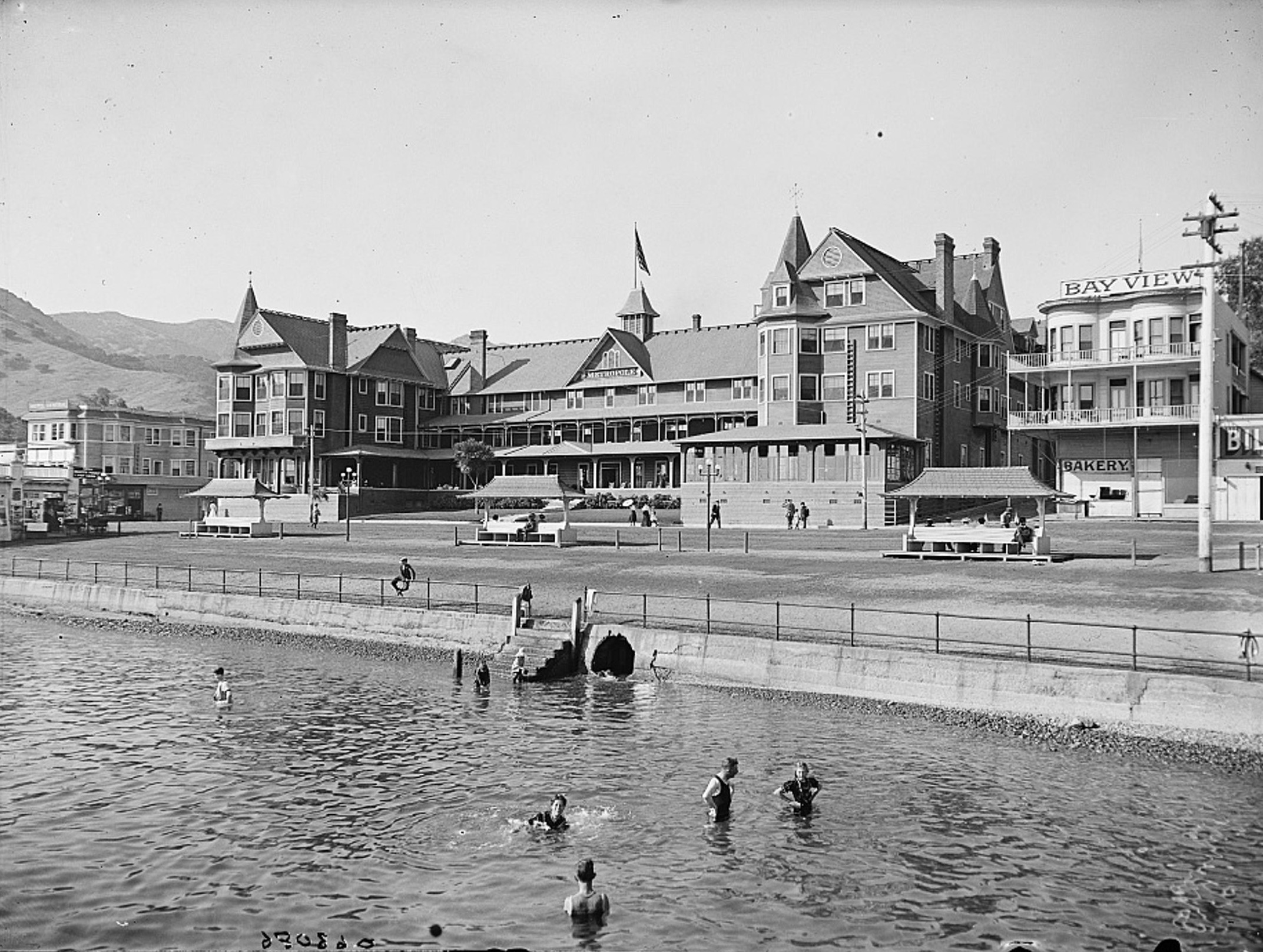
The Hotel Metropole on the beach at Avalon, Santa Catalina Island, California, with swimmers in front, sometime between 1900 and 1915. Its porches are where the bride’s white pigeon arrived in 1895. Detroit Publishing Co., Library of Congress, Prints and Photographs Division. Click the picture to see it full size.
By the numbers
- 50 miles from Avalon to Los Angeles, in a straight line
- 54 minutes for Orlando’s record flight
- 3 to 4 hours for the same trip by boat and train
- 60 trained pigeons in the Zahn brothers’ loft
- 1 inch long, the size of a rolled-up message
In 1895 the fastest way to get news off Catalina Island had feathers. Every afternoon the town came out to watch it leave.
Sources
- The San Francisco Call (San Francisco, California): August 22, 1895, page 4 (“Along the Coast. How Homing Pigeons Are Made to Replace the Telegraph,” with the sketches of Orlando and Missey).
- Richmond Dispatch (Richmond, Virginia): June 25, 1895, page 2 (“Catalina’s Pigeon Post,” reprinted from the San Francisco Chronicle).
- The Herald (Los Angeles, California): January 29, 1894, page 2 (“News by Pigeons. Four Homing Pigeons Arrive From Santa Catalina”).
- All newspaper images: Library of Congress, Chronicling America. Published 1894 and 1895, public domain.
- Photograph: Hotel Metropole, beach and swimmers, Avalon, Catalina Island, Detroit Publishing Co., between 1900 and 1915, Library of Congress, no known restrictions.
- Cover: “Carriers start for Wash’n, 2/13/15,” homing pigeons let go from a New York City rooftop for a flight to Washington, D.C., February 13, 1915, George Grantham Bain Collection, Library of Congress, no known restrictions. It shows how a pigeon flight started, not Avalon.