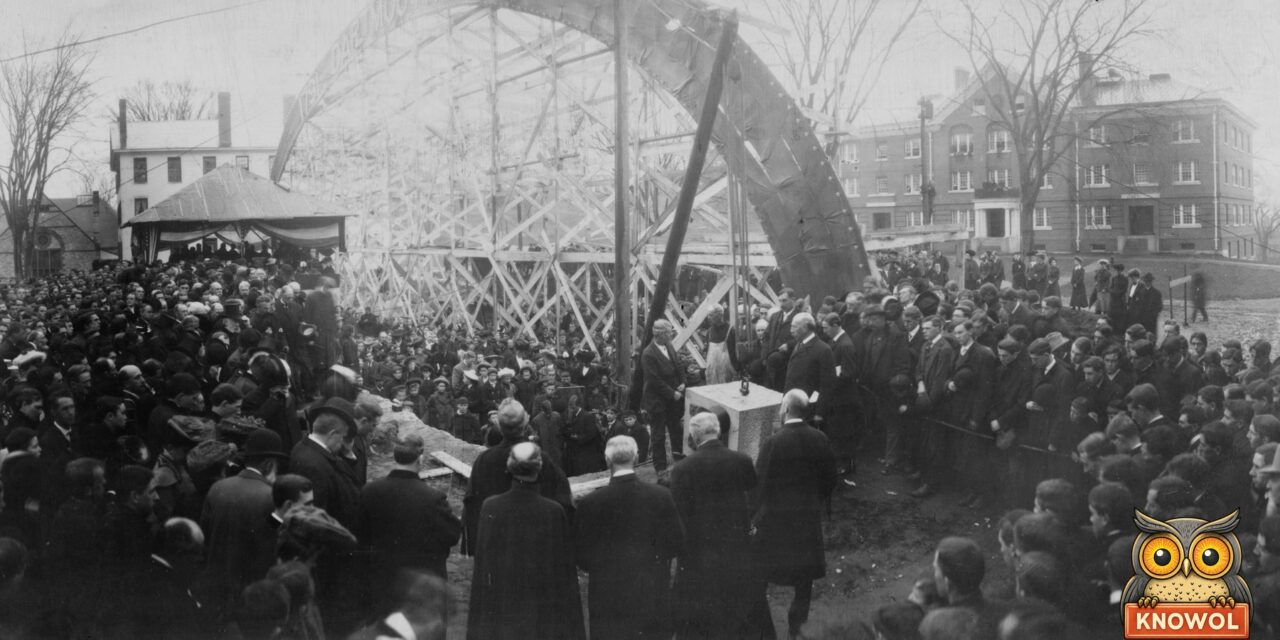
It’s late on a gray afternoon, October 26, 1904, in Hanover, New Hampshire. A huge crowd is packed around one square block of stone. Students in dark coats crowd in on the right. Women in big hats fill the left. In the middle, a few gray-haired men stand bareheaded by the stone, and ropes hang over it from a tall wooden pole, a derrick for lifting heavy things. Behind them all rises a giant wooden arch, taller than the houses, lined with light bulbs. The stone is the first piece of a new building. The man who came to set it in place had traveled all the way from England to do it.
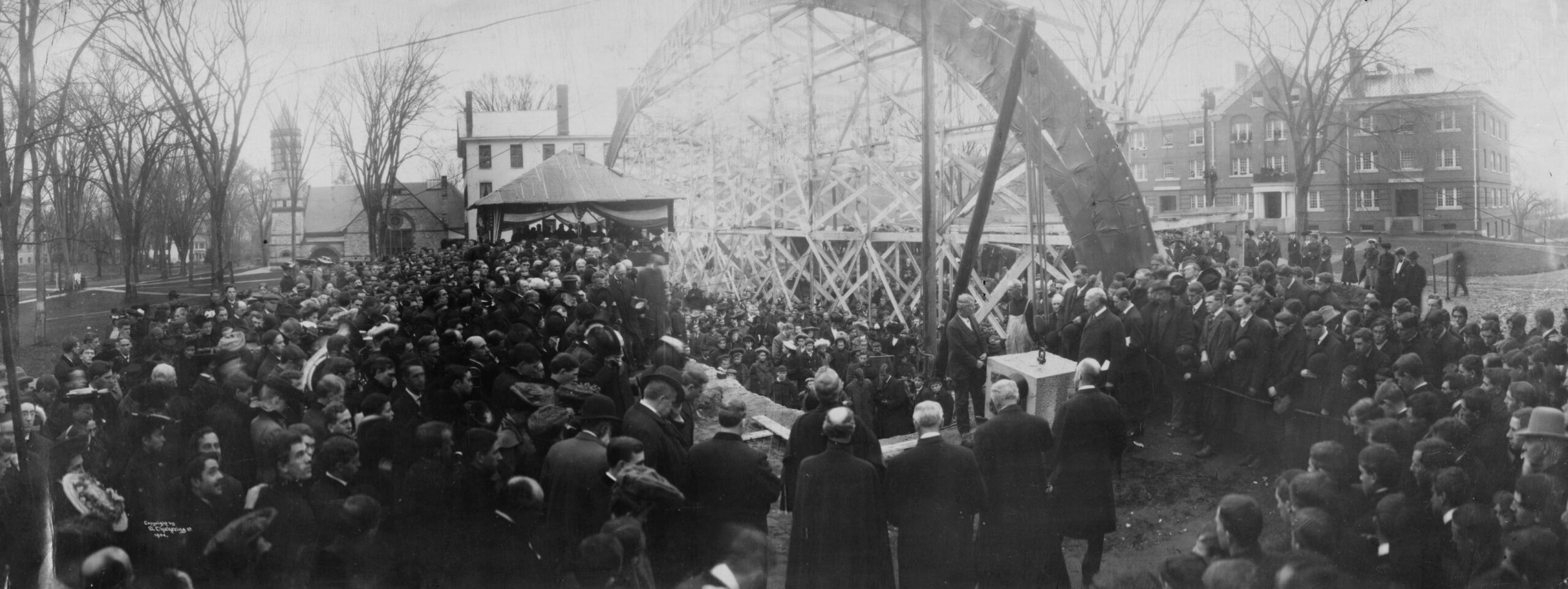
“One panoramic photograph showing the Earl of Dartmouth laying the corner stone of new building at Dartmouth College, Oct. 26, 1904.” E. Chickering & Co., Hanover, New Hampshire, October 1904. Library of Congress, Prints and Photographs Division, Panoramic Photographs. No known restrictions on publication. Click the picture to see it full size.
Why Hanover, New Hampshire, Needed a New Dartmouth Hall
Eight months before this picture, Dartmouth College in Hanover lost its oldest building. Dartmouth Hall was a long, white wooden building with a clock on the front and a little bell tower on top. It was finished in 1791, back when George Washington was president. For almost fifty years it was the whole college: the classrooms and the chapel, all under one roof.
On the morning of February 18, 1904, it burned. The college’s own book about that year says so, and it says the trustees met two days later and voted to raise money and build it again. The college’s graduates, called alumni, paid for the new one.
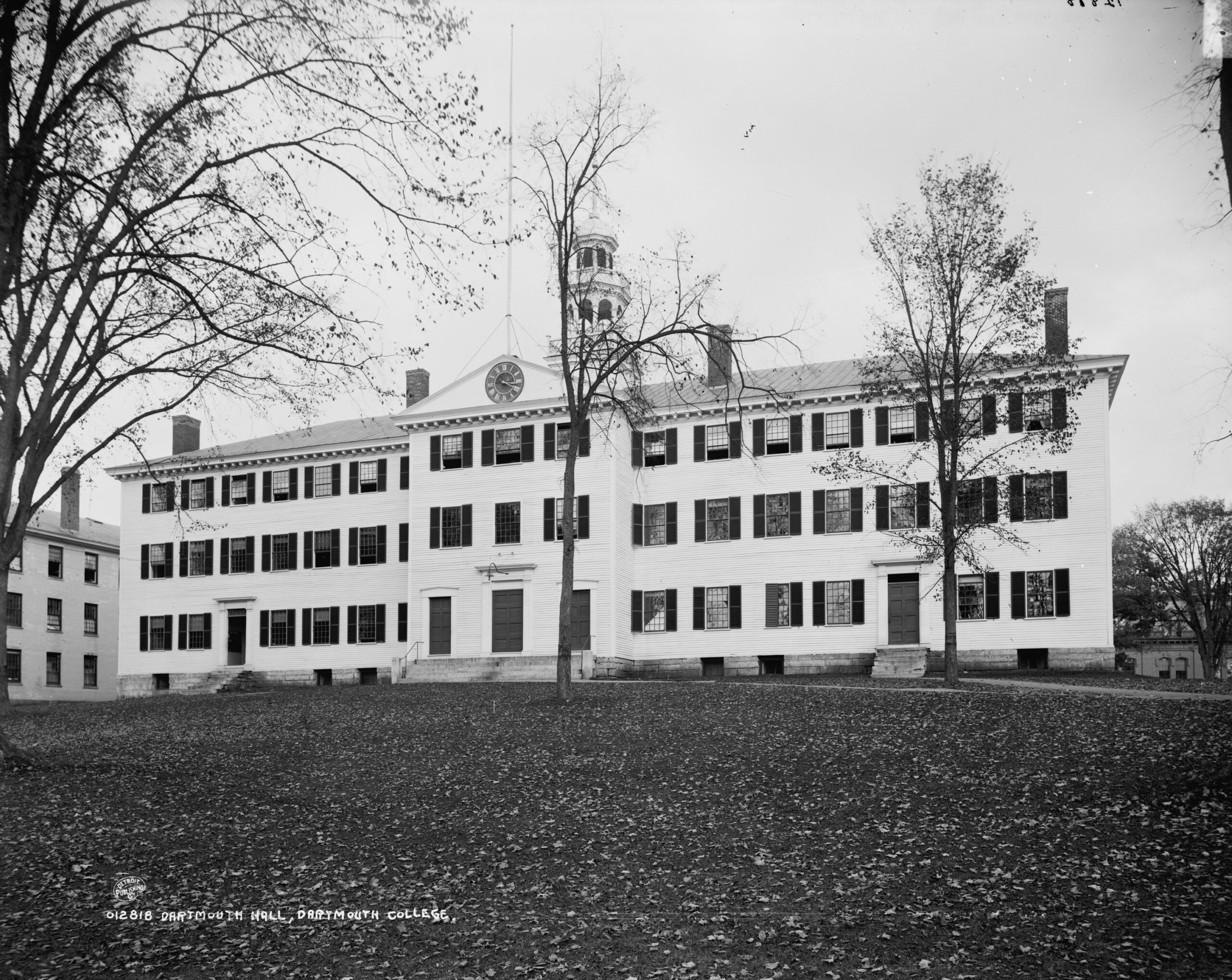
“Dartmouth Hall, Dartmouth College.” Detroit Publishing Co., about 1900 (in the company’s 1901 catalog). Library of Congress, Prints and Photographs Division, Detroit Publishing Company Collection. No known restrictions on publication. Click the picture to see it full size.
At the 1904 ceremony, a New York graduate named Charles F. Mathewson gave a speech about the old hall. He remembered “the old bell which summoned us to chapel and to the class-room.” Then he added a joke every old student must have known: “the College clock, which seldom agreed with the bell.”
A Visitor From England Comes to Hanover
The college in Hanover is named for a real person. In the 1760s, William Legge, the second Earl of Dartmouth, led the group of English supporters who held the money raised for the school of the Reverend Eleazar Wheelock. When Wheelock started his college in the New Hampshire woods in 1769, he named it after the earl.
In 1904, his descendant held the same title. William Heneage Legge, the sixth Earl of Dartmouth, was 53 years old and had spent years in British politics. The college asked him to come lay the cornerstone of the new hall, and he said yes. He crossed the Atlantic on a steamship, and the Countess of Dartmouth and Lady Dorothy Legge came with him.
The town of Lebanon, a few miles south of Hanover, got the first look. On October 25, the earl’s private railroad car rolled through. A Manchester paper, the New Hampshire Farmer and Weekly Union, reported what happened at the depot:
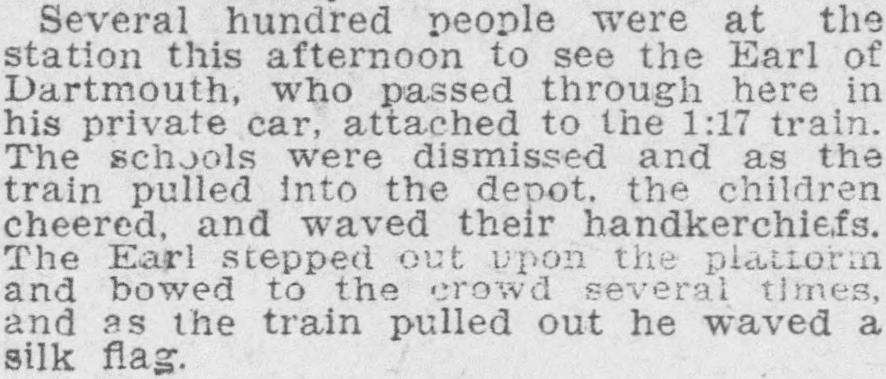
New Hampshire Farmer and Weekly Union, Manchester, New Hampshire, October 26, 1904, page 4, Lebanon news. Library of Congress, Chronicling America. Click the clipping to read it full size.
“The schools were dismissed and as the train pulled into the depot, the children cheered, and waved their handkerchiefs.” The earl stepped out and bowed to the crowd, and “as the train pulled out he waved a silk flag.” So the kids of Lebanon got the afternoon off from school to wave at a real English lord.
The Earl’s First Football Game in Hanover
The earl and his family rode the last miles from West Lebanon to Hanover by carriage. The students crowded onto the porch of College Hall and cheered, and the bells of Rollins Chapel rang.
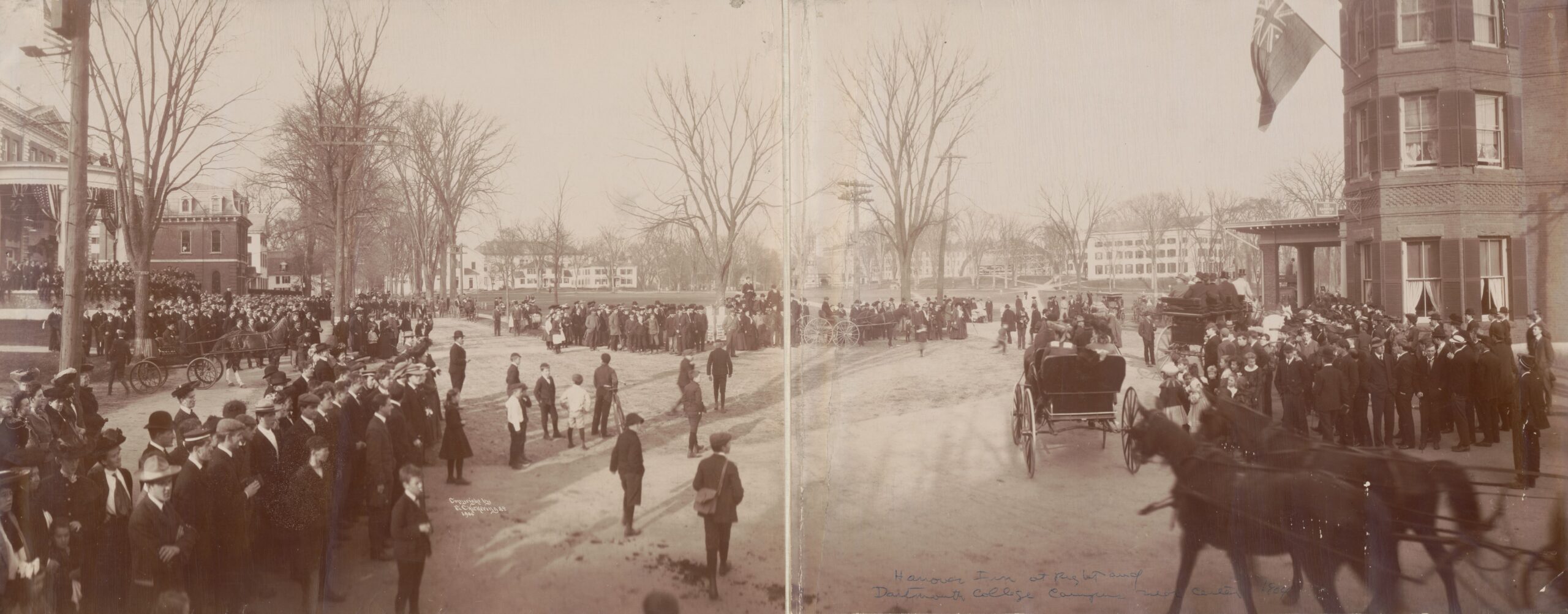
“One panoramic photograph showing Hanover Inn at right of picture and the Dartmouth College campus near centre of picture.” E. Chickering & Co., Hanover, New Hampshire, 1904 (sent to the Copyright Office the same day as the cornerstone photo). Library of Congress, Prints and Photographs Division, Panoramic Photographs. No known restrictions on publication. Click the picture to see it full size.
The same photo studio sent this second panorama to the Copyright Office in Washington on the same day as the cornerstone picture. It shows a crowd and carriages outside the Hanover Inn, with a British flag hanging off the corner. The record doesn’t say what day it shows, but it was probably that same week.
The first thing the college showed its famous guest was a football game. It was only a practice match, the varsity team against the second team, but the earl had never seen one. The Springfield Republican, a Massachusetts paper, told how it went:
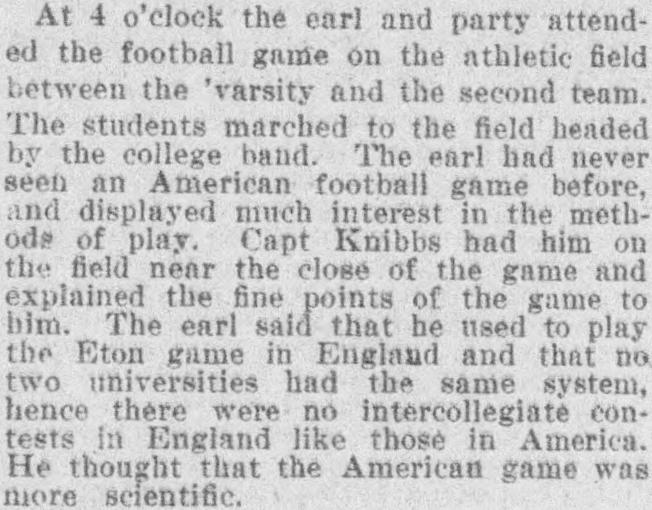
Springfield Weekly Republican, Springfield, Massachusetts, October 28, 1904, page 9. Library of Congress, Chronicling America. Click the clipping to read it full size.
“The earl had never seen an American football game before,” it said. Near the end, the team captain, Knibbs, brought him onto the field and “explained the fine points of the game to him.” The earl said he used to play “the Eton game” in England, the kind of football played at Eton, a famous English school. His verdict: “the American game was more scientific.”
That night he ate supper with the whole student body. In the middle of dinner, the college’s book says, “the electric lights suddenly went out.” The room sat in total darkness for a few moments. The students didn’t miss a beat. They sang college songs until the lights came back on.
Rain and a Trowel in Hanover
The big day, Wednesday, October 26, started with rain. In the morning, in the college church, Dartmouth gave the earl an honorary degree. He gave the college a gift in return: the real letters that Eleazar Wheelock and the second earl had written to each other in the 1700s, which his family had kept in England.
The rain kept on, so the speeches planned for the building site were moved inside the church. After that, the whole crowd marched out to Wheelock’s grave in the cemetery, and then on to the stone. That is the moment in the photograph. Look at the big wooden arch behind the people. The college’s book says that “over the Dartmouth Hall site was an electric arch.” Zoom in on the photo, and the light bulbs spell out “1791” and “DARTMOU…” along its curve.
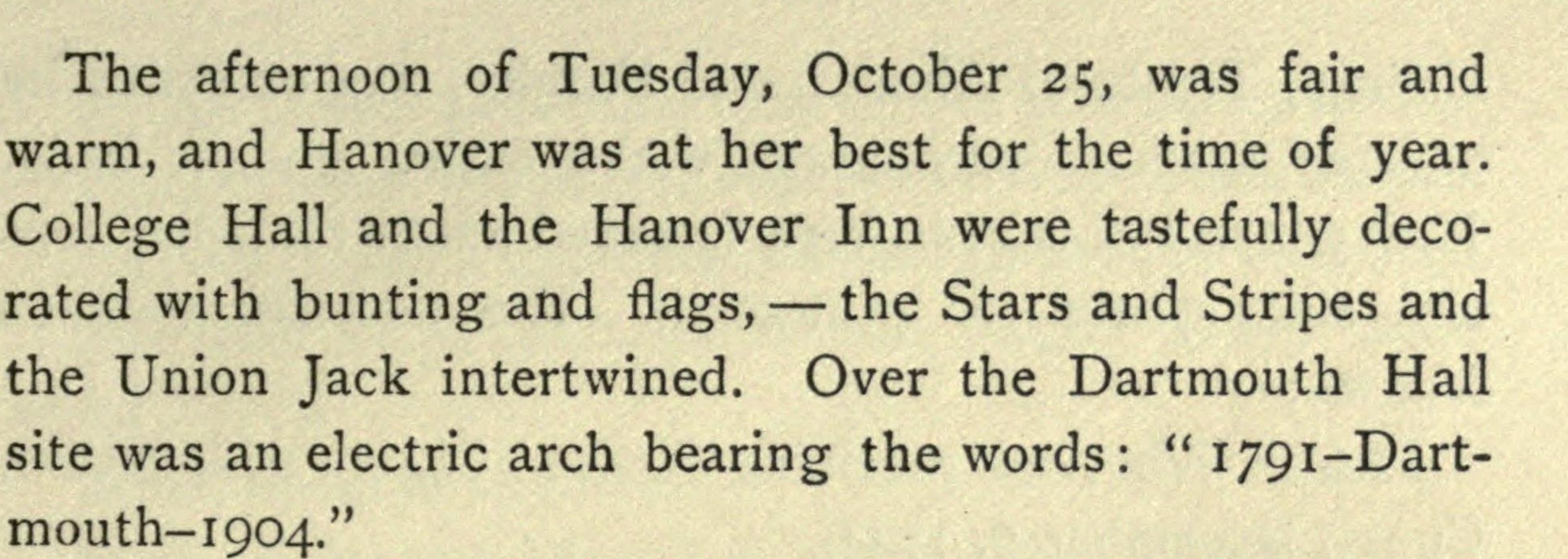
Exercises and Addresses Attending the Laying of the Corner-Stone of the New Dartmouth Hall and the Visit of the Earl of Dartmouth (Dartmouth College, 1905), page 9. Internet Archive. Public domain. Click the clipping to read it full size.
The book gives the whole sign: “1791-Dartmouth-1904.” That means the year the old hall was finished, the name, and the year it was born again.
A congressman from Massachusetts, Samuel L. Powers, handed the earl a trowel, the flat tool masons use to spread mortar. The earl spread mortar around the stone and said the words that make it official:
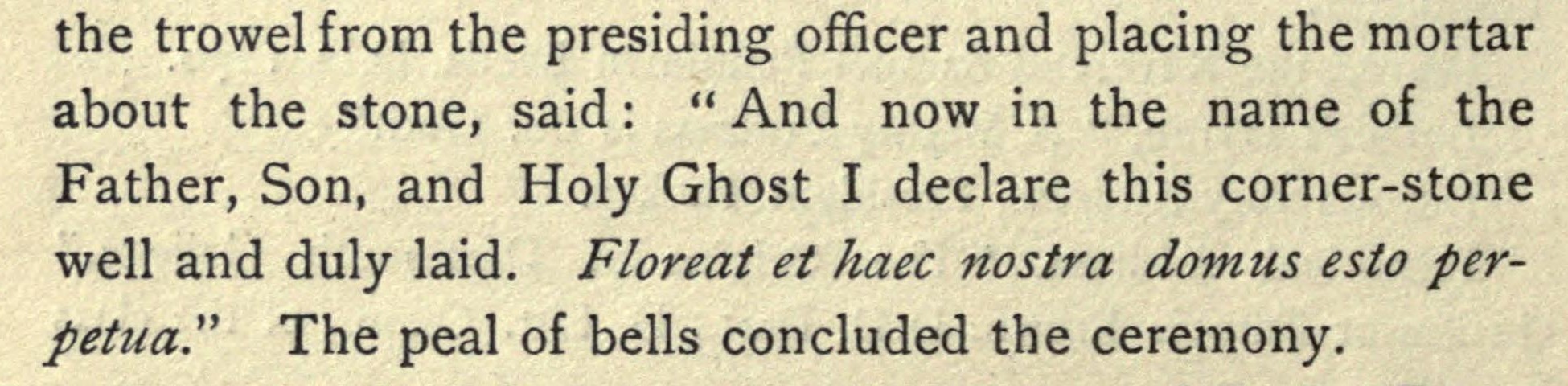
Exercises and Addresses Attending the Laying of the Corner-Stone of the New Dartmouth Hall (1905), page 14. Internet Archive. Public domain. Click the clipping to read it full size.
“I declare this corner-stone well and duly laid,” he said, and then added a line in Latin. It means, roughly, “May this house of ours also flourish and last forever.” Then the chapel bells rang again.
What Went Inside the Stone in Hanover
A cornerstone is often hollow, like a time capsule. The college’s book lists what went inside this one. There were college catalogs and a student directory for 1904-1905. There was a copy of the student newspaper, The Dartmouth, from October 21, 1904, and a yearbook made by the class of 1905. There was even an estimate of what all the college’s buildings were worth that October.
Who Took the Picture in Hanover
The picture was made by E. Chickering & Co., the Boston photo studio of Elmer Chickering, who was best known for portraits. Its name is written in white in the lower left corner of the print. Three days after the ceremony, on October 29, 1904, the studio sent a copy to the U.S. Copyright Office, which is how it ended up at the Library of Congress.
It’s a panorama, a picture more than twice as wide as it is tall. The print is 29 inches long, almost as long as a baseball bat. Studios made pictures like this with a special camera that swung slowly from one side to the other while it took the picture, so it could fit a whole crowd. Studios often sold copies to the people who were there, so they could take home the day they stood in.
Dartmouth Hall in Hanover, New Hampshire, Today
The new Dartmouth Hall was built of brick instead of wood, but it was made to look very much like the old one, at nearly the same size. It was ready for classes in 1906. It still stands on the college green in Hanover today, and students still have classes there. A big renovation was finished in 2022.
The arch of light bulbs came down long ago, and the crowd went home. But the building that grew from the earl’s stone is still there, and so is the picture. For one rainy afternoon in 1904, a whole town, a college and a visitor from England stood shoulder to shoulder on wet ground to start over, and somebody’s camera turned slowly from one side of the crowd to the other and caught them all.
Sources
- E. Chickering & Co., “One panoramic photograph showing the Earl of Dartmouth laying the corner stone of new building at Dartmouth College, Oct. 26, 1904,” copyright deposit October 29, 1904 (H52334), 1 photographic print, 11.5 x 29 in.: Library of Congress, item 2007663474 (shown from the b&w film copy, LC-USZ62-123078). No known restrictions on publication.
- E. Chickering & Co., “One panoramic photograph showing Hanover Inn at right of picture and the Dartmouth College campus near centre of picture,” c1904, copyright deposit October 29, 1904 (H52335): Library of Congress, item 2007662567. No known restrictions on publication.
- Detroit Publishing Co., “Dartmouth Hall, Dartmouth College,” about 1900, no. 012818: Library of Congress, item 2016808240. No known restrictions on publication.
- Dartmouth College, Exercises and Addresses Attending the Laying of the Corner-Stone of the New Dartmouth Hall and the Visit of the Earl of Dartmouth (1905): the fire and the trustees’ vote, the arrival, the football game, the dinner, the electric arch (page 9), the rain, the earl’s words and the cornerstone contents (page 14), and Mathewson’s address about the bell and the clock (page 64). Internet Archive.
- New Hampshire Farmer and Weekly Union, Manchester, New Hampshire, October 26, 1904, Lebanon news: page 4. Library of Congress, Chronicling America.
- Springfield Weekly Republican, Springfield, Massachusetts, October 28, 1904, “Earl of Dartmouth Welcomed”: page 9. Library of Congress, Chronicling America.
- The Sun, New York, October 27, 1904, “New Hall at Dartmouth” (the derrick and the order of the day): page 9. Library of Congress, Chronicling America.
- Dartmouth Hall’s history, the brick rebuilding and its use today: Rauner Special Collections Library, Dartmouth College, “Dartmouth Hall” and Wikipedia, Dartmouth Hall. The second earl and the college’s name: Wikipedia, William Legge, 2nd Earl of Dartmouth. The sixth earl: Wikipedia, William Legge, 6th Earl of Dartmouth.