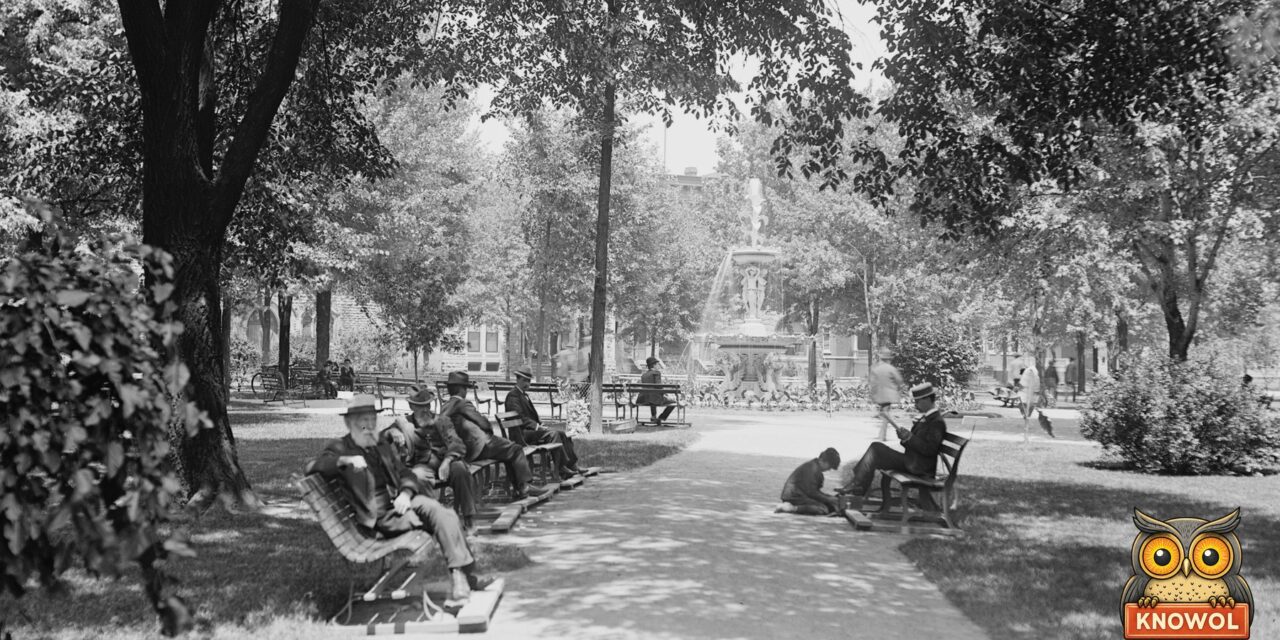
It’s a bright day in the 1890s, every tree is in full leaf, and the shade is thick under the elm trees of Grand Circus Park in Detroit, Michigan. A row of men in hats sits on the benches along the path. One old man with a long white beard leans back and stretches out his legs. Out past them, a tall fountain throws water into the air. Everybody here is resting. Everybody except one boy. He is kneeling on the path with a wooden box in front of him, and a man in a straw hat has one foot up on it. The man is reading. The boy is shining his shoes.
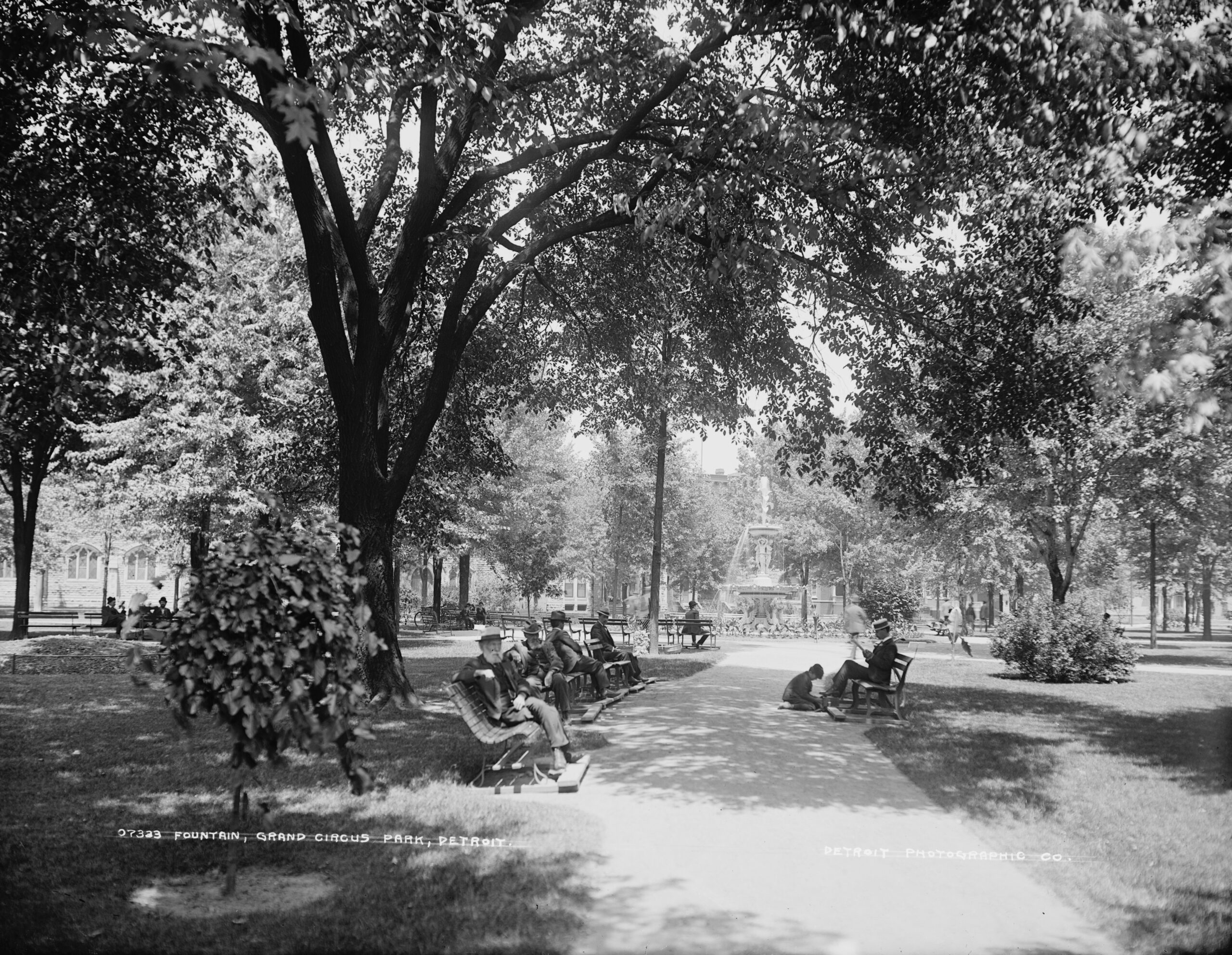
“Fountain, Grand Circus Park, Detroit.” Detroit Publishing Co., between 1880 and 1899 (in the company’s 1899 catalog). Photographer not named. Library of Congress, Prints and Photographs Division, Detroit Publishing Company Collection. No known restrictions on publication. Click the picture to see it full size.
Who Took the Picture in Grand Circus Park, Detroit
The picture of Grand Circus Park was made on an 8 by 10 inch glass plate by the Detroit Photographic Company, which later became the Detroit Publishing Company. You can see the name written right on the plate, in the lower right corner: DETROIT PHOTOGRAPHIC CO. On the left, in hand-lettered capitals, is the title and the number the company gave the picture. The Library of Congress lists it as number 07333.
The company didn’t shoot the news. It sold views of places, as prints and postcards, for people to hang up or mail home. The Library of Congress says the firm got its start in Detroit in the late 1890s. It doesn’t name the person who took this picture. The record says only that it was made between 1880 and 1899, and that it shows up in the company’s catalog of 1899.
The plates around it, with numbers just before and after, are almost all Detroit’s parks: Belle Isle, Water Works Park, Cass Park. So somebody from the company probably spent a nice stretch of weather going from park to park with a big camera on a stand.
That big camera explains one odd thing in the picture. Look behind the man in the straw hat, and a man walking by is a pale blur. Old glass plates needed a longer moment of light than a phone camera does. People who sat still came out sharp. People who kept walking turned into ghosts.
The Shoeshine Boy in Grand Circus Park
The boy is the one person in the picture doing a job. In the 1890s, a shoeshine worker was called a bootblack, because the black polish went on boots. A bootblack carried a box that held brushes, rags and tins of polish. The customer set one foot on top of the box, and the bootblack went to work, one shoe and then the other.
We don’t know this boy’s name. The record doesn’t give it, and nobody wrote it down. But we know a little about the work he did, from a Detroit bank.
In 1891 a Detroit guidebook printed a page from the Wayne County Savings Bank. It listed the jobs of the people who kept money in the bank on January 1, 1891. There were 2,600 carpenters and 3,733 clerks. There were 8 lamplighters, the people who lit the street lamps at night. And there were 752 infants, which means some parents were saving for their babies. Right in the middle of the list, it says: “Bootblacks, 93.” Just below on the other side is “Newsboys, 64.”
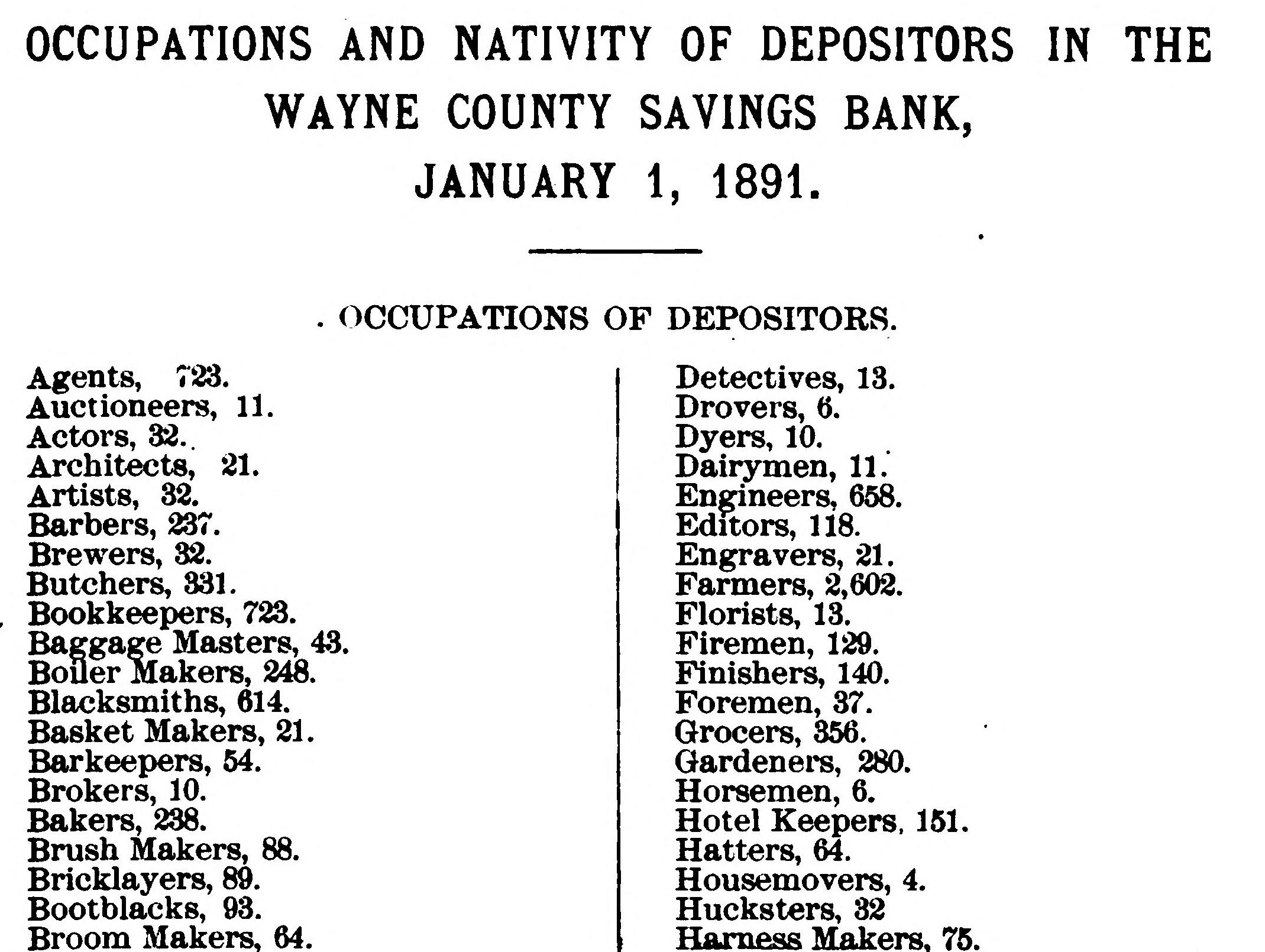
“Occupations and Nativity of Depositors in the Wayne County Savings Bank, January 1, 1891,” with “Bootblacks, 93.” Guide and Souvenir of Detroit (1891), page 111. Internet Archive. Public domain. Click the clipping to read it full size.
The list doesn’t say how old those 93 bootblacks were, or how much they saved. But 93 people in Detroit earned money one shine at a time, kneeling on sidewalks and in parks, and still put some of it in the bank.
What Grand Circus Park in Detroit Was Like
Grand Circus Park sits on Woodward Avenue, Detroit’s main street, a few blocks north of the river. It is shaped like half a circle. Woodward Avenue runs right through the middle, so it is really two parks, an east half and a west half. The judge who planned this part of Detroit, Augustus Woodward, laid it out after a fire burned down the town in 1805. The name comes from the big round arenas of old Rome, which were called circuses.
By the 1890s, it was the place downtown to sit in the shade. An 1891 guidebook told visitors riding the Woodward Avenue streetcar that they would see “the Grand Circus Parks; their fountains and the seats inviting to rest and meditation.” It added that “especially on a summer evening, large numbers of children and adults gather to enjoy the cool of the day.”
A Detroit guide from 1893 says the park “abounds with fine shade trees, has two fountains,” and that the Woodward Avenue electric cars went right past it. One stood on each side of Woodward. The one in our photo is tall, with figures in the middle and water spilling down into a wide basin ringed with plants.
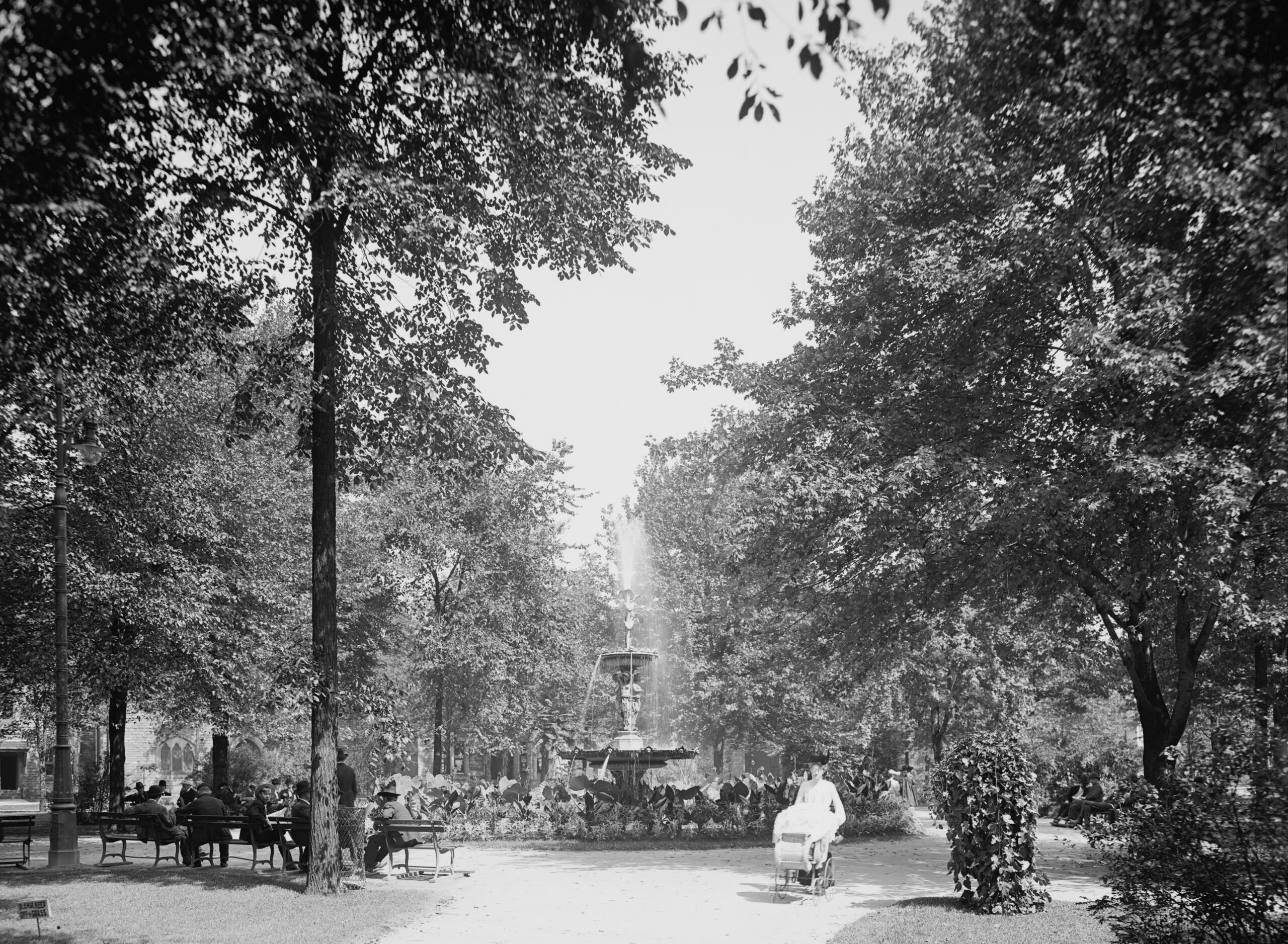
“Grand Circus Park, Detroit, Mich.” Detroit Publishing Co., between 1900 and 1910. Library of Congress, Prints and Photographs Division, Detroit Publishing Company Collection. No known restrictions on publication. Click the picture to see it full size.
Ice Water in Grand Circus Park
Detroit’s park department wrote a report every year, and those reports tell what the park was really like to visit. Benches were so popular that the grass wore out. The report for the year that ended in June 1903 tells about “the severe wear the lawns receive around the seats.”
The park also got a treat for hot days. In the year that ended in June 1902, a new drinking fountain was finished in the west part of Grand Circus Park. It didn’t just give water. It gave ice water. Inside was a bin that held two and a half tons of ice, about as heavy as a big pickup truck, and the report says it “requires filling but twice a week.” A year later the east side got one too, a bigger one holding about three tons. Water ran through a coil of pipe packed in the ice, so it came out cold.
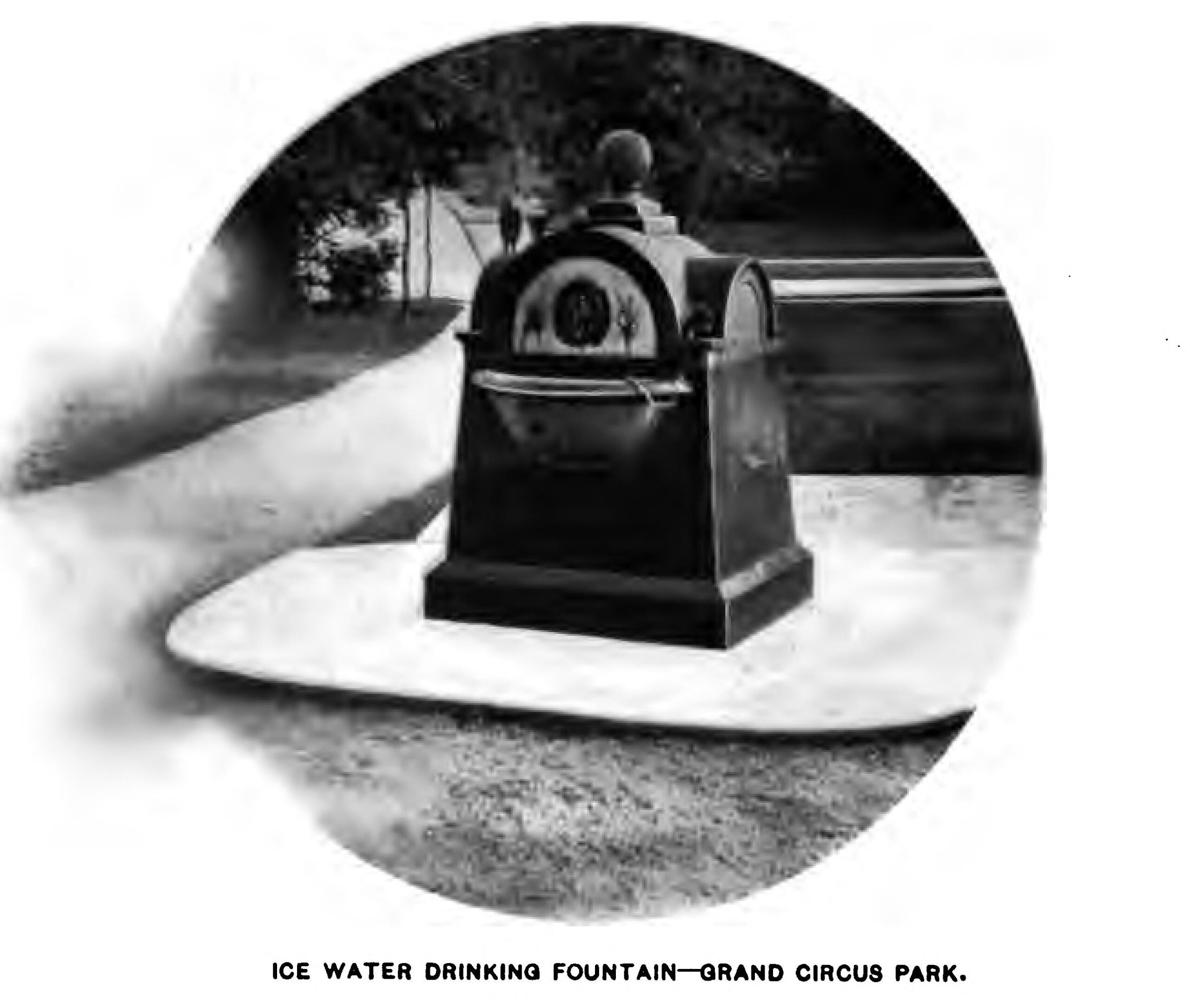
“Ice Water Drinking Fountain, Grand Circus Park.” Thirteenth Annual Report of the Commissioner of Parks and Boulevards, Detroit, for the year ending June 30, 1902, page 54. Internet Archive. Public domain. Click the clipping to read it full size.
That ice water came a few years after our photo. But it was built for people just like the boy on the path, kneeling in the summer heat one pair of shoes at a time.
The Old Fountains of Grand Circus Park, Detroit, Get Old
The fancy display fountains didn’t last forever. In that same 1903 report, the parks commissioner wrote that the display fountains “were cleaned and given two coats of paint.” Then he added: “I would suggest that these ancient style of fountains be replaced with more modern ones.” Ancient style meant old-fashioned. The fountains in our photo had gone out of style in less than a lifetime.
Detroit took his advice, slowly. Today the east half of the park holds the Russell A. Alger Memorial Fountain, a stone fountain with a bronze statue by Daniel Chester French, the sculptor of the Lincoln statue in Washington’s Lincoln Memorial. It was dedicated in 1921. The west half has the Edison Memorial Fountain, built in 1929 to honor the inventor Thomas Edison.
The park changed in other ways, too. In the 1890s photo, the trees are taller than most of the buildings. About twenty years later, tall hotels and office buildings stood all around it.
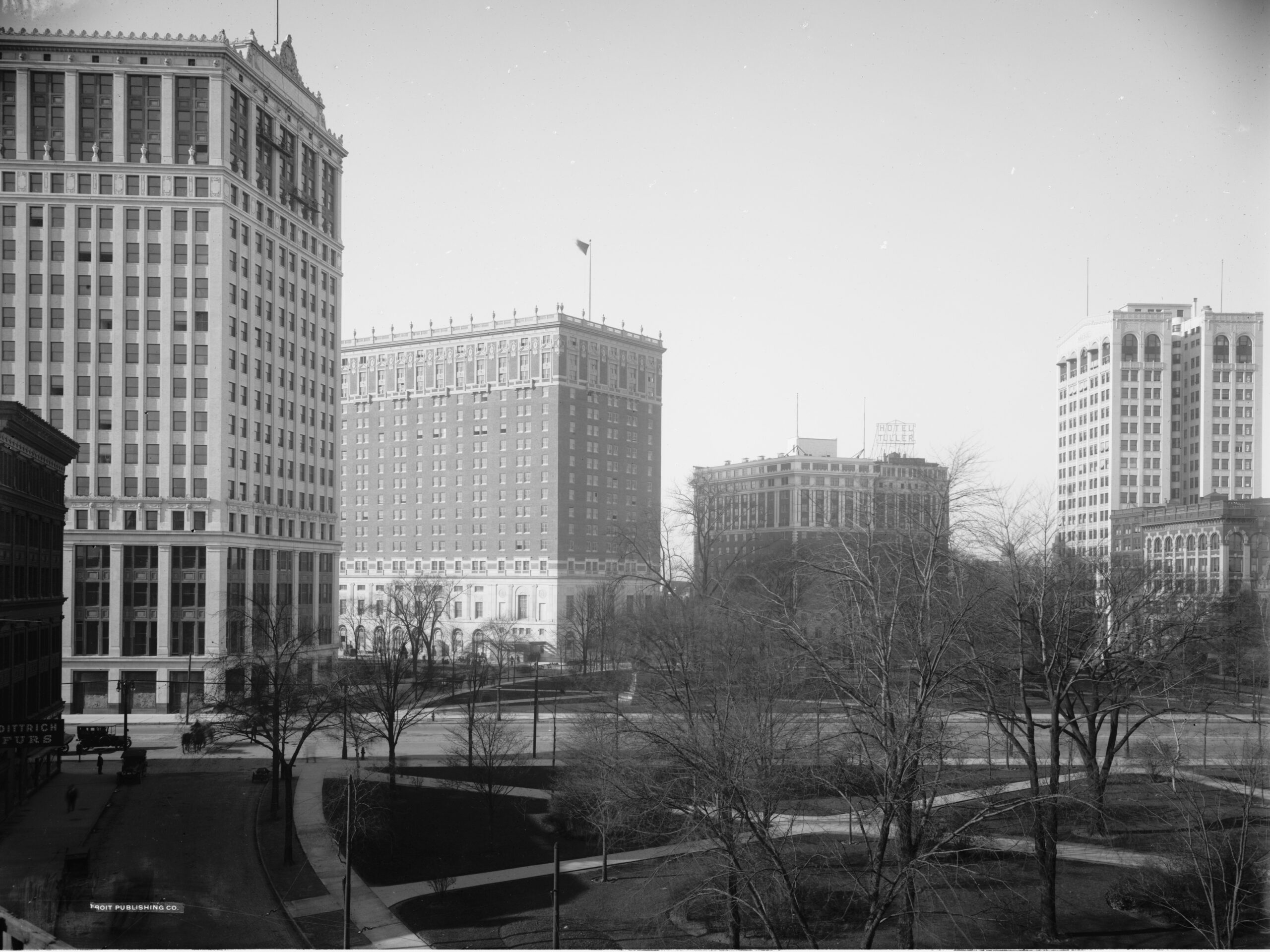
“Grand Circus Park west from Trowbridge Building, Detroit, Mich.” Detroit Publishing Co., between 1910 and 1920. Library of Congress, Prints and Photographs Division, Detroit Publishing Company Collection. No known restrictions on publication. Click the picture to see it full size.
Grand Circus Park, Detroit, Today
Grand Circus Park is still there, still split by Woodward Avenue, and still full of benches and trees. The neighborhood around it became the Grand Circus Park Historic District in 1983. Comerica Park, where the Detroit Tigers play baseball, is a short walk to the east.
The old metal fountains are gone, and so is the boy with the shoeshine box. Nobody wrote down his name. But a camera on a stand caught him on one bright day in the 1890s, the one person in a park full of resting grown-ups who was busy at work. Look at the picture again, and he’s easy to find: a small dark shape kneeling on a sunny path, with somebody’s shoe on his box.
Sources
- Detroit Publishing Co., “Fountain, Grand Circus Park, Detroit,” between 1880 and 1899 (date based on Detroit, Catalogue F, 1899), Detroit Publishing Co. no. 07333, 1 glass negative, 8 x 10 in.: Library of Congress, item 2016798662 (LC-D4-7333). No known restrictions on publication.
- Detroit Publishing Co., “Grand Circus Park, Detroit, Mich.,” between 1900 and 1910: Library of Congress, item 2016811682. “Grand Circus Park west from Trowbridge Building, Detroit, Mich.,” between 1910 and 1920: Library of Congress, item 2016800520. Neighboring plate numbers (Belle Isle, Water Works Park, Cass Park) from the same collection’s records. No known restrictions on publication.
- About the company: Library of Congress, Detroit Publishing Company collection.
- Guide and Souvenir of Detroit (1891): the Grand Circus Parks, page 20 of the scan; the Wayne County Savings Bank depositors list, page 111. Internet Archive.
- Gentsch’s Dictionary of Detroit and Its Vicinity (1893), “Grand Circus Park,” page 27. Internet Archive (Library of Congress copy).
- Detroit Commissioner of Parks and Boulevards, Thirteenth Annual Report (year ending June 30, 1902), the west ice water fountain, page 54; Fourteenth Annual Report (year ending June 30, 1903), the east ice water fountain and the worn lawns, page 29, and the “ancient style” fountains, page 30. Internet Archive.
- Grand Circus Park today, its shape, the Woodward plan and the 1983 historic district: Wikipedia, Grand Circus Park Historic District. The Alger and Edison fountains: Historic Detroit, Russell A. Alger Memorial Fountain and Edison Memorial Fountain.