One evening in April 1907, a man from Anchor Lodge sat down in the meeting of Eagle Lodge in Providence, Rhode Island. He had come for the silver arrows, and he had guessed right. They were there. So was a man from Pilgrim Lodge, who had guessed right too.
Only one of them could carry the arrows home, and the rule book settled it. “Anchor had one representative present and Pilgrim Lodge had one also,” the Sunday Tribune reported, “but as Anchor Lodge had the biggest average attendance the arrows were awarded to that lodge, according to the rules.”
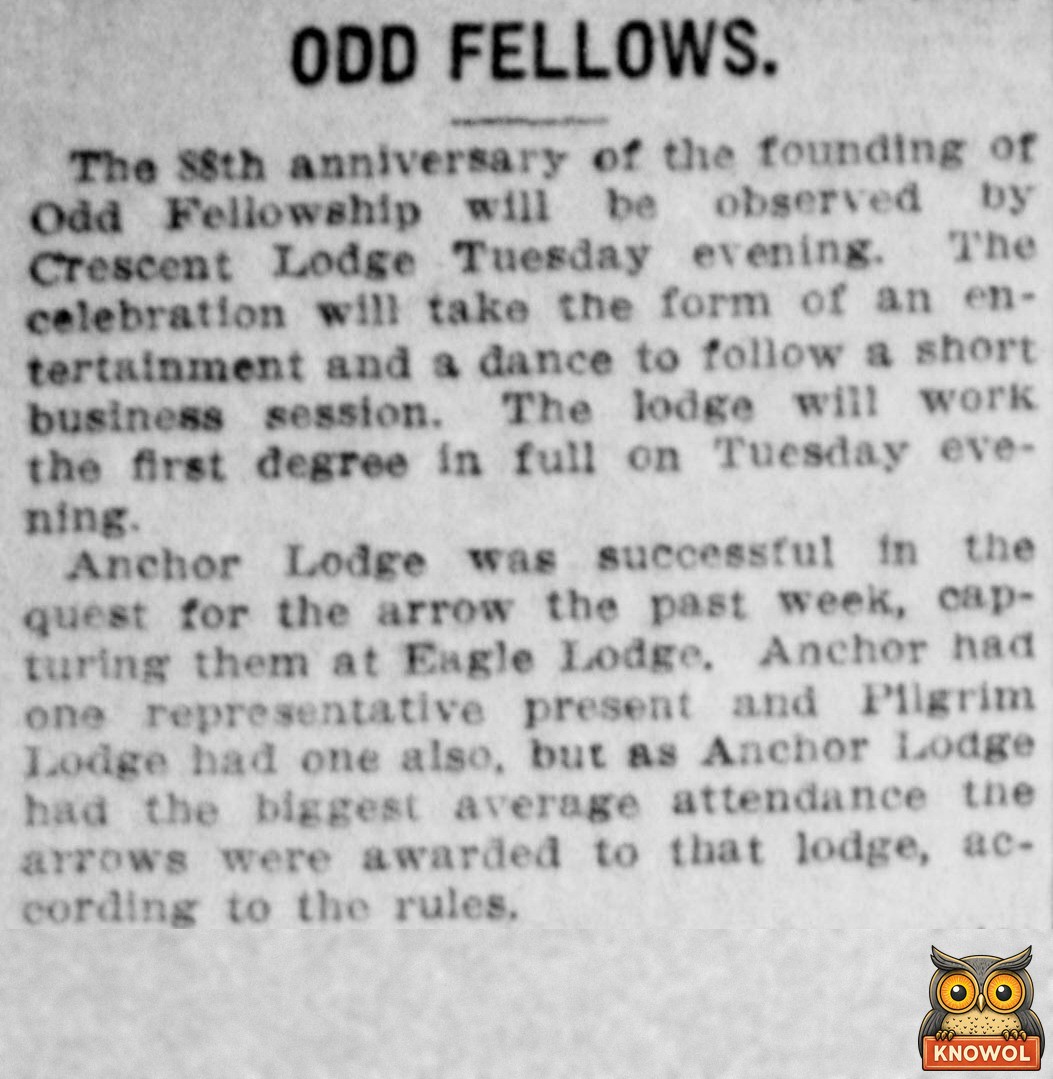
The tie at Eagle Lodge, in the Odd Fellows column. The Sunday Tribune (the Sunday edition of The Evening Tribune), Providence, Rhode Island, April 28, 1907, page 20. Library of Congress, Chronicling America. Click the clipping to read it full size.
It was the newest game in town that spring. About a dozen lodges of grown men were playing hide-and-seek with a set of silver arrows. The Sunday paper kept score, because Rule 11 told the winners to send in the news.
The players were Odd Fellows. That was the name of a big club, and its local branches were called lodges. Each lodge met one night a week. A membership certificate printed in 1907 put the club’s work in one line: “We visit the sick, relieve the distressed, educate the orphan, and bury the dead.”
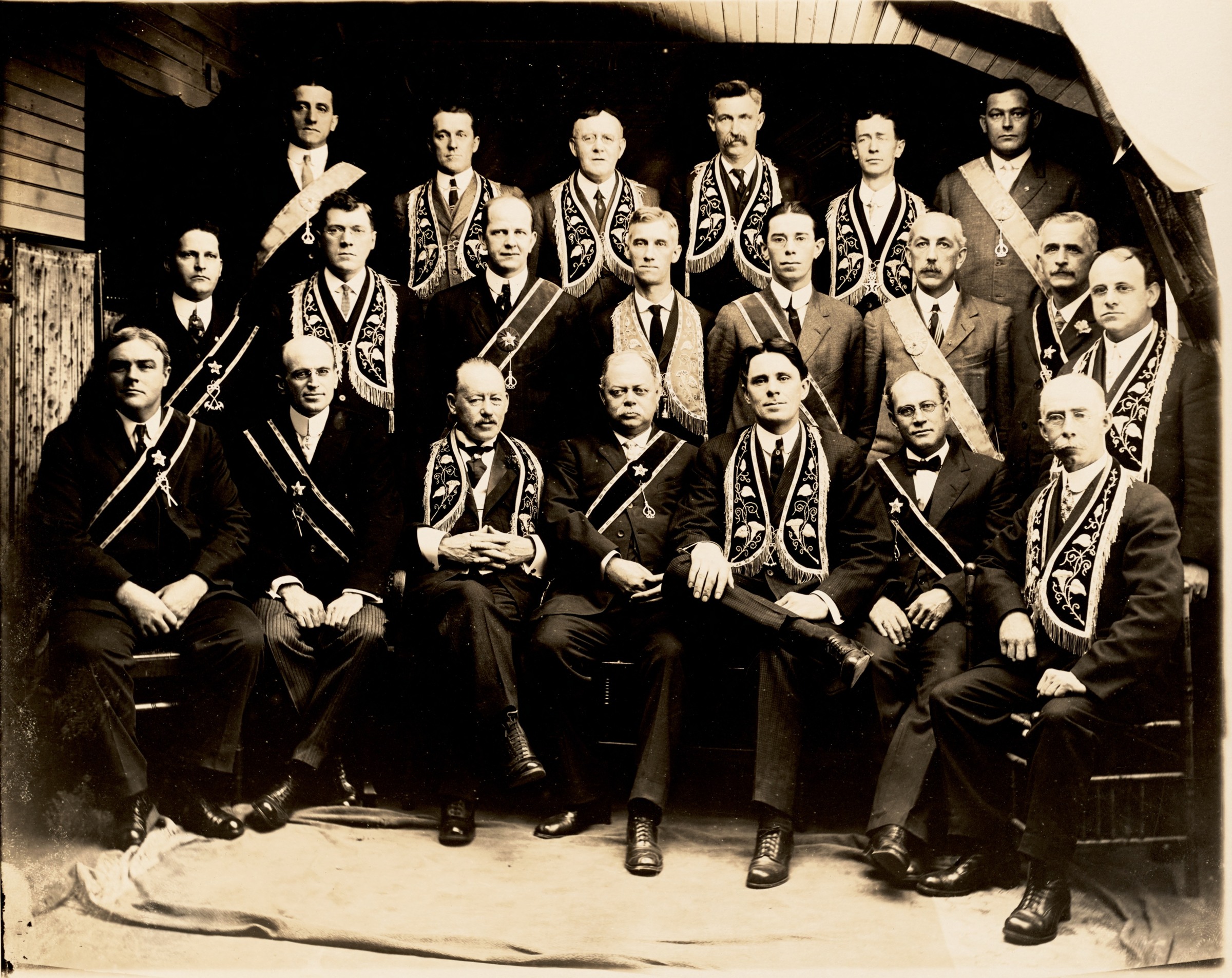
What lodge officers looked like: Leominster Lodge No. 86 of the Odd Fellows, in Leominster, Massachusetts, in their collars and sashes. This is not a Providence lodge. The photo was put in Leominster’s city hall time capsule in 1915, and the library’s note lists J. E. Smith, fifth from the left in the front row, as “N.G.” Leominster Public Library, through Digital Commonwealth. Click the picture to see it full size.
How the Providence lodges played the game
In Providence, Rhode Island, the game began at Crescent Lodge on Tuesday, March 5, 1907. The Tribune said the hall was “taxed to its utmost capacity,” with men from 15 lodges looking on. After the evening’s ceremony, “the rules were suspended, cigars lighted and the flight of the silver arrows was discussed.”
Here is how it worked. The head of a lodge was called the Noble Grand, or N. G. for short. The one who held the arrows had a week to “convey them secretly” to the Noble Grand of any other lodge he liked. That man had to set them out on an officer’s stand as soon as his next meeting opened.
Meanwhile every lodge in the game named two hunters each week. They could visit any lodge “they may suspect of having the arrows in custody,” but only one lodge a night. Guess wrong, and that evening was spent. Guess right, and the two carried the arrows home.
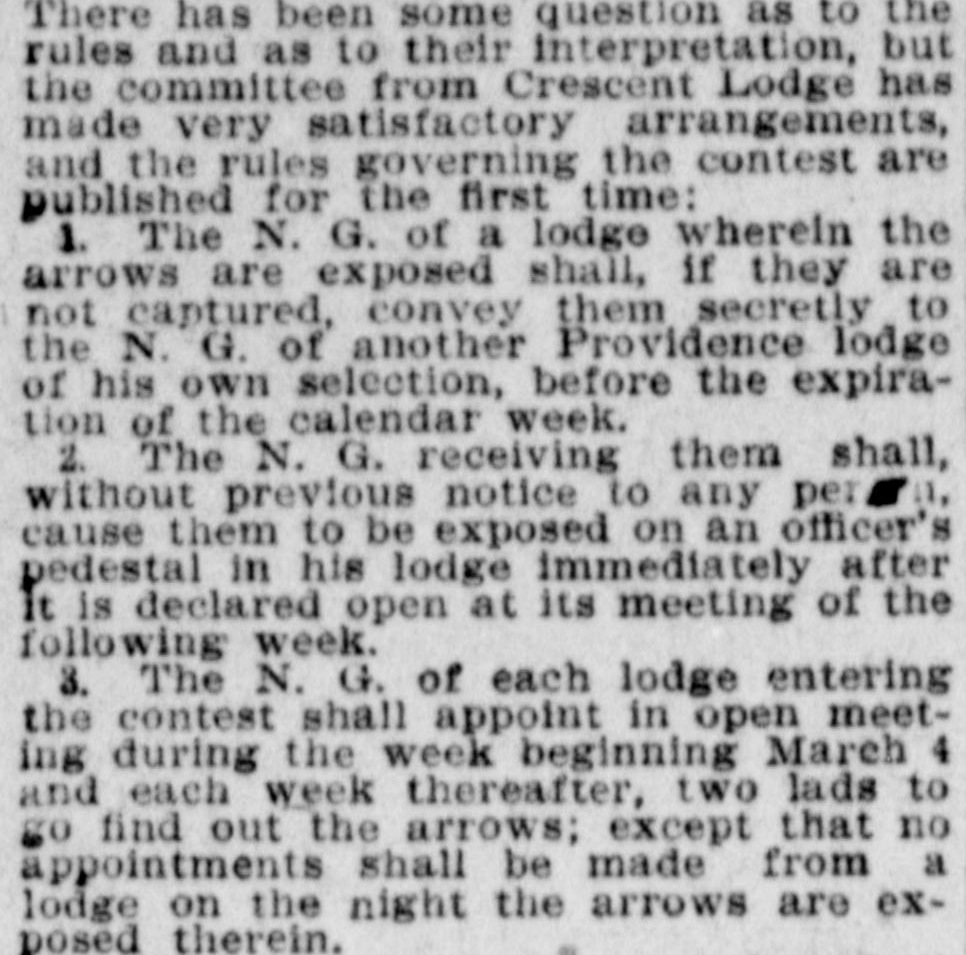
Rules 1 to 3 of the “Quest of the Arrows”: pass them in secret, set them out, send two lads. The Sunday Tribune, Providence, Rhode Island, March 17, 1907, page 7. Library of Congress, Chronicling America. Click the clipping to read it full size.
Rule 8 covered two lodges guessing right on the same night. Each pair of hunters carried a paper from their lodge secretary. It showed how many members the lodge had and how many had come to the meeting that picked them. The arrows went to the pair with “the highest percentage of attendance.”
That was the clever part. A lodge could not win by sending out its two sharpest men. Everybody back home had to show up too. It is just what decided the tie at Eagle Lodge.
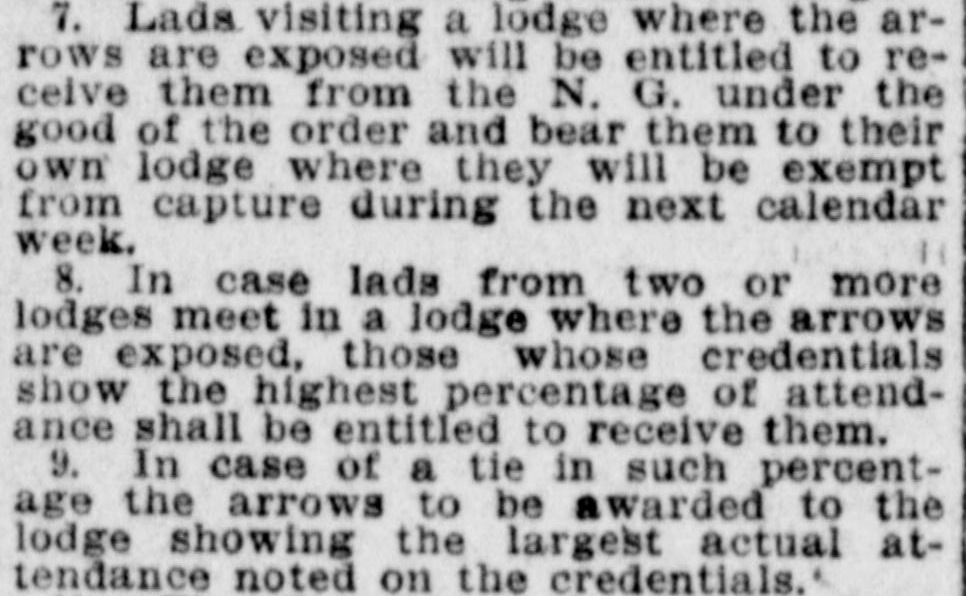
Rules 7 to 9: the winners carry the arrows home, and a tie goes to the lodge with the best attendance. The Sunday Tribune, Providence, Rhode Island, March 17, 1907, page 7. Library of Congress, Chronicling America. Click the clipping to read it full size.
Why the Providence hunters were called “lads”
The rules for the Providence, Rhode Island, game never call the hunters men. Each Noble Grand was to appoint “two lads to go find out the arrows.”
That wording comes from the Bible. In the First Book of Samuel, Jonathan has to warn his friend David, who is hiding in a field. He shoots arrows and sends a boy to fetch them. “And, behold, I will send a lad, saying, Go, find out the arrows,” Jonathan says in the King James Bible. What he calls out to the boy is really a signal to David.
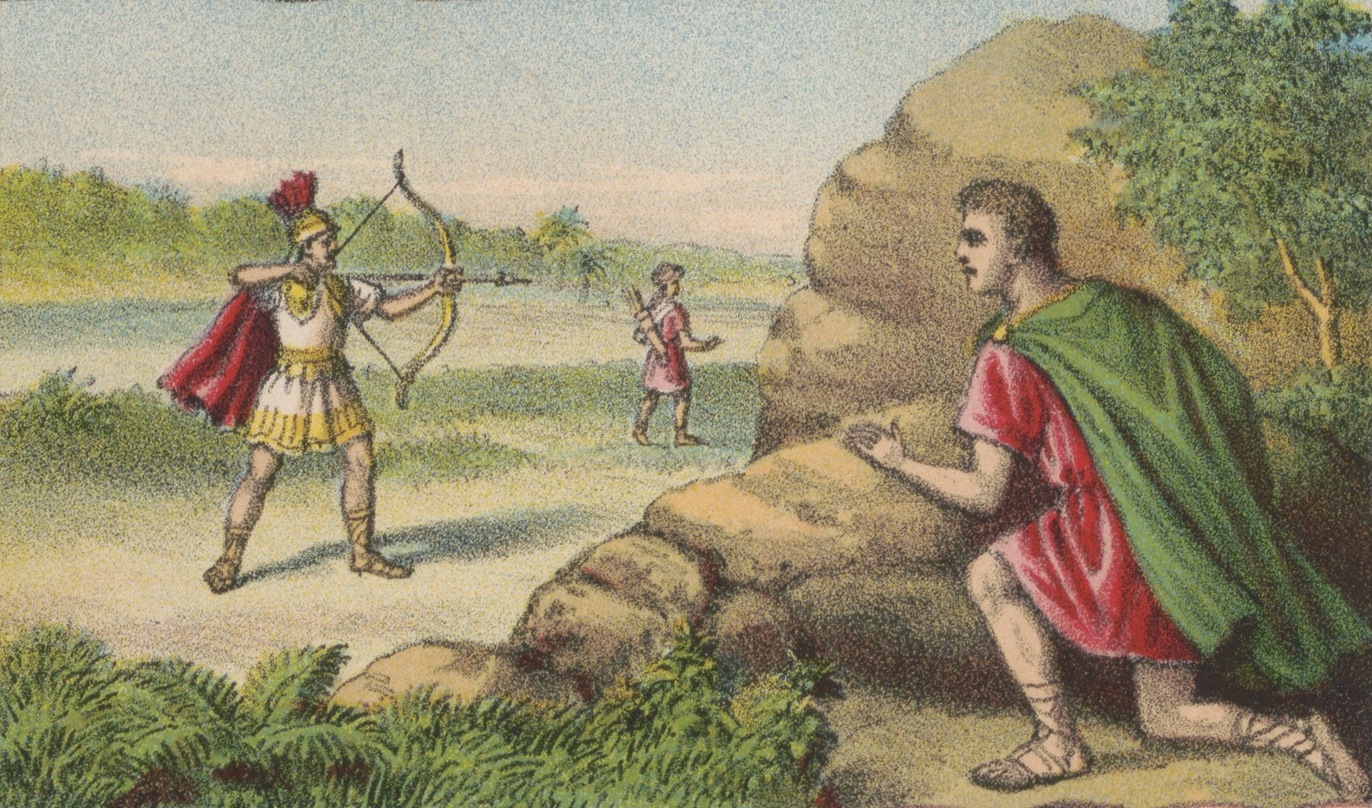
One panel of “Our Emblematic Odd Fellowship,” a membership certificate printed in 1907: an archer shoots, a boy carries arrows, and a man waits behind a rock. The print does not label the scene. It matches the story of Jonathan and David. Library of Congress, Popular Graphic Arts collection. Click the picture to see it full size.
Odd Fellows knew the story well. An 1861 book about the club, by an Indiana member named Thomas G. Beharrell, says of arrows, “They are an emblem of our Order.” The reason it gives is Jonathan’s arrow. So the game was the lodge’s own lesson about friendship, turned loose on a whole city.
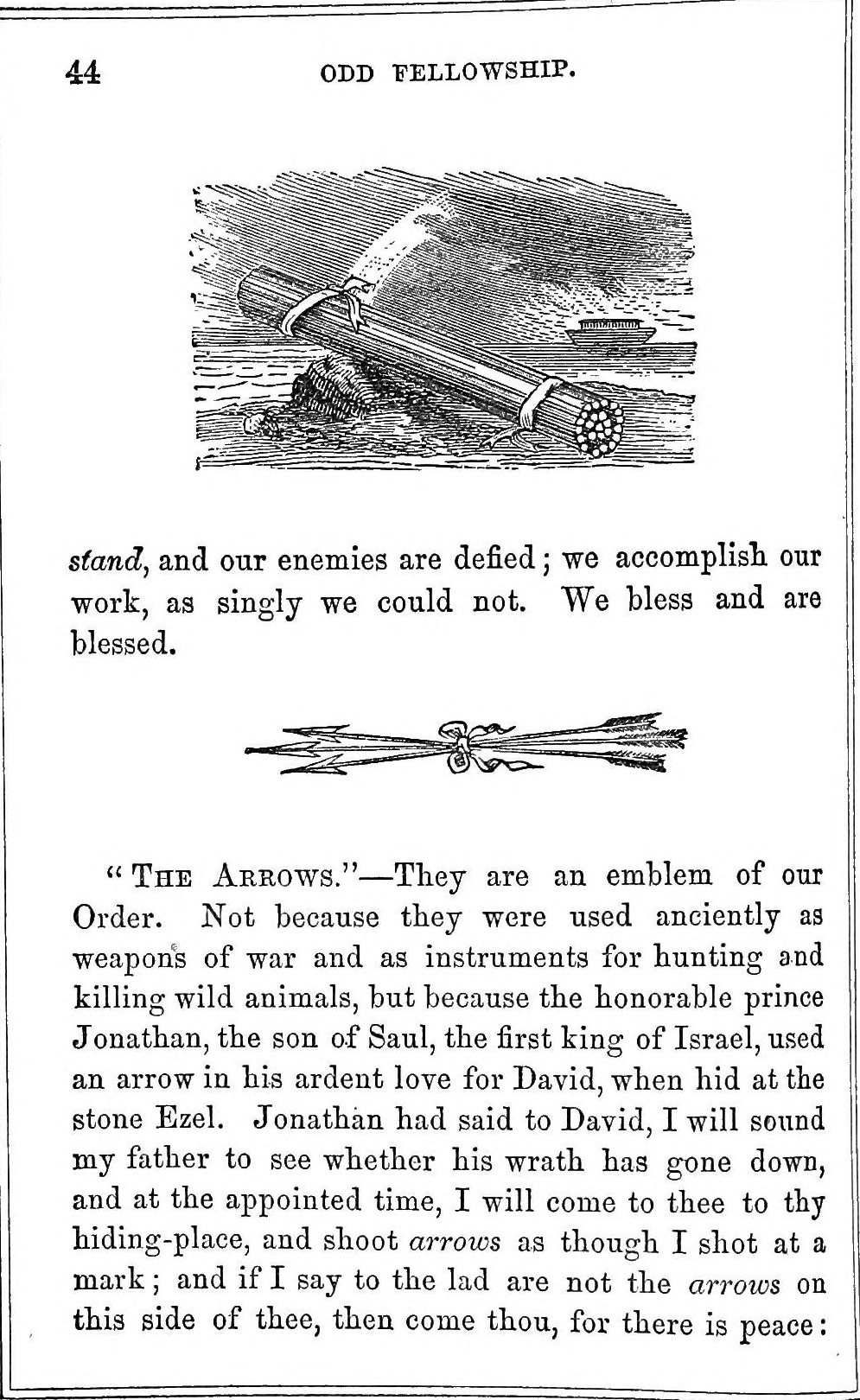
“The Arrows,” under a picture of another emblem, a bundle of sticks. Page 44 of The Brotherhood, by Thomas G. Beharrell (Cincinnati, 1861), public domain. Cornell University Library copy, through the Internet Archive. Click the clipping to read it full size.
The silver arrows cross Providence
In Providence, Rhode Island, the arrows went missing “soon after the rousing meeting” at Crescent Lodge. Swarts Lodge found them first, at Anchor Lodge in the Manton part of the city. The Tribune could already see what the game was good for. It had, the paper said, “a decided tendency to raise the attendance in the various lodges.”
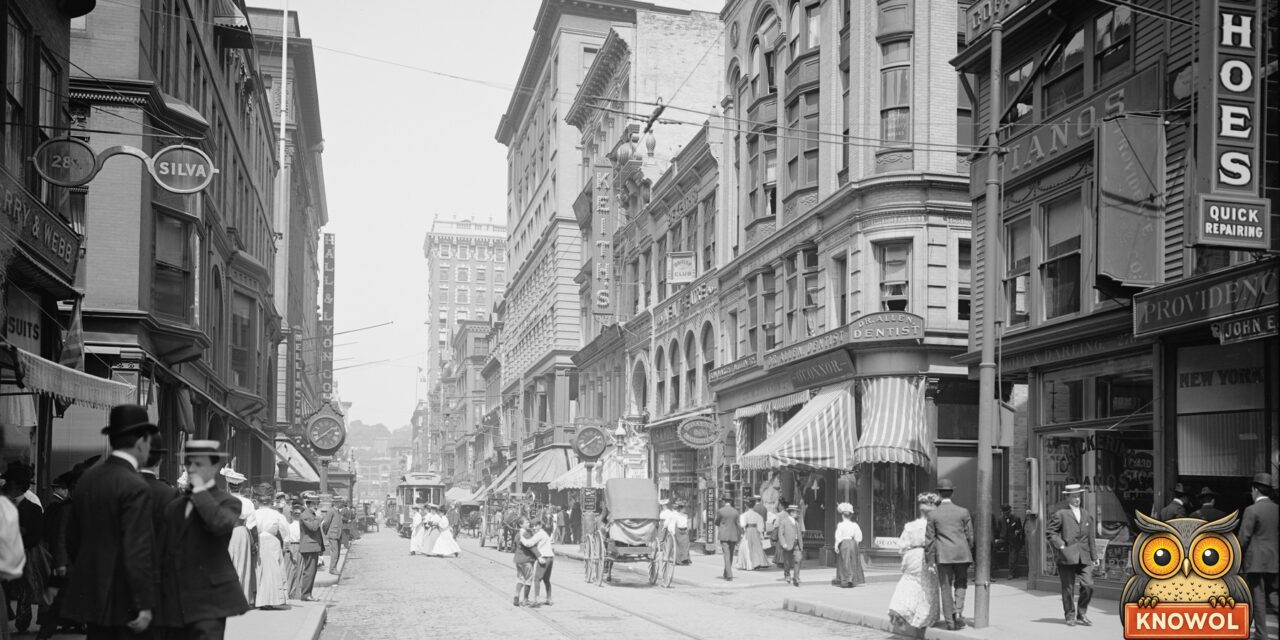
The lads had a whole city to cover. The photo at the top of this page shows Westminster Street in downtown Providence in 1906, the year before the game.
At the end of March it was Franklin Lodge’s turn. “Two wise and analytical lads,” James Hayes and Charles Frankland, tried North Star Lodge on a Monday evening. “Much to their surprise, as well as pleasure,” the arrows were set out half an hour into the meeting.
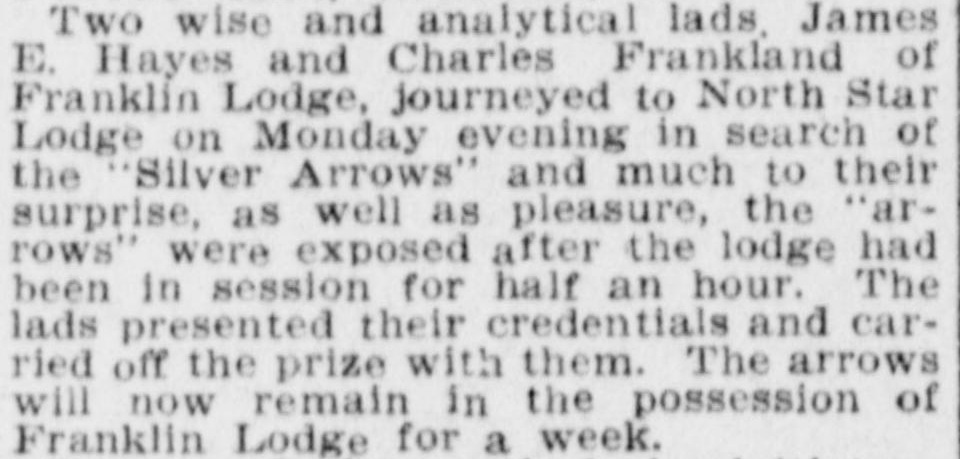
“Two wise and analytical lads.” The Sunday Tribune, Providence, Rhode Island, March 31, 1907, page 20. Library of Congress, Chronicling America. Click the clipping to read it full size.
By the middle of April the arrows had been through six other lodges and were back at Crescent, where they began. Two lodges had quit, “leaving 10 lodges in competition.”
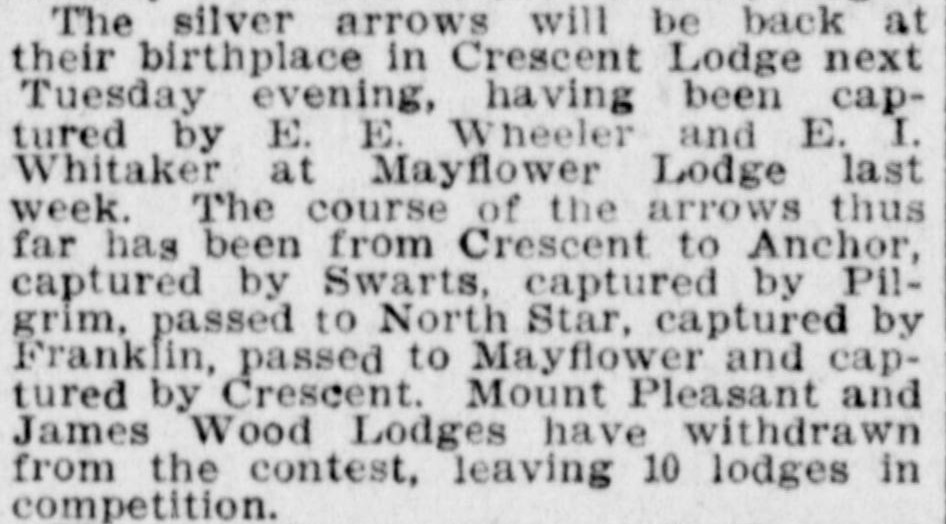
The trail of the arrows in their first six weeks. The Sunday Tribune, Providence, Rhode Island, April 14, 1907, page 20. Library of Congress, Chronicling America. Click the clipping to read it full size.
Then came the tie at Eagle Lodge. In late May, Franklin Lodge struck again, at Pilgrim Lodge. The paper liked Franklin’s chances. If the lodge kept it up, “it should become the permanent owner of the sticks.”
The rest of lodge night in Providence
Lodge night in Providence, Rhode Island, was not all rules. The column that reported the tie at Eagle Lodge also said Reliance Lodge of East Providence had kept its 33rd birthday at the Imperial Theatre, “and after the show a beefsteak supper was served at Gelb’s.” Rose Standish Lodge would “serve a crazy tea in Crescent Hall,” with whist, a card game, and dancing after. The paper did not say what made the tea crazy.
What became of the Providence arrows
After May 1907 we found no more captures of the Providence, Rhode Island, arrows in the Tribune’s lodge column. That November the column admitted, “Queries are constantly being made concerning the fate of the ‘Flight of the arrows.'”
The idea had spread, though. That same month an Odd Fellows group in Newport, Rhode Island, bought “an emblematic crook,” a shepherd’s staff, and soon sent it traveling, starting with Pawtucket, Rhode Island. In December, Lafayette Lodge got ready to carry a bundle of sticks to Hope Lodge.
The rules had set the end of the hunt for April 30, 1908, with the arrows going to the lodge that had captured them “the most times.” On May 10, 1908, the Tribune announced the last night. “Eleven city lodges, contestants in the ‘quest of the silver arrows,’ will visit Crescent Lodge on Wednesday evening, when the trophy will be formally delivered to the lodge most successful in their capture.”
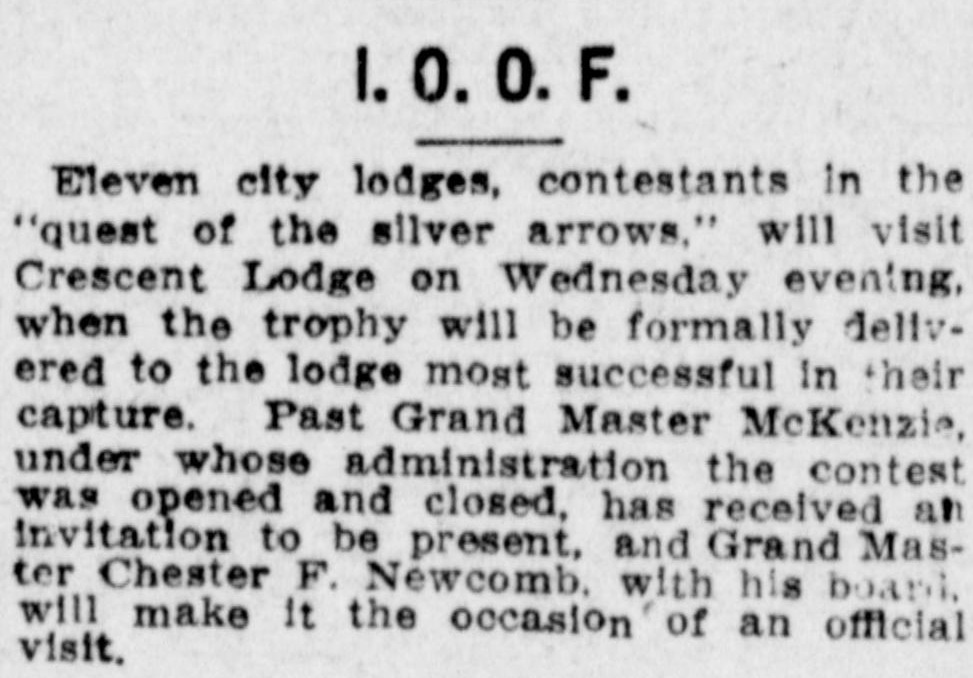
The last night is announced. The Sunday Tribune, Providence, Rhode Island, May 10, 1908, page 20. Library of Congress, Chronicling America. Click the clipping to read it full size.
The Tribune pages we could find never printed the winner’s name. It may have been Franklin Lodge, with its wise and analytical lads. What the paper did save is the part that mattered. For one spring in Providence, a man had a fresh reason to go to the meeting. The arrows might be there tonight.
Sources
- The tie at Eagle Lodge, the beefsteak supper and the crazy tea: The Sunday Tribune (Sunday edition of The Evening Tribune, Providence, Rhode Island), April 28, 1907, page 20. Library of Congress, Chronicling America.
- The first notice and the opening night: The Sunday Tribune, February 24, 1907, page 16 and March 10, 1907, page 5. Library of Congress, Chronicling America.
- The first capture and the 13 rules: The Sunday Tribune, March 17, 1907, page 7. Library of Congress, Chronicling America.
- The hunt that spring, all in The Sunday Tribune: March 31, 1907, page 20 (the Library of Congress files this issue under March 3; the page itself is dated March 31), April 14, page 20 and May 26, page 26. Library of Congress, Chronicling America.
- The questions, the crook and the bundle of sticks: The Sunday Tribune, November 10, 1907, page 20 and December 1, 1907, page 20. The last night: May 10, 1908, page 20. Library of Congress, Chronicling America.
- The Bible verse: 1 Samuel 20:21, King James Version, read at Wikisource.
- “The Arrows”: Thomas G. Beharrell, The Brotherhood: Being a Presentation of the Principles of Odd-Fellowship (Cincinnati: Applegate & Company, 1861), page 44. Cornell University Library copy, Internet Archive. Public domain.
- Certificate panel and the club’s motto: “Our emblematic Odd Fellowship,” J. Adams Company, Indianapolis, 1907. Library of Congress Prints and Photographs Division, Popular Graphic Arts, no known restrictions on publication.
- Lodge photo: “Leominster Lodge No. 86, Independent Order of Odd Fellows,” about 1880 to 1915, from the Leominster, Massachusetts, city hall time capsule of 1915. Leominster Public Library, through Digital Commonwealth, no known copyright restrictions.
- Cover photo: “Westminster St., Providence, R.I.,” Detroit Publishing Co., 1906. Library of Congress Prints and Photographs Division, no known restrictions on publication.