On Tuesday evening, April 23, 1918, the sun had just gone down over York, South Carolina. It was a few minutes after 8 o’clock, “between twilight and dark,” the town paper said. Then something lit up the western sky. People who looked that way saw “a ball of fire, apparently the size of an orange,” racing from north to south. It burned for a moment and was gone. Behind it hung a long white streak, glowing in the dusk. It stayed there “for a half hour afterward.” Hundreds of people saw it. By the end of the week, they still could not agree on what it was.
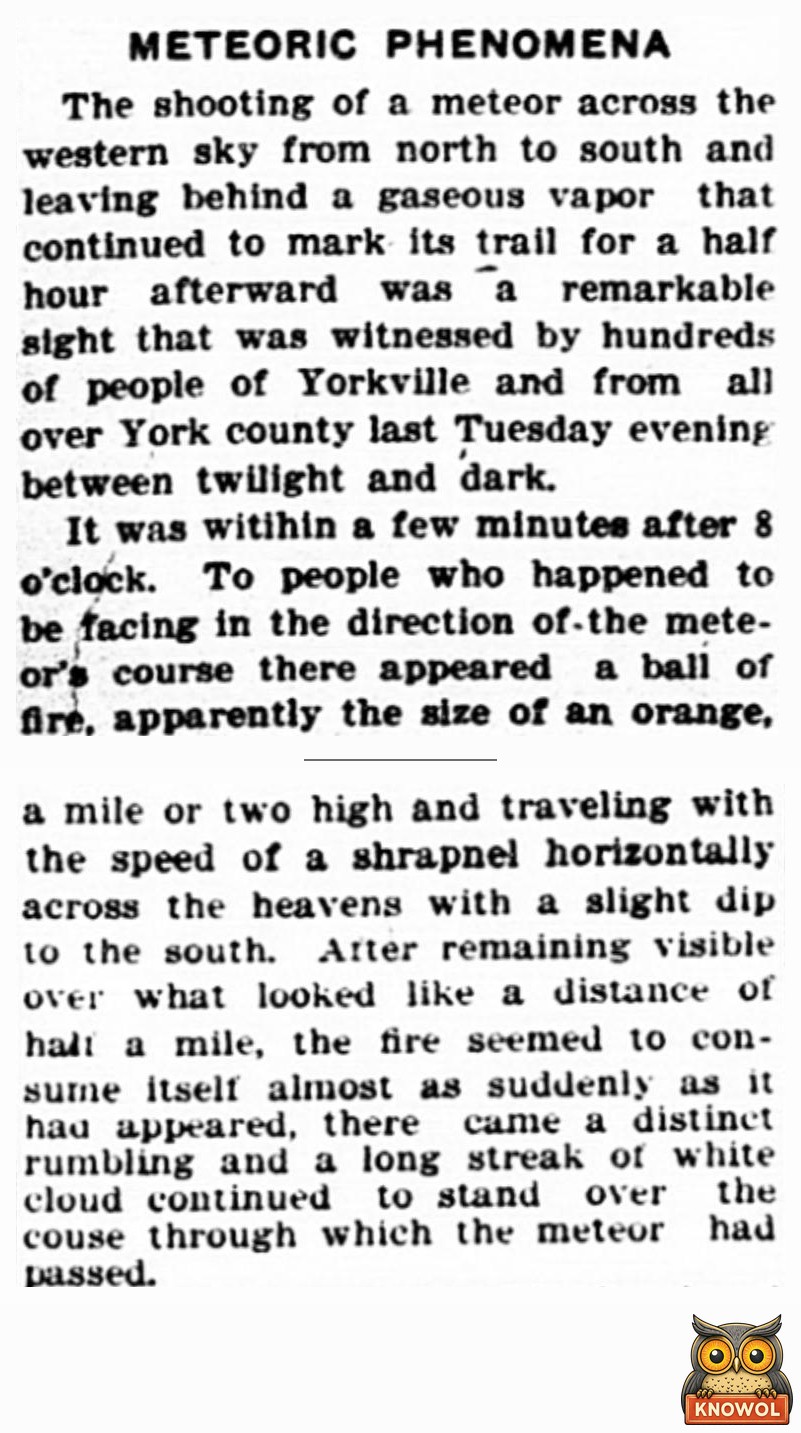
“Meteoric Phenomena.” The Yorkville Enquirer, York, South Carolina, April 26, 1918, page 2 (the story runs from the bottom of one column to the top of the next; the two parts are joined here). Library of Congress, Chronicling America. Click the clipping to read it full size.
A man, a woman and a propeller
The paper was the Yorkville Enquirer. Its own masthead said “York, S. C.,” but its writers still called the town Yorkville. Its “Here and There” column was where the paper passed along small things heard around town. That Friday, the small thing was the meteor.
“There are quite a number of people in Yorkville who refuse to be convinced that that meteor of Tuesday was not an airplane,” the column said. “They insist that they heard the noise of the propellors.” It got better. There was “one man in the courthouse who says he saw a man and woman in the airplane and heard loud talking.”
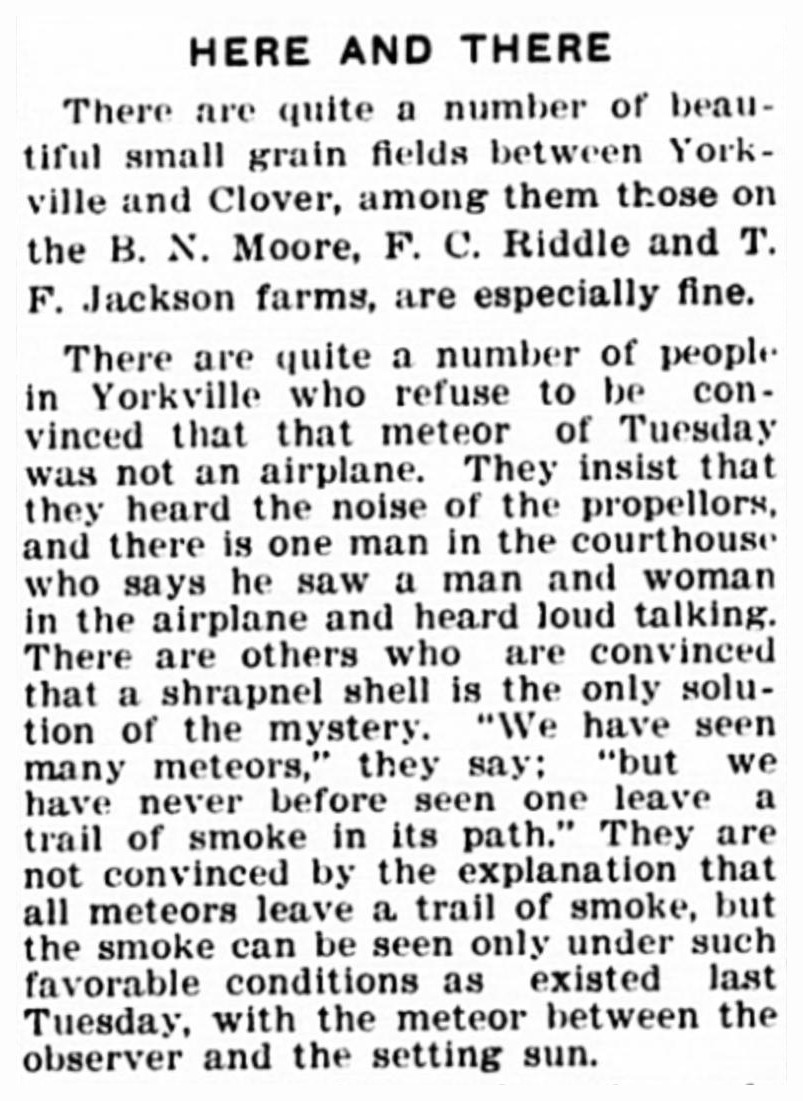
“Here and There.” The Yorkville Enquirer, York, South Carolina, April 26, 1918, page 2. Library of Congress, Chronicling America. Click the clipping to read it full size.
Other folks were sure it was a cannon shell. “We have seen many meteors,” they told the paper, “but we have never before seen one leave a trail of smoke in its path.”
Why everyone thought of the war
It helps to know what 1918 felt like. The United States had joined World War I the spring before. Young men from York County were off training at Army camps around the Carolinas. Two big ones sat on either side of York. Camp Greene was at Charlotte, North Carolina, to the northeast. Camp Wadsworth was at Spartanburg, South Carolina, to the west. Airplanes were still new and rare, and the war was on everybody’s mind. So when something strange crossed the sky, people saw the war in it.
The Enquirer listed the guesses. “Some people were sure that it was an airplane on its way to Camp Greene.” One man thought it was “a shell from a large German gun.” Another thought it was “stray shrapnel from the batteries at King’s Mountain,” meaning big guns. (Shrapnel is the flying metal from an exploding shell.)

Charlotte, North Carolina, about 1918, looking north from a high rooftop. The rows of Camp Greene are far off on the left. Some people in York were sure the “airplane” was headed there. Library of Congress Prints and Photographs Division. Click the picture to see it full size.
Then two well-known men had a little fun. “W. J. Cherry, Esq., tried to see the head of the kaiser in the cloud,” the paper said. The kaiser was the emperor of Germany, the enemy in the war. “Esq.” was a polite title, often used for lawyers.
A message in the sky
The best one came from John R. Hart, Esq. He “spelled out a message which said, ‘If you can’t buy a bond, buy a thrift stamp.'”
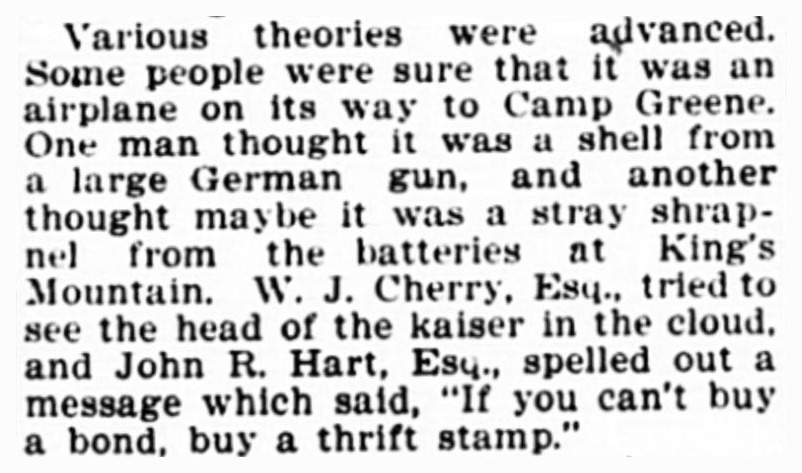
“Various theories were advanced.” The Yorkville Enquirer, York, South Carolina, April 26, 1918, page 2. Library of Congress, Chronicling America. Click the clipping to read it full size.
That was a joke, and everybody in town would have gotten it. That spring the whole country was in a drive called the Third Liberty Loan. People bought Liberty bonds, which were loans to the government to help pay for the war. A bond cost more than many families could spare. So the government also sold thrift stamps for a quarter each, and kids saved them on cards. The same page of the Enquirer ran long lists of York County bond buyers, and a note that “Subscriptions to the third Liberty loan close on May 4.”
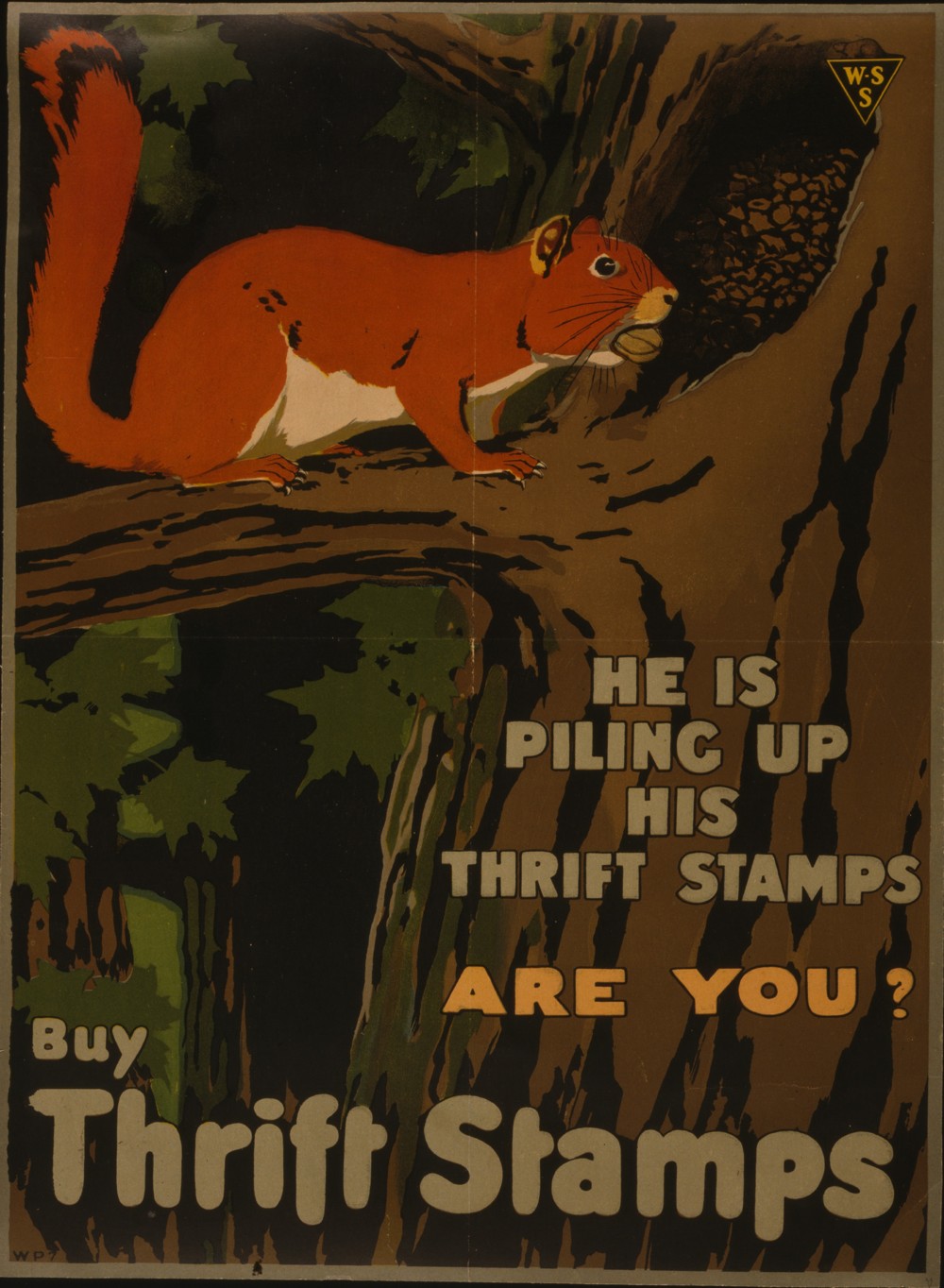
“He is piling up his Thrift Stamps. Are you? Buy Thrift Stamps.” A war savings poster from 1918. Library of Congress Prints and Photographs Division. Click the picture to see it full size.
Hart knew the bond drive well. That week he was riding out to country meetings with the county’s Liberty loan chairman, B. N. Moore. On meteor night itself, Tuesday, the party held a meeting at the church in Bethany, where “nearly all the seats were filled.” Hart was one of the speakers. So it’s no wonder that when he looked up at that cloud, he read a bond ad.
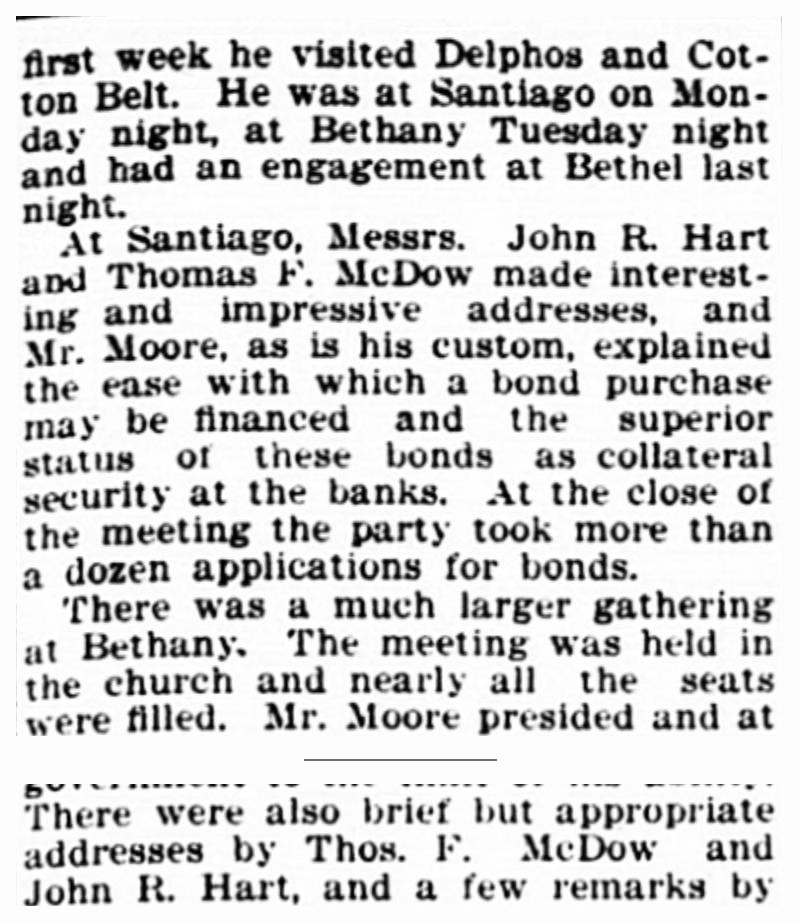
The bond meetings at Santiago and Bethany (two parts of the same story, joined). The Yorkville Enquirer, York, South Carolina, April 26, 1918, page 2. Library of Congress, Chronicling America. Click the clipping to read it full size.
The same sky, a hundred miles wide
York was not alone. The meteor was seen “over a distance of more than a hundred miles,” the Enquirer reported, “from points in North Carolina to beyond Greenville.” All along the way, people tied it to “some signal from the military training camps.”
At Spartanburg, the soldiers at Camp Wadsworth saw it too. “Although it was yet daylight, the illumination in the heavens cast shadows of every object,” a reporter there wrote. “The shadows of electrical wires overhead were suddenly outlined on the pavement.” Then a white cloud hung in the sky “as if a shrapnel shell had burst.” Three minutes after the flash came three loud booms. Many said it was a signal from camp, maybe a “star shell,” a flare fired up from a gun. Lots of soldiers believed it. But the Army’s signal office said “no such thing had been undertaken.”
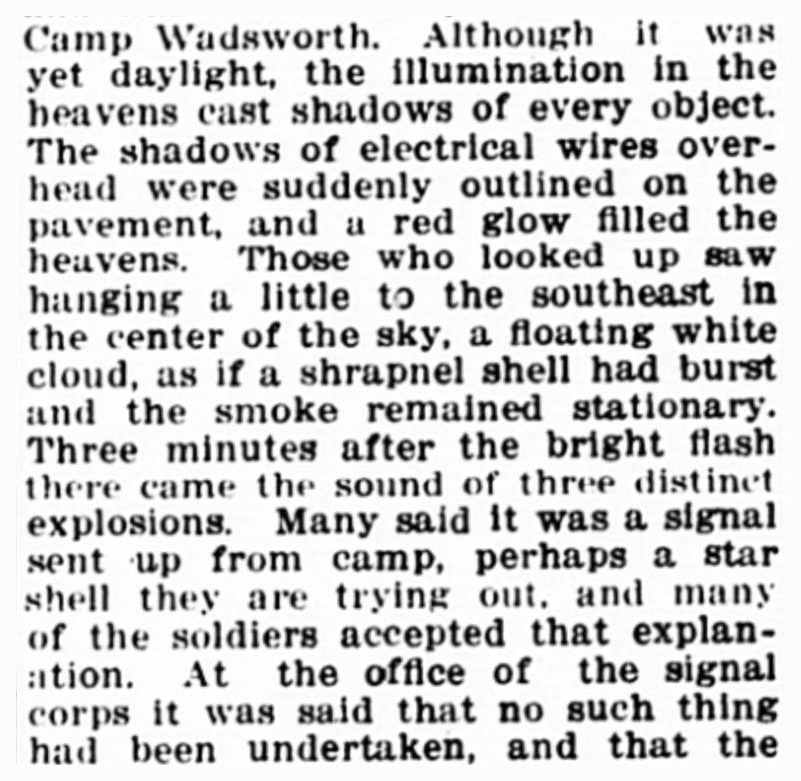
The Spartanburg report, as printed in the Yorkville Enquirer, York, South Carolina, April 26, 1918, page 2. Library of Congress, Chronicling America. Click the clipping to read it full size.
Up in Charlotte, the stories got even wilder. The Charlotte Observer’s report was reprinted in The Herald and News of Newberry, South Carolina. Its headline was “Trail of Fire Blazes in Sky.” In nearby Gaffney, it said, “many people thought that it was an aeroplane.” In Charlotte, a “bright cloud like silvery trail” stayed up for nearly half an hour.
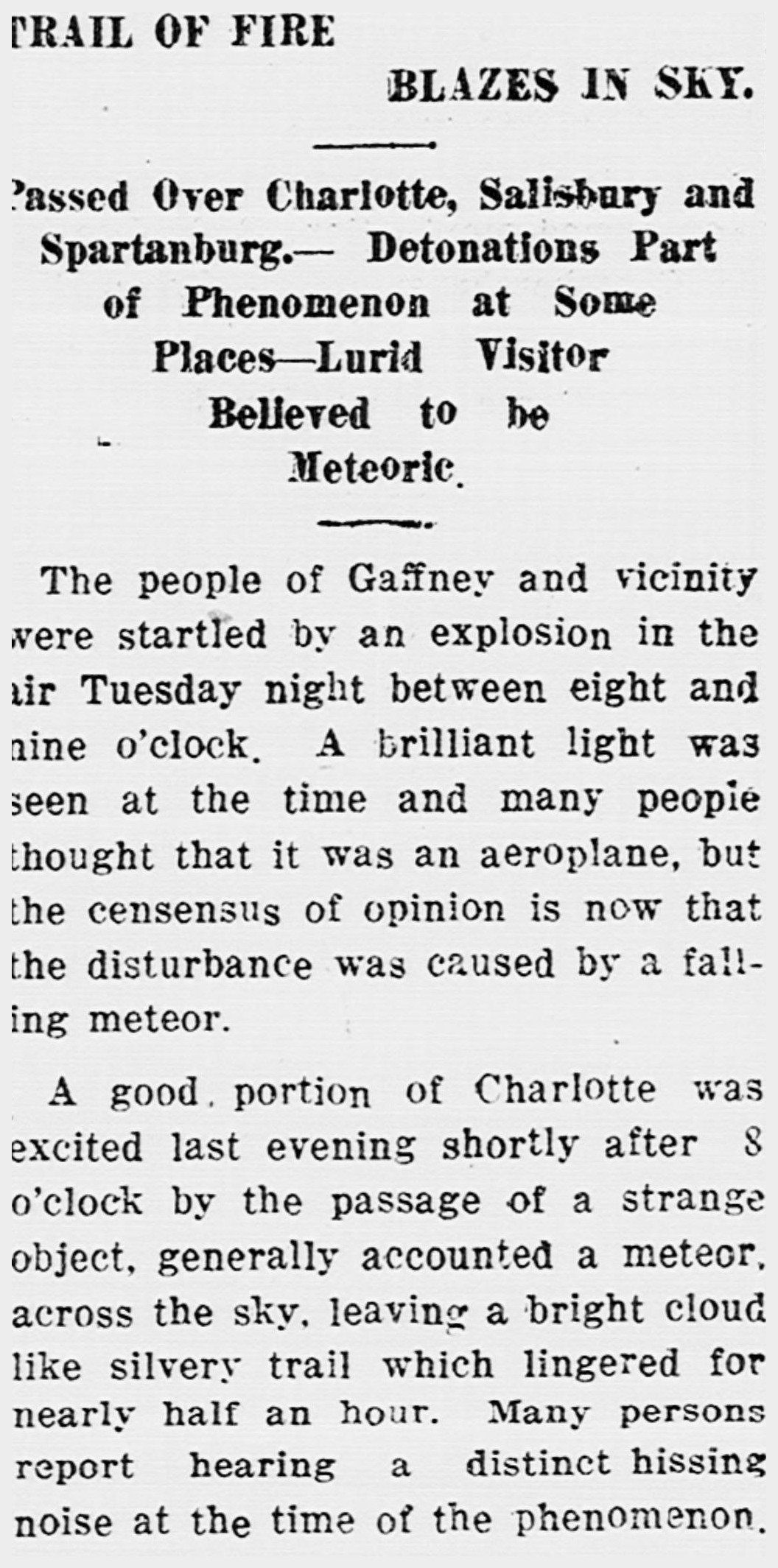
“Trail of Fire Blazes in Sky.” The Herald and News, Newberry, South Carolina, April 30, 1918, page 6, reprinting the Charlotte Observer. Library of Congress, Chronicling America. Click the clipping to read it full size.
“One man detected the smell of sulphur after the occurrence,” the paper said. “Another noted that the trail formed a perfect figure three, clearly in celebration of the Third Liberty Loan.” Others “talked of newly invented devilish German long-range guns.” And “one lieutenant is reported to have said it was a signal from Camp Green.”
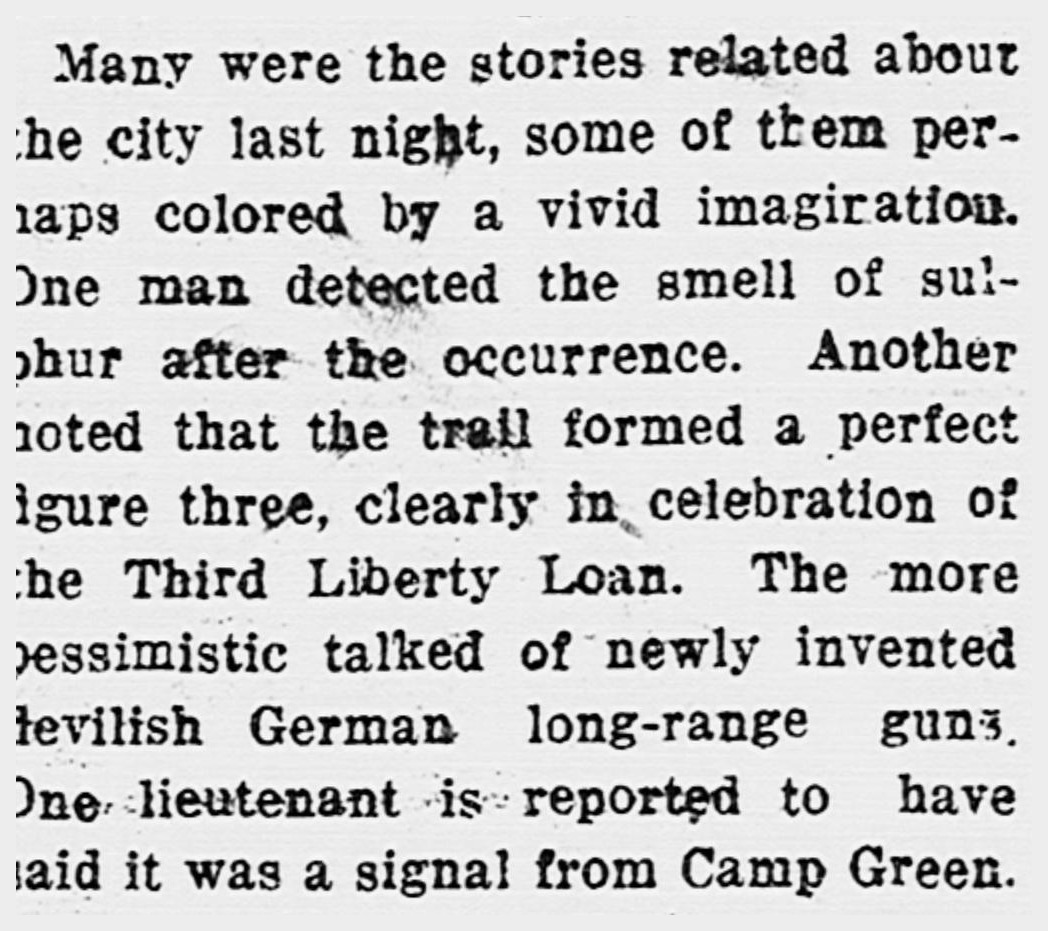
The figure three. The Herald and News, Newberry, South Carolina, April 30, 1918, page 6. Library of Congress, Chronicling America. Click the clipping to read it full size.
What really happened
It really was a meteor. A meteor is a chunk of rock or metal from space that slams into our air so fast that it heats up and glows. A very bright one is called a fireball. As it burns, it leaves a trail of dust and gas behind. A big one can also make booms. Sound is slow, though. It needs about five seconds to go one mile. So a three-minute wait at Spartanburg meant the booms came from more than 30 miles away.
R. H. Sullivan, the weather scientist in Columbia, figured the meteor “came to within 75 or 100 miles of the earth.”
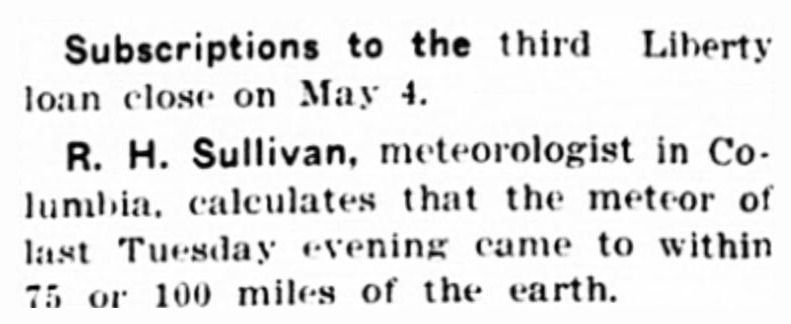
Two short notes from the same page. The Yorkville Enquirer, York, South Carolina, April 26, 1918, page 2. Library of Congress, Chronicling America. Click the clipping to read it full size.
People who had seen plenty of meteors said they had never seen a trail like this one. The Enquirer worked out why, and it got it right. The sun had set for the people on the ground. But the trail was miles up in the sky, high enough to still catch the light. “It had sunk behind the western horizon,” the paper said, “but its light was still falling on the path of the meteor.” That is why the white streak shone against the darker clouds until it drifted apart.
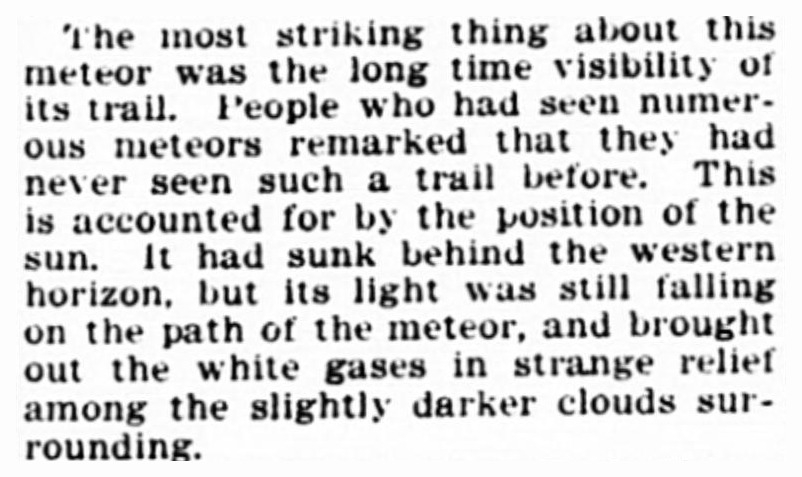
Why the trail glowed. The Yorkville Enquirer, York, South Carolina, April 26, 1918, page 2. Library of Congress, Chronicling America. Click the clipping to read it full size.
The trail faded, the argument didn’t
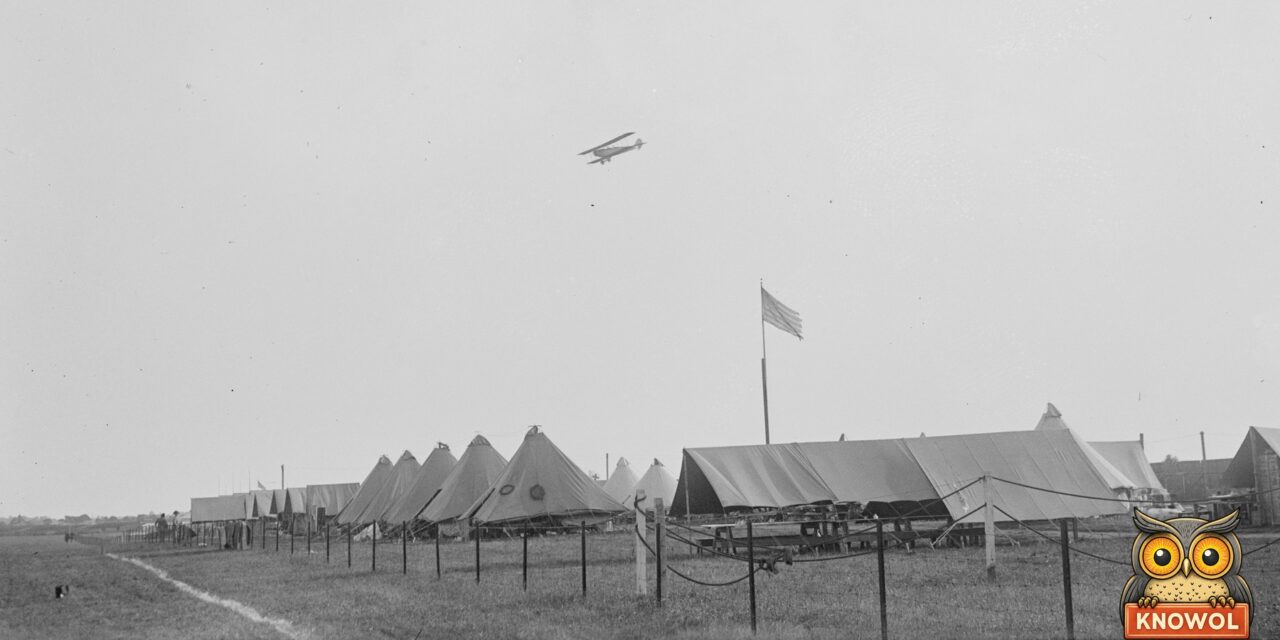
The picture at the top of this story is an Army airplane flying over the tents of an Army camp at Mineola, New York, in 1916 or 1917. It is not York. But it is just the kind of sight some folks in York were sure they had seen that night.
The paper explained the science as plainly as it could. Some people were still “not convinced by the explanation.” The white trail was gone within the hour. But when the paper went to press that Friday, the man at the courthouse was still telling the same story: a man and a woman went flying over York that night, talking loudly the whole way.
Sources
- The Yorkville Enquirer (York, South Carolina): “Meteoric Phenomena,” “Here and There,” the Liberty loan meetings, and the note on R. H. Sullivan, April 26, 1918, page 2. Library of Congress, Chronicling America.
- The Herald and News (Newberry, South Carolina): “Trail of Fire Blazes in Sky,” reprinted from the Charlotte Observer, April 30, 1918, page 6. Library of Congress, Chronicling America.
- The same Spartanburg report also ran in The Watchman and Southron (Sumter, South Carolina), April 27, 1918, page 5, and The Bamberg Herald (Bamberg, South Carolina), April 25, 1918, page 8, which said people in Bamberg, about 100 miles from Spartanburg, watched the white trail for fifteen or twenty minutes. Library of Congress, Chronicling America.
- Photos and poster: Bain News Service, “Army Aeroplane Over Camp, Mineola” (1916 or 1917, the cover), George Grantham Bain Collection; “Birds eye view, Charlotte, N.C., looking north, showing Camp Greene in the background on the left” (about 1918); “He is piling up his Thrift Stamps, are you? Buy Thrift Stamps” (1918); the price of a thrift stamp from the poster “Buy U.S. government War Savings Stamps, 25c starts you” (1917). Library of Congress Prints and Photographs Division. No known restrictions on publication.