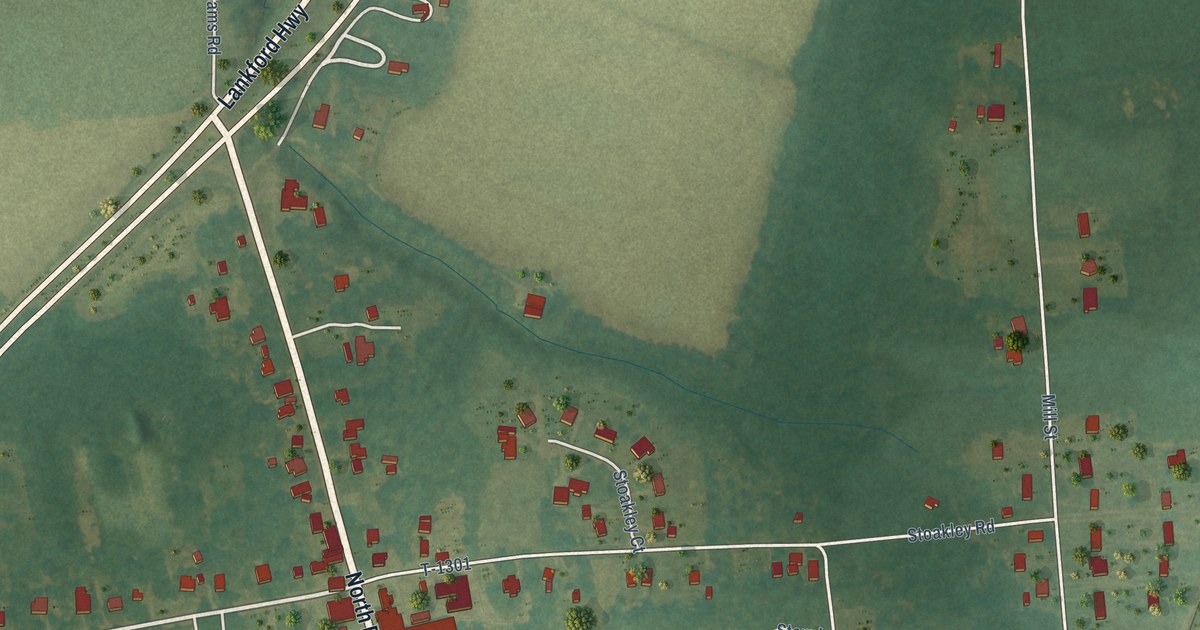
Late in May 1895, Ben Temple Taylor was out in a field on the Taylor family’s farm near Comorn, in King George County, Virginia, when he picked up a small terrapin with a chewed and battered shell. A shepherd dog had been catching and gnawing the terrapins in that field for years, so Taylor took the scratches for tooth marks. Then, tracing over them, he made out letters carved into the bottom shell: “8th Penna. Cav’y, May, 1863.”
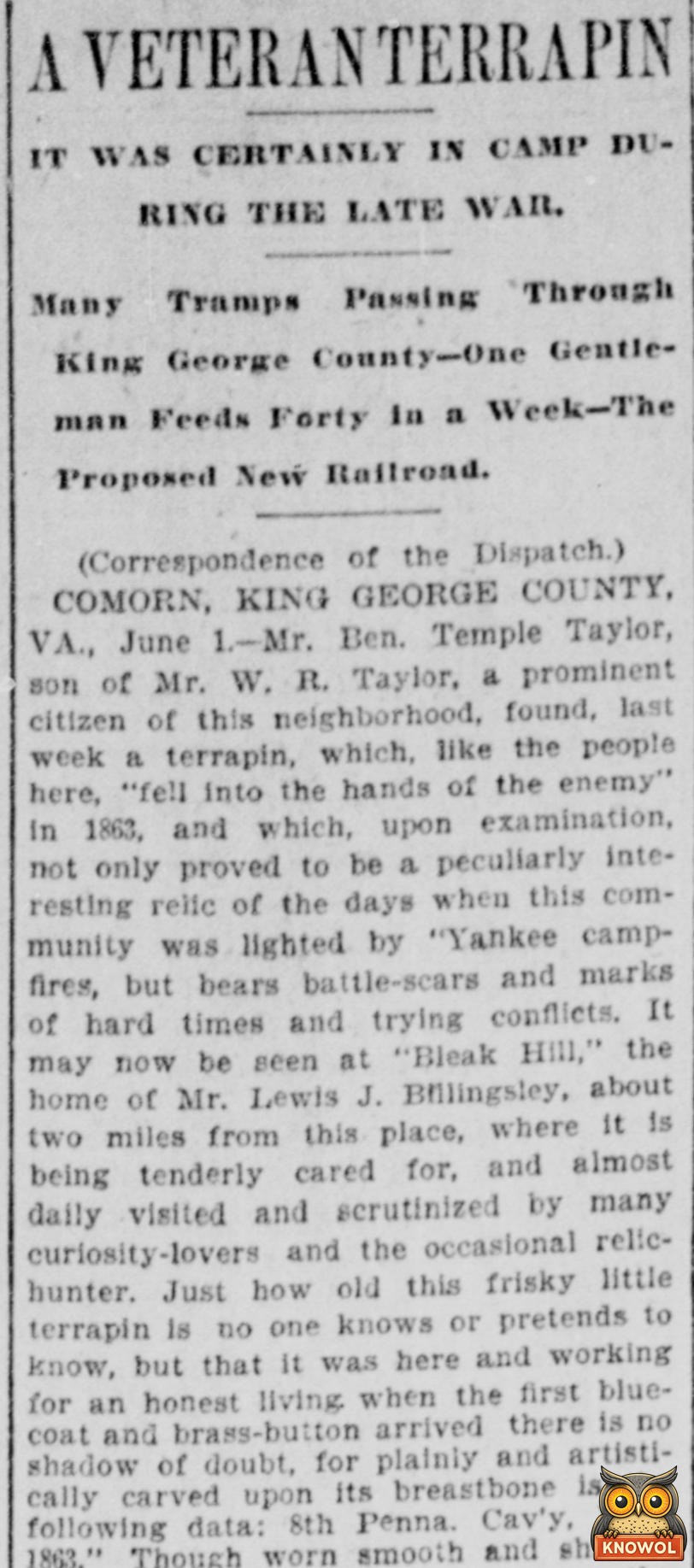
“A Veteran Terrapin,” The Richmond Dispatch, Richmond, Virginia, June 2, 1895, page 2. Library of Congress, Chronicling America. Click the clipping to read it full size.
A veteran terrapin
The Richmond Dispatch’s correspondent at Comorn wrote it all up on June 1. The Eighth Pennsylvania Cavalry had camped on Mr. Taylor’s “Mount View” farm in May 1863, right where the terrapin turned up. The letters were worn “smooth and shallow by thirty-two years’ friction upon the ground,” but every one could still be read, and they were so neat and even that the terrapin must have been full grown when they were cut. It weighed just eleven ounces.
That field had been plowed nearly every third year since the war, and hundreds of its terrapins had gone for crab bait. Dogs got others, and so did the fires when fields were cleared in spring. This one had come through it all. It was now living at Bleak Hill, the home of Lewis J. Billingsley, about two miles away, where neighbors and relic hunters came by almost every day to look at it. The people of Comorn who remembered the Pennsylvania cavalrymen, the writer said, hoped the man who carved it was still alive and might read the story.
The man who carved it
He was. Several northern papers copied the story, including the New York Times, and in Philadelphia it caught the eye of Captain Andrew B. Wells, who had been a lieutenant in Company F of the Eighth Pennsylvania Cavalry and later its commander. He wrote to the Dispatch, which printed his letter on June 12.
I had command of the picket-line of our army during the early part of May, 1863, while in King George county, Va., and on or about the 16th of May, 1863, I found the terrapin and cut upon its breast-bone the following: “8th Penna. Cav’y, May, 1863,” and, also, (I think), my initials, “A. B. W.” If a strong magnifying-glass was run over the inscription these letters might be found. I then turned the terrapin loose, and the article in the Times is the first I have heard of my ancient friend for thirty-two years.
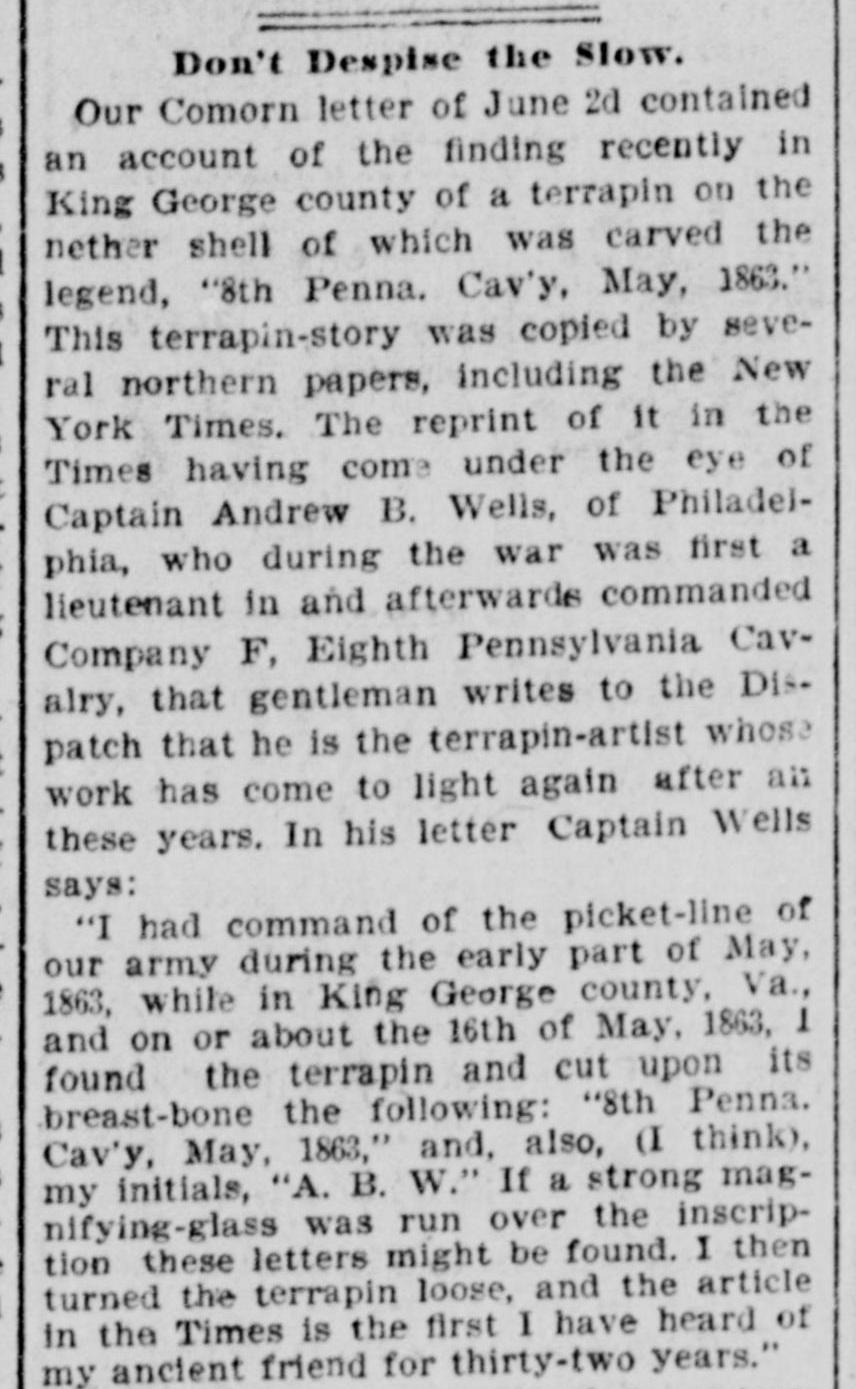
“Don’t Despise the Slow,” with Captain Wells’s letter, The Richmond Dispatch, June 12, 1895, page 2. Library of Congress, Chronicling America. Click the clipping to read it full size.
A note from a young lady
Wells sent along papers that told a second story. Just before he carved the terrapin, a young lady of King George had sent him a note asking him to call. On May 17 he set out from camp to accept, and, as he put it, “landed in Richmond,” a prisoner in Libby Prison.
For a quarter of a century he wondered whether that note had been a trap. At last he wrote to her family, and their letters set his mind at rest. She’d had no part in his capture. He had been very kind to her family, and she had sent for him only to ask him to save “the only horse left on the farm” from being taken. Her family had even heard he was in danger at Libby and written to General Lee, telling how he was captured and pleading for him.
The Dispatch drew its own lesson: “Do not despise the slow-going; for in this instance one of the slowest of creatures has ‘gotten here,’ to give us a bit of long-lost history, tinged with romance.”
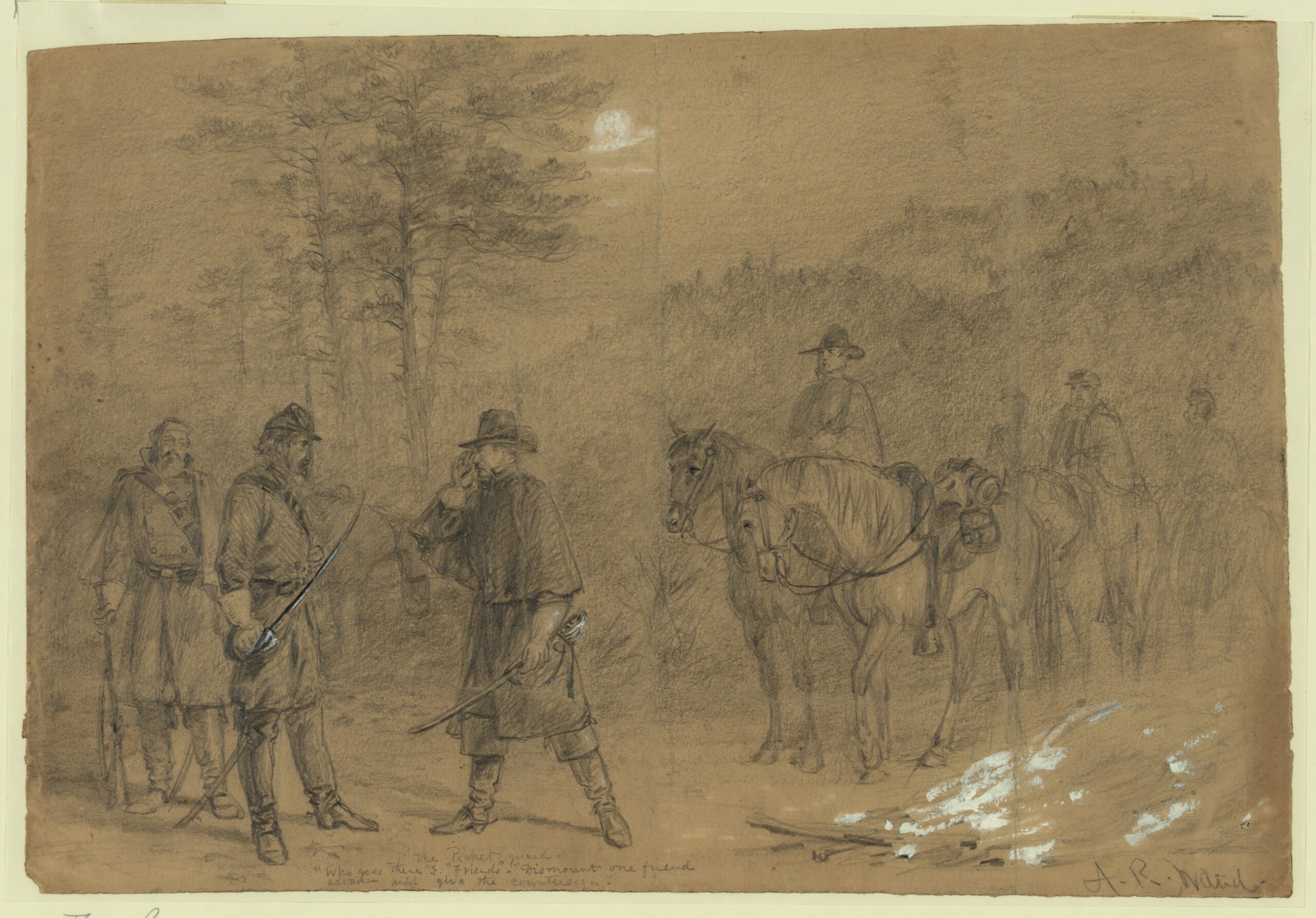
“The Picket Guard,” drawn by Alfred R. Waud and published in Harper’s Weekly on February 14, 1863: a picket challenging horsemen at night, the kind of duty Lieutenant Wells had in King George County that May. Library of Congress, Prints and Photographs Division, Morgan Collection of Civil War Drawings. Click the picture to see it full size.
Twelve cents a day
The same letter from Comorn carried the week’s other news. For two weeks the roads had been full of men walking toward Fredericksburg, headed for Baltimore and other cities. Their stories matched: agencies had promised them at least $1.50 a day at oyster-packing houses near the Chesapeake, but they could earn only 12 to 24 cents a day, and their board was “entirely of common cheese and crackers.” One man who lived on the main road fed and cared for forty of them in a single week and fixed up an outbuilding so they could sleep inside.
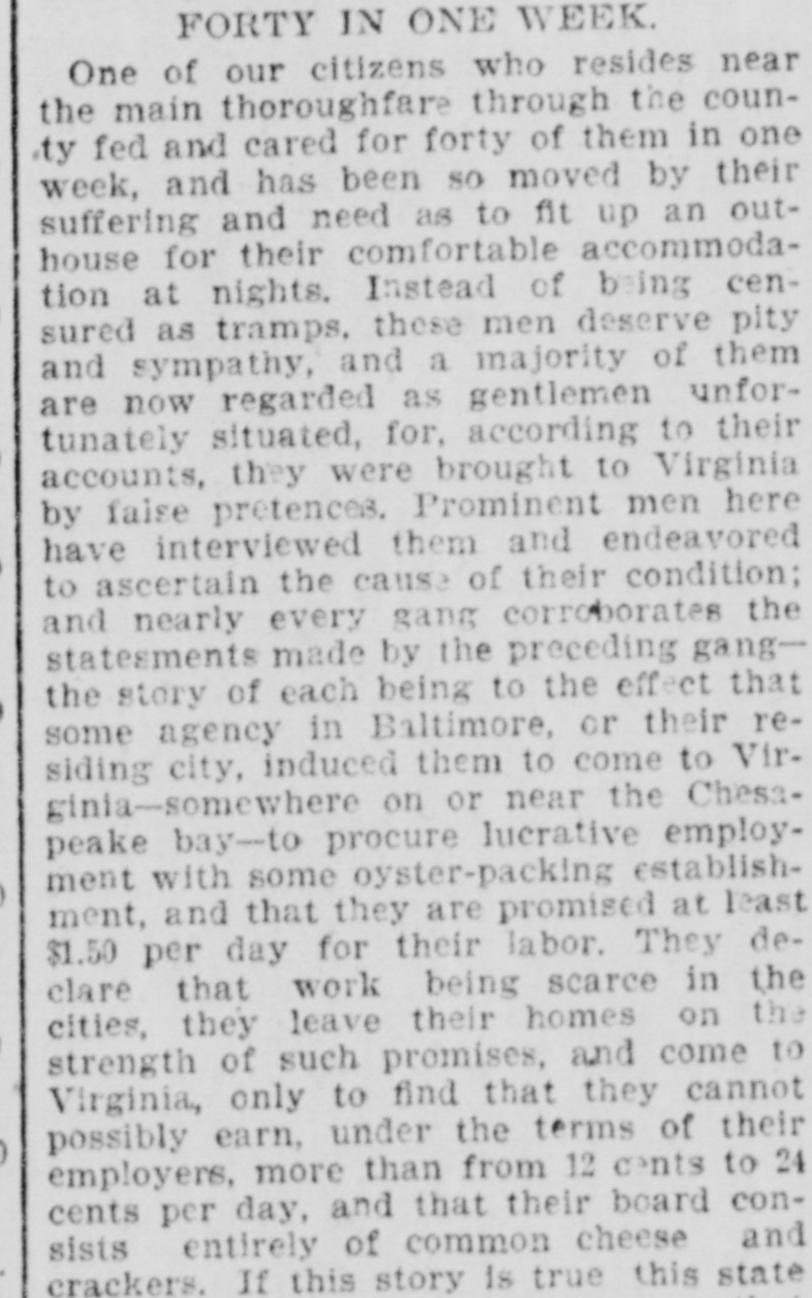
“Forty in One Week,” from the Comorn letter, The Richmond Dispatch, June 2, 1895, page 2. Library of Congress, Chronicling America. Click the clipping to read it full size.
Home again
Wells came home from Libby. The Pennsylvania regimental roster lists Andrew B. Wells of Company F as promoted to first lieutenant in March 1862 and to captain in February 1864, and discharged at the end of his three years that September. The papers don’t say whether anyone ever ran a magnifying glass over the shell to look for “A. B. W.” But for thirty-two years a Virginia terrapin carried a Pennsylvania lieutenant’s spring of 1863 around a King George field, until a farmer’s son picked it up and the man who carved it wrote back.
Sources
- The Richmond Dispatch (Richmond, Va.), June 2, 1895, page 2 (“A Veteran Terrapin,” letter from Comorn, King George County, dated June 1, with “Thought the Dog Did It,” “The Tramp Nuisance” and “Forty in One Week”) and June 12, 1895, page 2 (“Don’t Despise the Slow,” with Captain Wells’s letter).
- Alexandria Gazette (Alexandria, Va.), July 18, 1895, page 1 (“A Terrapin Marked May, 1863,” reprinted from the Dispatch).
- Samuel P. Bates, History of Pennsylvania Volunteers, 1861-65 (Harrisburg, 1868-1871), Eighth Cavalry, Company F roster, as transcribed at PA-Roots: Andrew B. Wells.
- Drawing: Alfred R. Waud, “The picket guard,” about January 1863, published in Harper’s Weekly, February 14, 1863. Library of Congress Prints and Photographs, Morgan Collection of Civil War Drawings, no known restrictions on publication.
- All newspaper images: Library of Congress, Chronicling America. Published 1895, public domain.
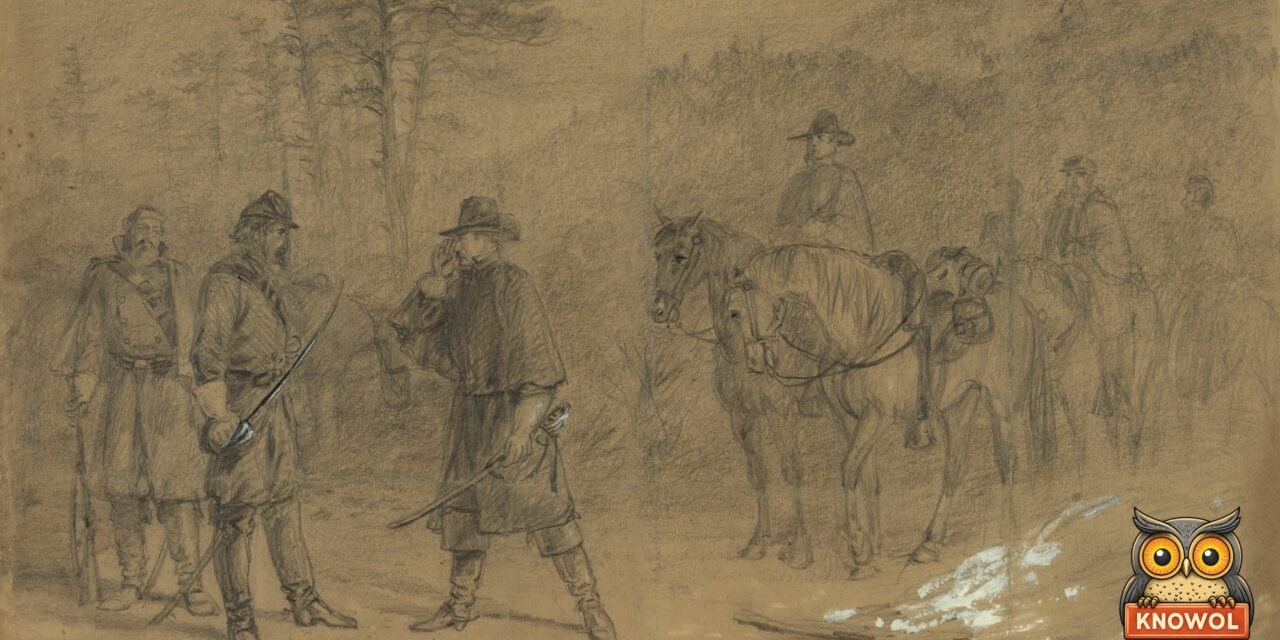
- Cover: Alfred R. Waud, “The picket guard,” 1863 (cropped). Library of Congress Prints and Photographs, Morgan Collection of Civil War Drawings. No known restrictions on publication.