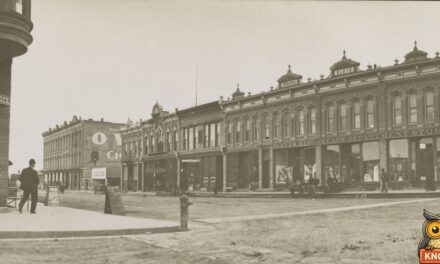
In February 1926, Abe Goldstein of Cheyenne, Wyoming, had a column to fill and not much news to fill it with. He was the Cheyenne social editor, the writer of party and club news, for a Denver weekly called The Intermountain Jewish News. Cheyenne’s Jewish families were having a quiet winter. Now and then, he wrote, “some zestful card party or a genial smoker,” an evening of cigars and talk for men, stirred things up.
But Goldstein could feel a change in the weather. “Yet it is only the silent lull before the storm,” he wrote. The storm was a party: the Mt. Sinai Purim ball and bazaar, set for Sunday night, February 28. He did not think small. On that night, he promised, “all roads from Greeley, from Fort Collins, from Laramie, even from Denver, will lead to Cheyenne.”
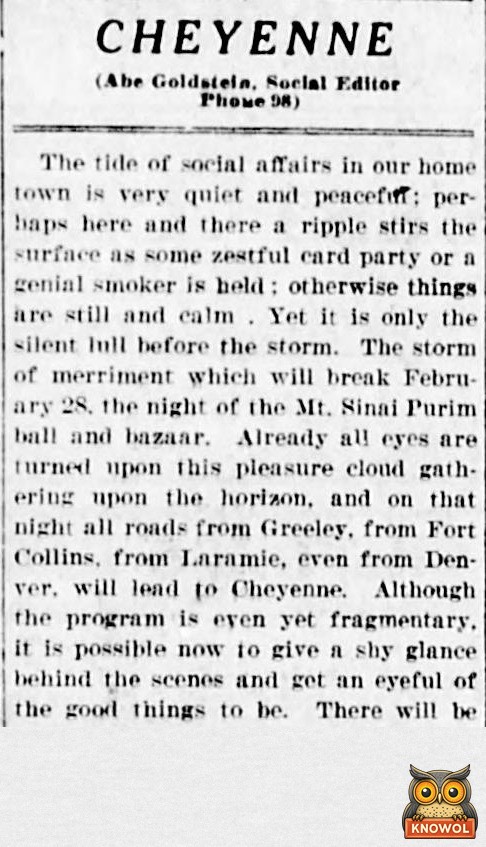
Abe Goldstein’s Cheyenne column. The Intermountain Jewish News, Denver, Colorado, February 18, 1926, page 3. Library of Congress, Chronicling America. Click the clipping to read it full size.
That was a big promise from a small group. In 1919, the American Jewish Year Book counted 113 Jewish people in all of Cheyenne. Their Mt. Sinai Congregation had formed in 1910, and in 1915 it began building the first synagogue in Wyoming. Now it was inviting “everyone in the intermountain region.” There would be a play, dance acts, an orchestra and a bazaar, with booths selling things to raise money. But the column left out one thing: where the party was.
Cheyenne’s Party With No Address
In Cheyenne, Wyoming, Abe Goldstein had some fun with the missing address. “The exact place of this celebration is still shrouded in mystery,” he wrote, “but the eager multitude wending its way Cheyenne-ward will have no difficulty whatsoever in locating the place by simply following the crowd at 7 p. m. February 28.”
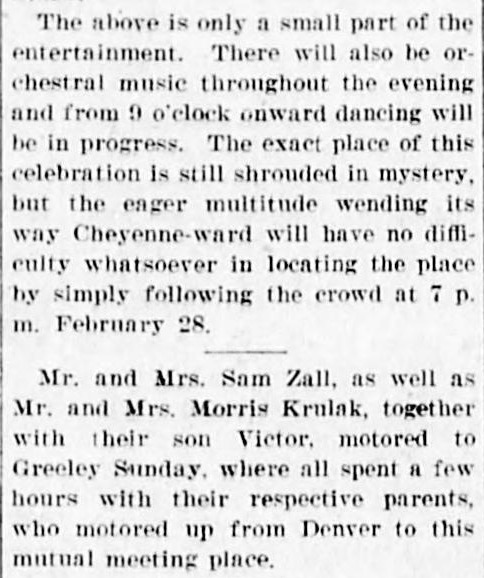
“Simply following the crowd.” The Intermountain Jewish News, Denver, Colorado, February 18, 1926, page 3. Library of Congress, Chronicling America. Click the clipping to read it full size.
Then comes the funny part. Thirty-seven lines farther down, the same column ended with the sponsors’ own invitation. It spilled over into the next column, and its last words gave the answer: “The time is 7 p. m.; the place, Central Gymnasium, Twenty-first and Central avenue.” Anyone who read to the very end knew exactly where to go.
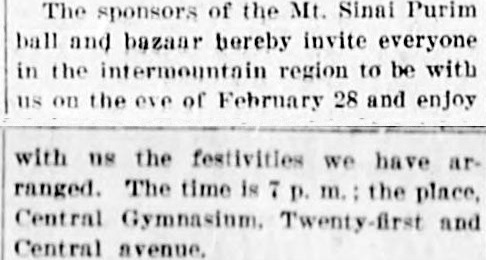
The answer, at the bottom of the same column. The Intermountain Jewish News, Denver, Colorado, February 18, 1926, page 3. Library of Congress, Chronicling America. Click the clipping to read it full size.
What Purim Is
Purim, the holiday Cheyenne’s Jewish families were getting ready for, comes on the 14th day of the Hebrew month of Adar, in late winter. It remembers a story told in the Bible’s Book of Esther. Long ago in Persia, the king’s prime minister, Haman, plotted against the Jews. Queen Esther and her cousin Mordecai outwitted him, and the Jews were saved.
Ever since, Purim has been a happy day, and a 1930 book for Jewish children, With the Jewish Child in Home and Synagogue, explains how it was kept. The Scroll of Esther is read aloud in the synagogue, and children shake rattles to drown out the names of Haman’s sons. Families send baskets of cakes to friends, give money to the poor and dress up in costumes.
That week’s Intermountain Jewish News was full of Purim parties. On the same page as the Cheyenne column, a women’s group from a Denver synagogue advertised its own masquerade dance on the very same night, with prizes for the best costumes and “GEO. MORRISON (HIMSELF) AND HIS 9-PIECE ORCHESTRA.” Tickets were $1.25 a couple. So when Goldstein wrote that roads would lead to Cheyenne “even from Denver,” he was asking Denver dancers to skip a party at home and drive north.
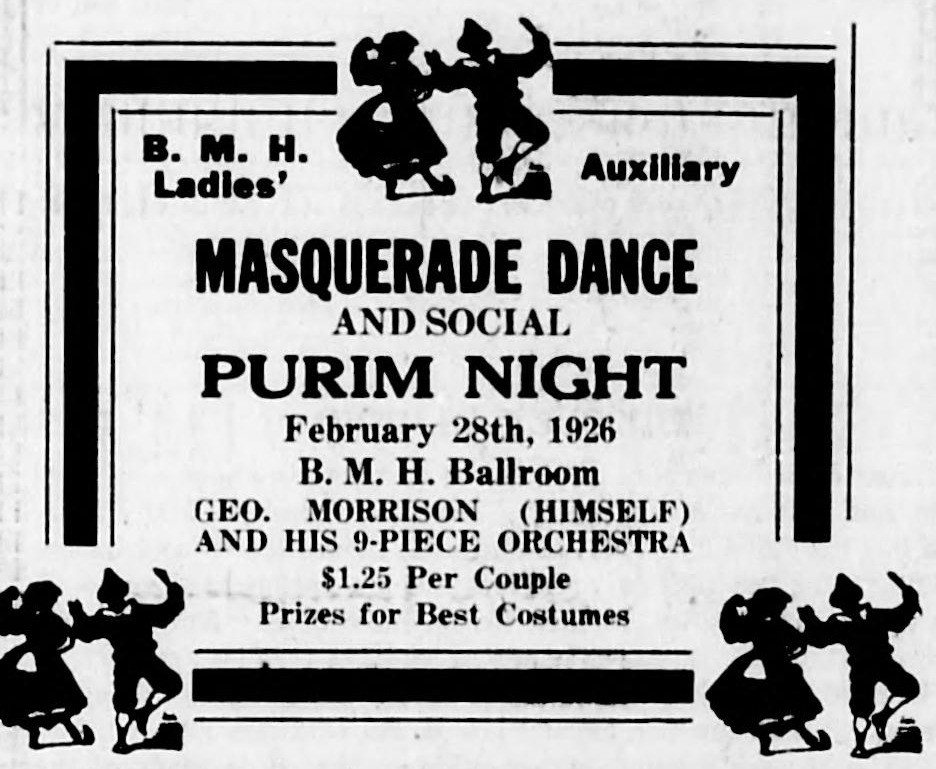
Denver’s own Purim Night dance, the same evening as Cheyenne’s ball. The Intermountain Jewish News, Denver, Colorado, February 18, 1926, page 3. Library of Congress, Chronicling America. Click the clipping to read it full size.
A Play, the Charleston and the Nimble Two G’s
The Cheyenne show was to open with a short play, “A Daughter of Her People.” The column called it “a clear-cut, concise, soulful peep into a typical Jewish home in Poland on the afternoon before Purim eve.” In the cast list, Margaret Goldfarb was the daughter, Esther, and Sol Bernstein was the father, Mordecai, named for the two heroes of the Purim story. Mary Marchick was Leah, the mother, Sarah Silverstein was a neighbor, and Dave Veta was “Count Paul, a Polish nobleman.”
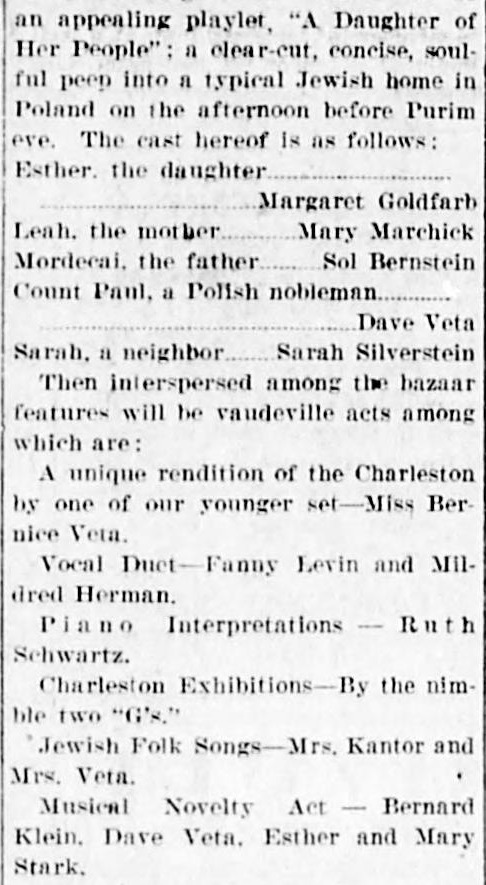
The program for the Cheyenne Purim ball. The Intermountain Jewish News, Denver, Colorado, February 18, 1926, page 3. Library of Congress, Chronicling America. Click the clipping to read it full size.
After the play came vaudeville acts, short variety numbers a lot like a talent show. Fanny Levin and Mildred Herman would sing a duet, Ruth Schwartz would play the piano, and Mrs. Kantor and Mrs. Veta would sing Jewish folk songs. Two of the acts were the Charleston, the dance craze of the day. Miss Bernice Veta, “one of our younger set,” would dance it alone. The other was billed as “Charleston Exhibitions,” by “the nimble two ‘G’s.'” The column never said who the two G’s were. At 9 o’clock, the orchestra would start the dancing for everyone.
The Charleston Comes to Cheyenne
The Charleston was already a hit with Cheyenne’s young people. The fall before, the junior branch of B’nai B’rith, a Jewish lodge, held a dance at the K. C. Hall, the hall of the Knights of Columbus, a Catholic men’s club. Cheyenne’s Jewish groups met there often. “The Charleston contest was the most enjoyable feature of the evening,” Goldstein reported. Miss Ethel Goldstein won for the ladies, and Mr. Julius Stark won for the men.
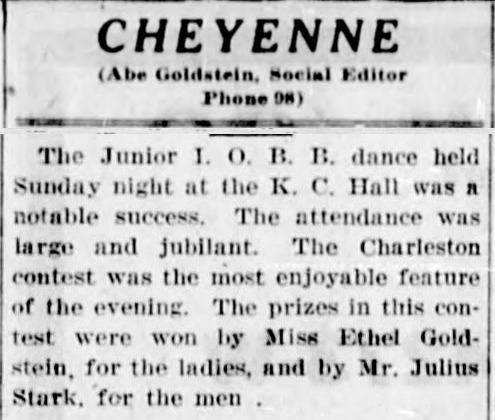
Cheyenne’s Charleston champions, the fall before. The Intermountain Jewish News, Denver, Colorado, November 5, 1925, page 5. Library of Congress, Chronicling America. Click the clipping to read it full size.
The Charleston was everywhere that winter. In a photo dated February 15, 1926, two weeks before the Cheyenne ball, a whole basketball team in Washington, D.C., is taking a Charleston lesson. The players belonged to the Palace Club, the city’s team in the American Basket Ball League. The typed caption on the photo begins, “The Charleston as an aid to the game.”
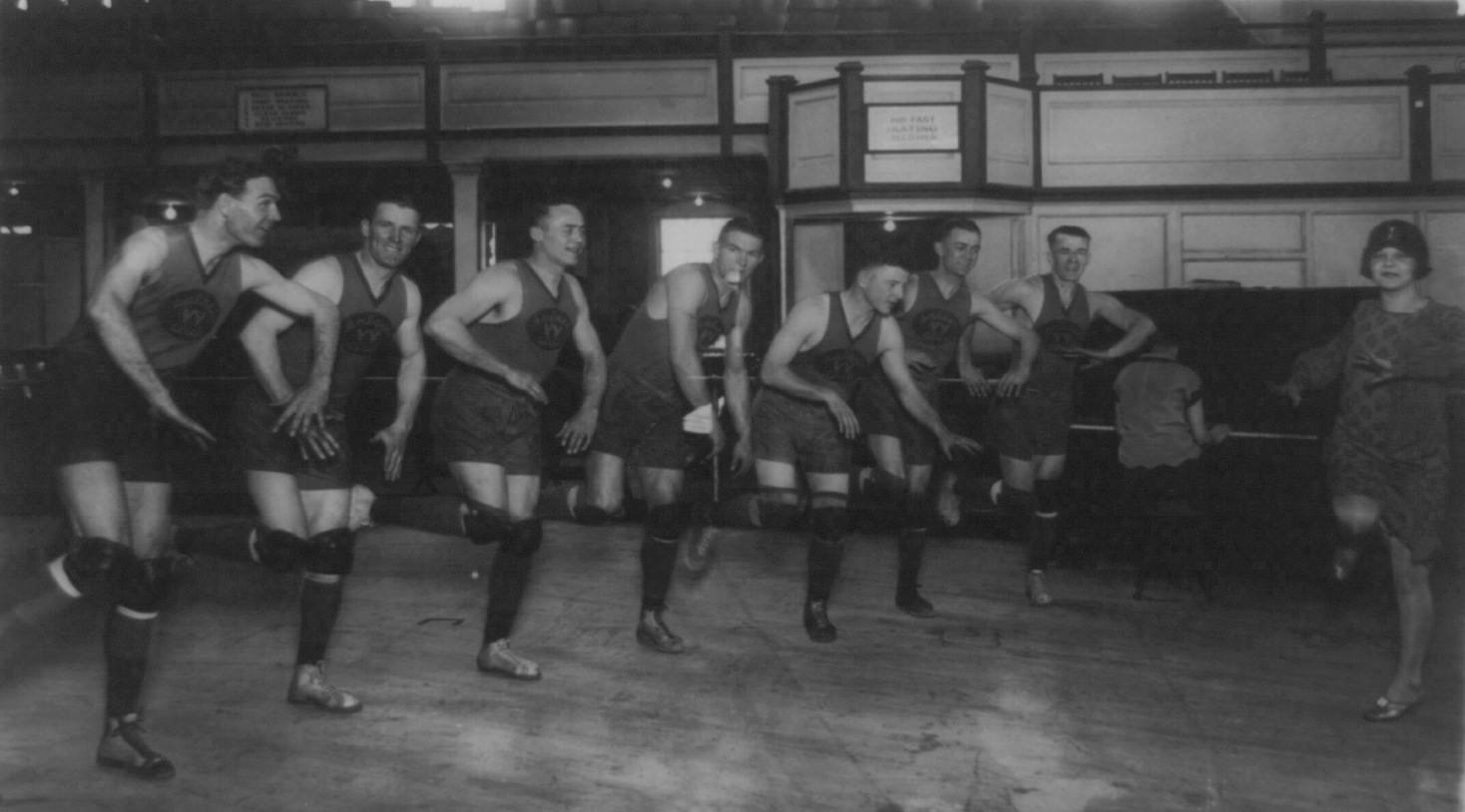
Players from the Palace Club, a Washington, D.C., basketball team, take a Charleston lesson from Miss Vivian Marinelli, February 15, 1926. Not Cheyenne, but the same dance in the same month. National Photo Company Collection, Library of Congress. Click the picture to see it full size.
The Man Cheyenne Called “Silent Abe”
In September 1926, the same Denver paper ran a front-page story about the Cheyenne man who wrote all those stormy words. Abe Goldstein, it said, was “known to this community as ‘Silent Abe.'”
His life had been anything but quiet. Born in St. Petersburg, Russia, he finished college there, then worked in America as a reporter for the Omaha Bee in Nebraska. In 1900 he took up a homestead, land a settler could claim from the government by farming it, in Routt County, Colorado, near Steamboat Springs, Colorado. He ranched there and sent local news to the Denver papers. Before he moved to Wyoming, the paper said, he managed the magazine and dining car business on the Moffat Railroad. He was also secretary of the Denver Baseball Club for twelve years.
By 1926 he had lived in Cheyenne for nearly 25 years. He was president of the Mt. Sinai Congregation and the founder of the Cheyenne Jewish Relief Association. In the state primary that year, he won a place on the Democratic ticket for the Wyoming legislature. The paper called him “the first Jewish Democratic candidate for the position in this state.” We could not find how his race came out that November.
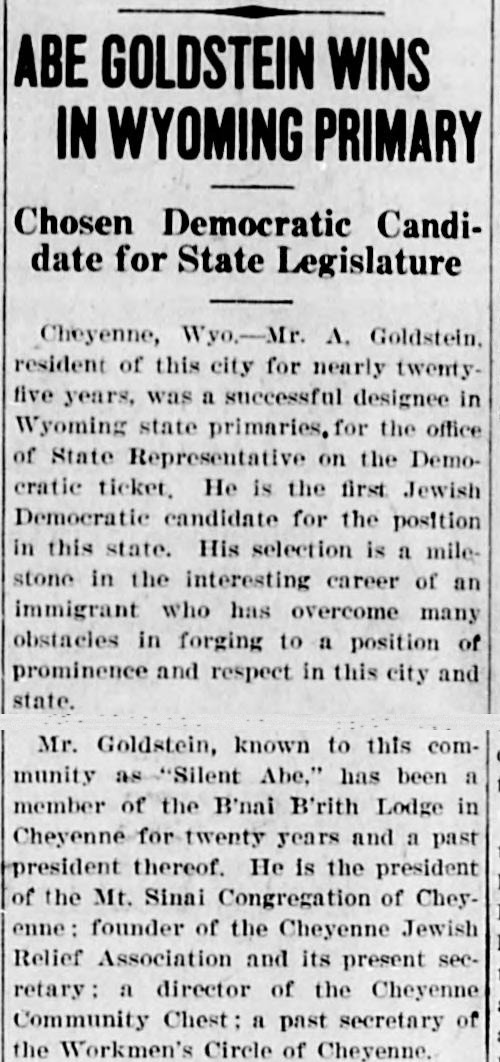
“Silent Abe.” The Intermountain Jewish News, Denver, Colorado, September 2, 1926, page 1. Library of Congress, Chronicling America. Click the clipping to read it full size.
The Night of the Purim Ball in Cheyenne
Abe Goldstein’s next Cheyenne column, on March 4, 1926, told how the big night went. It opened like a fond goodbye. “The Mt. Sinai Congregation Purim ball and bazaar is a thing of the past,” he wrote. “It passed away at midnight Sunday when the last note of the last dance died away.” The large crowd went home “well satisfied and happy.”
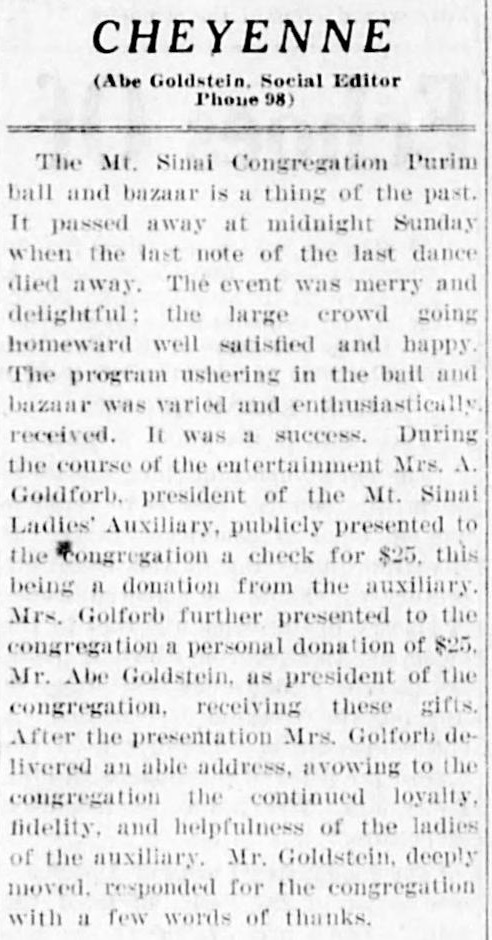
The report after the ball. The Intermountain Jewish News, Denver, Colorado, March 4, 1926, page 2. Library of Congress, Chronicling America. Click the clipping to read it full size.
There was one more scene. During the show, the president of the Mt. Sinai Ladies’ Auxiliary, printed as Mrs. A. Goldforb, presented the congregation, in front of everyone, with a check for $25 from the auxiliary. Then she gave $25 more of her own. That made $50, enough to buy 40 couples’ tickets to the Denver masquerade. Giving to others is part of Purim, too.
The man who accepted the checks, as president of the congregation, was Abe Goldstein himself. His own column told what he did next: “Mr. Goldstein, deeply moved, responded for the congregation with a few words of thanks.” For once, Silent Abe kept it short.
What Things Cost in February 1926
The ads on the same page as the Cheyenne column show what money bought that winter:
- A couple’s ticket to Denver’s Purim Night masquerade: $1.25
- A pair of eyeglasses at U. S. Optical Co. in Denver: $6.75
- A new Essex Six Coach automobile from Luby Motor Co.: $765, plus freight and tax
All Roads Lead to Cheyenne, Wyoming
Abe Goldstein’s line about the roads was more than big talk. In the 1920s and 1930s, Carl V. Hallberg wrote in the Annals of Wyoming, cars and better roads let Jewish families in small Wyoming towns reach services in bigger ones. Families from Laramie, Wyoming, came to Cheyenne. The same February column shows cars at work. Mr. and Mrs. Sam Zall and Mr. and Mrs. Morris Krulak, with the Krulaks’ son Victor, drove south to Greeley, Colorado, one Sunday. Their parents drove up from Denver, Colorado. The families met in between, at what Goldstein called “this mutual meeting place.”
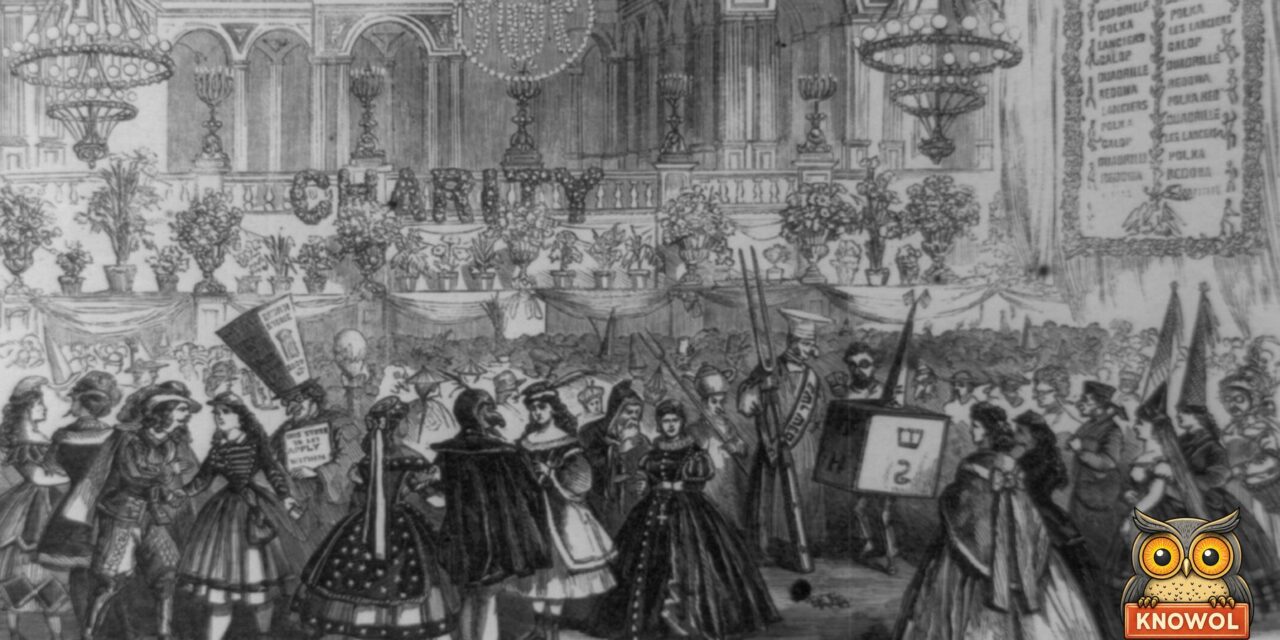
The picture at the top of this page is a Purim ball, but not Cheyenne’s. It shows New York’s Hebrew Purim Ball at the Academy of Music on March 14, 1865, drawn for Frank Leslie’s Illustrated Newspaper. Under the word CHARITY, spelled out in flowers, the guests dance in costume, and a board on the wall lists the night’s dances, from the polka to the quadrille. We found no photograph of the Cheyenne ball. Sixty-one years after that New York night, a much smaller crowd in Cheyenne danced until midnight, gave what it could, and then let the roads carry everyone home.
Sources
- Cheyenne column by Abe Goldstein, The Intermountain Jewish News (Denver, Colorado), February 18, 1926, page 3 (the Purim ball program, the Greeley trip, the sponsors’ invitation, and the Denver ads for the Purim Night masquerade, eyeglasses and the Essex coach). Library of Congress, Chronicling America.
- Cheyenne column by Abe Goldstein, The Intermountain Jewish News (Denver, Colorado), March 4, 1926, page 2 (the report after the ball). Library of Congress, Chronicling America.
- “Abe Goldstein Wins in Wyoming Primary,” The Intermountain Jewish News (Denver, Colorado), September 2, 1926, page 1. Library of Congress, Chronicling America.
- Cheyenne column, The Intermountain Jewish News (Denver, Colorado), November 5, 1925, page 5 (the Charleston contest at the K. C. Hall). Library of Congress, Chronicling America.
- Cheyenne column, The Intermountain Jewish News (Denver, Colorado), October 7, 1926, page 2 (the lodge meeting “in the K. of C. hall”). Library of Congress, Chronicling America.
- The American Jewish Year Book 5680 (1919-1920), page 583 (“CHEYENNE (Jewish pop. 113)”). Internet Archive.
- Carl V. Hallberg, “Jews in Wyoming,” Annals of Wyoming, volume 61 (1989), pages 26-27 (Mt. Sinai Congregation formed in 1910; the first synagogue in Wyoming begun in 1915; cars and roads in the 1920s). Wyoming State Historical Society, via Internet Archive.
- Elma Ehrlich Levinger, With the Jewish Child in Home and Synagogue (New York: Bloch Publishing Company, first published 1930), pages 77-80 (how Purim was kept). Internet Archive.
- Miss Vivian Marinelli giving lesson in dancing the Charleston to basketball players of Washington, D.C.’s Palace Club, February 15, 1926. National Photo Company Collection, Library of Congress Prints and Photographs Division. No known restrictions on publication.
- The Hebrew Purim Ball at the Academy of Music, March 14, wood engraving in Frank Leslie’s Illustrated Newspaper, April 1, 1865, page 21 (the cover). Library of Congress Prints and Photographs Division. No known restrictions on publication.
- The newspapers, the 1919 yearbook, the photograph and the engraving above were all published before 1931 and are in the public domain.