
A shoreline town between the East and Hammonasset Rivers, once the East Guilford parish, where farmers plowed whitefish into their fields, shipyards lined the shore, and summer visitors have come to the beach for well over a century.
Then and now
The same town 145 years apart. Click either map to look closer.
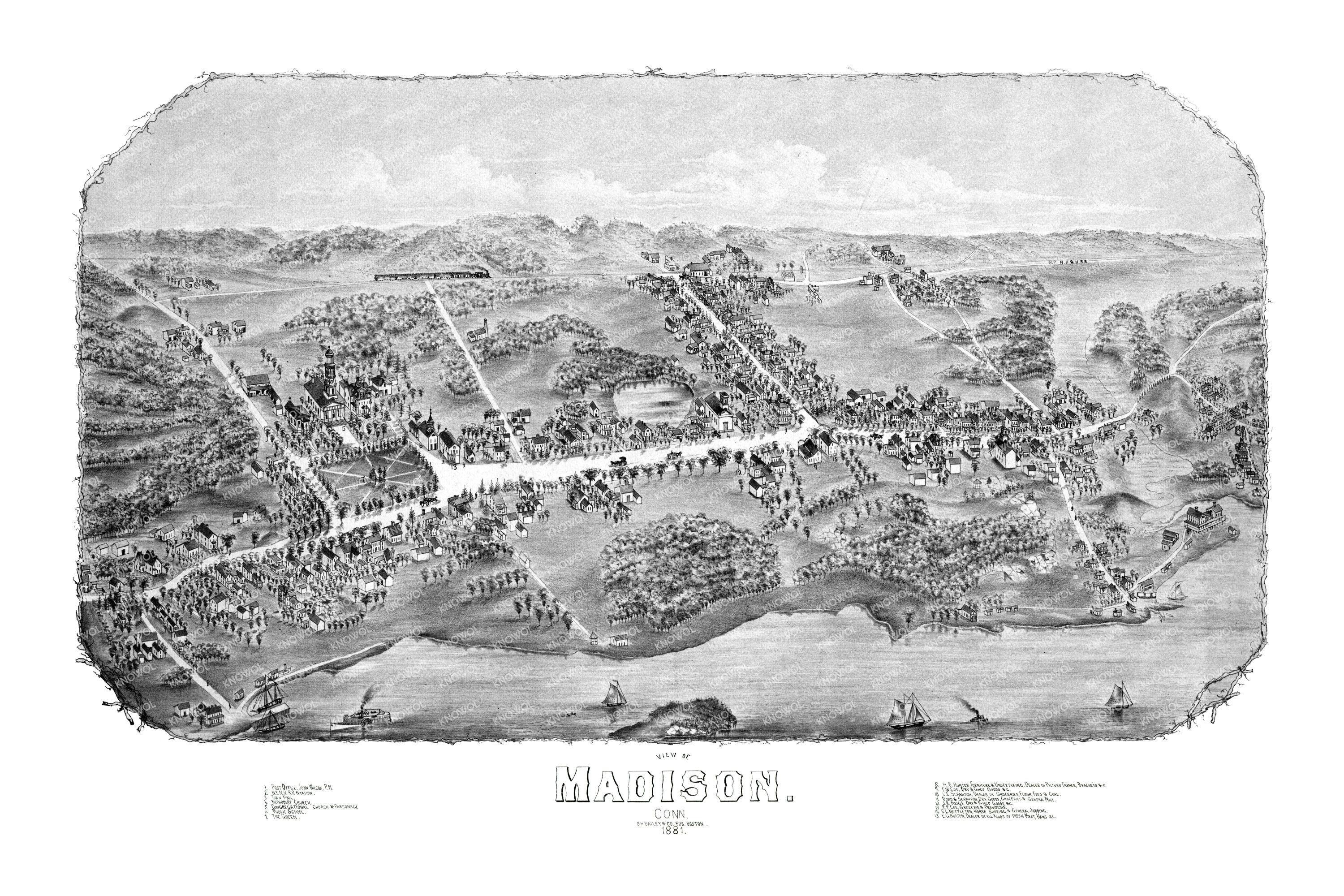
The bird's-eye view
By O.H. Bailey
Madison drawn as if from the sky in 1881, with The Green, the public schools, the New York and New Haven Railroad station, Nettleton Horse Shoeing, Coe Groceries and Provisions, Meigs Dry and Fancy Goods, Scranton Groceries and Hunter Furniture and Undertaking.5
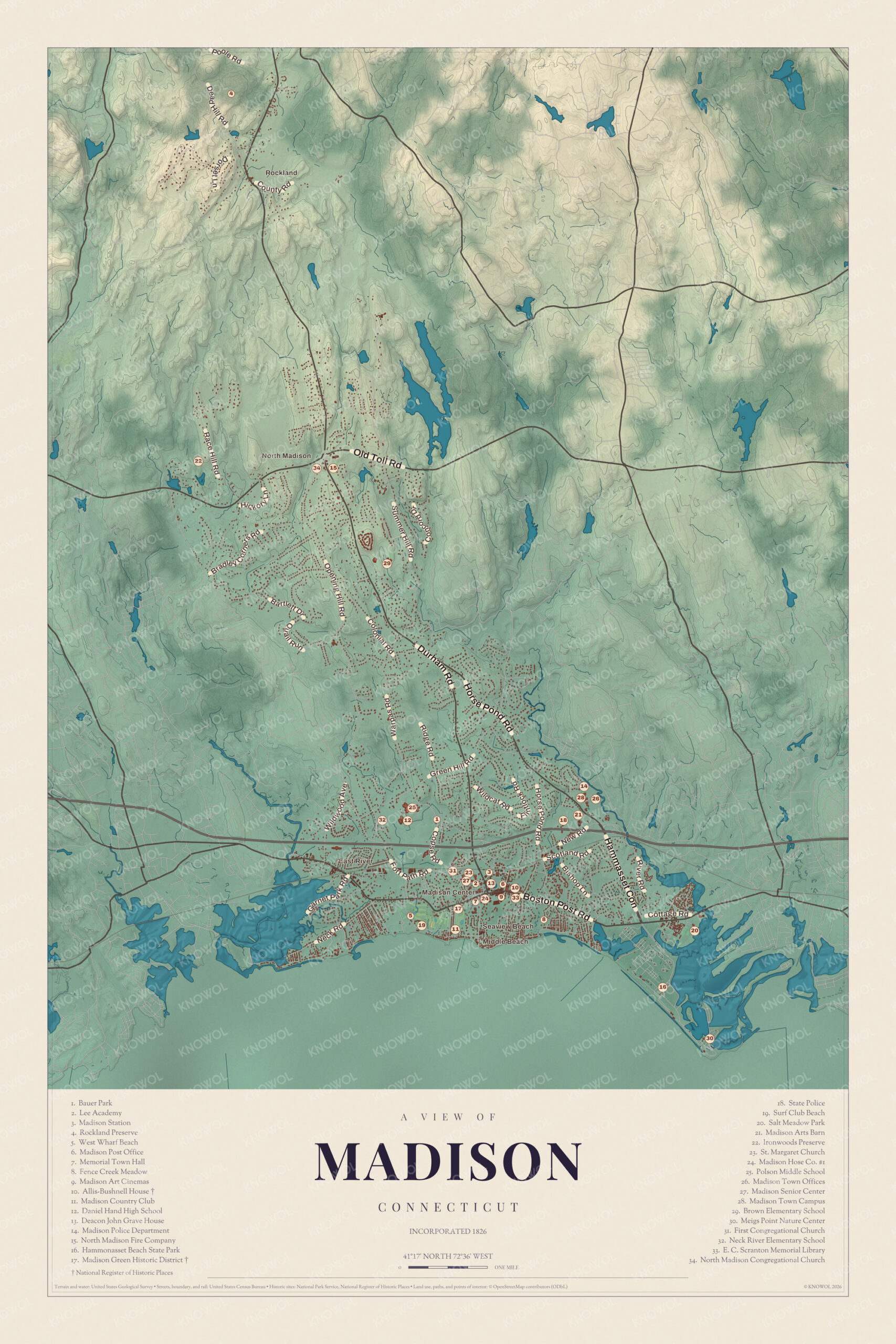
Madison today
By KNOWOL
Shaded hills from North Madison down to Seaview Beach and Hammonasset Point, every street from Boston Post Road to Durham Road, Hammonasset Beach State Park, and a guide of 34 numbered landmarks with the National Register sites marked.6
The story of Madison
The captain who named the town
Capt. Frederick Lee commanded a revenue cutter in the War of 1812, and Madison remembers him as much more than a sailor. In 1821 he built an academy a mile west of the green, and after it was incorporated in 1825 the building was hauled to the green, where Lee Academy still stands. When the new town met for the first time in 1826, Lee ran the meeting, and an 1897 history says he was the one who named the town. The same book says he brought Kosciuszko to America in his ship and counted the Polish hero as a friend. Sixty years later another son of the town, Daniel Hand, gave Madison a brick academy of its own, presented on November 22, 1884.789
Whitefish, charcoal and schooners
For most of its history Madison lived off the land and the water. In the summer of 1798 farmers here began plowing whitefish into their fields, ten to fifteen thousand fish to an acre. Up in rocky North Madison, where about half the land was left in woods, families burned charcoal and carted it to New Haven and Middletown. Along the shore, shipbuilding was the leading trade. Ichabod Lee Scranton built and owned more than twenty vessels, and the Miner family ran a yard for decades until a fire in June 1890 destroyed it, along with two four-masted schooners that were still unfinished. Over at East River, George Munger and his son made blackboards for schools from 1877, with about a dozen men in their shops.10111213
From East Guilford to the beach
Madison began as the eastern farms of Guilford, settled in 1641. By 1672 the families out near the Hammonasset found Killingworth's meeting house, three and a half miles from today's green, so much easier to reach than Guilford's that they longed to join it. Guilford helped the East Farmers get mills in 1699, and the General Assembly made East Guilford its own society in 1703. In 1782 the last British raid on this shore landed near East Wharf. The militia drove it off, but Captain Phineas Meigs was killed. The parish became the town of Madison in 1826. By 1892 summer visitors were filling cottages and hotels by the beach, and in 1919 the state bought the first 499 acres of Hammonasset.114131516173
Through the years
25 moments from 1641 to today.
- 1641English settlers arrive in the eastern part of Guilford, the land that will become Madison.1
- 1672Families near the Hammonasset ask to support Killingworth's church, which is closer than Guilford's.14
- 1681Deacon John Grave builds the saltbox that's now Madison's oldest house.2
- 1690About this year Jonathan Murray, a Scottish settler, builds his house on what's now Scotland Road.18
- 1699Guilford helps the East Farmers get a grain mill and a sawmill.13
- 1702John Hart, soon to be East Guilford's first minister, is the only member of Yale's senior class and its first regular graduate.19
- 1703The General Assembly forms the society of East Guilford.15
- 1705A meeting house goes up on what becomes Madison Green.9
- 1707Rev. John Hart of Farmington is ordained East Guilford's first pastor.15
- 1782The last British raid on this shore lands near East Wharf; Captain Phineas Meigs is killed driving it off.16
- 1785Aaron Blatchley begins the house now kept as the Allis-Bushnell House museum.20
- 1798Farmers first spread whitefish on their fields as fertilizer.10
- 1821Capt. Frederick Lee builds an academy a mile west of the green; in 1825 it's hauled to the green.7
- 1826Madison becomes a town, with Frederick Lee running its first town meeting.8
- 1828The Madison Channel Company dams the Neck River and digs a channel to grow oysters in the old bed.21
- 1838The First Congregational Church is built facing the green.9
- 1852The railroad reaches Madison.22
- 1865A paper mill is built on the Hammonasset River at Green Hill Road.23
- 1877George Munger and his son start making blackboards at East River.13
- 1884Daniel Hand presents the new Hand Academy to his native town on November 22.7
- 1890Fire destroys the Miner shipyard and two unfinished four-masted schooners.12
- 1901The E. C. Scranton Memorial Library is built, designed by Henry Bacon.1
- 1919The state buys the first 499 acres of Hammonasset Beach State Park.3
- 1933Civilian Conservation Corps crews begin building the State Park Supply Yard on Mill Road.24
- 1934Bridge No. 1132 carries Route 80 over the Hammonasset River on a concrete arch.25
Places to see
The numbers match the landmark guide printed on the 2026 map.
- 2Lee AcademyMadison Green. Captain Frederick Lee's academy of 1821.
- 3Madison StationNorth of the center. The 1896 station building still stands.
- 10Allis-Bushnell House853 Boston Post Road. Historical society house museum.Visit their website
- 12Daniel Hand High SchoolWest of the center. Goes back to Hand Academy, 1884.
- 13Deacon John Grave House581 Boston Post Road. Madison's oldest house, built 1681.Visit their website
- 16Hammonasset Beach State ParkEast of town. Two miles of shore since 1919.Visit their website
- 17Madison Green Historic DistrictTown center. The green laid out in 1705.
- 30Meigs Point Nature CenterHammonasset, Meigs Point. Touch tank and live turtles.Visit their website
- 31First Congregational ChurchMadison Green. Built 1838, and it owns the green.Visit their website
- 33E. C. Scranton Memorial LibraryBoston Post Road. Built 1901, enlarged 1989.Visit their website
On the National Register
All 9 places in Madison on the National Register of Historic Places that still stand today, oldest first, and why each one matters.4
-
Jonathan Murray House
Built by Jonathan Murray, a Scottish settler who came to the New Haven Colony in 1685, it's one of the state's small number of 17th-century houses. It stayed in the Murray family until 1800 and didn't get electricity or plumbing until 1956.18
-
Meigs-Bishop House
Begun by Janna Meigs about 1690 and grown into a saltbox by about 1725, it's believed to be Madison's second oldest house. Phineas Meigs, who was killed defending the shore from a British raid, later owned it.26
-
Shelley House
Its oldest room probably dates to the late 1600s, and the house shows unusually clearly how a one-room stone ender grew into a saltbox over the next century. Little is known of the Shelleys beyond the name.27
-
Madison Green Historic District
The green began in 1705 as the site of the East Guilford meeting house and grew into the town center. Around it stand the First Congregational Church of 1838, Lee Academy of 1821, Memorial Hall and many historic houses, with the Deacon John Grave House just to the east.9
-
Allis-Bushnell House
Aaron Blatchley built it between 1785 and 1789 as a one-and-a-half-story house, later raised to two full stories. The Madison Historical Society rented it in 1917, bought it in 1920 and keeps it as a museum.20
-
Hammonasset Paper Mill Site
The stone foundation, raceways and part of the dam of a mill that made strawboard for boxes until 1890. The site sits on both banks of the river at the town line and is reached by land trust trails.23
-
State Park Supply Yard
Civilian Conservation Corps crews built this maintenance yard for the state park system in 1933 to 1935. It's the best-preserved of the state's early park maintenance yards.24
-
Bridge No. 1132
An open-spandrel concrete arch with a 100-foot main span over a steep wooded ravine, one of only a few of its kind in the state. The Highway Department praised it for its scenic setting.25
-
Wiley-Tremaine House
Madison's newest National Register listing, added in February 2026.4
In their words
“Madison village has a very pleasant location, about half a mile from the beach of Long Island sound”
History of New Haven County, Connecticut, 189228
“The beach in Madison is hard and in long stretches, and the bathing is safe.”
History of New Haven County, Connecticut, 189217
“their equal was not be found in Madison”
Capt. Timothy Field on Ebenezer Dowd's eight sons, as told in the Commemorative biographical record of Hartford County, 190129
Nearby towns
Sources
- Madison, Connecticut, Wikipedia
- Deacon John Grave House, Wikipedia
- Hammonasset Beach State Park, Wikipedia
- National Register of Historic Places listings in New Haven County, Connecticut, Wikipedia
- Bird's-eye view of Madison, Connecticut from 1881, restored by KNOWOL
- Map of Madison, Connecticut in 2026, KNOWOL (USGS elevation, Census Bureau roads)
- History of New Haven County, Connecticut (1892), on Lee's Academy and the Hand Academy, Internet Archive
- A history of the plantation of Menunkatuck and of the original town of Guilford (1897), on Capt. Frederick Lee, Internet Archive
- Madison Green Historic District, Wikipedia
- Connecticut historical collections (1837), on Madison's farms and trades, Internet Archive
- Commemorative biographical record of New Haven County, Connecticut (1902), on Ichabod Lee Scranton, Internet Archive
- Genealogical and biographical record of New London County, Connecticut (1905), on the Miner shipyard, Internet Archive
- History of New Haven County, Connecticut (1892), on Madison's mills and trades, Internet Archive
- A history of the plantation of Menunkatuck and of the original town of Guilford (1897), on the Hammonassett families and Killingworth, Internet Archive
- Connecticut historical collections (1837), on Lee's Academy and the first ministers, Internet Archive
- History of New Haven County, Connecticut (1892), on the British raids, Internet Archive
- History of New Haven County, Connecticut (1892), on Madison Beach, Internet Archive
- Jonathan Murray House, Wikipedia
- Old paths and legends of the New England border (1907), on Madison's first minister, Internet Archive
- Allis-Bushnell House, Wikipedia
- A history of the plantation of Menunkatuck and of the original town of Guilford (1897), on the Madison Channel Company, Internet Archive
- Madison station (Connecticut), Wikipedia
- Hammonasset Paper Mill Site, Wikipedia
- State Park Supply Yard, Wikipedia
- Bridge No. 1132, Wikipedia
- Meigs-Bishop House, Wikipedia
- Shelley House (Madison, Connecticut), Wikipedia
- History of New Haven County, Connecticut (1892), on Madison village, Internet Archive
- Commemorative biographical record of Hartford County, Connecticut (1901), on the Dowd family of Hammonassett, Internet Archive