
A town of hill farms and small mill villages on the Fenton and Natchaug, where nearly every household once raised silkworms and the Storrs brothers' farm school of 1881 grew into the University of Connecticut.
Mansfield on the map
Click the map to look closer.
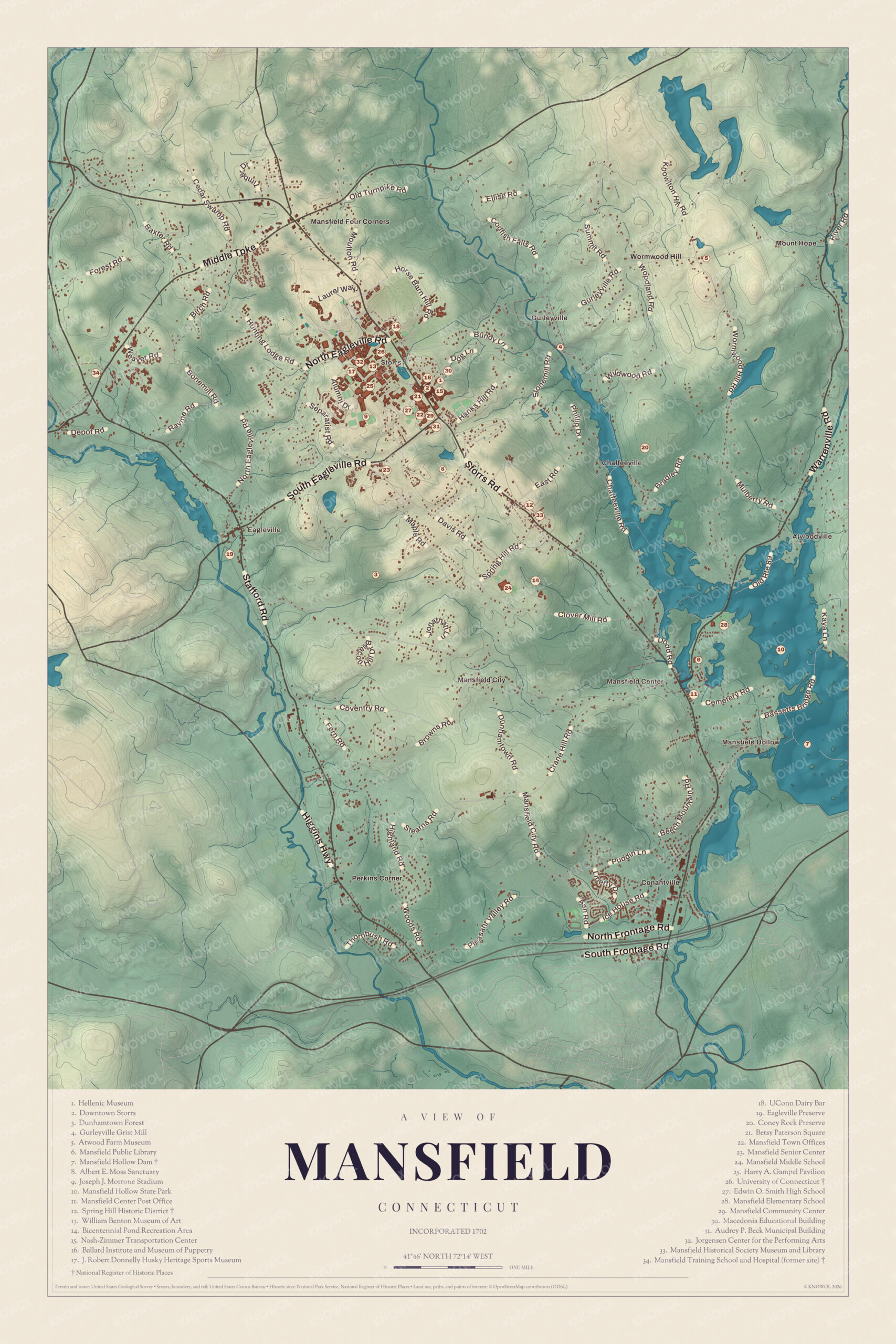
Mansfield today
By KNOWOL
Shaded hills from Merrow and Eagleville down to Mansfield Center and the Hollow, the Fenton River, every street, and a guide of 34 numbered landmarks with the National Register sites marked.3
The story of Mansfield
Silk on every farm
For a long stretch of the 1800s, Mansfield meant silk. Nearly every farmer raised mulberry trees, an 1883 history says, while his wife and daughters fed the silkworms and spun the thread. In 1788 thirty-two townspeople asked to be made a silk company. An 1819 gazetteer guessed the town turned out 2,500 pounds of raw silk a year, and in 1836 John Warner Barber wrote that more silk was made here than anywhere else in the country. In 1810 Rodney Hanks and his nephew Horatio spun silk by water power on machines they built with their own hands. Silk mills followed at Gurleyville, the Hollow and Conantville, named for Captain Joseph Conant. Then the girls began leaving the hillsides for the mill villages, and farm life was never the same.456789
The buzz saw and the bell foundry
Mansfield people were tinkerers. Barber wrote in 1836 that about sixty years earlier Daniel Hartshorn had invented the buzz saw here, turning it by hand to cut the teeth of horn combs. Nathan Palmer, a house joiner, and Andrew Hartshorn, a blacksmith, were credited with the screw auger. Benjamin Hanks, born in Mansfield in 1755, came home in 1785 to cast bells and brass cannon, and he's remembered for a clock on the old Dutch Church in New York that wound itself with a little windmill. In 1838 Joseph Merrow opened a knitting mill at the village that took his name, and in 1876 the Mansfield Organ Pipe Works moved into a mill at Mansfield Depot. Barber summed the town up as ingenious, enterprising and industrious.1011121314
From orphans' home to UConn
The University of Connecticut grew out of a fire and a gift. In 1865, with Charles Storrs urging him on, Edwin Whitney opened a boarding school in Mansfield's north parish, but a fire broke it up before the first term ended. Whitney couldn't serve in the Civil War, so he gave his new house and farm to the state as a home for soldiers' orphans. Later Augustus Storrs bought the old family homestead and proved with big crops that careful, scientific farming paid. In 1881 he and his brother Charles gave land, buildings and money for the Storrs Agricultural School, in the old orphans' home. For twelve years it taught between 40 and 63 students. It became a college in 1893 and took the name University of Connecticut in 1939.151617118
Through the years
25 moments from 1686 to today.
- 1686Twenty-one home lots are laid out at the Ponde-place at Naubesatuck, now Mansfield Center.19
- 1692English settlers have put down roots at what is now Mansfield Center.1
- 1693The burying ground at Mansfield Center is set aside.20
- 1697A Windham town meeting admits the town is really two settlements, four miles apart, with a bad river between.21
- 1702Pointing to the deep and dangerous river, the north end of Windham asks to be its own town, and Mansfield is incorporated in October.221
- 1710The town finishes a parsonage for Rev. Eleazer Williams, its first minister. The house still stands.23
- 1749Benjamin Davis begins a stone grist mill and dam on the Fenton River at Gurleyville.8
- 1785Benjamin Hanks comes home to Mansfield and opens a foundry for bells and brass cannon.11
- 1788Thirty-two townspeople ask the General Court to incorporate them to make silk.4
- 1789A June flood sweeps away seven bridges, and the Assembly lets the town raise 300 pounds by lottery to rebuild.24
- 1810Rodney and Horatio Hanks spin silk by water power, and the first silk mill in the United States is built here.41
- 1819A gazetteer estimates the town makes about 2,500 pounds of raw silk a year.5
- 1827Mansfield moves from Windham County to Tolland County.1
- 1838Joseph Makens Merrow starts the knitting mill that gives the village of Merrow its name.13
- 1847Edwin Reynolds, a Mansfield farm boy, is offered a machine shop apprenticeship while plowing a field. He later builds some of the largest steam engines in the world.25
- 1865Edwin Whitney opens a school in the north parish, and after a fire gives his new house and farm to the state as a soldiers' orphans' home.15
- 1876The Mansfield Organ Pipe Works sets up in the Brigham Mill at Mansfield Depot.14
- 1877The Gothic Baptist church at Spring Hill is built.26
- 1881Charles and Augustus Storrs give land and money to found the Storrs Agricultural School.1
- 1882The stone thread mill with its 75-foot tower goes up at Mansfield Hollow.9
- 1888Fire destroys the Merrow knitting mill, and the business moves to Norwich.27
- 1893The school becomes the Storrs Agricultural College.17
- 1917The Mansfield Training School and Hospital takes its name, a state school that ran until 1993.28
- 1939The college is renamed the University of Connecticut.18
- 1952The Army Corps of Engineers finishes Mansfield Hollow Dam to hold back floods.29
Places to see
The numbers match the landmark guide printed on the 2026 map.
- 2Downtown StorrsStorrs. The new town center of the mid-2000s.
- 4Gurleyville Grist MillGurleyville. Stone mill with its original equipment.Visit their website
- 6Mansfield Public LibraryMansfield Center. Brick Georgian Revival building of 1923.
- 7Mansfield Hollow DamMansfield Hollow. Flood control dam finished in 1952.
- 10Mansfield Hollow State ParkMansfield Hollow. Trails and a boat launch.Visit their website
- 12Spring Hill Historic DistrictStorrs Road. Turnpike village of the early 1800s.
- 13William Benton Museum of ArtUConn campus. Free museum in the old dining hall.Visit their website
- 16Ballard Institute and Museum of PuppetryDowntown Storrs. More than 2,500 puppets.Visit their website
- 18UConn Dairy BarNorth side of campus. Where generations line up for cones.
- 33Mansfield Historical Society Museum and LibrarySpring Hill. The town's own history museum.Visit their website
On the National Register
All 10 places in Mansfield on the National Register of Historic Places that still stand today, oldest first, and why each one matters.2
-
Mansfield Center Historic District
The old village center, laid out about 1692 with 21 large house lots along Storrs Road. It keeps its colonial layout, with the 1836 Fitch Mansion, the First Church of 1866, the 1923 library and an 1886 general store.30
-
Mansfield Center Cemetery
Set aside as early as 1693, it is one of the few pieces left of Mansfield's first settlement. More than 180 of its stones are credited to known carvers of eastern Connecticut, with cherubs and other old designs.20
-
Eleazer Williams House
Begun by Samuel Fuller in 1709 and finished by the town in 1710 for Rev. Eleazer Williams, the first minister, it served as the parsonage for 75 years. Its later changes show how a colonial house grew over a century.23
-
Spring Hill Historic District
A hilltop village that grew as a stop on the Norwich and Springfield turnpike and an early center for mulberry trees and silk. It holds the Gothic Baptist church of 1877 and two buildings that served as the town hall.26
-
Gurleyville Historic District
A former mill village on the Fenton River with a stone grist mill and dam begun in 1749, ruins of the Royce Silk Mill and a sawmill, and about a dozen old houses. Governor Wilbur Cross was born here.8
-
Mansfield Hollow Historic District
A mill village on the Natchaug River, where Zalmon Storrs started a silk mill in 1838. The stone mill of 1882, with its 75-foot tower, finished cotton thread and later made brass goods.9
-
Farwell Barn
A post-and-beam dairy barn built while Isaac Farwell owned the farm, bought by the Connecticut Agricultural College in 1911. The farmhouse burned in 1976 and is now an archaeological site, but the barn stands.31
-
University of Connecticut Historic District
The old core of the Connecticut Agricultural School campus, with 23 masonry buildings put up between 1906 and 1942 and the houses of Faculty Row. UConn began here in 1881 as the Storrs Agricultural School.18
-
Mansfield Training School and Hospital
From 1917 until 1993 this was a state school for people with developmental disabilities. After it closed, its buildings on the 350-acre campus were split between a state prison and the University of Connecticut.28
-
Mansfield Hollow Dam
Built by the Army Corps of Engineers to hold back floods on the Natchaug, Shetucket and Thames Rivers. Its earth embankment runs more than two miles, and the lake behind it supplies Willimantic's drinking water.29
In their words
“The inhabitants of this town have been distinguished for their ingenuity, enterprise and industry.”
Connecticut historical collections, 183610
“Mansfield is the ancestral home of the Storrs family of America”
The Connecticut magazine, 1900, after the Storrs family reunion at Spring Hill32
“From the rear of this cemetery, which is the highest ground in Mansfield, a view is obtained such as few inland towns furnish.”
The historical, statistical and industrial review of the state of Connecticut, 1883, on the Storrs cemetery33
Nearby towns
Sources
- Mansfield, Connecticut, Wikipedia
- National Register of Historic Places listings in Tolland County, Connecticut, Wikipedia
- Map of Mansfield, Connecticut in 2026, KNOWOL (USGS elevation, Census Bureau roads)
- The historical, statistical and industrial review of the state of Connecticut (1883), on Mansfield silk, Internet Archive
- A gazetteer of the states of Connecticut and Rhode-Island (1819), on Mansfield, Internet Archive
- Connecticut historical collections (1836), on Mansfield silk, Internet Archive
- Commemorative biographical record of Tolland and Windham counties (1903), on Joseph Conant, Internet Archive
- Gurleyville Historic District, Wikipedia
- Mansfield Hollow Historic District, Wikipedia
- Connecticut historical collections (1836), on Mansfield's inventors, Internet Archive
- The historical, statistical and industrial review of the state of Connecticut (1883), on Benjamin Hanks, Internet Archive
- The history of the town of Litchfield, Connecticut, 1720-1920 (1920), on Benjamin Hanks, Internet Archive
- History of Connecticut in monographic form (1925), on the Merrow knitting mill, Internet Archive
- Men of progress, Connecticut (1898), on the Mansfield Organ Pipe Works, Internet Archive
- The historical, statistical and industrial review of the state of Connecticut (1883), on the soldiers' orphans' home, Internet Archive
- Illustrated popular biography of Connecticut (1891), on Augustus Storrs, Internet Archive
- History of Connecticut in monographic form, vol. 2 (1925), on the Storrs Agricultural School, Internet Archive
- University of Connecticut Historic District, Wikipedia
- History of Windham County, Connecticut, vol. 1 (1874), on the Ponde-place home lots, Internet Archive
- Mansfield Center Cemetery, Wikipedia
- History of Windham County, Connecticut, vol. 1 (1874), on the 1697 town meeting, Internet Archive
- History of Windham County, Connecticut, vol. 1 (1874), on the division of Windham, Internet Archive
- Eleazer Williams House, Wikipedia
- The public records of the state of Connecticut (1894), on the 1789 bridge lottery, Internet Archive
- Commemorative biographical record of Tolland and Windham counties (1903), on Edwin Reynolds, Internet Archive
- Spring Hill Historic District (Mansfield, Connecticut), Wikipedia
- History of Hartford County, Connecticut, 1633-1928 (1928), on the Merrow mill, Internet Archive
- Mansfield Training School and Hospital, Wikipedia
- Mansfield Hollow Lake (Mansfield Hollow Dam), Wikipedia
- Mansfield Center Historic District, Wikipedia
- Farwell Barn, Wikipedia
- The Connecticut magazine (1900), on the Storrs family reunion, Internet Archive
- The historical, statistical and industrial review of the state of Connecticut (1883), on Mansfield's burying grounds, Internet Archive