
The old South Farms parish of Litchfield, a town of hills, farms and the south shore of Bantam Lake, named in 1859 for James Morris, whose academy taught young women and young men side by side.
Morris on the map
Click the map to look closer.
Morris today
By KNOWOL
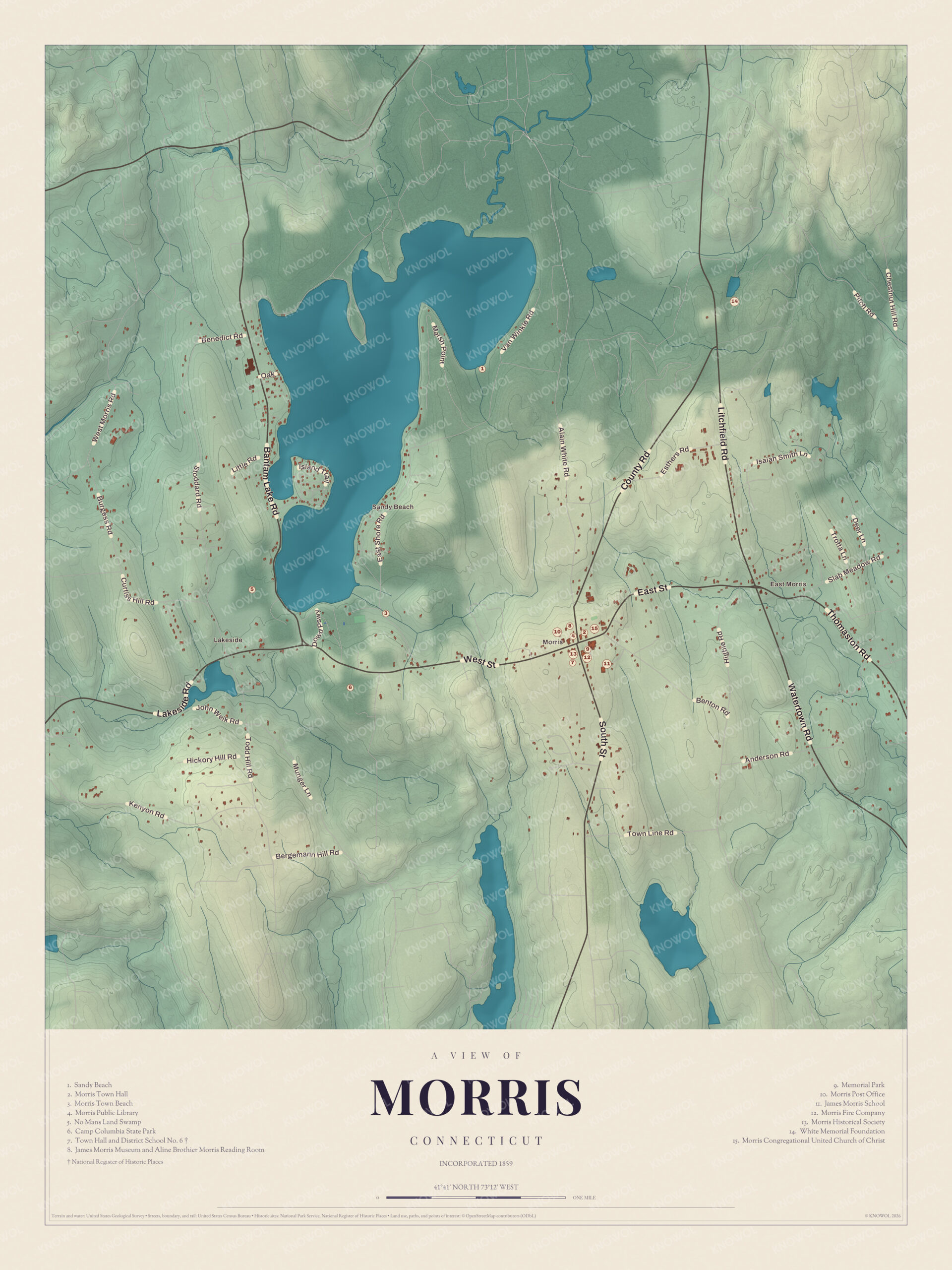
Shaded hills from Mount Tom and West Morris to the village center, every street, Bantam Lake, Lakeside and Camp Columbia State Park, and a guide of 15 numbered landmarks with the National Register site marked.4
The story of Morris
The pulpit that became matches
South Farms raised its second meeting house in 1785, and the society voted the committee rum, grindstones and ropes for the framing. An overseer handed out two drams a day to the spectators, one a little before noon and one a little before night, and the building was finished twenty weeks after the frame went up. A large carved pineapple sat over the double door, and the pulpit stood more than six feet high under a sounding board topped by a scarlet tulip. A gale in 1822 blew the steeple down and broke the bell. The first stove came in 1824, but the church stood on such an exposed spot that it never got warm, and it came down in 1844. Dibble Smith had part of the old pulpit made into matches. They ought to burn well, he said.56
Squire Morris and his academy
James Morris grew up in South Farms wanting books. His father said he could study Latin once the wood was in, and in about two weeks James sledded home sixty loads. He graduated from Yale in 1775, fought through the Revolution, and was captured at Germantown. Back home, he started with the children, and his first pupils were the young ladies. Some neighbors fought him, and in 1794 a church council heard the complaints and acquitted him. Neighbors built his academy house by subscription for $1,400, and by his own count more than 1,400 students of both sexes came through, John Brown among them. About 1816 he started a mission school here that moved to Cornwall the next year. The academy building, a barn by then, came down in 1892.781
Winter privileges
For more than a century Morris was the south end of Litchfield, five miles from the meetinghouse. In 1740 the families here asked to join the north society of Woodbury, today's Bethlehem, and Litchfield blocked them. The legislature did let them hold their own services three months each winter, and they first met under that Winter Privilege on November 23, 1748, at Capt. Thomas Harrison's house. The first person buried in the hillside cemetery was James Stoddard, killed at a house raising in 1749. In 1753 there were only 30 families. South Farms became its own church society in 1767, and by 1810 it had 1,238 people. When it became a town in 1859, it took the name of the schoolmaster who had done the most for it.21
Through the years
25 moments from 1723 to today.
- 1723The first land deeds are laid out on the east side of what's then the South Farms of Litchfield.1
- 1740South Farms families ask to join the north society of Woodbury, today's Bethlehem. Litchfield blocks it.2
- 1747The first schoolhouse is voted, with twenty pounds from the town treasury.2
- 1748Under the Winter Privilege, the parish holds its first meeting at Capt. Thomas Harrison's house.2
- 1749James Stoddard, killed at a house raising, is the first person buried in what's now Morris Cemetery.2
- 1764The people vote to build their first church, one story high.6
- 1767South Farms becomes its own church society, with about 70 families.2
- 1772About this year the schoolhouse now on South Street is built near King's Gristmill.9
- 1776A second burying ground is authorized in Footville, now West Morris.2
- 1785The first library in the town of Litchfield is founded in South Farms.1
- 1785The second meeting house goes up in twenty weeks, with two drams a day for the spectators.5
- 1790James Morris begins his academy in South Farms.7
- 1794A church council hears the complaints against James Morris and acquits him.7
- 1798About sixty women of the parish bring Rev. Amos Chase's family seventy runs of yarn.10
- 1803The Society and friends in Litchfield build the Academy house.7
- 1810South Farms counts 1,238 people, probably the most it ever had.2
- 1817The mission school James Morris began here moves to Cornwall.8
- 1822A great gale blows down the church steeple and breaks the bell.6
- 1844The cold old church comes down and today's church takes its place.6
- 1859South Farms becomes the town of Morris, named for James Morris.1
- 1861The town hall on South Street is built.9
- 1892The old Academy building, used as a barn in its last years, is torn down.8
- 1907Morris has four post offices: Morris, East Morris, West Morris and Lakeside.11
- 1913Alain and May White create the White Memorial Foundation, about half of its land in Morris.4
- 2000Camp Columbia becomes one of the state's newest parks.4
Places to see
The numbers match the landmark guide printed on the 2026 map.
- 1Sandy BeachBantam Lake. One of the lake's two public beaches.
- 3Morris Town BeachBantam Lake. The town beach on the lake.
- 4Morris Public LibraryNorth Street. Serving the town for over 100 years.Visit their website
- 5No Mans Land SwampWest of Camp Columbia. Woods and wetland near Route 209.
- 6Camp Columbia State ParkSouth of Bantam Lake. Columbia's old field station, a park since 2000.
- 7Town Hall and District School No. 6South Street. Schoolhouse of about 1772, town hall of 1861.
- 8James Morris Museum and Aline Brothier Morris Reading RoomNorth Street. Beside the public library.
- 11James Morris SchoolMorris center. Six school districts joined here in 1932.
- 14White Memorial FoundationNortheast. Trails on old farmland since 1913.Visit their website
- 15Morris Congregational United Church of ChristMorris center. The white church beside the town hall.
On the National Register
All 1 places in Morris on the National Register of Historic Places that still stand today, oldest first, and why each one matters.3
-
Town Hall and District School No. 6
The schoolhouse was built about 1772 near King's Gristmill, taught children until 1915, and was moved here in 1981. The town hall beside it was built in 1861 and served Morris until 1932. Together they now hold the historical society's museum.9
In their words
“This parish is principally a collection of hills, which are high, moist, and excellent grazing ground.”
Timothy Dwight, president of Yale, quoted in Sketches and chronicles of the town of Litchfield, 185912
“He said they ought to burn well, for the pulpit must be well seasoned by the brimstone theology preached in it”
Dibble Smith, on the old South Farms pulpit he had made into matches, from The history of the town of Litchfield, 19206
“But the little seed of foreign missions, sowed in South Farms, cannot be counted in numbers”
The history of the town of Litchfield, 1920, on James Morris's mission school8
Nearby towns
Sources
- Morris, Connecticut, Wikipedia
- The history of the town of Litchfield, Connecticut, 1720-1920 (1920), on South Farms, Internet Archive
- National Register of Historic Places listings in Litchfield County, Connecticut, Wikipedia
- Map of Morris, Connecticut in 2026, KNOWOL (USGS elevation, Census Bureau roads)
- The history of the town of Litchfield, Connecticut, 1720-1920 (1920), on raising the 1785 meeting house, Internet Archive
- The history of the town of Litchfield, Connecticut, 1720-1920 (1920), on the South Farms churches, Internet Archive
- The history of the town of Litchfield, Connecticut, 1720-1920 (1920), on James Morris and the Morris Academy, Internet Archive
- The history of the town of Litchfield, Connecticut, 1720-1920 (1920), on the mission school and the end of the Academy, Internet Archive
- Town Hall and District School No. 6, Wikipedia
- The history of the town of Litchfield, Connecticut, 1720-1920 (1920), on the 1798 gift of yarn, Internet Archive
- Register and manual of the State of Connecticut (1907), Internet Archive
- Sketches and chronicles of the town of Litchfield, Connecticut (1859), Internet Archive