
Wrentham's old North Parish on the upper Charles, a town of farms and small mill villages, from the felt mill at City Mills to the paper mill on the Stop River at Highland Lake.
Norfolk, Massachusetts on the map
Click the map to look closer.
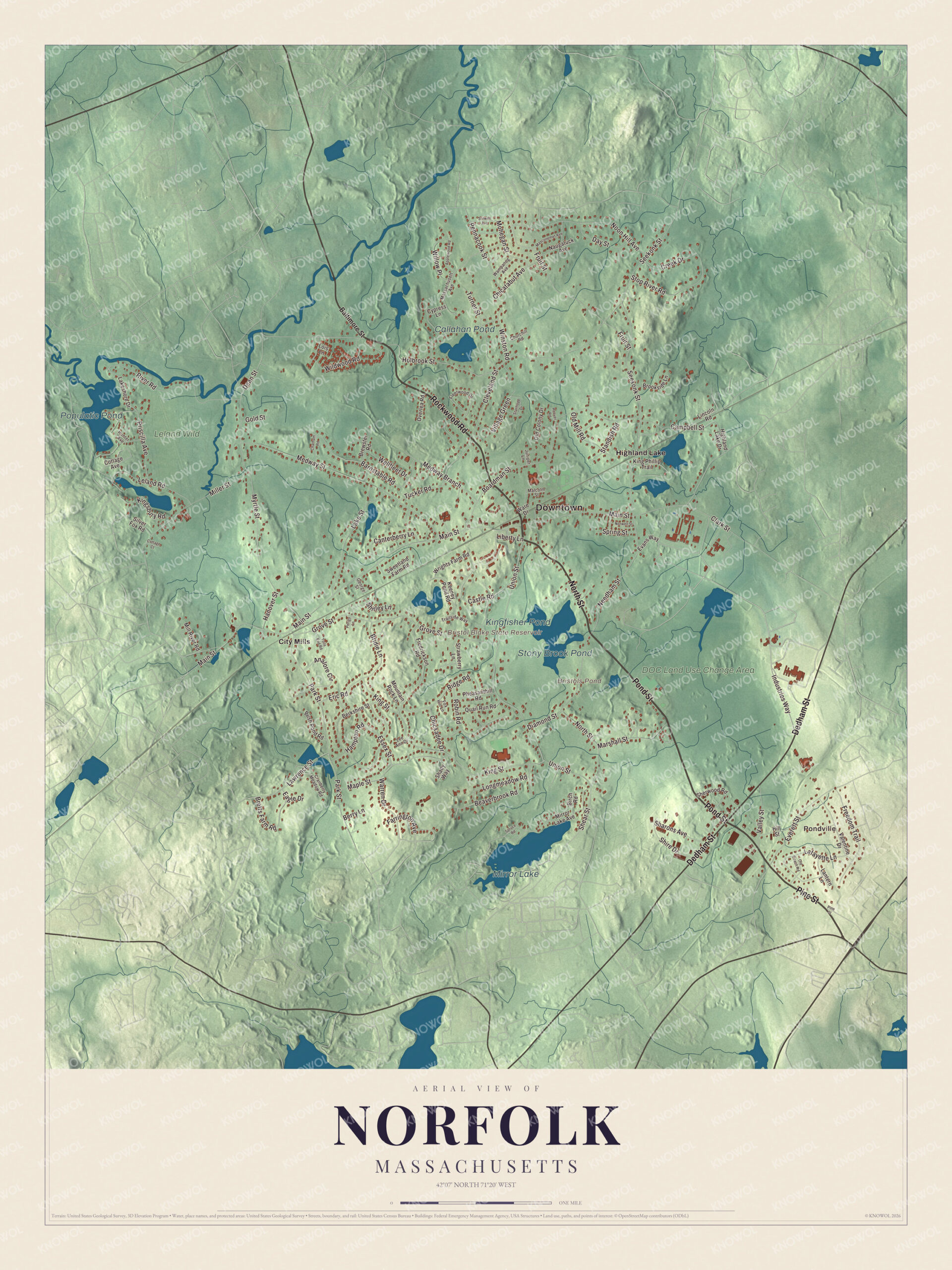
Norfolk today
By KNOWOL
Drawn in the look of an old atlas from elevation data and Census Bureau streets, with Rockwood Road, North, Pond, Pine, Dedham and Needham Streets, and the water of Highland Lake, Mirror Lake, Bristols Pond and Populatic Pond.6
The history of Norfolk, Massachusetts
The quarrel that made a parish
Norfolk began with a church fight in the older town. In the early 1790s Wrentham split over its minister, Rev. David Avery, and the 1884 county history says families were divided into Averians and Anti-Averians. In 1793 the town voted 74 to 1 to let him go. On September 29, 1795, the people of Wrentham's north end met to decide on a meetinghouse of their own, and thirty-eight men pledged $1,244 for the building and a minister. It went up in 1796, and North Wrentham became the North Parish. When the parish became the town of Norfolk in 1870, the old meetinghouse became the town house. In 1879 it was remodeled with a tower, and Josiah Ware gave the clock. The town hall burned in 1922, and town meetings moved to the Grange Hall until 1949.783910
Ore, paper and a summer lake
Highland Lake on the Stop River was a working place long before it was a pleasure ground. Walpole men dug bog iron in the dry seasons and carted it to a smelter there, at the crossing of Lincoln Road, until about 1830, when better ore turned up at Massapoag Pond in Sharon. In 1845 George and Thomas Campbell bought the site and began making paper, and the railroad stop there went by the name Campbell's Station before it became Highland Lake. That corner was Walpole land until it was set off to Norfolk in 1870. By 1884 the county history called the lake a pleasure ground of the New York and New England Railroad, a beautiful spot much visited in summer, and in 1885 eighteen people worked in the town's paper mill.11129
City Mills, older than the town
City Mills is older than the town around it. The 1884 county history says Wrentham set up a corn mill at a spot called Jack's Pasture, the site of City Mills, in the 1690s. About 1819 Eli Richardson built a stone store there and became postmaster of the first post office inside today's Norfolk. By 1884 the Ray family of Franklin ran the City Mills as a felt mill with eighty hands, making 500,000 yards a year. When Norfolk was made a town on February 23, 1870, it took in Wrentham's North Parish and pieces of Franklin, Medway and Walpole, and City Mills came along from Franklin. In 1917 City Mills still had its own post office, one of only two in town.134142
Norfolk, Massachusetts through the years
25 moments from 1669 to today.
- 1669A half dozen small farms are started here, then the far edge of Dedham.1
- 1673Wrentham splits from Dedham, with what is now Norfolk as its northern part.1
- 1680A mill village begins at City Mills.1
- 1693About this year Wrentham sets up a new corn mill at Jack's Pasture, the site of City Mills.13
- 1712Stephen Turner buys the Seekonk Street land where his house still stands.15
- 1733Ebenezer Ware builds the saltbox house now called Warelands.16
- 1736About this year the burying ground at Sullivan's Corner is begun, the town's oldest.17
- 1793After a quarrel that split families, Wrentham votes 74 to 1 to let Rev. David Avery go.7
- 1795On September 29 the people of the north end meet and agree to build their own meetinghouse.8
- 1796The North Parish meetinghouse goes up. It later serves as Norfolk's town house.9
- 1814The Stony Brook Manufacturing Company is incorporated.18
- 1819About this year Eli Richardson builds the stone store at City Mills and opens the first post office in what is now Norfolk.4
- 1830About this year the smelter on the Stop River, fed with Walpole bog ore, shuts down.11
- 1845George and Thomas Campbell buy the old foundry site at what is now Highland Lake and start making paper.11
- 1849The Norfolk County Railroad opens, with North Wrentham station near the village center.1
- 1863The Baptists build their church on Rockwood Road, now the Grange Hall.10
- 1870On February 23 North Wrentham, with pieces of Franklin, Medway and Walpole, becomes the town of Norfolk.2
- 1870The first town meeting is held on March 7, and two men give the town its ballot box.19
- 1871The naturalist John Edwards Holbrook, author of American Herpetology, dies in Norfolk on September 8.20
- 1879The old meetinghouse is remodeled as the town house, with a tower and Josiah Ware's clock.9
- 1885Norfolk's 94 farms are known for cranberries, apples and strawberries, and 30 people make straw goods.12
- 1901The King's Daughters of Norfolk County found the Pond Home in Pondville.21
- 1915With 1,268 people, Norfolk has the smallest population of any town in the county except Dover.22
- 1922The town hall burns, and town meetings move to the Grange Hall until 1949.10
- 1925After this year a hospital and a state prison go up on the Walpole line, and the town grows fast.1
Places to see in Norfolk, Massachusetts
Places worth a visit in Norfolk today.
- Rockwood RoadNorfolk center. The railroad village street, now a historic district.
- Norfolk stationRockwood Road crossing. Commuter rail stop in the small center.
- City MillsWest side, on Mill River. Mill village with Norfolk's first post office.
- PondvilleSoutheast, on the Wrentham line. Mill village settled after 1730.
- Highland LakeStop River, Walpole line. Once Mann Pond, later Campbell's paper mill.
- Stop RiverEastern border. Flows north 9.3 miles to the Charles.
- Populatic PondNorthwest corner. The town line follows its western shore.
- Stony Brook Wildlife SanctuaryStony Brook, south part of town. Pond trail ending at an old mill site.Visit their website
Norfolk on the National Register of Historic Places
All 6 places in Norfolk on the National Register of Historic Places that still stand today, oldest first, and why each one matters.5
-
Stephen Turner House
The house went up some time after Stephen Turner bought the land in 1712, and his son Ichabod, a Revolutionary War veteran, sold it in 1792. The ell was added in 1812, and the house may hold beams from a 17th-century fortified house.15
-
Warelands
Ebenezer Ware built this saltbox house in 1733, with a massive central chimney, wide plank floors and fine wood paneling. From 1905 to 1913 it was home to the Warelands Dairy and its dairy school, early leaders in the clean handling of milk.16
-
Sullivan's Corner Historic District
An old rural crossroads with Norfolk's oldest cemetery, begun about 1736, and five houses facing it. Sullivan's Store of about 1913 is the town's only commercial building from that time, and 1 Needham Street is one of its best-kept Greek Revival houses.17
-
Pondville Cemetery
Begun about 1757 for the village of Pondville, when Norfolk was still part of Wrentham. It rises in terraces from Everett Street, and its best-known stone is the Victorian memorial of about 1877 to Captain Abijah Pond, a Revolutionary War veteran.23
-
Rockwood Road Historic District
Mostly houses built between about 1850 and 1900, after the railroad came, showing the center's growth as a railroad village. The oldest are the Mann House of about 1806 and the Darius Ware House of about 1814, and the district takes in the 1863 Grange Hall.24
-
Norfolk Grange Hall
Built in 1863 as the Baptist church, it has been the Norfolk Grange's hall since 1921. Town meetings were held here from 1922, when the town hall burned, until 1949, and the public library had rooms at the back until 1956.10
Norfolk in their words
“To promote the happiness of ourselves as well as the rising Generation, we, the subscribers, do jointly agree to the subsequent articles.”
The North Parish subscription paper of 1795, from the History of Norfolk County, 18848
“Island Lake is a pleasure-ground belonging to the New York and New England Railroad. It is a beautiful spot, and is much frequented during the summer season.”
History of Norfolk County, 1884, on the lake now called Highland Lake9
“an elegant and valuable tower clock, which will tell the hour to the passer-by for many a year”
History of Norfolk County, 1884, on Josiah Ware's gift to the town house25
Towns near Norfolk, Massachusetts
Sources for the history of Norfolk
- Norfolk, Massachusetts, Wikipedia
- History of Norfolk County, Massachusetts (1884), Norfolk chapter, on the incorporation of the town, Internet Archive
- History of Norfolk County, Massachusetts, 1622-1918 (1918), on the North Parish of Wrentham, Internet Archive
- History of Norfolk County, Massachusetts, 1622-1918 (1918), on Norfolk's post offices, Internet Archive
- National Register of Historic Places listings in Norfolk County, Massachusetts, Wikipedia
- Map of Norfolk, Massachusetts in 2026, KNOWOL (USGS elevation, Census Bureau roads)
- History of Norfolk County, Massachusetts (1884), Wrentham chapter, on the quarrel over Rev. David Avery, Internet Archive
- History of Norfolk County, Massachusetts (1884), Norfolk chapter, on the North Parish meeting of 1795, Internet Archive
- History of Norfolk County, Massachusetts (1884), Norfolk chapter, on the town house and the town's industries, Internet Archive
- Norfolk Grange Hall, Wikipedia
- The story of Walpole, 1724-1924 (1925), on the Stop River foundry and the Campbell paper mill, Internet Archive
- A gazetteer of the state of Massachusetts (1890), on Norfolk, Internet Archive
- History of Norfolk County, Massachusetts (1884), Wrentham chapter, on the corn mill at Jack's Pasture, Internet Archive
- History of Norfolk County, Massachusetts (1884), Franklin chapter, on the Rays' felt mill at City Mills, Internet Archive
- Stephen Turner House, Wikipedia
- Warelands, Wikipedia
- Sullivan's Corner Historic District, Wikipedia
- History of Norfolk County, Massachusetts (1884), Wrentham chapter, on the Stony Brook Manufacturing Company, Internet Archive
- History of Norfolk County, Massachusetts, 1622-1918 (1918), on the first town meeting, Internet Archive
- A gazetteer of the state of Massachusetts (1890), on John Edwards Holbrook, Internet Archive
- Resident and business directory of the town of Franklin, Massachusetts (1909), Norfolk section, Internet Archive
- History of Norfolk County, Massachusetts, 1622-1918 (1918), on Norfolk in 1915, Internet Archive
- Pondville Cemetery, Wikipedia
- Rockwood Road Historic District, Wikipedia
- History of Norfolk County, Massachusetts (1884), on Josiah Ware, Internet Archive