
The old North Society of Stonington, a town of farms and mill villages on the Shunock and the Ashaway streams, with Lantern Hill in the southwest and a village once called Milltown at its heart.
North Stonington on the map
Click the map to look closer.
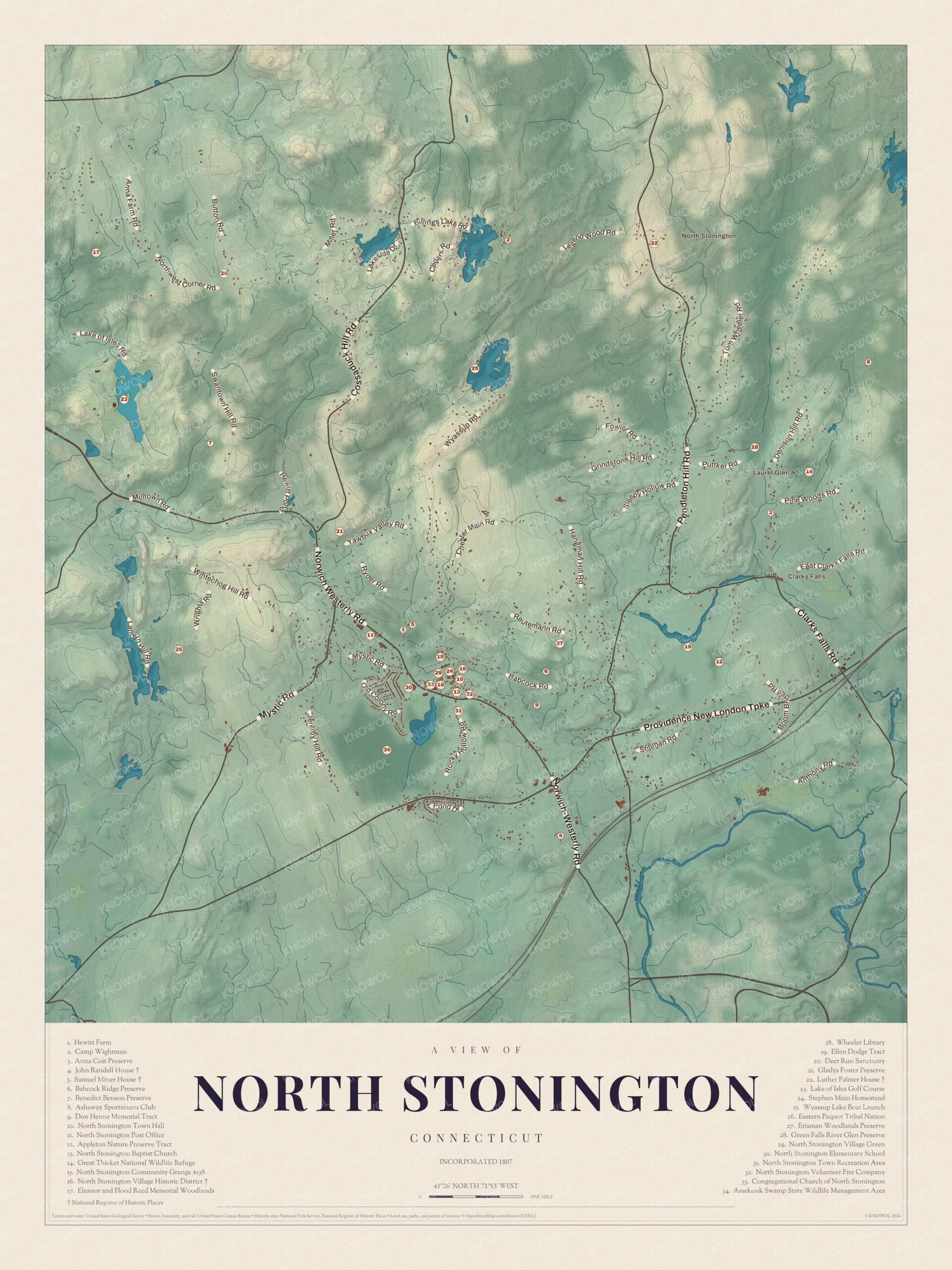
North Stonington today
By KNOWOL
Shaded hills from the Pachaug woods around Wyassup Lake down to Clarks Falls, every road by name, North Stonington Village, Laurel Glen and Lake of Isles, and a guide of 34 numbered landmarks with the National Register sites marked.5
The story of North Stonington
The bear in the cavern
Around 1750 a bear was carrying off sheep and young stock from farms in the upper part of town, and the farmers sent for Maj. Israel Hewitt of Winchechoog Hill, a hunter who kept a kennel of bloodhounds. The hounds tracked the bear to a cave but wouldn't go in, so the major checked his rifle and crawled in on his hands and knees. In the dark he saw two eyes and heard a growl, and he fired. When he came back with a torch, the bear was dead, though none of the hounds would touch its meat. The cave, about three miles north of the village, became known as the Bear's Hole, and it was a favorite outing for young people until snakes were seen at its mouth.6
The old Black meeting-house
The North Society could agree to build a meeting-house but not where to put it. Committees from the General Assembly came and went for two years before the house was raised in May 1723, a few rods northwest of the present old town hall. It was forty feet by thirty-five, people sat on benches until 1728, and they came to call it the old Black meeting-house. Rev. Joseph Fish was pastor for forty-eight years, baptized 606 children and married 363 couples. The revival of 1742 brought in ninety-nine members in one year, then split the church in two. In 1817 the old house came down, both congregations built one new church together, and in 1827 they reunited.731
Milltown and the mill streams
North Stonington is where the Mystic, the Shunock and the western branches of the Ashaway begin, and in the 1800s every stream turned a wheel. At Milltown the Shunock was led from the old dam through a canal, mostly underground, to the factory on the east side of the village. The first mill there was Ayres' gristmill, and about 1840 George W. Bentley built a factory that made cotton cloth until after 1850, then wool. Wyassup Lake was raised into a reservoir to feed the mills downstream, floating island and all. At Clark's Falls, Alfred Clark and Peleg S. Tift built a mill in 1864 that made army goods until the war ended, then flannels and suitings.89
Through the years
25 moments from 1667 to today.
- 1667Ezekiel Main settles where the village is now, and Jeremiah Burch at what becomes Clarks Falls.1
- 1683A Pequot reservation is set aside at Lantern Hill.1
- 1702Samuel Richardson has a mill running on the Shunock River.1
- 1717The northern farmers of Stonington form their own church society.1
- 1723After years of quarreling over the site, the North Society raises its meeting-house in May.7
- 1724The General Assembly names the North Society North Stonington.7
- 1727A church is formed and Rev. Ebenezer Russell becomes its pastor on February 22.3
- 1732Rev. Joseph Fish is ordained. He serves 48 years and baptizes 606 children.3
- 1742The Great Awakening adds ninety-nine members to the church in a single year.3
- 1743The First Baptist Church is organized, the first in Stonington or North Stonington.1
- 1750About this year Maj. Israel Hewitt follows a bear into its cavern and shoots it, at the place later called the Bear's Hole.6
- 1753Surveyors, among them 16-year-old Silas Deane, mark out today's Route 49.1
- 1768A weekly stagecoach starts running between Norwich and Providence through the town.1
- 1777Charles Hewitt, Major Hewitt's grandson, helps capture the British general Richard Prescott at Newport.6
- 1807After a heated town meeting, the north becomes its own town. It asks to be Jefferson and is named North Stonington.10
- 1814Four North Stonington militia companies help drive off the British at Stonington.11
- 1817The old Black meeting-house is taken down and the two divided churches build one house together.3
- 1820The New London and Providence Turnpike opens, today's Route 184.1
- 1828The Third Baptist Church is organized in the mill village, "to set up a banner for God."12
- 1840About this year George W. Bentley builds a cotton factory at the old gristmill site in Milltown.8
- 1842The Third Baptist Church votes to forbid all intoxicating liquor as a drink.12
- 1864Alfred Clark and Peleg S. Tift build the Clark Falls Mill, which makes army goods until the war ends.8
- 1884The Lantern Hill silex quarry is said to hold forty million tons of crumbled quartz for porcelain and paint.13
- 1904Dwight Wheeler gives one of the family stores to the town as its town hall.1
- 1983The North Stonington Village Historic District is listed on the National Register.14
Places to see
The numbers match the landmark guide printed on the 2026 map.
- 4John Randall HouseOff Route 2. Plank-framed house begun in 1685.
- 13North Stonington Baptist ChurchSouth of the green. Baptist church in the village.
- 16North Stonington Village Historic DistrictNorth Stonington Village. The old mill village, once Milltown.
- 18Wheeler LibraryMain Street. Romanesque school and library of 1900.Visit their website
- 22Luther Palmer HousePendleton Hill. Federal farmhouse, Palmer land since 1711.
- 24Stephen Main HomesteadBy the green. Home of the historical society.
- 25Wyassup Lake Boat LaunchWyassup Lake. On the lake's southwestern shore.
- 26Eastern Pequot Tribal NationLantern Hill. Reservation set aside in 1683.
- 29North Stonington Village GreenNorth Stonington Village. The heart of the village.
- 33Congregational Church of North StoningtonMain Street. Heir to the 1727 church.Visit their website
On the National Register
All 3 places in North Stonington on the National Register of Historic Places that still stand today, oldest first, and why each one matters.4
-
John Randall House
Its earliest part dates to 1685 and the main block took its present shape before 1720. It is framed with planks an inch thick, and the early preservationist Norman Isham restored it in the 1930s. A descendant, Darius Randall, was an abolitionist, and the house is remembered as a stop on the Underground Railroad.15
-
North Stonington Village Historic District
A 105-acre mill village where Assekonk Brook meets the Shunock River, which flourished before the Civil War and declined after. It holds 72 contributing buildings, mostly 18th and early 19th century houses, along with the Wheeler Library, the old Wheeler store town hall and traces of the canal and dams.14
-
Luther Palmer House
Also called Pauchunganuc Farm, on the summit of Pendleton Hill, in the Palmer family since 1711. Luther Palmer built the Federal farmhouse, and its rooms kept their original 19th century furnishings, with the family's receipts for them.16
In their words
“Feel that it is high time for us to set up a banner for God.”
Covenant of the Third Baptist Church of North Stonington, 1828, printed in the History of New London County, 188212
“The peak of Lantern Hill, that last of landmarks to the outward bound and first to greet him with a welcome home.”
A centennial poem on Groton Heights, History of New London County, 188217
“Its prosperous farms add much to the variety of scenery in the county.”
A modern history of New London County, 19222
Nearby towns
Sources
- North Stonington, Connecticut, Wikipedia
- A modern history of New London County, Connecticut (1922), Internet Archive
- History of New London County, Connecticut (1882), on the North Stonington church and Rev. Joseph Fish, Internet Archive
- National Register of Historic Places listings in New London County, Connecticut, Wikipedia
- Map of North Stonington, Connecticut in 2026, KNOWOL (USGS elevation, Census Bureau roads)
- History of New London County, Connecticut (1882), on Maj. Israel Hewitt and the Bear's Hole, Internet Archive
- History of New London County, Connecticut (1882), on the North Society and its meeting-house, Internet Archive
- History of New London County, Connecticut (1882), on the mills of North Stonington, Internet Archive
- History of New London County, Connecticut (1882), on the division of the town, Internet Archive
- History of the town of Stonington, from its first settlement in 1649 to 1900 (1900), Internet Archive
- History of New London County, Connecticut (1882), on the militia of 1813 and 1814, Internet Archive
- History of New London County, Connecticut (1882), on the Baptist churches of North Stonington, Internet Archive
- The historical, statistical and industrial review of the state of Connecticut (1884), on the Lantern Hill silex quarry, Internet Archive
- North Stonington Village Historic District, Wikipedia
- John Randall House, Wikipedia
- Luther Palmer House (Pauchunganuc Farm), National Register nomination, National Park Service
- History of New London County, Connecticut (1882), a poem on Groton Heights, Internet Archive