
The oldest-settled part of the Lymes, where the Connecticut River meets Long Island Sound, home of the Griswolds of Black Hall, a sea captains' street of elms and old houses, and the art colony that gathered at Miss Florence's.
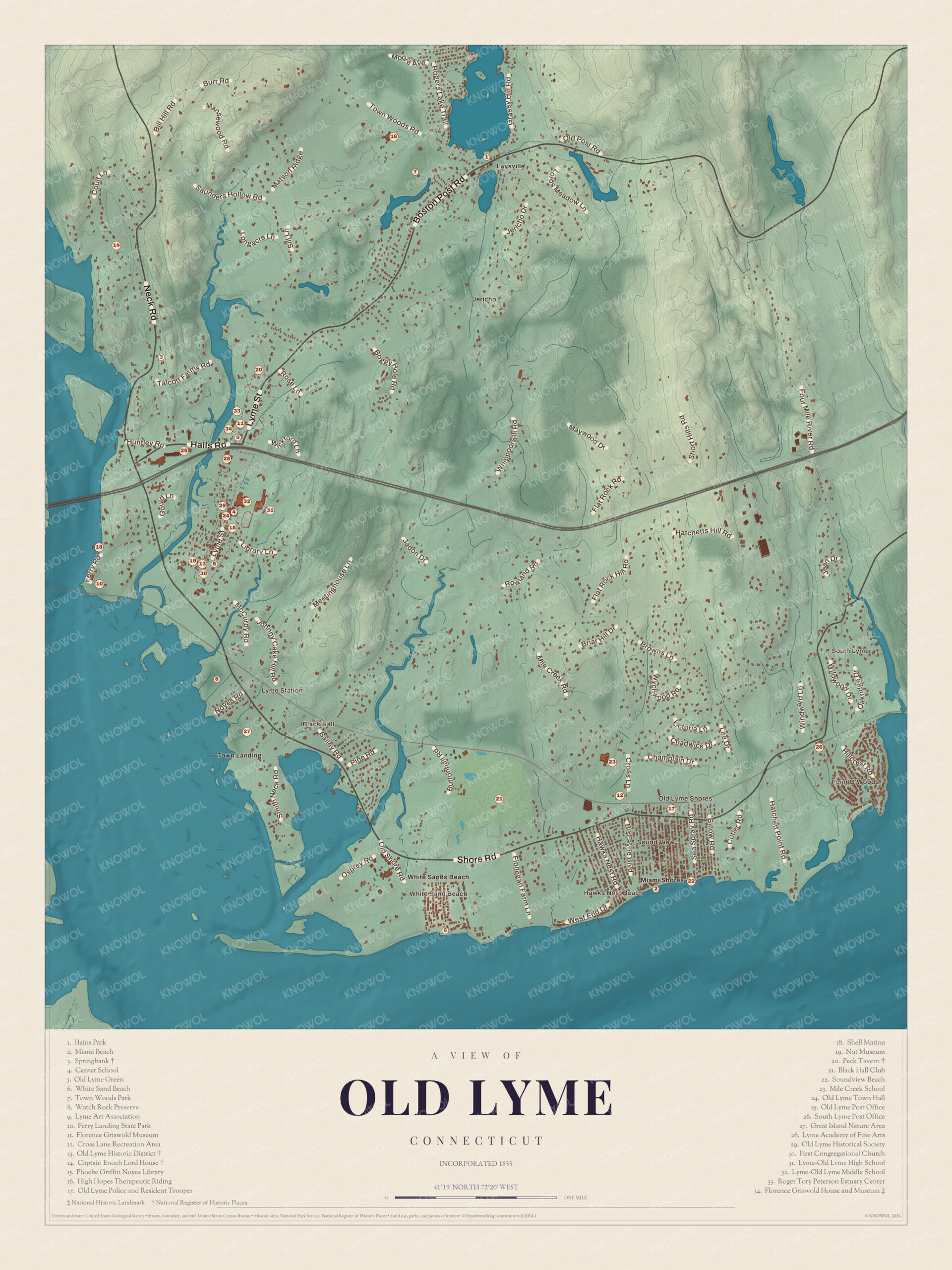
Old Lyme on the map
Click the map to look closer.
Old Lyme today
By KNOWOL
Shaded land from the rocky hills in the north down to the marshes and the beaches at Point O'Woods, every street from Lyme Street to White Sands Road, and a guide of 34 numbered landmarks with the National Historic Landmark and the National Register sites marked.5
The story of Old Lyme
Tea on The Street
Old Lyme had its Revolution early, and much of it happened in one house on The Street. John McCurdy, a Scotch-Irish shipping merchant, bought the house in 1753. His friend the minister Stephen Johnson wrote a fiery article there against the Stamp Act, and McCurdy quietly got it printed in the Connecticut Gazette. On March 16, 1774, a peddler from Martha's Vineyard rode into town with a hundred pounds of tea in his saddlebags. That evening the Sons of Liberty built a bonfire on The Street, just above the church, burned every ounce and buried the ashes. Lafayette stayed in the north chamber of the McCurdy house during the war, and he came back to sleep there again in 1825.678910
The Black Hall Boys
Black Hall, on the point where the river meets the Sound, was the Griswold family seat, a cluster of houses in a grove where in winter the sun rises and sets over the water. Matthew Griswold got the land in 1645. A later Matthew, who became governor, was so shy that his cousin Ursula Wolcott kept asking him, "What did you say, Cousin Matthew?" Meeting him on the beach one morning, she told him it was time he said something, and they were married. His eight sisters were called the Black Hall boys because they could ride, leap, row and swim. One of them, Phebe, married the minister Jonathan Parsons and once sent him off to prayer meeting with his face blackened.21112
Four meetinghouses
The church that Childe Hassam painted is the latest in a long line. The first was a log meetinghouse on the brow of Meeting-house Hill, and tradition says the men came to services with loaded muskets and posted guards. In 1754 Barnabas Tuthill offered a bell if the people would build a steeple. In 1780 a watchman shot at woodpeckers boring into the roof, and his musket wad set the timbers on fire. Lightning burned that house down in 1815, and Samuel Belcher's new church went up near the south end of the main street in 1817. The elms around it were planted in 1828. Belcher's church burned in 1907, and the one standing today is a replica finished in 1913.13141516175
Through the years
25 moments from 1645 to today.
- 1645Matthew Griswold receives the Black Hall land and builds a log house, called the first house in Lyme.2
- 1648William Lord of the Saybrook Colony acquires land along what's now Lord's Cove.18
- 1665Lyme is set off from Saybrook as its own town, with its first center here.1
- 1666Moses Noyes starts preaching, and a log meetinghouse goes up on Meeting-house Hill soon after.13
- 1693The town votes to gather a church, with Moses Noyes as its pastor.13
- 1748About this year Enoch Lord builds the Red House above Lord's Cove.18
- 1751Wharves and warehouses are built on the Lieutenant River for the West India trade.19
- 1754Barnabas Tuthill gives the church a bell, and a steeple is built to hang it.14
- 1765Rev. Stephen Johnson writes an article against the Stamp Act in John McCurdy's house on The Street.6
- 1774The Sons of Liberty burn a peddler's hundred pounds of tea on The Street.8
- 1776George Washington stops in April on his way from Boston to New York.5
- 1780A shot at woodpeckers sets the meetinghouse roof on fire, and soldiers put it out.15
- 1815Lightning burns the meetinghouse on Meeting-house Hill to the ground.16
- 1817Samuel Belcher's new meetinghouse is built near the south end of the main street.16
- 1825Lafayette stays at the McCurdy house a second time, on his journey to Boston.10
- 1828The church plants the elms that will shade its churchyard.17
- 1855The southern part of Lyme becomes a town, South Lyme. Two years later it takes the name Old Lyme.1
- 1858John Bradbury leases Lay's old stone mill and starts making satinets.20
- 1862Capt. John Griswold is mortally wounded at Antietam. His monument stands in the Griswold cemetery at Black Hall.21
- 1880The census counts 1,387 people in Old Lyme.22
- 1899Henry Ward Ranger visits Miss Florence's boardinghouse and returns the next year with other painters.5
- 1907The meetinghouse burns. A replica is finished in 1913.5
- 1921The Lyme Art Association opens its gallery next to the Griswold House.5
- 1975Doctors investigating a puzzling illness in children of Lyme and Old Lyme identify what becomes known as Lyme disease.1
- 1993The Florence Griswold House becomes a National Historic Landmark.3
Places to see
The numbers match the landmark guide printed on the 2026 map.
- 3SpringbankNeck Road. Brick house of 1844 with formal gardens.
- 8Watch Rock PreserveSouth of the village. Where the Duck River meets the Connecticut.Visit their website
- 9Lyme Art AssociationLyme Street. The artists' gallery, opened in 1921.Visit their website
- 11Florence Griswold Museum96 Lyme Street. Miss Florence's boardinghouse for the art colony.Visit their website
- 13Old Lyme Historic DistrictLyme Street. The old village of sea captains' houses.
- 14Captain Enoch Lord HouseTantummaheag Road. The Red House above Lord's Cove.
- 15Phoebe Griffin Noyes LibraryLyme Street. Site of the artists' first show.Visit their website
- 19Nut MuseumOld Lyme. Elizabeth Tashjian's museum, opened 1972.
- 20Peck TavernSill Lane. Old post road tavern, Washington's stop.
- 30First Congregational ChurchOld Lyme Green. Replica of Belcher's meetinghouse, built 1913.Visit their website
On the National Register
All 11 places in Old Lyme on the National Register of Historic Places that still stand today, oldest first, and why each one matters.4
-
Bennett Rockshelter
A prehistoric rock shelter on private woodland, one of a group of Woodland period archaeological sites of the lower Connecticut River valley listed together in 1987. Its location is kept private to protect it.23
-
Lieutenant River No. 2
One of three prehistoric archaeological sites along the Lieutenant River, listed in 1987 with other Woodland period sites of the lower Connecticut River valley.24
-
Lieutenant River III Site
A prehistoric archaeological site on the Lieutenant River, listed in 1987 with other Woodland period sites of the lower Connecticut River valley.25
-
Lieutenant River IV Site
A prehistoric archaeological site on the Lieutenant River, listed in 1987 with other Woodland period sites of the lower Connecticut River valley.26
-
Natcon Site
A prehistoric archaeological site, listed in 1987 with other Woodland period sites of the lower Connecticut River valley. Its location is kept private to protect it.27
-
Griswold Point Historic District
A shoreline landscape at Black Hall that preserves centuries of prehistoric and historic land use, on the point long held by the Griswold family.4
-
Old Lyme Historic District
The village center along Lyme Street, settled in the mid-1600s, with houses from the early 1700s to the late 1800s. It flourished as a shipbuilding town and home of sea captains, and later as the home of the Old Lyme Art Colony.28
-
Peck Tavern
One of the town's oldest buildings, believed to date to the first half of the 1700s and perhaps holding parts of a house that stood here about 1680. John Peck bought it about 1769, it was a busy stop on the post road, and its old taproom still holds the original tavern sign.29
-
Capt. Enoch Lord House
Enoch Lord built it around the time of his marriage on land his family had held since William Lord acquired it in 1648. It was moved to its present spot above Lord's Cove in the 1860s and became a Colonial Revival summer house after 1898.18
-
Florence Griswold House and Museum
National Historic Landmark
Samuel Belcher designed the house for William Noyes. As Florence Griswold's boardinghouse it was the center of the Old Lyme Art Colony, and the artists left 41 painted panels on its walls and doors. It's a National Historic Landmark.3
-
Springbank
Thomas Pilgrim, who owned a landing on the river, built the brick house in 1844. In the 1930s it was restyled in the Colonial Revival manner and given terraced gardens by the landscape architect Marian Cruger Coffin.30
In their words
“Black Hall, the seat of the Griswolds, is a cluster of half a dozen houses in the midst of a thick grove of trees, on the fine segment of land which slopes into the Sound so far that in winter the sun rises and sets over the water.”
Martha J. Lamb, 1876, in the History of New London County, 18822
“As you proceed from the hotel, 'The Street' springs upon you like a new character in a novel. There is no warning of its nearness until you are among its soft shadows.”
Martha J. Lamb, 1876, in the History of New London County, 188231
“It is one of the loveliest nooks on the New England coast, and if its distinguished sons and daughters could all be gathered home, the world might well pause to exclaim”
Martha J. Lamb on Lyme, 1876, in the History of New London County, 188232
Nearby towns
Sources
- Old Lyme, Connecticut, Wikipedia
- History of New London County, Connecticut (1882), on Black Hall, Internet Archive
- Florence Griswold Museum, Wikipedia
- National Register of Historic Places listings in New London County, Connecticut, Wikipedia
- Map of Old Lyme, Connecticut in 2026, KNOWOL (USGS elevation, Census Bureau roads)
- History of New London County, Connecticut (1882), on the McCurdy house and the Stamp Act, Internet Archive
- Old paths and legends of the New England border (1907), on the landmarks of The Street, Internet Archive
- History of New London County, Connecticut (1882), on the Lyme tea party, Internet Archive
- Why remember the fathers (1900), on the Old Lyme tea party, Internet Archive
- History of New London County, Connecticut (1882), on Lafayette at the McCurdy house, Internet Archive
- History of New London County, Connecticut (1882), on Matthew Griswold and Ursula Wolcott, Internet Archive
- History of New London County, Connecticut (1882), on the Black Hall boys, Internet Archive
- History of New London County, Connecticut (1882), on the first meetinghouse, Internet Archive
- History of New London County, Connecticut (1882), on the church bell, Internet Archive
- Old paths and legends of the New England border (1907), on the meetinghouse fire of 1780, Internet Archive
- History of New London County, Connecticut (1882), on the meetinghouse of 1817, Internet Archive
- History of New London County, Connecticut (1882), on the churchyard elms, Internet Archive
- Captain Enoch Lord House, Wikipedia
- History of New London County, Connecticut (1882), on the Lieutenant River wharves, Internet Archive
- Genealogical and biographical record of New London County, Connecticut (1905), on John Bradbury, Internet Archive
- The Connecticut war record (1863), on Capt. John Griswold's monument, Internet Archive
- The historical, statistical and industrial review of the state of Connecticut (1884), Internet Archive
- Bennett Rockshelter, National Register record, National Park Service
- Lieutenant River No. 2, National Register record, National Park Service
- Lieutenant River III Site, National Register record, National Park Service
- Lieutenant River IV Site, National Register record, National Park Service
- Natcon Site, National Register record, National Park Service
- Old Lyme Historic District, Wikipedia
- Peck Tavern, Wikipedia
- Springbank (Old Lyme, Connecticut), Wikipedia
- History of New London County, Connecticut (1882), on The Street, Internet Archive
- History of New London County, Connecticut (1882), on Lyme, Internet Archive