
A river town in the bend of the Connecticut whose brownstone built houses from Boston to San Francisco, and whose Gildersleeve shipyard launched vessels for more than a century and a half.
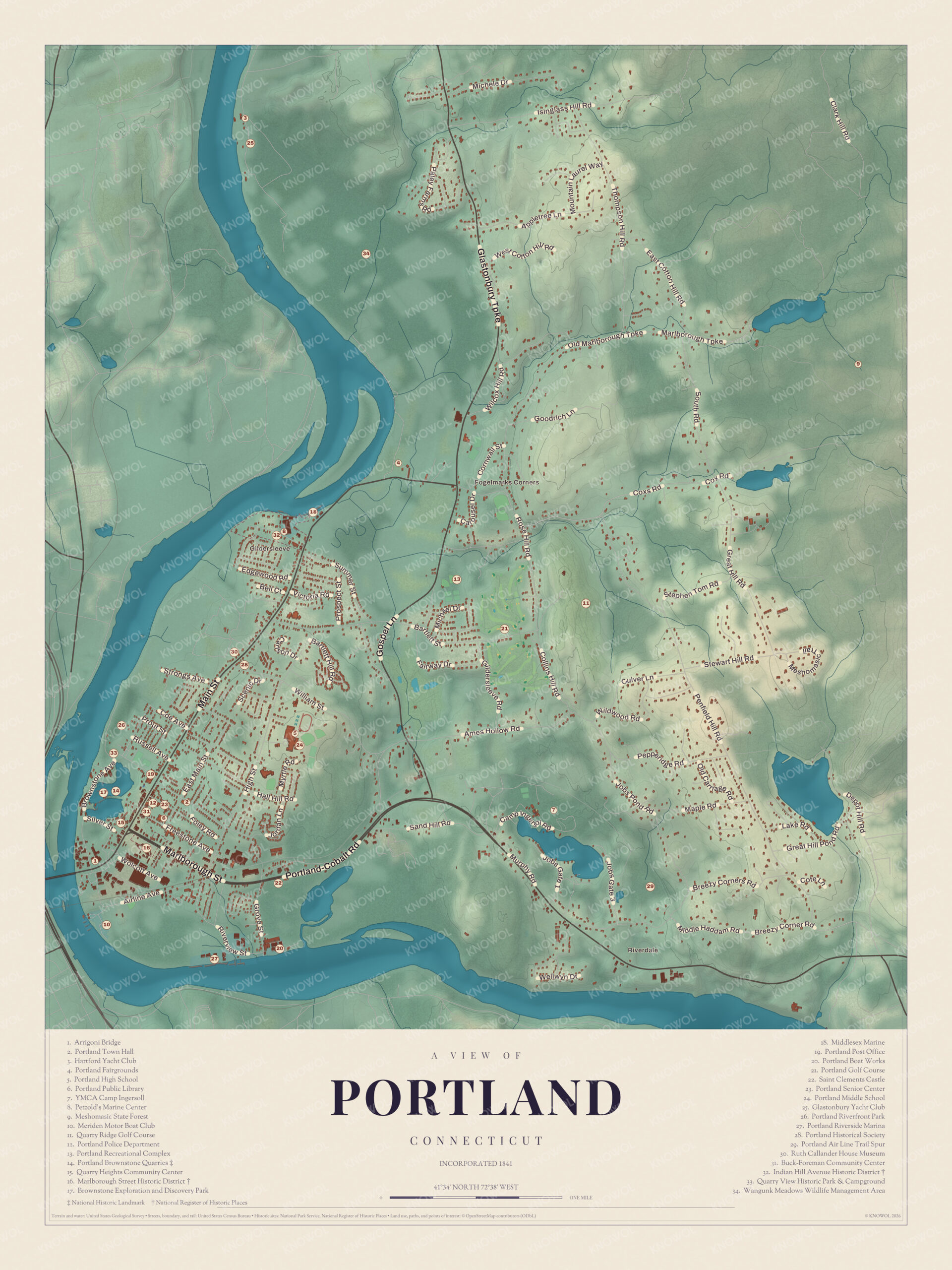
Portland on the map
Click the map to look closer.
Portland today
By KNOWOL
Shaded hills from Bodkin Rock to Great Hill and the Meshomasic woods, every street from Main Street to Ames Hollow Road, and a guide of 34 numbered landmarks with the National Historic Landmark and the National Register sites marked.5
The story of Portland
Lowering the oxen
Middletown knew early what it had across the river. In 1665 it charged 12 pence a ton on stone dug there for outsiders, and in 1715 it banned taking stone out of town at all. The Hancock house in Boston was built of it in 1737. By 1884 the deepest pit went down 200 feet, and horses and oxen rode 150 feet down to work in a huge box swung off the brink by a derrick. An old elm that once stood on the riverbank, with boats tied to rings in its trunk, ended up 28 feet below ground as quarry waste pushed the river back. When Connecticut sent a block for the Washington Monument, it was Portland stone.67891011
Four generations on one sofa
Sylvester Gildersleeve started his firm in 1821, and his family built ships at Gildersleeve for generations. In 1836 they helped build the schooner William Bryan, the first regular packet from New York to Texas, and later five ships for the Galveston line named for Texas patriots. In 1861 the yard was building the gunboat Cayuga, which led the fleet at the capture of New Orleans. In the old days, a bucket of cider brandy went around the yard four times a day. By 1911 the count stood at 264 vessels. A photograph showed Sylvester on one sofa with his son, grandson and great-grandson, four generations of shipbuilders.12131415316
The town that was almost Conway
Portland began as East Middletown, the farms across the river from Middletown. In 1767 it became part of Chatham, a town named for Chatham, England, because of its shipbuilding. When the old First Society was set off as its own town in May 1841, the name first given was Conway. It was changed to Portland at the same session, after the great sandstone quarries of Portland, England. Ebenezer White kept a journal here for 60 years, and on July 4, 1798, he wrote that the people made a great fuss about Independence and burnt much powder. In the freshet of 1854, water reached second stories on the sandbank.11721819
Through the years
23 moments from 1665 to today.
- 1665Middletown charges 12 pence a ton on stone dug at the rocks on the east side of the river for outsiders.6
- 1690James Stanclift begins quarrying here, building stonework for Middletown in exchange for land.20
- 1714The east side of the river becomes its own parish, the Third Society of Middletown.1
- 1715Middletown bans taking stone from the town quarry out of town, at 20 shillings a stone.7
- 1721Rev. Daniel Newell is ordained the first pastor.1
- 1737The Hancock house in Boston is built of Portland stone.8
- 1741The first vessel built in town is launched.1
- 1767The town of Chatham is formed, named for Chatham, England, for its shipbuilding.17
- 1783Commercial quarrying begins at what becomes the Brainerd Quarry.20
- 1796Portland brownstone goes into Hartford's Old State House.1
- 1798Philip Gildersleeve builds the frigate Connecticut for the Navy.14
- 1821Sylvester Gildersleeve starts the firm that becomes S. Gildersleeve & Sons.12
- 1836The Portland-built schooner William Bryan becomes the first regular packet from New York to Texas.13
- 1841Portland becomes a town of its own, named Conway at first and renamed at the same session.2
- 1854A great freshet fills the quarries and floods the shipyard.19
- 1861Oliver Gildersleeve starts work at the yard on the gunboat Cayuga.15
- 1872The town puts up its 33-foot brownstone Soldiers' Monument.21
- 1878The Gildersleeve ice house is built, the only one on the river shipping ice to New York.22
- 1895The town starts its public library in a room of the town hall.1
- 1903Meshomasic, the first state forest in Connecticut, begins with 70 acres.5
- 1936The river floods the quarries, ending the brownstone industry.1
- 1938The Arrigoni Bridge opens to Middletown.5
- 2000The Portland Brownstone Quarries become a National Historic Landmark.20
Places to see
The numbers match the landmark guide printed on the 2026 map.
- 1Arrigoni BridgeWest end of town. Steel arches to Middletown since 1938.
- 2Portland Town Hall33 East Main Street. The old Central School.
- 6Portland Public LibraryTown center. Library begun in 1895.Visit their website
- 9Meshomasic State ForestNortheast hills. Connecticut's first state forest.
- 14Portland Brownstone QuarriesBetween Main Street and the river. National Historic Landmark since 2000.
- 16Marlborough Street Historic DistrictMarlborough Street. Homes of the quarry owners.
- 17Brownstone Exploration and Discovery ParkThe quarries. Zip lines over the flooded pits.
- 29Portland Air Line Trail SpurEast of the center. Old Air Line railroad bed.
- 30Ruth Callander House MuseumMain Street. Historical society house museum.Visit their website
- 32Indian Hill Avenue Historic DistrictNorth along the river. Colonial shipbuilding village.
On the National Register
All 6 places in Portland on the National Register of Historic Places that still stand today, oldest first, and why each one matters.4
-
Portland Brownstone Quarries
National Historic Landmark
Quarrying began here in 1690, and stone from these pits went into landmark buildings in Chicago, Boston, New York, Philadelphia, Baltimore, Washington, New Haven and Hartford. A flood in 1936 and the hurricane of 1938 filled the quarries, which are now a recreation park.20
-
White-Overton-Callander House
Built by Nathaniel White II, it's believed to be the fourth house built in what is now Portland. Seth Overton, who oversaw the building of the USS Connecticut, owned it, and it's now the Portland Historical Society's house museum.23
-
Indian Hill Avenue Historic District
A colonial shipbuilding village laid over a much older Wangunk settlement, with Portland's largest group of buildings from the 1700s and early 1800s, among them the Thomas Stevenson House of about 1766.24
-
Daniel and Mary Lee House
A well-kept rural colonial house with an unusual side-hall plan, built on land James Stevenson gave his daughter Mary and her husband Daniel Lee, who raised ten children here. It's the only known house of its type left in town.25
-
Marlborough Street Historic District
The street where the quarry owners and their managers built their homes, including the Hart-Jarvis House of 1830 and the Brainerd family's Italianate villa of 1852.26
-
Williams and Stancliff Octagon Houses
Twin octagon houses built of Portland brownstone from Gilbert Stancliff's own quarry, for Stancliff and his brother-in-law Joseph Williams. They're the only known pair of little-altered octagon houses in the state.27
In their words
“Any one who has seen the Portland quarries will not forget the sight.”
History of Middlesex County, 188428
“Truly Portland has contributed in no small degree to the building up of our country”
History of Middlesex County, 1884, on Portland's brownstone8
“Few towns possess so elegant yet imposing a monument to their fallen heroes.”
History of Middlesex County, 1884, on the Soldiers' Monument21
Nearby towns
Sources
- Portland, Connecticut, Wikipedia
- History of Middlesex County, Connecticut (1884), on the naming of Portland, Internet Archive
- Genealogical and family history of the state of Connecticut (1911), on the Gildersleeve vessels, Internet Archive
- National Register of Historic Places listings in Middlesex County, Connecticut, Wikipedia
- Map of Portland, Connecticut in 2026, KNOWOL (USGS elevation, Census Bureau roads)
- History of Middlesex County, Connecticut (1884), on the 1665 stone vote, Internet Archive
- History of Middlesex County, Connecticut (1884), on the 1715 quarry ban, Internet Archive
- History of Middlesex County, Connecticut (1884), on buildings of Portland stone, Internet Archive
- History of Middlesex County, Connecticut (1884), on the work of quarrying, Internet Archive
- History of Middlesex County, Connecticut (1884), on the Brainerd Quarry, Internet Archive
- History of Middlesex County, Connecticut (1884), on the durability of Portland stone, Internet Archive
- Genealogical and family history of the state of Connecticut (1911), on S. Gildersleeve & Sons, Internet Archive
- Historic towns of the Connecticut River Valley (1906), Internet Archive
- History of Middlesex County, Connecticut (1884), on the Portland shipyards, Internet Archive
- Genealogical and family history of the state of Connecticut (1911), on Oliver Gildersleeve, Internet Archive
- Representative citizens of Connecticut (1916), on the Gildersleeve shipbuilders, Internet Archive
- History of Middlesex County, Connecticut (1884), on the naming of Chatham, Internet Archive
- History of Middlesex County, Connecticut (1884), on Ebenezer White's journals, Internet Archive
- History of Middlesex County, Connecticut (1884), on the freshet of 1854, Internet Archive
- Portland Brownstone Quarries, Wikipedia
- History of Middlesex County, Connecticut (1884), on the Soldiers' Monument, Internet Archive
- History of Middlesex County, Connecticut (1884), on the Gildersleeve ice house, Internet Archive
- White-Overton-Callander House, Wikipedia
- Indian Hill Avenue Historic District, Wikipedia
- Daniel and Mary Lee House, Wikipedia
- Marlborough Street Historic District, Wikipedia
- Williams and Stancliff Octagon Houses, Wikipedia
- History of Middlesex County, Connecticut (1884), on the Portland quarries, Internet Archive