
A rural Bristol County town on the Palmer River, named by Samuel Newman for the broad places of Genesis, where Anawan was captured at his rock in 1676, mill streams once spun cotton and turned bobbins, and the Antiquarian Society has held its clambake since 1886.
Rehoboth, Massachusetts on the map
Click the map to look closer.
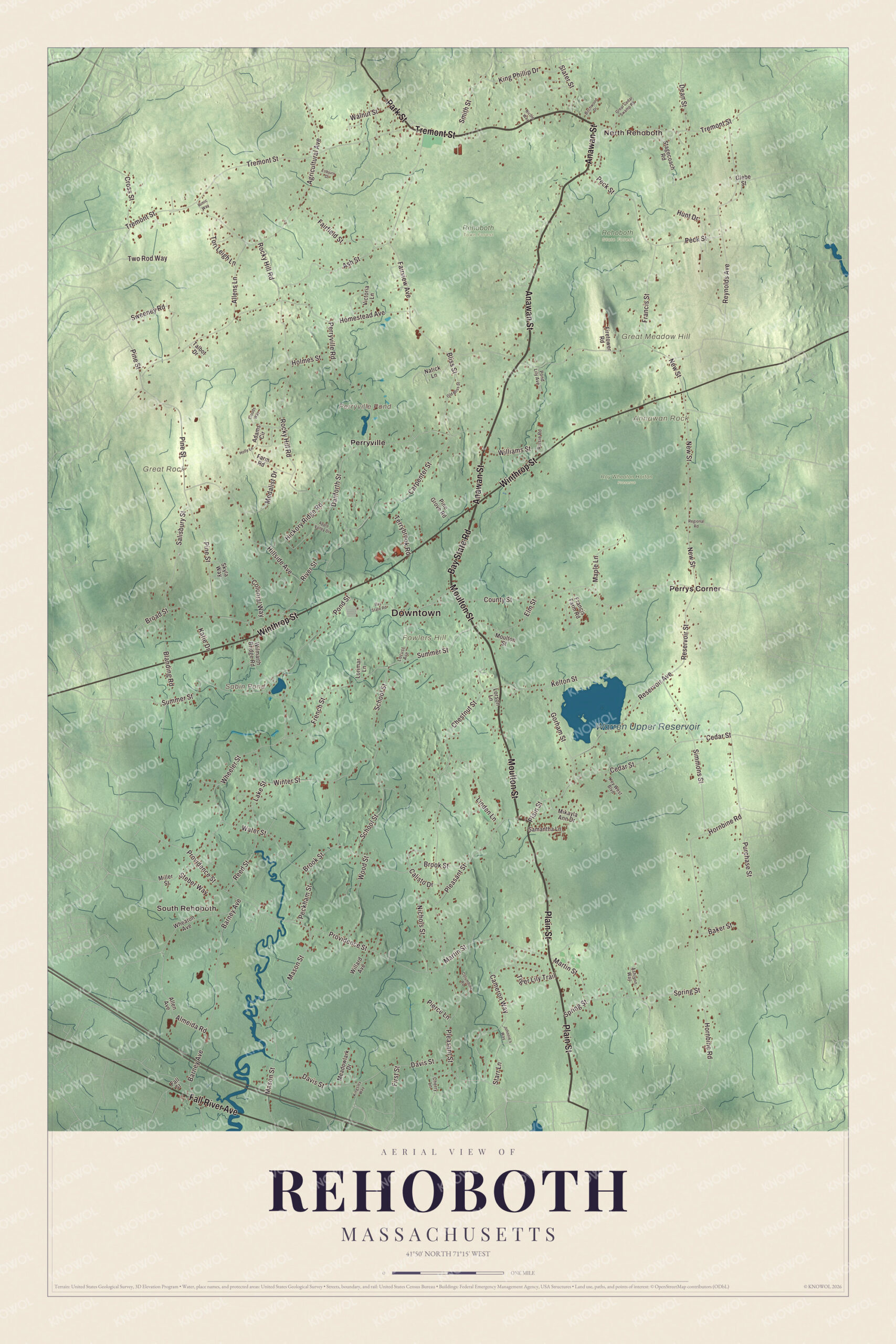
Rehoboth today
By KNOWOL
All 46.8 square miles of the town over shaded hills, with Bay State Road, Anawan Street, Tremont Street, Moulton Street, Plain Street and Park Street, Annawan Rock, the Warren Upper Reservoir and Great Meadow Hill.2
The history of Rehoboth, Massachusetts
The reservoir called Bad Luck
In the fall and winter of 1837 and 1838, Nelson and Darius Goff of the Village mill and Benjamin Peck of the Orleans mill built a reservoir on Bad Luck Brook to keep their water wheels turning. It lived up to its name. Very early on June 24, 1859, the dam gave way and the whole pond poured down the valley, uprooting trees, carrying off four bridges and undermining the Village mill. People heard the roar for miles. In 1898 the Annawan Club, a group of Rhode Island sportsmen, built a lodge of hand-hewn cedar logs on its shore and renamed it Annawan Lake. The Bristol and Warren Water-Works bought a half interest in 1911 and rebuilt the dam in 1913 for about $30,000. Today it's the Warren Upper Reservoir.5678
Goff Hall and the clambake
On January 2, 1884, the Congregational minister George H. Tilton spotted an old loom at George N. Goff's house and told Mrs. Goff, "We must have an Antiquarian Society." He sold shares at ten dollars apiece, and the mill owner Darius Goff matched the town's $4,000 and gave an acre where the old Goff Inn, his birthplace, stood. Goff Memorial Hall was dedicated on May 10, 1886, his 77th birthday, with the new Blanding Library inside. On August 24 the society held its first clambake, with tables under the orchard trees. Within a few years it needed the largest tent in New England, feeding 1,400 people at fifty cents a plate. Lightning burned the hall in 1911, and the brick hall of 1915 still hosts the bake.91032
Hornbine, the hornbeam corner
Hornbine, in the southeast part of town about six miles from the Village, takes its name from the hornbeam trees that grow there, the 1918 town history says. About thirty Six-Principle Baptists formed a church here in 1753, and their plain meeting house still stands, the oldest Baptist meeting house in southeastern Massachusetts. Elder Thomas Seamans, a farmer, preached in it after he turned 100 and died in 1826 at 104. In Elder Preserved Pierce's day the church paid no salary, and he said his only pay was fifty cents a year, slipped into his hand by Miss Molly Miller. On a very hot Saturday in 1862 a Civil War company from four towns elected its officers in the church. Across the road, the Hornbine School taught children until 1937.11121314
Rehoboth, Massachusetts through the years
24 moments from 1643 to today.
- 1643Samuel Newman, Walter Palmer and William Sabin establish the settlement.1
- 1645The town is incorporated as Rehoboth, a name Newman chose because "the Lord hath made room for us."15
- 1676Narragansett warriors under Canonchet burn 42 homes and 21 barns in Old Rehoboth, then a much larger town.1
- 1676Captain Benjamin Church captures Anawan at the rock that now bears his name, the last event of King Philip's War.2
- 1717The General Court lets the Palmer's River neighborhood, today's Rehoboth, build its own meeting-house.16
- 1753About thirty Six-Principle Baptists form a church at Hornbine and ordain Daniel Martin as pastor.11
- 1773The Yellow Meeting House goes up on Readway's plain, where the Village Cemetery is now.17
- 1809The Rehoboth Union Manufacturing Company builds a cotton mill at Bliss's Mill, now Rehoboth Village.18
- 1811A cotton mill starts up on the Palmer River at the later Orleans site, two years before Fall River's first mills.7
- 1826Elder Thomas Seamans of the Hornbine church dies at 104, after preaching past his 100th birthday.11
- 1829The Taunton and Providence Turnpike is finished through town, with a toll-gate near Annawan Rock.19
- 1837A Providence company leases the Hunt mulberry orchard on Salisbury Street and starts raising silkworms.20
- 1837The Goffs and Benjamin Peck start building the Bad Luck Reservoir to feed their mills.5
- 1859The Bad Luck dam bursts before dawn on June 24, sweeping away four bridges.5
- 1862A Civil War company from four towns elects Otis A. Baker of Rehoboth its captain in the Hornbine Church.13
- 1884Rev. George H. Tilton founds the Rehoboth Antiquarian Society.9
- 1884The stone Orleans factory at Shad Factory burns on March 5.7
- 1886The Great Freshet takes out nearly every bridge on the Palmer River, and the mail crosses on a tight rope.21
- 1886Goff Memorial Hall is dedicated on Darius Goff's 77th birthday, with the Blanding Library inside.10
- 1886The Antiquarian Society holds its first clambake, on August 24.3
- 1898Electric cars start running through Rehoboth Village in June.22
- 1911Lightning burns Goff Memorial Hall; the brick hall that replaces it is dedicated in 1915.10
- 1913The Bad Luck dam is rebuilt for the Bristol and Warren water supply.7
- 1992For its 350th anniversary, Rehoboth stages a promotional take-back of the places carved from Old Rehoboth.1
Places to see in Rehoboth, Massachusetts
Places worth a visit in Rehoboth today.
- Annawan RockOff Route 44. Where Anawan was captured in 1676.
- Goff Memorial Hall124 Bay State Road. Brick hall of 1915, clambake out back.Visit their website
- Blanding Free Public LibraryGoff Memorial Hall. The town library since 1886.Visit their website
- Carpenter MuseumLocust Street. The Antiquarian Society's history museum.Visit their website
- Hornbine SchoolHornbine Road. One-room school, taught until 1937.
- Warren Upper ReservoirOff Reservoir Street. The old Bad Luck Reservoir of 1837.
- Rehoboth State ForestOff Peck Street. State forest with hiking trails.Visit their website
- Redway PlainRoute 44 and Bay State Road. Field of the September block party.
- Great Meadow HillHead of the Palmer's East Branch. Near the Pecks' old iron forge.
- Perryville PondPerryville. In the old Perry mill village.
Rehoboth on the National Register of Historic Places
All 35 places in Rehoboth on the National Register of Historic Places that still stand today, oldest first, and why each one matters.4
-
Anawan Rock
The puddingstone ledge where Captain Benjamin Church captured the Wampanoag leader Anawan on August 28, 1676, the last event of King Philip's War. It's reached by a short footpath off Route 44, one of the few sites from the war still intact.23
-
Kingsley House
Its oldest part was probably built about 1680 by John Kingsley as a stone-ender, making it the oldest house in Rehoboth. Its heavy timber frame, chamfered beams and gunstock posts are First Period work.24
-
Abiah Bliss House
Tradition dates it to 1666, which would make it one of the few houses to survive King Philip's War. Its southern part, said to be built by Jonathan Bliss, went up before 1740, and the Bliss family kept it into the 20th century.25
-
Wheeler-Ingalls House
A saltbox whose oldest part may have been built between 1710 and 1750 by Samuel Millard. Dr. John Wheeler bought it in 1760, and by the Revolution it had passed to the Ingalls family.26
-
Brown House
At its core is a house from the early 1700s, enlarged and given Italianate trim in the late 1800s.27
-
Ingalls-Wheeler-Horton Homestead Site
Listed for the archaeological remains of a house of about 1730 that stood into the early 1900s, and for the house of 1895 on the property, a fine local late Greek Revival example. Private.28
-
Seth Knapp Jr. House
Built about 1735 for Ichabod Wood of bricks made at a brickworks on the nearby Palmer River, it is the only brick house in town from before 1850. A later owner, Seth Knapp Jr., made shoes here.29
-
Elisha Allen House
One of the oldest and least-altered houses in town, this Cape was built between 1738 and 1759, probably by Deacon Ezekiel Read or his son. The Allen family owned it from 1759 to 1895.30
-
Daniel Bliss Homestead
A five-bay Georgian farmhouse of about 1741. One owner carefully took out and stored its Georgian details during a renovation, and a later owner put them back about 1970.31
-
Aaron Wheeler House
One of the town's best-preserved gambrel-roofed houses, built about 1745 by Aaron Wheeler, a farmer, part owner of local industrial sites and a Revolutionary War participant. Its detailed deed history is rare in Rehoboth.32
-
Caleb Cushing House and Farm
A farm established about 1750, with one of the town's best-preserved pre-Revolutionary farmhouses and a Cape of 1836. The Cushing family owned it into the mid-20th century.33
-
Nathaniel Drown House
One of the best-preserved local examples of the gambrel-roofed Georgian house, built about 1750. Its first known owner, Nathaniel Drown, held it during the Revolution, and its paneling, fireplaces and floors are original.34
-
Goff Homestead
Built about 1750 to 1780, it is a very rare local Georgian house with end chimneys instead of one central chimney, a design found in only one other Massachusetts house, also in Rehoboth. The Goff family owned it from 1784 to about 1920.35
-
Welcome Horton Farm
A well-preserved Georgian farmhouse of about 1750 to 1770 with fine period woodwork inside. The Martins, for whom the street is named, owned it for many years before Welcome Horton bought it in 1895.36
-
Martin Farm
A four-bay Cape built about 1750 to 1780 and enlarged bit by bit over the next 120 years. Martin family descendants still owned it in 1983.37
-
Rehoboth Village Historic District
The village center at Bay State Road and Locust Street grew up around mills on the Palmer River between about 1750 and 1850. It includes the Congregational church of 1839 and Goff Memorial Hall with the Blanding Library.38
-
Hornbine Baptist Church
Built in 1753 by the Six-Principle Baptists of Hornbine, it is the oldest Baptist meeting house in southeastern Massachusetts. It stands opposite the Hornbine School and is now home to Holy Cross Catholic Church.12
-
Col. Thomas Carpenter III House
Thomas Carpenter and his bride Elizabeth Moulton moved into this Georgian house before it was finished in September 1755, and their twelve children were born here by 1776.39
-
Peck-Bowen House
A five-bay Cape of about 1770 to 1780 that keeps its old chair rails and mantels. It may have belonged to the Pecks, who ran an iron forge and grist mill nearby.40
-
Briggs Tavern
Built about 1780 at what was then Stevens Corner, it is the town's only surviving 18th-century commercial building, now a private home with its paneled fireplaces and splayed window lintels.41
-
Nathan Bowen House
One of the town's finest Federal houses, built about 1785 for two households, one on each floor, each with its own kitchen fireplace and bake oven. The Bowens owned it until the late 1800s.42
-
Carpenter House
The two-story wood-frame house was probably built in 1789 by Thomas Carpenter III, reusing elements of an older (c. 1750) structure that is known to have stood at the site. The house is one of several locally distinctive houses designed with kitchen fireplaces on both floors.43
-
Christopher Carpenter House
Built about 1800, possibly by Deacon Thomas Carpenter, it is a particularly fine local Federal house, with a pedimented doorway and fanlight and bake ovens on both floors.44
-
Elm Cottage/Blanding Farm
A farmhouse of about 1800 where the Blanding family ran a long and successful farm. Dr. William Blanding, an early resident, wrote an important early study of Rehoboth's old houses.45
-
Goff Farm
Built about 1800 as a one-story Federal house and raised to two stories with Italianate trim in 1897. The Goffs were prominent in town politics, and their farmland stayed in use until it became the Rehoboth Country Club.46
-
Capt. Mial Pierce Farm
A farm built around a Cape of about 1800, probably by Mial Pierce, a militia captain in the Revolution who is buried in a family plot on the property. The complex also includes a number of 19th-century farm outbuildings.47
-
Samuel Viall House
Built about 1800 as an outbuilding, probably by Peter or Thomas Carpenter, it was bought in 1850 by Samuel Viall, who turned it into a Greek Revival side-hall house, a type rare in Rehoboth.48
-
House at 30 Kelton Street
The town's finest end-chimney Greek Revival cottage, probably built by L. Bowen, likely a son of Nathan Bowen, whose house stands nearby.49
-
Hornbine School
A one-room district school that taught children until 1937 and is the best-preserved rural schoolhouse in town. The Hornbine School Association bought it in 1968 and runs it as a local history museum.14
-
James Perry House
Built about 1860 by James Perry, a wealthy manufacturer, it is one of Rehoboth's finest Italianate houses, on Perry family land overlooking the family's mill.50
-
Carpenter Bridge
A double-span bridge of local fieldstone over the West Branch of the Palmer River, built in 1873 with cap stones up to ten feet long. It's the only 19th-century stone bridge left in town.51
-
Baker House
A rare period duplex for Rehoboth, built about 1875 to 1890, with angled bay windows on either side of the door and a bracketed Italianate hood.52
-
House at 197 Hornbine Road
The town's finest Italianate house, built about 1890 by a member of the Baker family, with bracketed eaves, round-arch gable windows and its original front door and hood.53
-
Anawan Club Clubhouse and Caretaker's House
A hunting and fishing lodge built in 1898 of locally cut cedar logs on the shore of Warren Upper Reservoir, with fieldstone chimneys at each end. The caretaker's house is a much older Cape, probably built by a Kelton between 1750 and 1780.8
-
Bramble Hill
A fieldstone house in the French Norman Revival style, built about 1923 to 1928 to a design by the Providence architect Albert Harkness for Doris Mather Briggs, a relative of the Carpenter family. It's one of the few houses in town with a known architect.54
Rehoboth in their words
“The Lord hath made room for us.”
Samuel Newman, naming the town in 1645, in The history of Rehoboth, 183615
“No matter how hard the day's work nor how tired the arms and legs, at the touch of the seine all was forgotten.”
Dr. H. E. Horton on the spring shad run in Palmer's River, in A history of Rehoboth, 191855
“They have great luck in clam-bakes up at Rehoboth”
An old settler, in Old paths and legends of New England, 190356
Towns near Rehoboth, Massachusetts
Sources for the history of Rehoboth
- Rehoboth, Massachusetts, Wikipedia
- Map of Rehoboth, Massachusetts in 2026, KNOWOL
- A history of Rehoboth, Massachusetts, 1643-1918 (1918), on the Antiquarian Society clambake, Internet Archive
- National Register of Historic Places listings in Bristol County, Massachusetts, Wikipedia
- A history of Rehoboth, Massachusetts, 1643-1918 (1918), on the Bad Luck Reservoir, Internet Archive
- A history of Rehoboth, Massachusetts, 1643-1918 (1918), on the Annawan Club, Internet Archive
- A history of Rehoboth, Massachusetts, 1643-1918 (1918), on the Orleans mill and Shad Factory, Internet Archive
- Anawan Club Clubhouse and Caretaker's House, Wikipedia
- A history of Rehoboth, Massachusetts, 1643-1918 (1918), on the founding of the Rehoboth Antiquarian Society, Internet Archive
- A history of Rehoboth, Massachusetts, 1643-1918 (1918), on Goff Memorial Hall, Internet Archive
- A history of Rehoboth, Massachusetts, 1643-1918 (1918), on the Hornbine Church, Internet Archive
- Hornbine Baptist Church, Wikipedia
- The Third Massachusetts Regiment Volunteer Militia in the War of the Rebellion, 1861-1863 (1906), Internet Archive
- Hornbine School, Wikipedia
- The history of Rehoboth, Bristol County, Massachusetts (1836), on the town's name, Internet Archive
- Historical collections: being a general collection of interesting facts, traditions, biographical sketches, anecdotes (1841), on Rehoboth, Internet Archive
- A history of Rehoboth, Massachusetts, 1643-1918 (1918), on the Yellow Meeting House, Internet Archive
- A history of Rehoboth, Massachusetts, 1643-1918 (1918), on the Rehoboth Union Manufacturing Company, Internet Archive
- A history of Rehoboth, Massachusetts, 1643-1918 (1918), on the Taunton and Providence Turnpike, Internet Archive
- A history of Rehoboth, Massachusetts, 1643-1918 (1918), on silk culture, Internet Archive
- A history of Rehoboth, Massachusetts, 1643-1918 (1918), on the Great Freshet of 1886, Internet Archive
- A history of Rehoboth, Massachusetts, 1643-1918 (1918), on the electric railway, Internet Archive
- Anawan Rock, Wikipedia
- Kingsley House, Wikipedia
- Abiah Bliss House, Wikipedia
- Wheeler, Ingalls House, Wikipedia
- Brown House, Wikipedia
- Ingalls, Wheeler, Horton Homestead Site, Wikipedia
- Seth Knapp Jr. House, Wikipedia
- Elisha Allen House, Wikipedia
- Daniel Bliss Homestead, Wikipedia
- Aaron Wheeler House, Wikipedia
- Caleb Cushing House and Farm, Wikipedia
- Nathaniel Drown House, Wikipedia
- Goff Homestead, Wikipedia
- Welcome Horton Farm, Wikipedia
- Martin Farm, Wikipedia
- Rehoboth Village Historic District, Wikipedia
- Col. Thomas Carpenter III House, Wikipedia
- Peck, Bowen House, Wikipedia
- Briggs Tavern, Wikipedia
- Nathan Bowen House, Wikipedia
- Carpenter House, Wikipedia
- Christopher Carpenter House, Wikipedia
- Elm Cottage/Blanding Farm, Wikipedia
- Goff Farm, Wikipedia
- Capt. Mial Pierce Farm, Wikipedia
- Samuel Viall House, Wikipedia
- House at 30 Kelton Street, Wikipedia
- James Perry House, Wikipedia
- Carpenter Bridge, Wikipedia
- Baker House, Wikipedia
- House at 197 Hornbine Road, Wikipedia
- Bramble Hill, Wikipedia
- A history of Rehoboth, Massachusetts, 1643-1918 (1918), on some old Rehoboth customs, Internet Archive
- Old paths and legends of New England (1903), on Rehoboth's clambakes, Internet Archive