
A hilltop town in the northwest corner of Connecticut, laid out along a mile-long green of elms, where iron furnaces once worked in Sharon Valley, the Hotchkiss family made inventions in metal, and summer families came for the high, clear air.
Sharon on the map
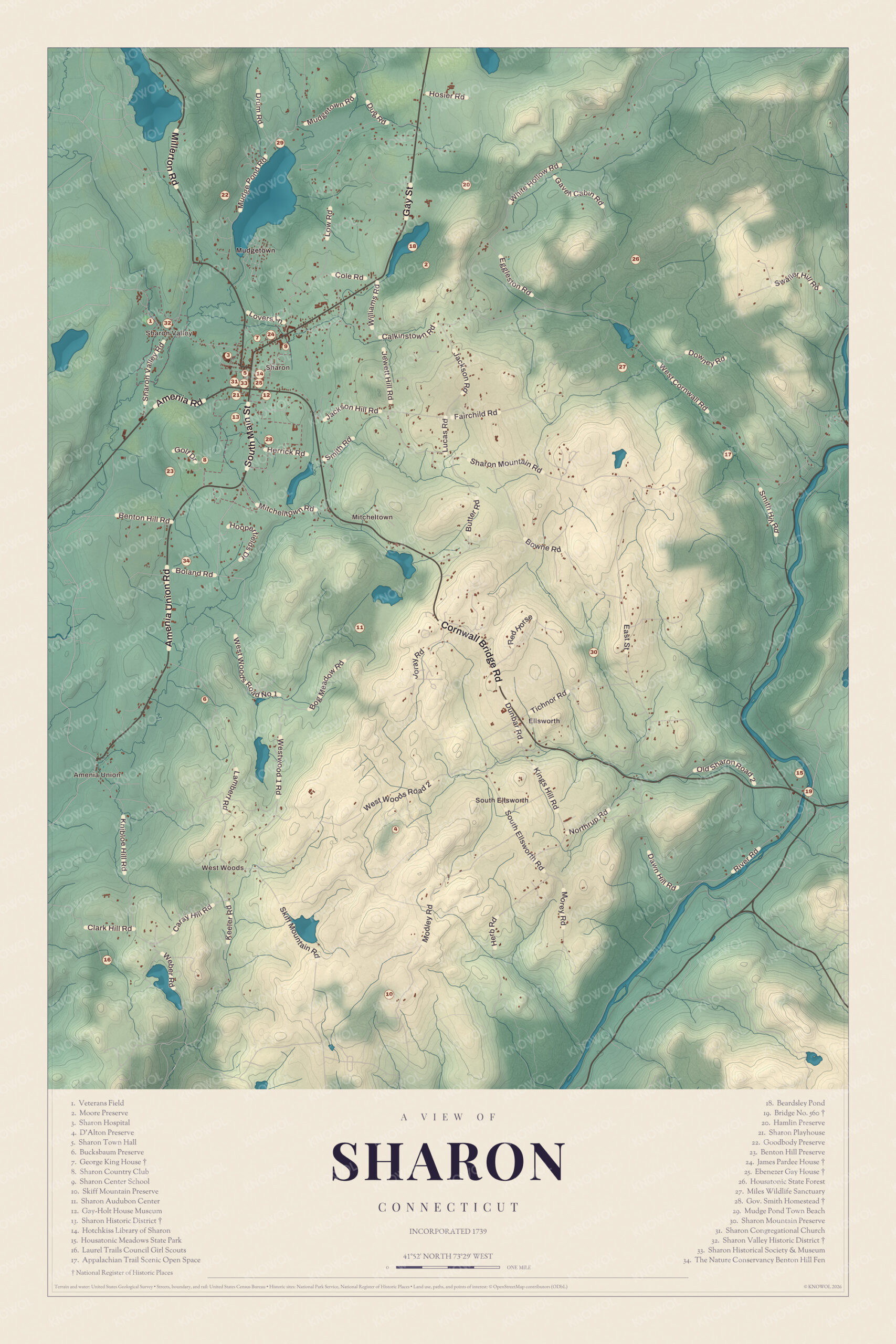
Click the map to look closer.
Sharon today
By KNOWOL
The shaded hills of the Northwest Highlands running down to the Housatonic, every street and the town line, Sharon, Sharon Valley and Amenia Union printed by name, and a guide of 34 numbered landmarks with the National Register sites marked.4
The story of Sharon
Scaffolds, a stove and a tavern ballroom
In the spring of 1741 Sharon's church raised a meetinghouse built of poles, thirty-six feet by twenty. Philip Livingston offered a bell if the town would build a steeple, but the steeple was never built and the bell never came. In 1770 George Whitefield preached here, and the crowd was so big that scaffolding went up all around the meetinghouse so people could listen through the open windows. When news of Lexington came on a Sunday, Parson Cotton Mather Smith announced it from the pulpit, then went north as chaplain to Colonel Hinman's regiment. Buying the first stove started a real quarrel, since some members held it was orthodox to freeze. And Sharon's Methodists first met in the ballroom of Gallow's Tavern, until the town threatened the keeper's license.5
Furnaces, mousetraps and the Hotchkiss inventions
Sharon farmed until 1825, when its first iron furnace went up in Sharon Valley, with water power from two creeks, forests for charcoal and ore near Indian Lake. A few years later the Hotchkiss family arrived. Young Andrew Hotchkiss, who couldn't go to school as a boy, was inventing by fifteen: a currycomb, an ox-bow pin, a screw wrench, a rake head, a snow plow and a rifle-cannon projectile, later finished by B. B. Hotchkiss. His firm, Hotchkiss and Sons of Sharon Valley, grew from a small start into a big business. By 1845 the town's shops also turned out brooms, teasels, and mouse and rat traps. Benjamin Berkley Hotchkiss grew up in Sharon, and in 1893 his widow opened the gray limestone Hotchkiss Library in his memory.2678
The Lake of Grace
On the New York line lies Indian Pond, which Moravian missionaries called the Lake of Grace. In 1749 David Bruce, a missionary born in Scotland, served the Native congregation at Wechquadnach by its shore, and he died there that summer. His mourners carried him across the lake to be buried on the Connecticut side. In time his gravestone went missing, until part of it, inscription and all, turned up laid into a farm stone wall. Later the Moravian Historical Society came to put up a monument, and the procession moved to the old burial ground to the music of trombones. Driving on toward Kent that evening, the visitors saw Sharon high on its hill, a pretty village of white houses almost buried in maples and elms.910
Through the years
23 moments from 1739 to today.
- 1739Daniel Jackson, the first settler, sells his land to Garritt Winegar, who builds Sharon's first grist mill.11
- 1739Sharon is incorporated and named for the Plain of Sharon.1
- 1739The first town meeting is held in December at the house of Nathaniel Skinner.12
- 1741The congregation raises a meetinghouse built of poles, thirty-six feet by twenty.5
- 1749David Bruce, a Moravian missionary from Scotland, dies at the Wechquadnach mission on Indian Pond.9
- 1757John Penoyer builds a brick house later called perhaps the oldest dwelling in Sharon.13
- 1765Simeon Smith begins his stone house at the south end of the green.14
- 1769The oldest part of the George King House is built.15
- 1770George Whitefield preaches here, and scaffolding goes up around the meetinghouse for the crowd.5
- 1775News of Lexington arrives on a Sunday, and Parson Cotton Mather Smith announces it from the pulpit.5
- 1775Ebenezer Gay begins his brick house facing the green.16
- 1782James Pardee builds his house of salmon-colored local brick.17
- 1825Sharon's first iron furnace goes up in Sharon Valley.2
- 1831The Hotchkiss family moves to Sharon Valley, where young Andrew Hotchkiss will become an inventor.6
- 1845Sharon's shops make brooms, teasels, and mouse and rat traps, beside its forge and furnaces.7
- 1880The Berlin Bridge, an iron lenticular truss, is set over Webutuck Creek in Sharon Valley.2
- 1893The Hotchkiss Library opens, built in memory of Benjamin Berkley Hotchkiss.8
- 1898The Sharon Valley Iron Company sells out, and its furnace and lime kiln shut down soon after.2
- 1907Thomas Edison stays at the Sharon Inn with fourteen people in tow.18
- 1930Bridge No. 560 is built over the Housatonic at Cornwall Bridge.19
- 1933Civilian Conservation Corps men plant 45,000 red pines at Housatonic Meadows.20
- 1951Anne Hoyt leaves the Ebenezer Gay House to the Sharon Historical Society.16
- 1961Clement and Keyo Ford give Bog Meadow Farm to the National Audubon Society.21
Places to see
The numbers match the landmark guide printed on the 2026 map.
- 7George King HouseNorth Main Street. Brick wing of 1769.
- 11Sharon Audubon CenterCornwall Bridge Road. Forest, two ponds, 11 miles of trails.Visit their website
- 13Sharon Historic DistrictMain Street. The long green and its houses.
- 14Hotchkiss Library of SharonSharon center. Romanesque library of 1893.Visit their website
- 15Housatonic Meadows State ParkAlong the Housatonic. Camping, canoeing and fly-fishing.Visit their website
- 19Bridge No. 560Cornwall Bridge. Concrete arches of 1930.
- 25Ebenezer Gay House18 Main Street. Brick house of 1775, now a museum.
- 28Gov. Smith HomesteadSouth Main Street. Stone house begun in 1765.
- 29Mudge Pond Town BeachNorth of the center. Swimming lanes and a playground.
- 32Sharon Valley Historic DistrictNear the New York line. The old iron village.
On the National Register
All 8 places in Sharon on the National Register of Historic Places that still stand today, oldest first, and why each one matters.3
-
Webutuck Agricultural Valley Historic District
About 3,800 acres of farmland along Webutuck Creek, with some twenty farmsteads and three small hamlets cultivated since the early 1700s. It lies mostly in Amenia, New York, with a small section in Sharon where the hamlet of Amenia Union crosses the state line.22
-
Sharon Historic District
The town center, centered on a mile-long green lined with Federal houses from Sharon's best years, four church buildings, the Romanesque library of 1893 and a memorial clock tower. South Main Street has one of the highest concentrations of Colonial Revival estates in the state.23
-
Gov. Smith Homestead
A large stone house begun by Simeon Smith, a doctor, druggist and militia leader, who held a meeting of doctors here in 1779. His nephew John Cotton Smith, Governor of Connecticut during the War of 1812, made it his home.14
-
George King House
Bought in 1783 by George King, who supplied the army during the Revolution. A descendant and her husband, Admiral Thomas C. Hart, who helped build the Navy's submarine fleet and served briefly in the Senate, expanded it in 1925.15
-
Ebenezer Gay House
A Georgian brick house built in 1775 and 1776 by Ebenezer Gay, who led the local militia in the Revolution and died insolvent in 1787. It's now home to the Sharon Historical Society and Museum.16
-
James Pardee House
Built of salmon-colored local brick by James Pardee, son of town founder John Pardee, on one of the town's original home lots. It keeps most of its original windows and woodwork.17
-
Sharon Valley Historic District
The village that grew around Sharon's iron furnace of 1825 and the Hotchkiss iron works. It keeps workers' houses, the iron company's Carpenter Gothic office, lime kiln ruins and an 1880 lenticular truss bridge.2
-
Bridge No. 560
Six open-spandrel concrete arches spanning 674 feet, built by C.W. Blakeslee and Sons, the longest arch 180 feet across the river. A fairly large example of this kind of bridge.19
In their words
“But Sharon, at any rate, is a very fine town, full of majestic elms and stately houses, seated on a lofty hill and looking out north and west over many a mile of blue hill country.”
Odell Shepard, The harvest of a quiet eye, 192724
“Sharon is a pretty New England village, with white frame houses set back from the wide grass-grown streets, almost buried in maples and elms, the favorite shade trees of this country.”
A memorial of the Moravian Historical Society, 186025
“Where is there another church that has the unique charm and interest of having been expelled from a saloon?”
About an old New England church, an address for the 150th anniversary of Sharon's Congregational Church, 18915
Nearby towns
Sources
- Sharon, Connecticut, Wikipedia
- Sharon Valley Historic District, Wikipedia
- National Register of Historic Places listings in Litchfield County, Connecticut, Wikipedia
- Map of Sharon, Connecticut in 2026, KNOWOL (USGS elevation, Census Bureau roads)
- About an old New England church: an address for the 150th anniversary of the Congregational Church of Sharon, Connecticut (1891), Internet Archive
- Genealogical and family history of the state of Connecticut (1911), on Andrew Hotchkiss, Internet Archive
- Annual report of the Bureau of Labor Statistics of the State of Connecticut, industrial history of Sharon, Internet Archive
- The Connecticut magazine (1899), The Rose of Sharon, on the Hotchkiss Library, Internet Archive
- A memorial of the dedication of monuments erected by the Moravian Historical Society (1860), on David Bruce, Internet Archive
- A memorial of the dedication of monuments erected by the Moravian Historical Society (1860), on Indian Pond, the Lake of Grace, Internet Archive
- Connecticut historical collections, by John Warner Barber (1837), on Sharon's first settlers, Internet Archive
- Burying grounds of Sharon, Connecticut, Amenia and North East, New York (1903), on the first town meeting, Internet Archive
- The Connecticut magazine (1899), The Rose of Sharon, on Sharon's old houses, Internet Archive
- Gov. Smith Homestead, Wikipedia
- George King House, Wikipedia
- Ebenezer Gay House, Wikipedia
- James Pardee House, Wikipedia
- The Rise of the Second Home Community in Sharon, ConnecticutHistory.org
- Cornwall Bridge (Bridge No. 560), Wikipedia
- Housatonic Meadows State Park, Wikipedia
- Sharon Audubon Center, Wikipedia
- Webutuck Agricultural Valley Historic District, National Register nomination draft, Connecticut State Historic Preservation Office
- Sharon Historic District (Sharon, Connecticut), Wikipedia
- The harvest of a quiet eye: a book of digressions, by Odell Shepard (1927), Internet Archive
- A memorial of the dedication of monuments erected by the Moravian Historical Society (1860), on the village of Sharon, Internet Archive