
A river town across from Windsor, with long Main Street farms and tobacco sheds by the Connecticut, where Jonathan Edwards and John Fitch were born and the parish of Wapping grew up in the woods to the east.
Then and now
The same town 157 years apart. Click either map to look closer.
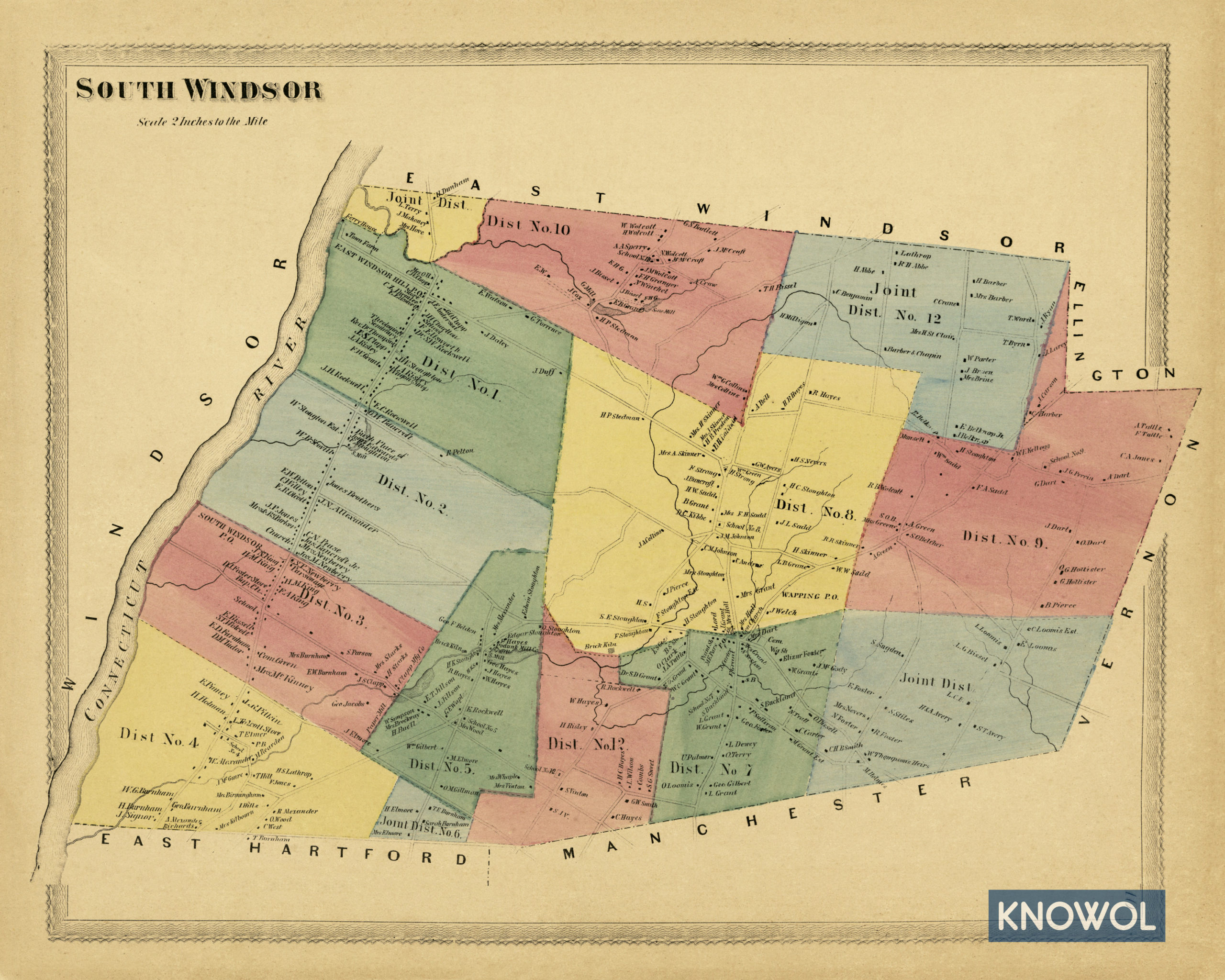
The landowners map
By Baker & Tilden
South Windsor in 1869, with every plot labeled with its owner's name, 14 districts including joint districts with five neighboring towns, and landmarks like the Town Farm, the Theological Seminary, Risley's Wagon Shop, D.J. Foster's Store, the East Windsor Hill and Wapping post offices and a brick kiln.5
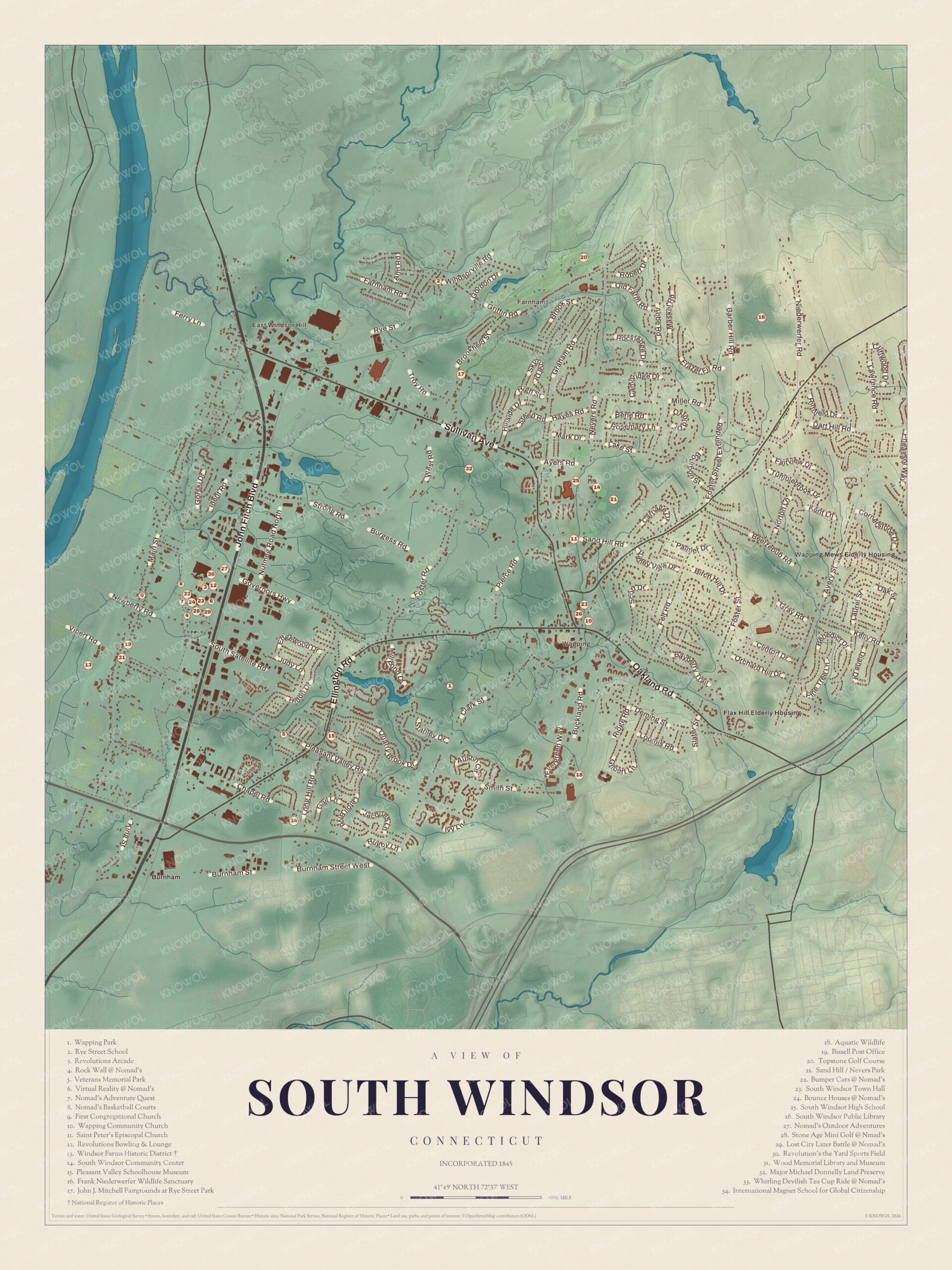
South Windsor today
By KNOWOL
Shaded land from the river meadows below Main Street and Burnham east to Wapping, every street and the town line, and a guide of 34 numbered landmarks with the National Register district marked.6
The story of South Windsor
The Wapping barn
Wapping shares its name with a street in London, on the Thames. By 1705 a hunter named Samuel Rockwell was selling venison to Thomas Bissell in the northwest corner of Wapping. In 1761 the parish counted about 200 people in 32 houses, and they complained that church on the Street meant four and a half miles through the wilderness. Matthew Rockwell, a Yale graduate and a physician, preached to them in 1762, by tradition in Mr. Grant's old house. Their first meetinghouse, of about 1765, had its upper windows boarded up and was used only in the warmer months. People called it the Wapping barn, and in 1789 some young men out on a frolic pulled it down. A new meeting house went up in 1801.78910
The steamboat man comes home
John Fitch was born in 1743 in a house that stood on the line between East Windsor and Hartford, so today it stands on the line between South Windsor and East Hartford. A 1928 county history calls him the first man to use steam to drive a boat. By 1788 his boat was making regular trips at Philadelphia, and in 1791 Washington, Jefferson and Knox signed his letters patent. In 1793 he went to France to build a steamboat, but in the turmoil of the Revolution there he found no money. In 1794 he came home working his passage as a common sailor and stayed about two years with his sister, Mrs. Timothy King, in what's now South Windsor. A bronze tablet in the State Capitol honors him.111213
The seminary on the hill
Families from Windsor settled East Windsor Hill in 1638, and from 1648 John Bissell's ferry tied them to the west bank. Samuel Grant, ancestor of Ulysses S. Grant, had moved here by 1672. In 1834 an association of Congregational ministers won a charter for the Theological Institute of Connecticut, meant to be a manual labor theological school, and built it here. Its first president, Bennett Tyler, built his Greek Revival house in 1835. East Windsor Hill Academy followed in 1851 under Paul A. Chadbourne, later president of Williams College. When its money ran short ten years on, the trustees closed it rather than let its good name suffer. By 1854 the hill felt too far from the world, and in 1865 the seminary moved to Hartford, where it grew into the Hartford Seminary.214151617
Through the years
25 moments from 1638 to today.
- 1638Families from Windsor settle East Windsor Hill, across the river.2
- 1648John Bissell starts the first ferry across the Connecticut River, landing at Ferry Lane.2
- 1659Thomas Burnham buys the land of today's South Windsor and East Hartford from Tantinomo, chief sachem of the Podunk.1
- 1672Samuel Grant, ancestor of Ulysses S. Grant, has moved to East Windsor Hill by this year.14
- 1694The oldest house now in the Windsor Farms Historic District is built.18
- 1698Timothy Edwards becomes the first minister for the settlers on the east side of the river.1
- 1703Jonathan Edwards is born here on October 5.19
- 1705A hunter named Samuel Rockwell is selling venison to Thomas Bissell in the northwest corner of Wapping.7
- 1743John Fitch, the steamboat man, is born in South Windsor.12
- 1757Ebenezer Grant begins his house at East Windsor Hill, finished in 1758.20
- 1761Wapping's 200 people in 32 houses petition about their four-and-a-half-mile trip to church.8
- 1765Wapping builds its first meetinghouse, used only in the warm months.9
- 1768The east side of the river becomes the town of East Windsor.1
- 1789Young men out on a frolic pull down the worn-out Wapping meetinghouse, known as the Wapping barn.9
- 1794John Fitch comes home from Europe, working his passage as a common sailor, and stays with his sister here.13
- 1801The Wapping Congregational meeting house goes up.10
- 1834The Theological Institute of Connecticut is chartered and builds its first seminary at East Windsor Hill.15
- 1845South Windsor becomes a town of its own, and the First Congregational Church is built on Main Street.18
- 1851East Windsor Hill Academy opens under Paul A. Chadbourne, later president of Williams College.16
- 1861On October 2 a town meeting votes to raise troops; 101 South Windsor men go on to serve.3
- 1865The Theological Institute moves to Hartford, where it grows into the Hartford Seminary.15
- 1869Baker & Tilden publish the landowners map of South Windsor.5
- 1890South Windsor has 1,736 people, and farming is its main industry.21
- 1901Shade-grown tobacco for cigar wrappers comes to South Windsor.18
- 1926The Classical Revival Wood Memorial Library is built on Main Street.18
Places to see
The numbers match the landmark guide printed on the 2026 map.
- 1Wapping ParkSouthwest of town hall. Town park near Wapping.
- 9First Congregational ChurchMain Street. Greek Revival church of 1845.Visit their website
- 10Wapping Community ChurchTown center. Church next to town hall.Visit their website
- 13Windsor Farms Historic DistrictMain Street. Colonial farm street above the river.
- 15Pleasant Valley Schoolhouse MuseumSouth of town. Schoolhouse museum near Veterans Park.Visit their website
- 16Frank Niederwerfer Wildlife SanctuaryNortheast. Wildlife sanctuary in the northeast.
- 19Bissell Post OfficeNear Main Street. Post office near Main Street.
- 23South Windsor Town HallTown center. Beside the public library.
- 31Wood Memorial Library and MuseumMain Street. Classical Revival building of 1926.Visit their website
- 32Major Michael Donnelly Land PreserveNorth. Land preserve in the north.
On the National Register
All 4 places in South Windsor on the National Register of Historic Places that still stand today, oldest first, and why each one matters.4
-
Windsor Farms Historic District
The colonial heart of South Windsor, over 1,600 acres of houses along Main Street with narrow farm strips running down to the river, many still in tobacco. It takes in the 1845 First Congregational Church, an 1845 schoolhouse, the 1926 Wood Memorial Library and a house of 1694.18
-
East Windsor Hill Historic District
Settled from Windsor in 1638 and tied to it by John Bissell's ferry of 1648, the village keeps houses built from about 1700 to 1860, a ferry tavern of about 1750 and Bennett Tyler's Greek Revival house of 1835, built for the first president of the Theological Institute.2
-
Ebenezer Grant House
Built in 1757 and 1758, with a rear ell thought to hold Samuel Grant's house of 1695, it's one of the most elaborate colonial houses left in Connecticut, with a richly carved Connecticut River doorway. During the Revolution it held the Loyalist governor of New Jersey, William Franklin, and the British general Richard Prescott.20
-
Elmore Houses
A pair of Greek Revival farmhouses on land the Elmore family held from the 1600s into the 1900s. Number 78 was standing by 1816 and was restyled in the 1840s, and Dennis Burnham, a Hartford builder in the family, built number 87 in the 1840s.22
In their words
“It should be notable to the entire civilized world, for all time, as the birth-place of John Fitch, the inventor and builder of the first steamboat of the world.”
Historic towns of the Connecticut River Valley, 190611
“Jonathan Edwards, that remarkable man whose name has long since become illustrious throughout the civilized world.”
The memorial history of Hartford County, 188619
“There were no easy carriages or even wagons in those early days, and the fathers and mothers went to meeting on horseback, taking such of the children as could be carried in front on the horse or behind.”
One hundredth anniversary of the Wapping Congregational meeting house, 190210
Nearby towns
Sources
- South Windsor, Connecticut, Wikipedia
- East Windsor Hill Historic District, Wikipedia
- The memorial history of Hartford County, Connecticut, 1633-1884 (1886), on South Windsor in the Civil War, Internet Archive
- National Register of Historic Places listings in Hartford County, Connecticut, Wikipedia
- Historic landowners map of South Windsor, CT from 1869, restored by KNOWOL
- Map of South Windsor, Connecticut in 2026, KNOWOL (USGS elevation, Census Bureau roads)
- History of ancient Windsor, Connecticut (1859), on the settling of Wapping, Internet Archive
- History of ancient Windsor, Connecticut (1859), on Wapping parish, Internet Archive
- One hundreth anniversary of the Wapping Congregational meeting house (1902), on the first meetinghouse, Internet Archive
- One hundreth anniversary of the Wapping Congregational meeting house; erected 1801 and occupied 1802 in South Windsor, Connecticut (1902), Internet Archive
- Historic towns of the Connecticut River Valley (1906), on South Windsor, Internet Archive
- History of Hartford County, Connecticut, 1633-1928 (1928), on John Fitch, Internet Archive
- The history and genealogies of ancient Windsor, Connecticut (1891), on John Fitch, Internet Archive
- Genealogical and family history of the state of Connecticut (1911), on Samuel Grant, Internet Archive
- The Connecticut magazine (1905), on the Theological Institute of Connecticut, Internet Archive
- The memorial history of Hartford County, Connecticut, 1633-1884 (1886), on East Windsor Hill Academy, Internet Archive
- History of Hartford County, Connecticut, 1633-1928 (1928), on the Hartford Seminary, Internet Archive
- Windsor Farms Historic District, Wikipedia
- The memorial history of Hartford County, Connecticut, 1633-1884 (1886), on the graduates of South Windsor soil, Internet Archive
- Ebenezer Grant House, Wikipedia
- Register and manual of the state of Connecticut (1896), on South Windsor, Internet Archive
- Elmore Houses, Wikipedia