
A Naugatuck River mill city that grew out of a pine forest called Mast Swamp, where Wolcottville's woolen mill, brass kettles and sewing machine needles built the largest city in Litchfield County.
Then and now
The same town 149 years apart. Click either map to look closer.
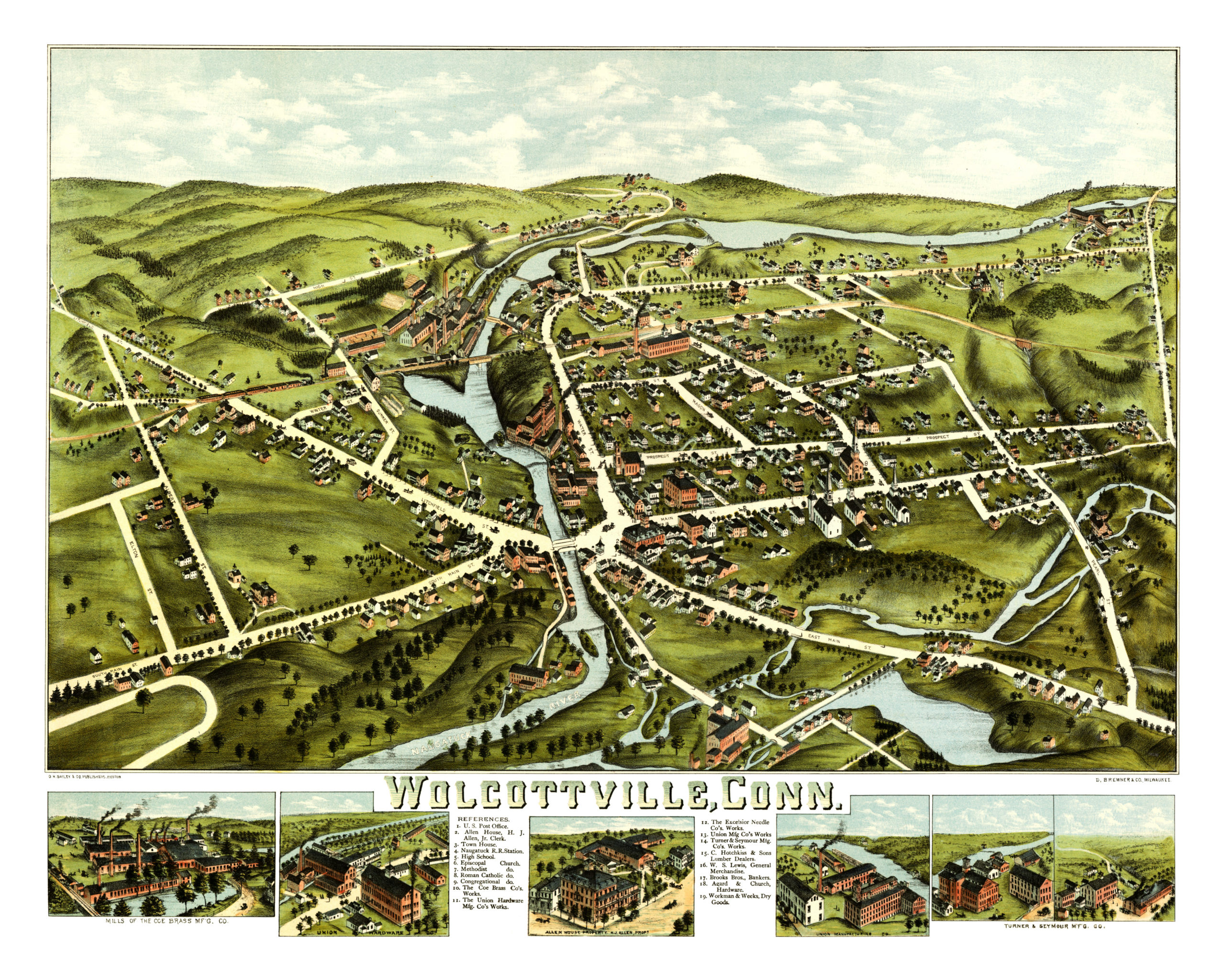
The bird's-eye view of Wolcotville
By O.H. Bailey
Wolcottville, the village that's now downtown Torrington, drawn as if from the sky, with the Naugatuck Railroad station, the Coe Brass Company, Union Hardware, the Excelsior Needle Company and Brooks Brothers Bankers.5
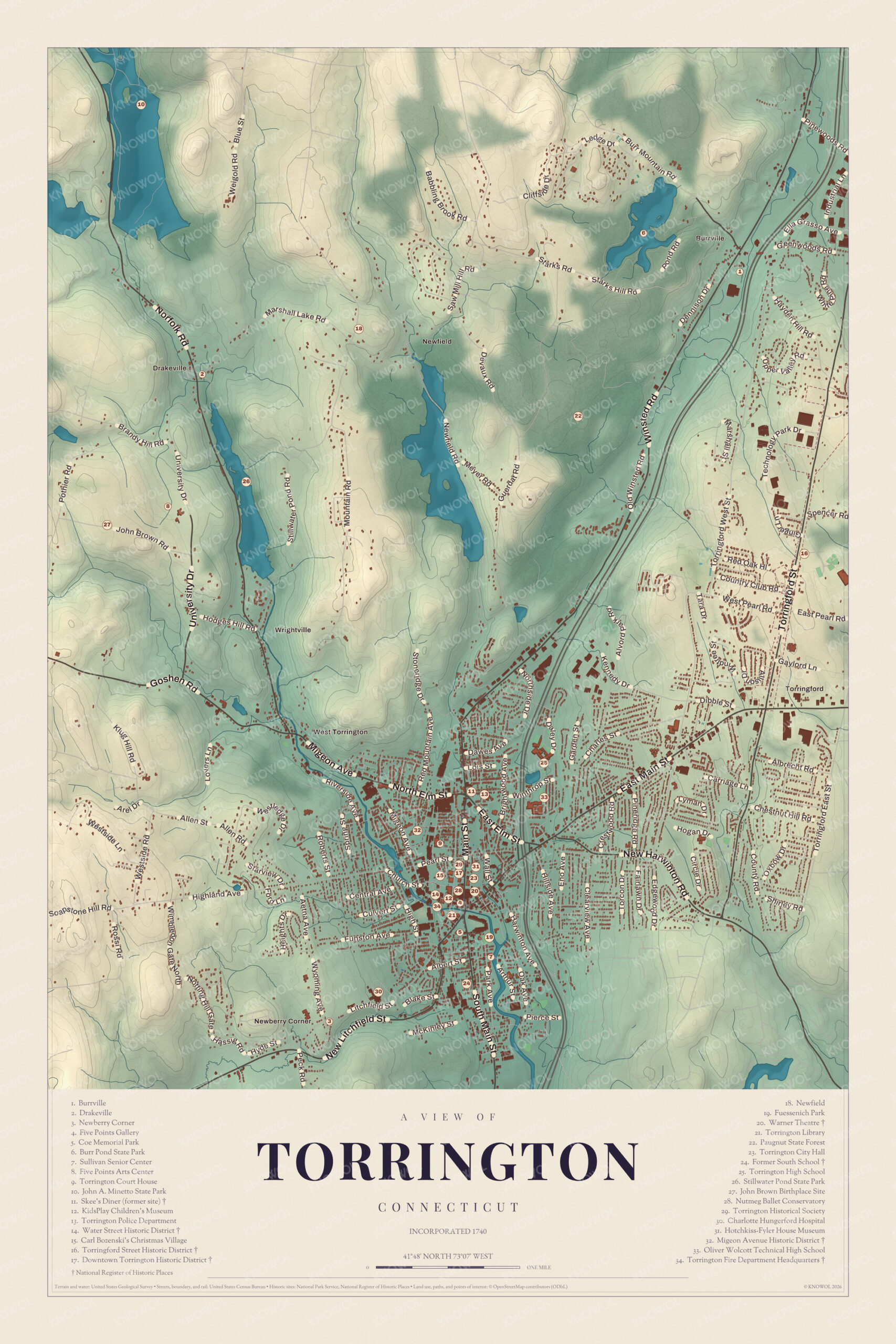
Torrington today
By KNOWOL
Shaded hills from Burrville down to the Naugatuck River valley, every street, Torringford, Drakeville, Newfield and West Torrington, and a guide of 34 numbered landmarks with the National Register sites marked.6
The story of Torrington
How Mast Swamp became Wolcottville
Downtown Torrington started out as Mast Swamp, a forest of pines so tall and straight that shipbuilders on the Sound wanted them for masts. For years hardly anyone lived there. One who did was Paul Peck, a hunter with a cabin in the swamp, who shouldered his musket when the British raided Danbury in 1777 and never came home. In 1803 John Brooker and Benoni Leach raced to raise the first frame house, and Brooker won by about a week. That night a crowd put up a pole hung with rams' horns and called the place Orleans village. In 1813, at the raising of the Wolcotts' woolen mill, Rev. Alexander Gillet called out a new name, Wolcottville, and everyone agreed. In 1881 the post office made it Torrington.78910
Kettles, needles and reed organs
In 1834 Israel Coe's company began making brass kettles at Wolcottville by hammering them out, the first such try in America. Thirty-eight English men, women and children came over on one ship to do the work, and before long the local Yankees had learned the trade themselves. A mile up the river at Daytonville, Arvid Dayton built his first reed organ in 1846, believed to be the first made in America, and sent out more than five thousand. Nearby, Bassett Dunbar's rakes carried his brand as far as Ohio, and James Ashborn later made guitars in the same shop. In 1866 the new Excelsior Needle Company started there too. By 1878 it was sending Wheeler and Wilson 150,000 sewing machine needles a month.2113
Born on the hills
Torrington was settled from the hilltops down. Torringford Street, on the eastern hill, was laid out in 1732, and Shubael Griswold built what was probably its first framed house in 1754, keeping a tavern in it. In 1781 the French army camped on the Torringford hills on its way to join Washington near New York. Two boys born on these hills became famous. Samuel J. Mills, born at Torringford in 1783, helped start the movement that founded the American Board of foreign missions. John Brown, the abolitionist, was born in the west of town on May 9, 1800, on a farm where his father, Owen, kept a tannery. The family left for Ohio when he was five. Since 2000 the Torrington Historical Society has owned his birthplace site.121314151617
Through the years
24 moments from 1732 to today.
- 1732The colony names the new township, allotted to Windsor proprietors, Torrington.18
- 1735Ebenezer Lyman Jr. of Durham settles here.1
- 1740Torrington is allowed to organize a government and incorporate as a town.1
- 1744The town builds a fort in its western part for protection from raids.19
- 1751The Naugatuck is dammed for Amos Wilson's sawmill, the start of the village in Mast Swamp.20
- 1752A highway twenty feet wide is laid through the swamp. It's now Main Street.21
- 1781The French army camps on the Torringford hills on its way to join Washington.14
- 1783Samuel J. Mills, a founder of American foreign missions, is born at Torringford.15
- 1800John Brown, the abolitionist, is born in the western part of town on May 9.1
- 1803John Brooker raises the first frame house in the valley, beating his neighbor by a week.8
- 1813The Wolcotts build a woolen mill, and at its raising the village is named Wolcottville.9
- 1834Wolcottville begins the first attempt in America to make brass kettles by hammering.2
- 1836Town meetings move down from the hills to Wolcottville.22
- 1846Arvid Dayton builds his first reed organ at Daytonville.11
- 1849The Naugatuck Valley railroad reaches Torrington.1
- 1851Milo Burr dams mountain streams to make Burr Pond.1
- 1856Gail Borden opens the first commercial milk condensery at Wolcottville.23
- 1866The Excelsior Needle Company is organized on March 2.24
- 1877O.H. Bailey publishes his bird's-eye view of Wolcotville.5
- 1881The post office renames Wolcottville as Torrington, and the old Torrington village becomes West Torrington.10
- 1887Torrington is incorporated as a borough.10
- 1923Torrington is chartered as a city.1
- 1931Warner Bros. opens the Warner Theatre on August 19.25
- 1955Floods from Hurricanes Connie and Diane destroy much of downtown.1
Places to see
The numbers match the landmark guide printed on the 2026 map.
- 1BurrvilleNortheast. Milo Burr's sawmill and tannery village.
- 5Coe Memorial ParkSouth of the river. The Coe children's gift of 1906.
- 6Burr Pond State ParkBurrville. Milo Burr's pond of 1851.Visit their website
- 14Water Street Historic DistrictWest of Main Street. Factories and shops of 1885 to 1920s.
- 16Torringford Street Historic DistrictThe eastern hill. A road laid out in 1732.
- 17Downtown Torrington Historic DistrictDowntown. 56 acres, 71 historic buildings.
- 20Warner TheatreMain Street. Art Deco movie palace of 1931.Visit their website
- 27John Brown Birthplace SiteWest of town. Where the abolitionist was born in 1800.
- 31Hotchkiss-Fyler House MuseumMain Street. Chateauesque mansion of 1897.Visit their website
- 34Torrington Fire Department HeadquartersWater Street. Romanesque firehouse finished in 1901.
On the National Register
All 12 places in Torrington on the National Register of Historic Places that still stand today, oldest first, and why each one matters.4
-
Torringford Street Historic District
Torringford Street was laid out in 1732, and its 119 historic buildings run from the 1700s to the middle 1900s, including the Shubael Griswold Tavern of about 1757. When the railroad drew business to the town center in 1849, Torringford stayed largely farm country.12
-
Downtown Torrington Historic District
Downtown grew where the Waterbury Turnpike met the Canton Turnpike, around a mill of 1813 and the railroad of 1849. Its 56 acres hold 71 historic buildings, including the old Conley Hotel of 1891, now the Yankee Pedlar.26
-
Water Street Historic District
Water Street joined a sawmill on the Naugatuck, first dammed in 1751, to Main Street, and between about 1880 and 1920 it filled with factories and shops. Among its oldest buildings are the American Brass Company office of 1881 and the railroad depot of 1898.20
-
James Alldis House
A well-kept Queen Anne house with a round tower, built for James Alldis, the English-born superintendent of the Excelsior Needle Company. Inside are original floors, light fixtures and two colored-glass windows.27
-
Fyler-Hotchkiss Estate
A brick Chateauesque mansion with a round three-story turret, designed by William H. Allen for Orsamus Fyler, a Civil War veteran and state insurance commissioner. The Torrington Historical Society runs it as the Hotchkiss-Fyler House Museum.28
-
Migeon Avenue Historic District
Grand houses built for leading businessmen around the turn of the 1900s, with landscaping by the Olmsted Brothers. The largest, Laurelhurst, was built in the late 1890s for Achille Migeon, the textile maker's son.29
-
Torrington Fire Department Headquarters
A Romanesque Revival firehouse with a bell tower, designed by Charles Scranton Palmer. It had electricity and an automatic system that released the horses from their stalls, and it was the main firehouse until 1980.30
-
Warrenton Woolen Mill
Woolen cloth was made on this site from 1844 until 1984, latterly heavy cloth for police and military uniforms. The brick complex of 1908 is the only known Connecticut work of the mill designer Charles T. Main, and it's condominiums now.31
-
South School
A Beaux Arts school by the New York architect Wilson Potter, the city's first large elementary school and a model for the ones built through the 1930s. It's apartments now.32
-
Villa Friuli
A Mediterranean Revival house built by John and Matthew DeMichiel, brothers among the first Italians to settle in Torrington. They were stonecutters, and their first big job was the pillars of Torrington City Hall.33
-
Warner Theatre
An Art Deco movie palace by Thomas W. Lamb that Warner Bros. opened on August 19, 1931, with Governor Wilbur Cross there. Local people saved it from demolition and reopened it as an arts center in 1983.25
-
Paugnut Forest Administration Building
A stone and wood bungalow built by the Civilian Conservation Corps as the headquarters of its camp at Burr Pond. It's one of the best-preserved CCC buildings in the state.34
In their words
“The cloths made have a substantial texture and are manufactured in a style scarcely inferior to the highest finished English cloths.”
A gazetteer of 1819 on the Wolcottville woolen mill, quoted in the History of Torrington, 187835
“The quick eye and ready hand of Wolcottville Yankees soon secured experts in the making of brass kettles.”
History of Torrington, 18782
“Far excelling as it does in growth and development, all other places in Litchfield county.”
Judge Gideon H. Welch, The Connecticut Magazine, 190536
Nearby towns
Sources
- Torrington, Connecticut, Wikipedia
- History of Torrington, Connecticut (1878), on the Coe brass kettle works, Internet Archive
- History of Torrington, Connecticut (1878), on the Excelsior Needle Company, Internet Archive
- National Register of Historic Places listings in Litchfield County, Connecticut, Wikipedia
- Bird's-eye view of Wolcotville (Torrington), Connecticut from 1877, restored by KNOWOL
- Map of Torrington, Connecticut in 2026, KNOWOL (USGS elevation, Census Bureau roads)
- The Connecticut magazine (1905), The Growth of Torrington, on Mast Swamp and Paul Peck, Internet Archive
- History of Torrington, Connecticut (1878), on the first frame house and Orleans village, Internet Archive
- History of Torrington, Connecticut (1878), on the naming of Wolcottville, Internet Archive
- The Connecticut magazine (1905), The Growth of Torrington, on the 1881 name change and the 1887 borough, Internet Archive
- History of Torrington, Connecticut (1878), on Daytonville, its organs, rakes and guitars, Internet Archive
- Torringford Street Historic District, Wikipedia
- Genealogical and family history of the state of Connecticut (1911), on Shubael Griswold, Internet Archive
- Chapter sketches, Connecticut Daughters of the American Revolution; patron saints (1901), Internet Archive
- A history of Connecticut (1922), on Samuel J. Mills, Internet Archive
- History of Torrington, Connecticut (1878), on Owen Brown and the John Brown place, Internet Archive
- Hidden Nearby: John Brown's Torrington Birthplace, ConnecticutHistory.org
- Connecticut historical collections (1837), on Torrington, Internet Archive
- The Connecticut magazine (1905), Gideon H. Welch, The Growth of Torrington, on the fort of 1744, Internet Archive
- Water Street Historic District (Torrington, Connecticut), Wikipedia
- History of Torrington, Connecticut (1878), on the highways through Mast Swamp, Internet Archive
- The Connecticut magazine (1905), The Growth of Torrington, on town meetings moving to Wolcottville, Internet Archive
- Evaporated Milk's Connecticut Connection, ConnecticutHistory.org
- Thread Your Needle, ConnecticutHistory.org
- Warner Theatre (Torrington, Connecticut), Wikipedia
- Downtown Torrington Historic District, Wikipedia
- James Alldis House, Wikipedia
- Fyler-Hotchkiss Estate, Wikipedia
- Migeon Avenue Historic District, Wikipedia
- Torrington Fire Department Headquarters, Wikipedia
- Warrenton Woolen Mill, Wikipedia
- South School (Torrington, Connecticut), Wikipedia
- Villa Friuli, Wikipedia
- Paugnut Forest Administration Building, Wikipedia
- History of Torrington, Connecticut (1878), quoting the 1819 gazetteer on Wolcottville, Internet Archive
- The Connecticut magazine (1905), The Growth of Torrington, on the borough, Internet Archive