
A shore town between the Niantic River and the Thames, set off from New London in 1801, whose Millstone Point granite went into forts from Newport to New Orleans and whose shore holds Harkness, the O'Neill and the Hartford Colony.
Waterford on the map
Click the map to look closer.
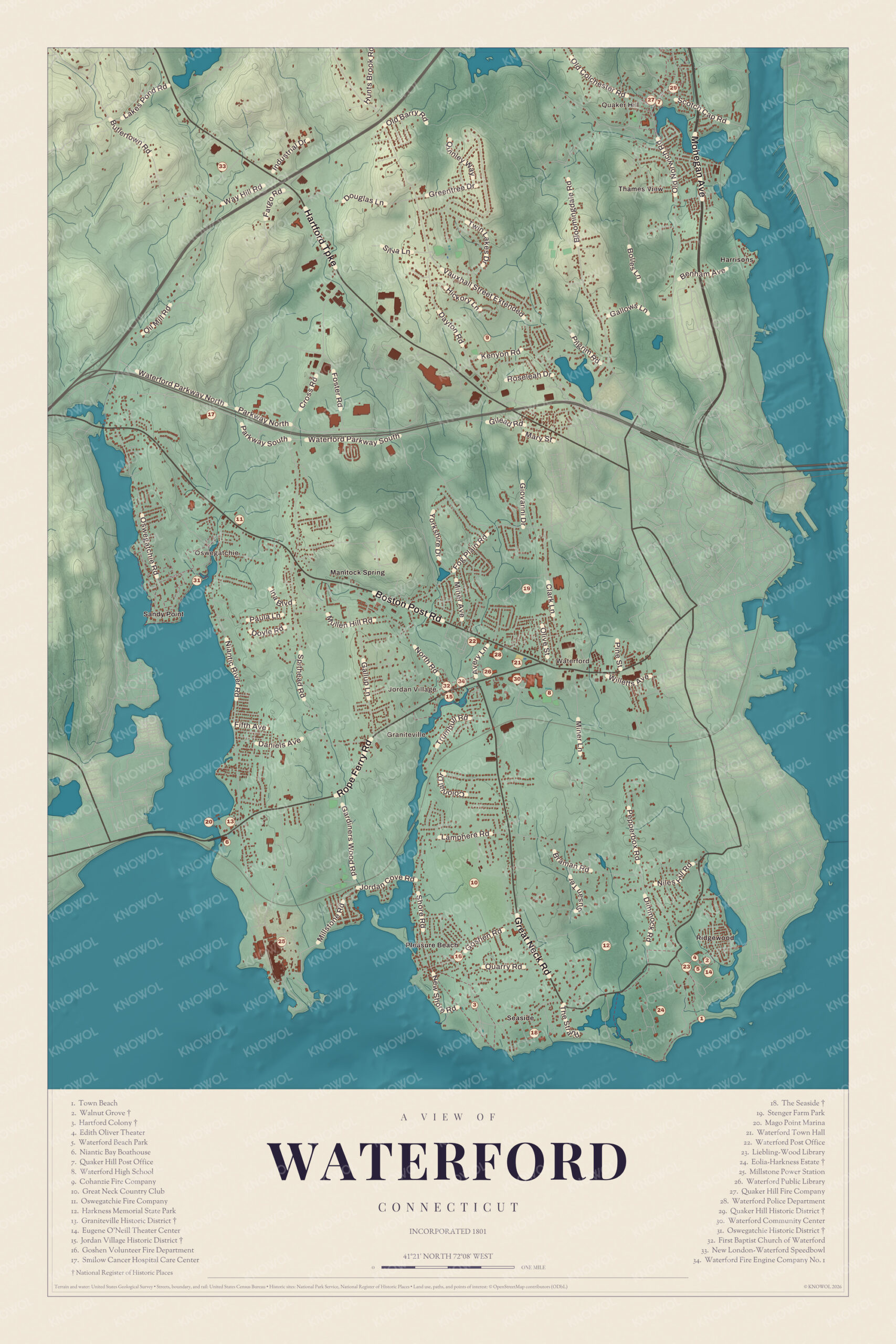
Waterford today
By KNOWOL
Shaded hills from the country around Bartlett down to the coves along the Sound, every street, the villages of Quaker Hill, Oswegatchie, Jordan Village, Graniteville, Seaside and Pleasure Beach, and a guide of 34 numbered landmarks with the National Register sites marked.5
The story of Waterford
Stone from Millstone Point
Millstone Point took its name from the millstones cut there as early as 1737, but the big work began in June 1832, when Warren Gates arrived with about fifteen men. Little was known then of what the stone was worth. It soon went into most of the forts and lighthouses on the coast from Newport to New Orleans, and in one year as many as ten thousand tons were shipped for the foundation of Fort Sumter. Millstone granite went into Grand Central Depot and the Tribune building in New York, and an 1882 history says it paved the Grand Square of Mexico City. One stonecutter, Silas Geer, cut the stone ties for the first railroad into Albany. The point is home to the Millstone Power Station today.67891
How Waterford got its name
Until 1801 Waterford was the West Farms of New London. That year the Legislature made it a town of its own, taking more than two thirds of New London's land and leaving the old town the smallest in the state. Isaac Rogers carried the petition, and he's said to have suggested the name, for a town on the Sound and Niantic Cove with a fordable stream, the Jordan, running through it. The Jordan had a story of its own. The English first called the cove Robin Hood's Bay, until a devout settler, it seems, renamed it for the river in Palestine. The first town meeting met at the Darrow meeting-house that November. When East Lyme was carved out in 1839, Waterford voted that it was none too large.101112
Baptists by the Niantic
In 1674 Baptist ministers from Rhode Island held the first Baptist baptisms in the colony of Connecticut here, and the General Court was asked to stop them. About 1710 the Baptists of this part of New London formed their own church, counted as the second Baptist church in Connecticut. One of its pastors, Nathan Howard, was a fisherman, and a fishing ground he found in the Sound was still called Howard's Ledge in 1882. Zadoc Darrow, who came after him, held meetings at Great Neck, Lake's Pond, Jordan, Rope Ferry and Quaker Hill, and his meeting-house hosted Waterford's first town meeting in 1801. The church built its new home at Jordan in 1848. Up at Quaker Hill, the Rogerenes, a sect of their own, gave the village its name.3101314
Through the years
25 moments from 1660 to today.
- 1660The right to keep the ferry over the Niantic River is added to John Winthrop's land here, which becomes the Ferry farm.15
- 1674Baptist ministers from Rhode Island hold the first Baptist baptisms in the colony of Connecticut here.3
- 1694Peter Huckley builds a fulling mill at Jordan.15
- 1710About this year the local Baptists form their own church, counted as the second Baptist church in Connecticut.3
- 1737Men are cutting millstones out of the granite at what becomes Millstone Point.9
- 1764On June 10 a procession of Rogerenes from Quaker Hill walks into the Congregational meetinghouse in New London.16
- 1777Nathan Howard dies, a fisherman pastor whose favorite fishing ground in the Sound is called Howard's Ledge.3
- 1792Old Norwich Road is built through Quaker Hill as a turnpike between New London and Norwich.14
- 1801Waterford is set off from New London, with a name said to be suggested by Isaac Rogers.10
- 1801The first town meeting meets at the Darrow meeting-house in November.10
- 1804The first oil mill goes up at the head of the Niantic River, built to process sumac.17
- 1811On January 5 four men net 9,900 pounds of bass in one night near the bridge at the head of the Niantic River.2
- 1832Warren Gates opens his quarry at Millstone Point with about fifteen men.6
- 1839The part of Waterford west of the Niantic River goes to the new town of East Lyme.12
- 1848The Baptist church at Jordan is built, and a small building boom follows.13
- 1878About this year the Italianate Graniteville School is built for the quarry village.9
- 1881John B. Palmer employs more than a hundred men at his Millstone Point quarry.18
- 1886Konomoc Grange No. 41 is organized at Waterford on March 25.19
- 1891The artist Henry Cooke White sees this shore on a summer trip and starts the Hartford Colony.20
- 1906Work begins on Eolia, the Harkness mansion on the Sound, finished in 1907.21
- 1910Stanley Jordan, an English gardener, takes charge of the Harkness estate.22
- 1934Children with tuberculosis move into The Seaside, designed by Cass Gilbert.23
- 1951The Speedbowl opens on April 15.24
- 1964George C. White founds the Eugene O'Neill Theater Center.25
- 1970The first reactor at Millstone, begun in 1966, is finished.1
Places to see
The numbers match the landmark guide printed on the 2026 map.
- 3Hartford ColonyThe shore by White Point. Summer place of Hartford families since 1891.
- 12Harkness Memorial State ParkOn the Sound. The Harkness summer home and Eolia.Visit their website
- 13Graniteville Historic DistrictRope Ferry Road. The quarry workers' village.
- 14Eugene O'Neill Theater CenterWaterford Beach Park. Founded in 1964 on the old Walnut Grove estate.Visit their website
- 15Jordan Village Historic DistrictRope Ferry and North Roads. The historic center of town.
- 25Millstone Power StationMillstone Point. Where the granite came out of the ground.
- 29Quaker Hill Historic DistrictOld Norwich Road. Rogerene village on the Thames.
- 31Oswegatchie Historic DistrictThe Niantic River. Farms, boarders and summer estates.
- 32First Baptist Church of WaterfordJordan Village. The church of 1848.
- 33New London-Waterford SpeedbowlRoute 85. Racing since April 1951.
On the National Register
All 9 places in Waterford on the National Register of Historic Places that still stand today, oldest first, and why each one matters.4
-
Jordan Village Historic District
The historic center of Waterford, on the flat land at the head of Jordan Cove, which grew around a Baptist congregation founded in 1710. Most of its Greek Revival houses went up in a small boom after the Baptist church was built in 1848.13
-
Quaker Hill Historic District
A village first settled by the Rogerenes, who refused to pay ministerial taxes, then strung along the Old Norwich Road turnpike of 1792. It made paper in the 1800s, and its only stone house was built in 1794 for Christopher Green.14
-
Walnut Grove
The estate now home to the Eugene O'Neill Theater Center, listed for its architecture and its ties to the Revolutionary War colonel William North and the railroad man Edward Crowninshield Hammond, who often had the young O'Neill thrown off the property.25
-
Oil Mill Historic District
About 55 acres at the head of the Niantic River, with the remains of a water-powered mill begun in 1804 to process sumac, where linseed oil was made for about 65 years. It keeps the houses of the mill community, including both mill owners' homes, and the site of the old town almshouse.17
-
Graniteville Historic District
A village of quarry workers' houses that grew up along Rope Ferry Road in the 1840s and 1850s, with the Italianate Graniteville School of about 1878, the house of the quarry owner John Palmer, and two of the old quarries.9
-
Hartford Colony
A summer colony of well-to-do Hartford families begun in 1891 by the artist Henry Cooke White, with Shingle-style houses by architects such as Wilson Eyre, including the estate of Mary Batterson Beach, daughter of the founder of the Travelers Insurance Company.20
-
Oswegatchie Historic District
A peninsula on the Niantic River that went from farms to quarry boarding houses, a summer hotel and trolley-era summer estates, then to year-round homes after World War II. The Oswegatchie Church was built in 1929 for the summer people.26
-
Eolia-Harkness Estate
The summer home of Edward and Mary Harkness, a 42-room Renaissance Revival mansion built in 1906 and 1907, with gardens by Beatrix Farrand added from 1918 to 1929. Mary Harkness left it to the state in 1950.21
-
The Seaside
Nationally significant as the first institution designed to treat children with tuberculosis with sunlight and sea air, in Tudor Revival buildings by Cass Gilbert. Patients moved here in 1934, and it later served the elderly and people with developmental disabilities until 1996.23
In their words
“that Waterford was none too large.”
History of New London, 1852, on the town's vote against giving up land to East Lyme in 183912
“The bar at the ferry is one of nature's curiosities.”
History of New London, 1852, on the sandbar at Rope Ferry12
“From the tops of the rocks he could see England.”
History of New London County, 1882, repeating an old joke about the rocky Mountain farms15
Nearby towns
Sources
- Waterford, Connecticut, Wikipedia
- History of New London, Connecticut (1852, reprinted 1895), on Niantic Bay and Millstone Point, Internet Archive
- History of New London County, Connecticut (1882), on the First Baptist Church of Waterford, Internet Archive
- National Register of Historic Places listings in New London County, Connecticut, Wikipedia
- Map of Waterford, Connecticut in 2026, KNOWOL (USGS elevation, Census Bureau roads)
- History of New London County, Connecticut (1882), on Warren Gates and Millstone Point, Internet Archive
- History of New London County, Connecticut (1882), on Millstone Point granite in New York, Internet Archive
- Genealogical and biographical record of New London County, Connecticut (1905), on Silas Geer, Internet Archive
- Graniteville Historic District (Waterford, Connecticut), Wikipedia
- History of New London, Connecticut (1852, reprinted 1895), on Waterford made a town, Internet Archive
- History of New London, Connecticut (1852, reprinted 1895), on the name Jordan, Internet Archive
- History of New London, Connecticut (1852, reprinted 1895), on East Lyme and the Rope Ferry bar, Internet Archive
- Jordan Village, Connecticut, Wikipedia
- Quaker Hill Historic District (Waterford, Connecticut), Wikipedia
- History of New London County, Connecticut (1882), on Waterford's early grants, Internet Archive
- The Rogerenes; some hitherto unpublished annals belonging to the colonial history of Connecticut (1904), Internet Archive
- Oil Mill Historic District, National Register nomination, Connecticut State Historic Preservation Office (2022)
- History of New London County, Connecticut (1882), on John B. Palmer, Internet Archive
- A modern history of New London County, Connecticut (1922), on Konomoc Grange, Internet Archive
- Hartford Colony, Wikipedia
- Harkness Memorial State Park, Wikipedia
- A modern history of New London County, Connecticut (1922), on Stanley Jordan, Internet Archive
- The Seaside (Waterford, Connecticut), Wikipedia
- Waterford's Need for Speed, ConnecticutHistory.org
- Eugene O'Neill Theater Center, Wikipedia
- Oswegatchie Historic District, Wikipedia