
A Charles River town settled in 1630, where the Provincial Congress met in the meetinghouse in 1775, Seth Bemis lit his mill with coal gas in 1812, and the United States Arsenal stood beside the river from 1816.
Watertown then and now
The same town 96 years apart. Click either map to look closer.
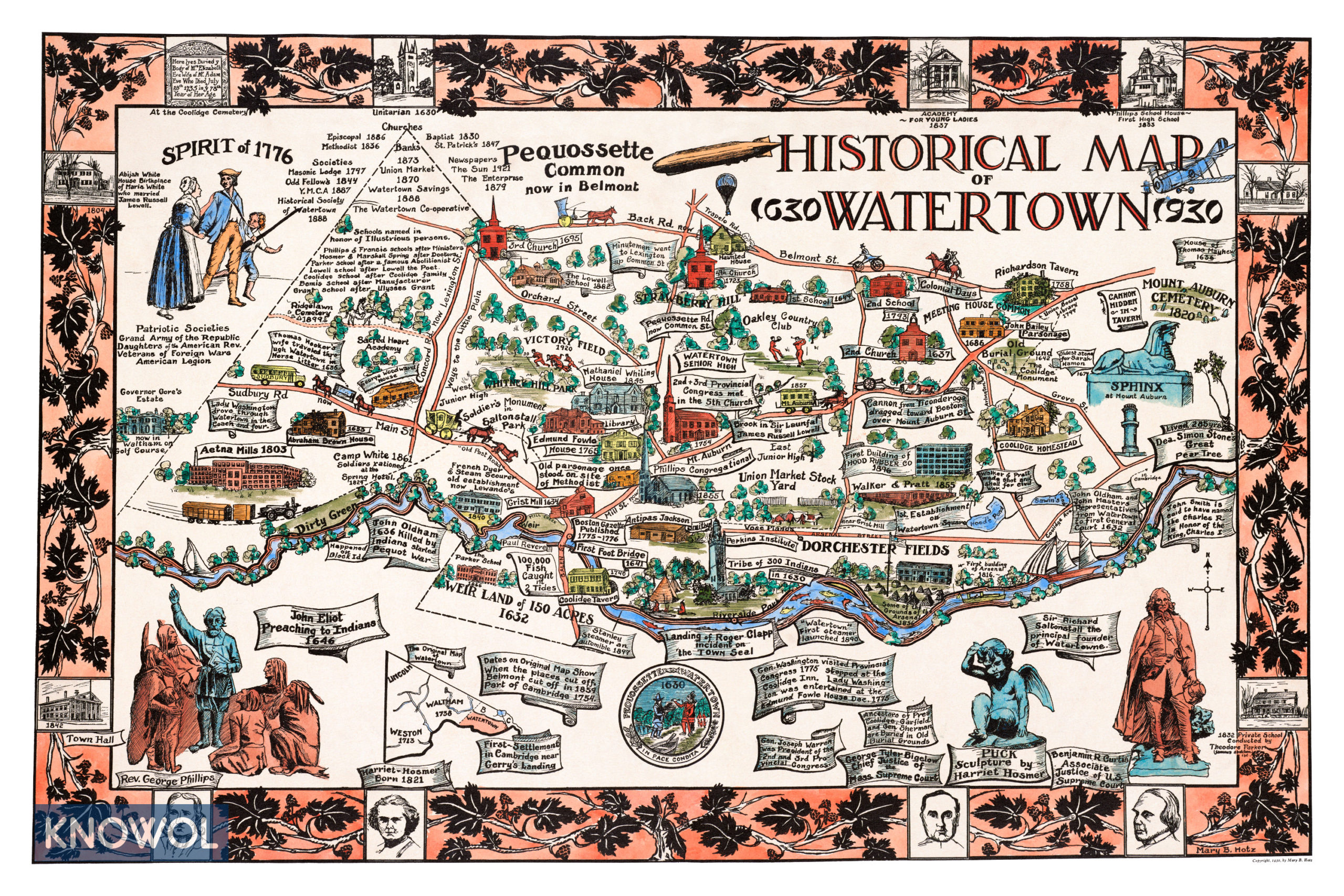
The 300th anniversary map
By Mary Hotz, Watertown High School
Drawn by Mary Hotz, a Watertown High School senior, whose map won her art class contest for the town's 300th anniversary. It shows Aetna Mills, Governor Gore's Estate, the Soldier's Monument in Saltonstall Park, Strawberry Hill, Richardson Tavern, the Sphinx at Mount Auburn, the Coolidge Homestead, Dorchester Fields and the Union Market Stock Yard.6
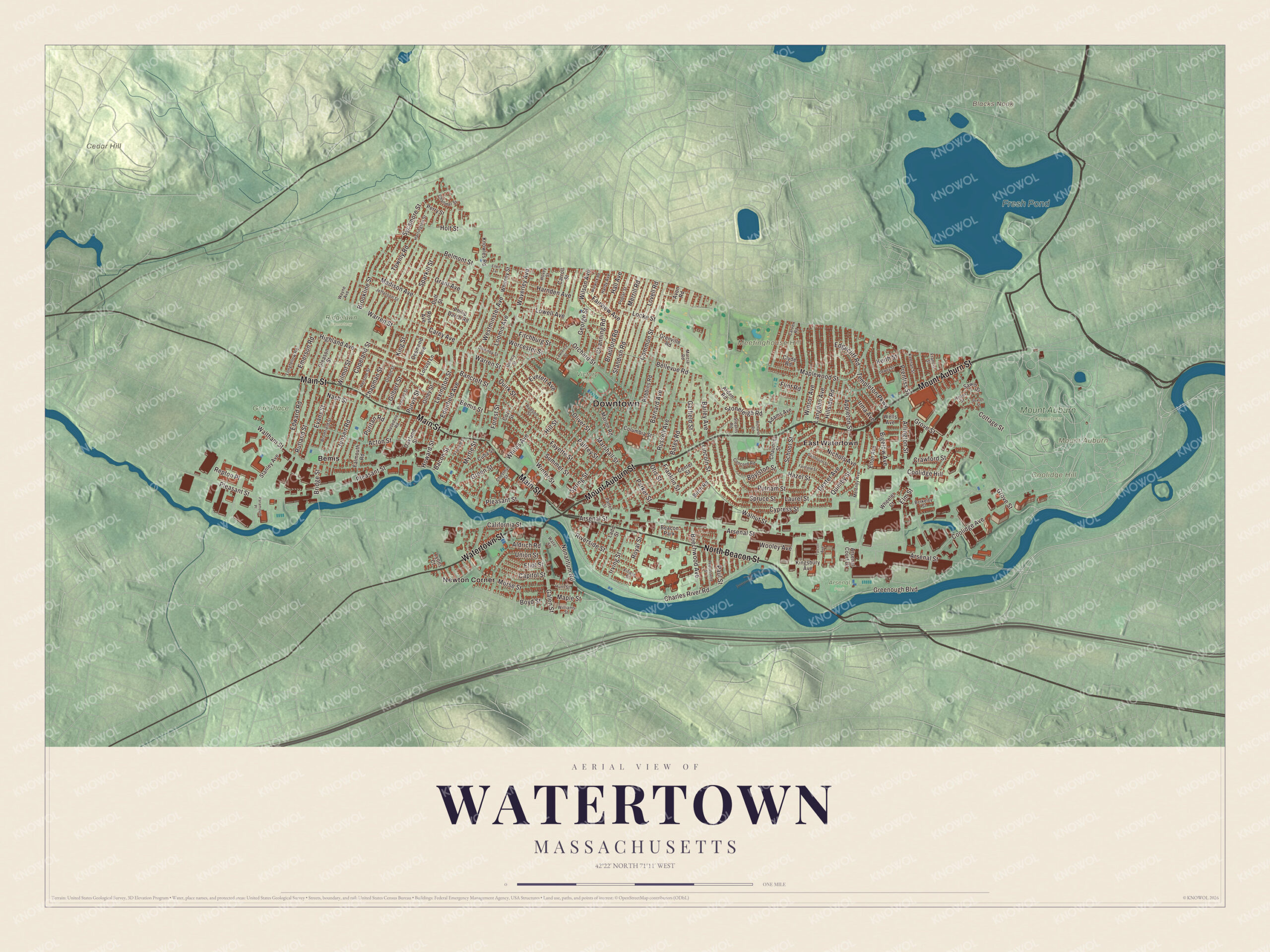
Watertown today
By KNOWOL
Downtown and Bemis, with Mount Auburn Street, North Beacon Street, Main Street, Watertown Street, Galen Street and Nonantum Road, plus East Watertown, Newton Corner, Fresh Pond, Cedar Hill, Coolidge Hill and Meetinghouse Hill printed on the art.2
The history of Watertown, Massachusetts
Gaslight at the Bemis mill
In 1778 David Bemis built a grist mill and a snuff mill on the Watertown bank of the Charles, at the place still called Bemis. His son Seth ground chocolate, dyewoods and medicinal roots there, and in 1803 he began spinning cotton by machine. Families who still wove at home wanted Bemis' warp, because it beat thread spun by hand. About 1809 the mill made cotton duck for sails, the first in the country by an 1890 county history's account. In the fall of 1812 Seth Bemis lit the factory with gas made from coal, and people came from a distance to see it. The tin pipes leaked, so after the second year he gave it up. Workers were called by a tin horn, and the village carried the nickname Tin Horn for years.7849
Congress in the meetinghouse
In April 1775 the Provincial Congress, called to Concord, adjourned at once to Watertown and met in the meetinghouse, with Joseph Warren presiding. The town filled with people from Boston, and the schools closed because the buildings were used as armories. That winter the House of Representatives sat in the Coolidge tavern near the bridge while workmen put stoves into the meetinghouse. Nearby, in a chamber of the old John Cook house, Paul Revere engraved and printed the colony's notes for the Provincial Congress, and Henry Knox lived in the same house for a while. The tavern's sign showed King George III until news of the Declaration of Independence arrived. Then it came down and went back up with George Washington's portrait.101112
From Dorchester Fields to the Arsenal
In 1630 ten men of the Dorchester company came up the Charles, landed their goods on a steep bank, and traded biscuit for bass with the people who lived nearby. They soon moved on, but the place kept the name Dorchester Fields. In 1816 Captain George Talcott chose that same landing place for the United States Arsenal. During the Civil War, under Captain T. J. Rodman, inventor of the Rodman gun, more than a thousand men, women, boys and girls worked there. Rodman also asked Miles Pratt whether the men at his stove foundry could cast iron balls, and they began making shot before any order came. In the winter of 1917 to 1918 the Arsenal repainted fifty new oil-tank cars with a plain code, because cars marked for war work were being wrecked.1314151617
Watertown, Massachusetts through the years
25 moments from 1630 to today.
- 1630Ten men of the Dorchester company land where the Arsenal now stands, and the spot is long called Dorchester Fields.13
- 1630Settlers led by Sir Richard Saltonstall and Rev. George Phillips found Watertown, incorporated the same year.1
- 1630On July 30 forty men sign a church covenant, gathering the sixth church in Massachusetts.18
- 1632Residents protest a tax for a stockade fort at Cambridge, an early stand against taxation without representation.1
- 1633William Wood writes that the town's fish weir took 100,000 shad and alewives in two tides.3
- 1634A board of selectmen is chosen by August, a first that a Weston church history of 1900 claims for Watertown.19
- 1647The General Court orders a horse-bridge built over the Charles near Watertown Mill.20
- 1649The earliest recorded schoolhouse stands on Strawberry Hill, later called Meeting-House Hill.21
- 1754Common Street Cemetery is laid out as the town center moves to today's Watertown Square.22
- 1772Edmund Fowle builds the house where the Treaty of Watertown is signed in 1776.23
- 1775The Provincial Congress leaves Concord and meets in Watertown's meetinghouse, with Joseph Warren presiding.10
- 1775In a chamber of the John Cook house, Paul Revere engraves and prints the colony's notes.12
- 1778David Bemis builds a grist mill and snuff mill on the Watertown bank at today's Bemis.7
- 1779Subscribers start the Union Library, the social library that later passed its books to the Free Public Library.24
- 1781The General Court orders David Bemis to open two sluices in his dam so fish can pass upriver.25
- 1789President Washington lodges at the Coolidge Tavern on Galen Street during his New England tour.26
- 1809About this year Seth Bemis becomes the first maker of cotton sail duck in the United States.4
- 1812Seth Bemis lights his mill with gas made from coal, said to be the first attempt in the country.4
- 1816Captain George Talcott picks the riverside site for the United States Arsenal.14
- 1831Mount Auburn Cemetery is founded, almost all of it inside Watertown.1
- 1859Belmont is incorporated from the northern part of the town.1
- 1861Miles Pratt's stove foundry starts casting shot and shell for the Arsenal.16
- 1897The Stanley brothers build their first steam car in Watertown.1
- 1917That winter the Arsenal repaints fifty new oil-tank cars with a plain code to keep them from being wrecked or sidetracked.17
- 1930Mary Hotz draws her prize map for the town's 300th anniversary.6
Places to see in Watertown, Massachusetts
Places worth a visit in Watertown today.
- DowntownWatertown Square. Where the main roads meet the river.
- BemisWest end, on the Charles. The Bemis family's mill village.
- East WatertownToward Cambridge. Armenian groceries along its streets.
- Meetinghouse HillNorth of the square. Once Strawberry Hill, then School-House Hill.
- Galen StreetSouth of the river. Where the Coolidge Tavern stood.
- Mount Auburn StreetEast from the square. Past both old burying grounds.
- Main StreetWest from the square. Home of the Browne House.
- North Beacon StreetAlong the river, east. A listed stretch of river parkway.
- Nonantum RoadSouth bank of the Charles. River parkway built 1910 to 1931.
Watertown on the National Register of Historic Places
All 11 places in Watertown on the National Register of Historic Places that still stand today, oldest first, and why each one matters.5
-
Old Burying Ground
The town's first formal cemetery, with graves from 1665, at Arlington and Mount Auburn Streets near the first meetinghouse. A memorial honors Joseph Coolidge, a militiaman who died in the fighting of April 19, 1775.27
-
Abraham Browne House
A colonial house built between about 1694 and 1701, the oldest surviving house in Watertown. It was nearly ruined when William Sumner Appleton bought it in 1919, and Historic New England now runs it as a museum.28
-
Common Street Cemetery
Founded in 1754 when the town center moved to today's Watertown Square, it holds more than 500 burials. The town's second meetinghouse stood on this ground, where planning went on during the Siege of Boston.22
-
Edmund Fowle House
Built by Edmund Fowle in 1772 on today's Mount Auburn Street and moved to Marshall Street in 1871. Committees of the Provincial Congress met here in 1775, and the Treaty of Watertown with the Mi'kmaq and St. John's First Nations was signed here in 1776. The Historical Society of Watertown has owned it since 1922.23
-
Watertown Arsenal Historic District
The Army opened the arsenal on 40 acres beside the Charles in 1816, with brick buildings designed by Alexander Parris. It grew into a gun carriage works, and after the Army left in 1995 it became a park, offices, shops and an arts center.29
-
Miles Pratt House
Watertown's finest surviving Italianate house, with paired brackets under wide eaves and an arched entry hood. Miles Pratt founded the stove works that supplied the Union Army with ammunition and gun carriage castings.30
-
Commanding Officer's Quarters, Watertown Arsenal
Captain T. J. Rodman, inventor of the Rodman gun, commissioned these lavish quarters of about 12,700 square feet during the Civil War, and Congress rebuked the cost as wasteful. An 1880 county history dates the new quarters to 1865. Today the house holds offices and a museum about the arsenal.31
-
Charles River Reservation Parkways
Riverside roads laid out from Charles Eliot's plan for the Metropolitan Parks Commission. In Watertown they include Charles River Road, Greenough Boulevard and a stretch of North Beacon Street, all finished by 1910.32
-
Old Watertown High School
Charles Brigham designed this English Revival brick high school, built in 1913 about a mile east of the town center. It later served as a junior high school and is now the Brigham House assisted living residence.33
-
Coolidge School
A Classical Revival brick school by local architects Clarence Hoyt and Curtis Bixby, built in 1915 and given its east wing in 1925. It taught elementary pupils until 1984 and now holds homes.34
-
Town Diner
George Contos and his father built this diner on the site in 1947, around their earlier Worcester Lunch Car diner, which became the kitchen. Its porcelain siding and round glass-block corners borrow from two famous diner makers.35
Watertown in their words
“The history of Watertown is important, as it is the oldest town now in Middlesex County; the town which has colonized so many other towns”
Quoted in Middlesex County and its people, 192736
“We have seen that the freemen of Watertown were exceedingly jealous of their rights”
The First Parish of Weston's 200th anniversary book, 190019
“Watertown, a place nothing inferior for land, wood, meadow and water to Newtowne.”
William Wood, New England's Prospect, 1633, quoted in the History of Middlesex County, 18803
Towns near Watertown, Massachusetts
Sources for the history of Watertown
- Watertown, Massachusetts, Wikipedia
- Map of Watertown, Massachusetts in 2026, KNOWOL
- History of Middlesex County, Massachusetts (1880), quoting William Wood's New England's Prospect, Internet Archive
- History of Middlesex County, Massachusetts (1890), on Seth Bemis, cotton duck and coal gas, Internet Archive
- National Register of Historic Places list, Wikipedia
- Beautifully restored map of Watertown, MA from 1930, restored by KNOWOL
- History of Middlesex County, Massachusetts (1890), on the first Bemis mills, Internet Archive
- History of Middlesex County, Massachusetts (1880), on Bemis' warp, Internet Archive
- History of Middlesex County, Massachusetts (1880), on the Bemis gas works and Tin Horn, Internet Archive
- Historical sketches of Watertown, Massachusetts (1893), on the Provincial Congress, Internet Archive
- Historical sketches of Watertown, Massachusetts (1893), on the Coolidge tavern, Internet Archive
- History of Middlesex County, Massachusetts (1880), on the John Cook house and the Coolidge tavern, Internet Archive
- History of Middlesex County, Massachusetts (1880), on Dorchester Fields, Internet Archive
- History of Middlesex County, Massachusetts (1880), on the founding of the Arsenal, Internet Archive
- History of Middlesex County, Massachusetts (1880), on the Arsenal in the Civil War, Internet Archive
- Historical sketches of Watertown, Massachusetts (1893), on Miles Pratt's foundry, Internet Archive
- Technology's war record (1920), on Watertown Arsenal's disguised tank cars, Internet Archive
- History of the town of Weston, Massachusetts, 1630-1890 (1913), on the Watertown church, Internet Archive
- An account of the celebration by the First Parish of Weston of its two hundredth anniversary (1900), Internet Archive
- Family memorials: genealogies of the early settlers of Watertown (1855), on the first horse-bridge, Internet Archive
- Historical sketches of Watertown, Massachusetts (1893), on the first schoolhouse, Internet Archive
- Common Street Cemetery, Wikipedia
- Edmund Fowle House, Wikipedia
- Middlesex County and its people; a history (1927), on Watertown's libraries, Internet Archive
- Resolves of the General Court of the Commonwealth of Massachusetts (1781), on the petition of David Bemis, Internet Archive
- Historic houses and spots in Cambridge, Massachusetts, and near-by towns (1897), on the Coolidge Tavern, Internet Archive
- Old Burying Ground, Wikipedia
- Abraham Browne House, Wikipedia
- Watertown Arsenal Historic District, Wikipedia
- Miles Pratt House, Wikipedia
- Commanding Officer's Quarters, Watertown Arsenal, Wikipedia
- Charles River Reservation Parkways, Wikipedia
- Old Watertown High School, Wikipedia
- Coolidge School, Wikipedia
- Town Diner, Wikipedia
- Middlesex County and its people; a history (1927), on Watertown, Internet Archive