
The old west end of Marlborough, set off in 1717, where Chauncy Pond keeps the name of a Harvard president's land grant, Eli Whitney was born, and the turnpike taverns of Wessonville gave way to sleigh shops, straw works and the railroad depot.
Westborough then and now
The same town 146 years apart. Click either map to look closer.
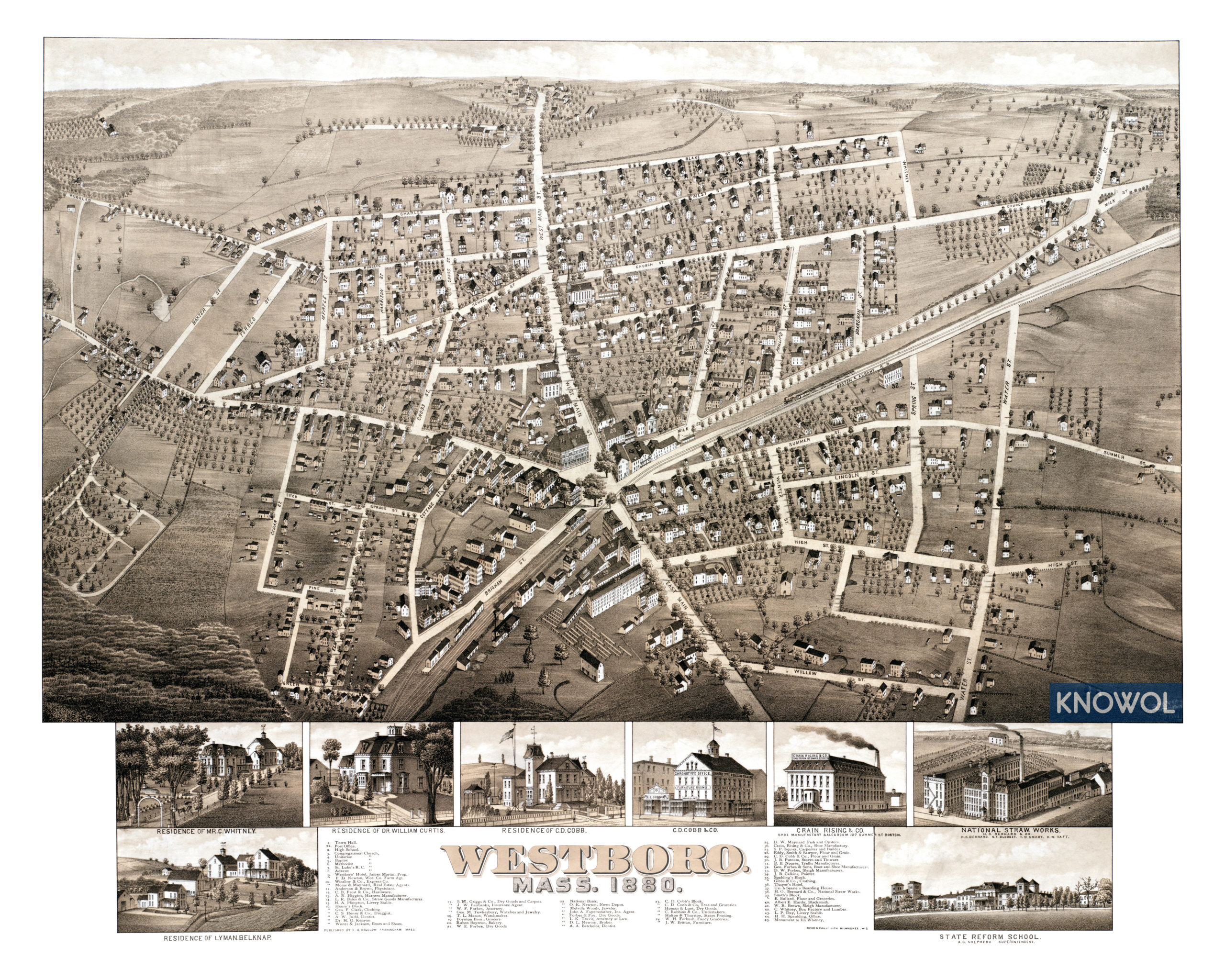
The bird's-eye view
By Beck & Pauli
Westborough drawn as if from the sky in 1880, with its street names and landmarks like the Westboro Hotel, Henry's Block, Thayer's Hotel, Searle's Boarding House, the National Straw Works and the Eli Whitney Monument.5
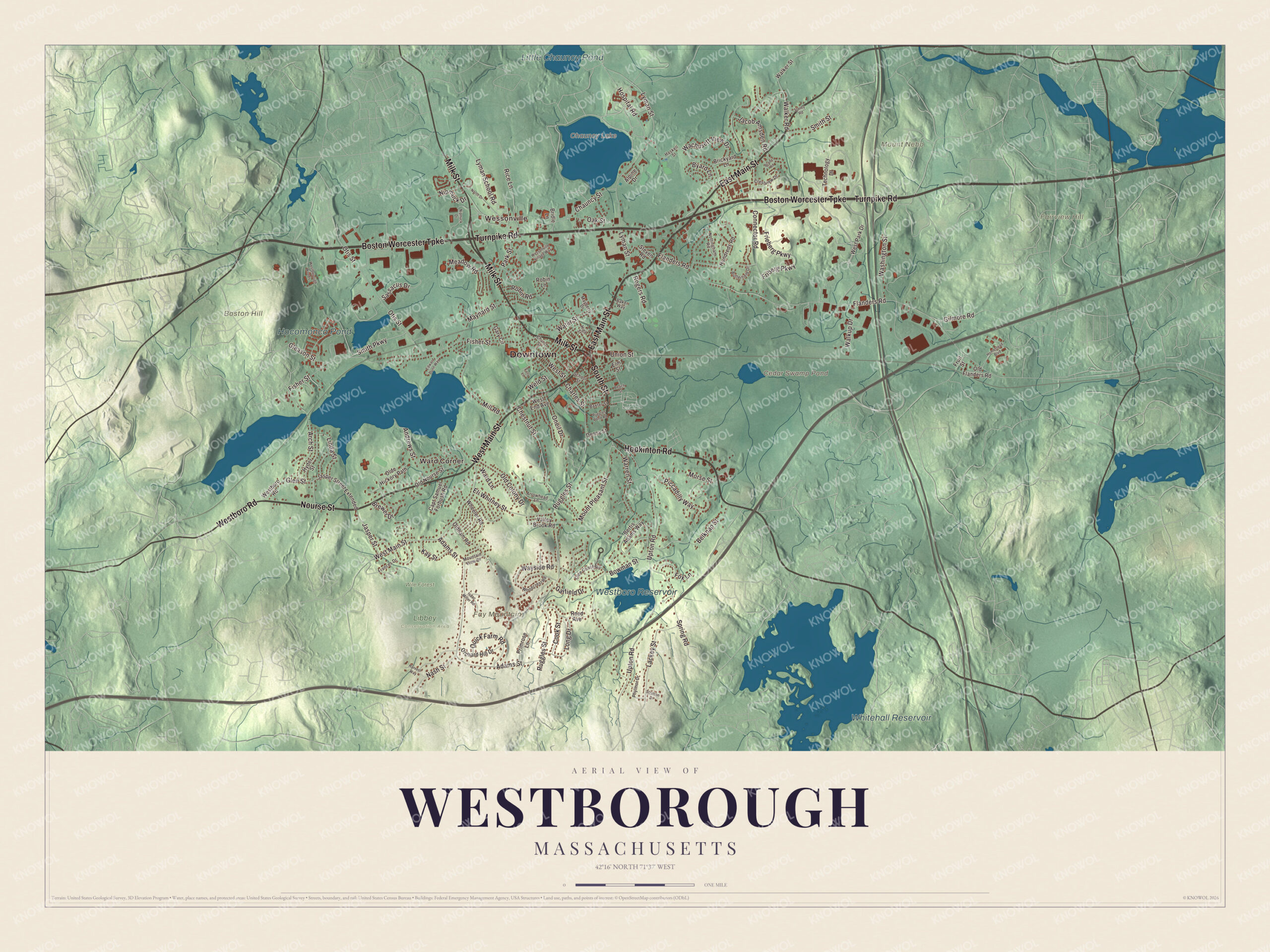
Westborough today
By KNOWOL
Westborough's streets, buildings, ponds, hills and terrain, from Downtown and Wessonville out to Ward Corner, with Chauncy Lake, Cedar Swamp Pond, Westboro Reservoir, Boston Hill, Fairview Hill and Fay Mountain named on the map.6
The history of Westborough, Massachusetts
Sleighs on the first snow
During the Revolution, young Eli Whitney ran a small but profitable business here making nails. Westborough worked with its hands. Carpenters built houses in summer and sleighs in winter, on shares: the blacksmith who added the shoes and braces usually kept two sleighs out of five, and the painter took another as his pay. When the snow came, strings of six or eight sleighs behind a single horse set off for Boston, Providence, Worcester and Lowell. From 1870 to 1880 the town averaged over 3,000 sleighs a year, and D. W. Forbes & Son were said to be the oldest sleigh makers in the country. Straw paid too. Women and children braided winter rye, stores kept a cash price and a straw price, and by 1891 the National Straw Works had eight or nine hundred hands.738910
When Wessonville was the center
Westborough's first meetinghouse went up in 1718 on the hill at Wessonville, a rough, barn-like building with no porch, steeple or chimney. The minister, Ebenezer Parkman, lived close by in a roomy house finished in carved English oak. When the Worcester Turnpike came through, the old Forbush Tavern became a place to change horses, and a newer tavern at Wessonville grew so popular that the village seemed about to be the center again. The post office followed Silas Wesson from tavern to tavern, and in 1825 Lafayette stopped at Wessonville for lunch while forty men and boys waited outside for one more look. Then in 1834 the railroad opened across town. Stores, shops and churches gathered by the station, the Wessonville post office closed in 1838, and as an 1889 history put it, the glory of the turnpike had departed.1112131415
The boys in the flax field
On August 8, 1704, when this was still the west end of Marlborough, men and boys were spreading flax in a field near Thomas Rice's garrison house when raiders came down from the wooded hill. Five-year-old Nahor Rice was killed, said to be the first English person buried in what is now Westborough. Four boys from seven to ten were taken to Canada. Asher Rice was ransomed four years later but never fully recovered, and he spent years on a grist mill whose lower stone turned, since in the human mouth it's the lower jaw that does the work. Timothy, taken at seven, was adopted by a chief of the mission village near Montreal and became a chief himself. In 1740 he came back. He'd forgotten English, but he remembered the house and the place he was taken from.161718
Westborough, Massachusetts through the years
25 moments from 1659 to today.
- 1659Land by the pond is granted to Harvard College's President Chauncy, and the name Chauncy sticks to this corner of Marlborough.19
- 1675By late this year a few families have settled near Lake Chauncy, in the west end of Marlborough.1
- 1704On August 8 raiders seize four Rice boys spreading flax near Thomas Rice's garrison house and kill a fifth, five-year-old Nahor.16
- 1717Westborough is incorporated on November 18 from the west end of Marlborough, with twenty-seven families.1
- 1718The first meetinghouse is raised near today's Wessonville, a bare building with no porch, steeple or chimney.11
- 1724A church is gathered on October 28, and Ebenezer Parkman is ordained as the first minister.20
- 1728About 1,900 acres from Sutton are added, the town's southern projection.21
- 1740Timothy Rice, taken as a boy and now a chief near Montreal, comes back to visit his birthplace on September 15.18
- 1744The town is split into two precincts; thirty-eight of its 125 families are in the north.22
- 1765Eli Whitney, the future inventor of the cotton gin, is born in Westborough on December 8.2
- 1766The north precinct becomes the District of Northborough on January 24.23
- 1775Forty-six Westborough minutemen serve under Captain Edmund Brigham.1
- 1811The town's first post office opens on March 6, with Nathan Fisher as postmaster.14
- 1825Lafayette stops to lunch at the Wessonville tavern while forty men and boys wait outside.13
- 1828J. B. Kimball & Co. start making boots and shoes in a little shop on West Main Street.24
- 1832The town votes to give no more rum to its paupers, except on a doctor's prescription.25
- 1834The railroad opens, and stores, shops and churches gather around the new station.15
- 1848The State Reform School for Boys opens on Lake Chauncy.1
- 1861The town votes $5,000 for the Westborough Rifle Company, which serves three years as Company K of the 13th Massachusetts.26
- 1863Bates, Parker & Co. start the town's straw hat business, with two hundred and fifty sewers working outside the shop.9
- 1880Beck & Pauli draw their bird's-eye view, with the National Straw Works and the Eli Whitney Monument.5
- 1885The reform school moves to Willow Park and becomes the Lyman School for Boys.27
- 1886The Westborough Insane Hospital opens on December 1 in the old reform school buildings, New England's first state homeopathic hospital for the insane.28
- 1894The town's official name is changed to Westboro; it goes back to Westborough in 1971.1
- 2015A memorial service at Pine Grove Cemetery remembers more than 500 hospital patients who were buried unclaimed.28
Places to see in Westborough, Massachusetts
Places worth a visit in Westborough today.
- DowntownTown center. Grew up around the 1834 railroad station.
- WessonvilleRoute 9, the old turnpike. The tavern village of the stagecoach days.
- West Main StreetRoute 30, west of the center. Historic district of the old center.
- East Main StreetRoute 30, east of the center. Part of the same historic district.
- Milk StreetRoute 135. Follows an old trail toward Canada.
- Chauncy LakeNear Lyman Street. Where the first families settled.
- Cedar Swamp PondCedar Swamp, east of the center. Where Nipmuc people hunted and fished.
- Fay MountainHighest ground in town. An old landmark for Nipmuc travelers.
Westborough on the National Register of Historic Places
All 8 places in Westborough on the National Register of Historic Places that still stand today, oldest first, and why each one matters.4
-
Jonah Warren House
One of Westborough's oldest buildings, put up along the Old Connecticut Path, a Native trail. Jonah Warren, a tanner who came to town in 1719 and probably built it, also helped build the first meetinghouse.29
-
Nathan Fisher House
A Federal house built by Nathan Fisher, who married into the prominent Lothrop family and kept a store that faded after the railroad bypassed the area in 1834. Next to it stood a thread factory, now gone, where steam power was first used in Westborough. The state bought the property in 1884 for the Lyman School.30
-
Joseph Lothrop House
A Federal house built in 1825 by Joseph Lothrop, Nathan Fisher's brother-in-law, close to the center of Wessonville when it was the center of town activity. It later became Bergson's restaurant and, in 2013, company offices. The Register lists it in the Shrewsbury vicinity, but the state's inventory places it in Westborough.31
-
Maples Cottage
A Greek Revival cottage built in 1832 by Rev. William White on the site of a 1725 parsonage. The state bought it in 1884 for the reform school grounds, and it has since lost most of its Greek Revival trim.32
-
Vintonville Historic District
About 80 modest houses on small lots east of the town center, built mostly between 1860 and 1890. The neighborhood is named for Otis Vinton, who laid out some of its first streets.33
-
Lyman School for Boys
The state's school for boys sent by the courts, named for its chief benefactor, Theodore Lyman, a former mayor of Boston. Boys, many of them sent for offenses like truancy, farmed about 500 acres and learned trades here under strict discipline until the school closed in 1971.34
-
West Main Street Historic District
A large district taking in much of the old residential center and part of the downtown business blocks. First listed in 1987, it was enlarged in 1990, 2006 and 2009.35
-
Cedar Swamp Archeological District
More than 2,600 acres of wetland around the headwaters of the Sudbury River, east of the town center and into Hopkinton. A hearth found on an island in the swamp has been radiocarbon dated to about 200 BCE, and finds here run from the Archaic to the Late Woodland periods.36
Westborough in their words
“Her mulled wine, mince pies and election cake being known all over this part of the country.”
History of Worcester County, 1889, on Mrs. Dexter Brigham of Brigham's Tavern37
“The glory of the turnpike had departed.”
History of Worcester County, 1889, on the coming of the railroad in 183415
“The town of Westborough is rich in the number of shade trees that line its public streets and roads.”
Transactions of the Worcester County Horticultural Society, 189338
Towns near Westborough, Massachusetts
Sources for the history of Westborough
- Westborough, Massachusetts, Wikipedia
- The history of Westborough, Massachusetts (1891), on Eli Whitney, Internet Archive
- The history of Westborough, Massachusetts (1891), on sleigh making, Internet Archive
- National Register of Historic Places listings in Worcester County, Massachusetts, Wikipedia
- Historic bird's eye view of Westborough, MA in 1880, restored by KNOWOL
- Map of Westborough, Massachusetts in 2026, KNOWOL
- The history of Westborough, Massachusetts (1891), on early manufactures, Internet Archive
- The history of Westborough, Massachusetts (1891), on D. W. Forbes & Son, Internet Archive
- The history of Westborough, Massachusetts (1891), on straw braiding and straw hats, Internet Archive
- The history of Westborough, Massachusetts (1891), on the H. O. Bernard straw factory, Internet Archive
- More old houses in Westborough, Mass., and vicinity (1908), Internet Archive
- History of Worcester County, Massachusetts (1889), on Parkman's parsonage, Internet Archive
- History of Worcester County, Massachusetts (1889), vol. 2, on the turnpike taverns, Internet Archive
- The history of Westborough, Massachusetts (1891), on the post office, Internet Archive
- History of Worcester County, Massachusetts (1889), vol. 2, on the railroad and the business center, Internet Archive
- The history of Westborough, Massachusetts (1891), on the raid of August 8, 1704, Internet Archive
- The history of Westborough, Massachusetts (1891), on Asher Rice, Internet Archive
- The history of Westborough, Massachusetts (1891), on Timothy Rice's visit of 1740, Internet Archive
- Proceedings of the Worcester Society of Antiquity, field day at Westborough, Internet Archive
- Topographical and historical sketches of the town of Northborough (1826), Internet Archive
- History of Worcester County, Massachusetts (1879), on the town's bounds, Internet Archive
- History of the town of Marlborough (1862), on the division of Westborough, Internet Archive
- History of the town of Marlborough (1862), on the District of Northborough, Internet Archive
- The history of Westborough, Massachusetts (1891), on J. B. Kimball & Co., Internet Archive
- History of Worcester County, Massachusetts (1879), on the temperance votes, Internet Archive
- History of Worcester County, Massachusetts (1879), on the Civil War, Internet Archive
- The history of Westborough, Massachusetts (1891), on the move to Willow Park, Internet Archive
- Westborough State Hospital, Wikipedia
- Jonah Warren House, Wikipedia
- Nathan Fisher House, Wikipedia
- Joseph Lothrop House, Wikipedia
- Maples Cottage, Wikipedia
- Vintonville Historic District, Wikipedia
- Lyman School for Boys, Wikipedia
- West Main Street Historic District, Wikipedia
- Cedar Swamp Archeological District, Wikipedia
- History of Worcester County, Massachusetts (1889), vol. 2, on Brigham's Tavern, Internet Archive
- Transactions of the Worcester County Horticultural Society (report for 1893), Internet Archive