
The Whip City on the Westfield River, settled as Woronoco when it was the westernmost town in the colony, where whips first made by hand around 1808 grew into a trade that, by the town's own 1919 count, turned out 95 percent of the world's whips.
Westfield, Massachusetts on the map
Click the map to look closer.
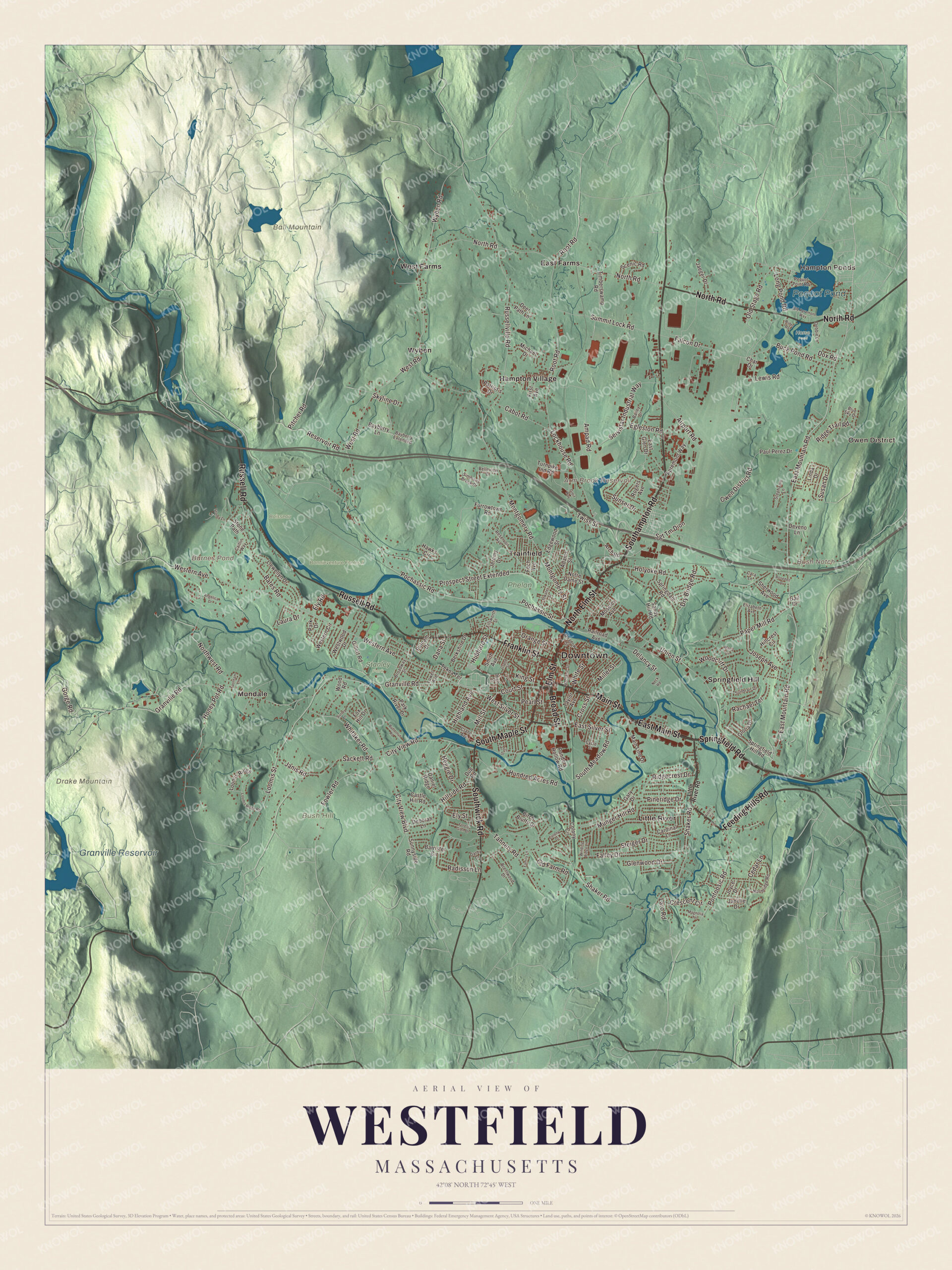
Westfield today
By KNOWOL
Every street and building with the terrain, ponds and ridgelines, from Downtown and Hampton Ponds out to Mundale, East Farms and Little River, with Arm Brook Reservoir, Pequot Pond, Ball Mountain, Drake Mountain and Bush Notch named on the map.5
The history of Westfield, Massachusetts
How Westfield became the Whip City
Westfield's whip trade started small. A 1902 county history says that as early as 1808 a local man made whips with hickory stocks, with the lash tied on by a loop. The first plaited whip in town is said to have come out of Erastus Grant's cabinet shop, where D. L. Farnham glued rattan around a whalebone center. Westfield cutters became known for stripping strands from horsehides with wonderful skill. The American Whip Company was organized in 1855, and by 1875 whips were the town's biggest product, just ahead of cigars. In 1892 a state memorial book called Westfield the largest whip manufacturing community in the world. The town's own 1919 history claimed 95 percent of the world's whips, more than 20 million a year. Then the automobile came, and the trade faded.67829
The night the dike broke
The Westfield River comes down fast out of the hills. The town's 1919 chronicle says a great flood in 1692 made the island in the river, and an 1879 history counts four destructive floods after that, in 1819, 1839, 1869 and 1878. The 1869 flood broke the river levee the day before the town's 200th birthday. The party went ahead, and more than a thousand people sat down to a feast in the open air. The worst came on December 10, 1878. At ten that night the dike gave way, and water three to ten feet deep poured into the village. Elm Street became a roaring river. Steer & Turner's organ factory was shattered, then blown flat by a wind storm, and the loss came to about $100,000.110311
Streamfield on the frontier
Before it was Westfield it was Woronoco, and an 1855 history calls it one of the best places for beaver, with more skins coming from here than from any other spot. John Pynchon of Springfield bought the land south of the river from Paupsunnick, the wife of Panesan, for about fifty pounds paid by the settlers. Benjamin Saxton, born in 1666, was the first child born among them. When the town was set off in 1669, the name Streamfield gave way to Westfield, since it was then the westernmost town in the colony. During King Philip's War a palisade about two miles around is said to have enclosed the center. A drum called people to worship, three women went before the court in 1673 for wearing silk, and by 1696 the town had set aside a place to play goal.12131415161718
Westfield, Massachusetts through the years
25 moments from 1639 to today.
- 1639Traders from the Connecticut Colony build trading houses at Woronoco.1
- 1647Massachusetts makes Woronoco part of Springfield.1
- 1666Benjamin Saxton is born, the first child born among the settlers.14
- 1669Westfield becomes its own town. The name first proposed was Streamfield.12
- 1671Thomas Dewey rides to the Bay and comes home on horseback with Rev. Edward Taylor, the new minister.19
- 1673Three Westfield women are brought before the court for wearing silk against the law.17
- 1679The First Church is organized, and a drum calls people to worship.16
- 1684John Pynchon confirms the settlers' purchase of the land south of the river from Paupsunnick.13
- 1692A great flood forms the town island in the Westfield River.10
- 1696The town sets aside its first playground, a place to play goal.18
- 1775At the Lexington alarm a company of 70 Westfield men marches under Capt. Warham Parks.20
- 1783Westfield celebrates the peace with a flag on the green and thirteen cannon at noon.21
- 1793The legislature establishes Westfield Academy. Its building is dedicated on January 1, 1800.22
- 1800About this year many Westfield families move to the Black River country in New York.23
- 1808By tradition, the first Westfield whips are made this early, with hickory stocks.6
- 1829Methodists build their first church at Hoop-Pole, the settlement now called West Parish.24
- 1839Town Hall goes up on Broad Street.1
- 1844The State Normal School comes to Westfield, with help from Rev. Emerson Davis.25
- 1855The American Whip Company is organized.7
- 1869Westfield turns 200 on October 6, the day after the river levee breaks.11
- 1878The great flood of December 10 pours three to ten feet of water into the village.3
- 1902President Roosevelt attends the Normal School commencement.26
- 1919At the 250th anniversary the town claims 95 percent of the world's whips.2
- 1920Westfield becomes a city.1
- 1939Alice Burke is elected mayor, the first woman mayor in Massachusetts and New England.1
Places to see in Westfield, Massachusetts
Places worth a visit in Westfield today.
- DowntownElm Street and Park Square. Whip factories and the old normal school.
- Main StreetEast from Park Square. Home of the Landlord Fowler Tavern.
- Broad StreetDowntown. Where Town Hall went up in 1839.
- Springfield RoadU.S. Route 20, east. The old road to Springfield.
- East Main StreetU.S. Route 20. The city's main shopping strip.
- Hampton PondsNorth side. Electric cars reached it in 1903.Visit their website
- Pequot PondHampton Ponds. Largest of the Hampton Ponds.
- MundaleWest Parish. Methodists preached here in 1794.
- Little RiverAlong the Little River. Site of the first successful mill.
- East FarmsEast Farms Hill. One of the old farming settlements.
Westfield on the National Register of Historic Places
All 13 places in Westfield on the National Register of Historic Places that still stand today, oldest first, and why each one matters.4
-
Mechanic Street Cemetery
The city's oldest burying ground, set aside by 1677, with the oldest documented grave dated 1683. Nearly all of Westfield's early settlers are buried here, and burials went on until about 1875.27
-
Joseph Dewey House
Built about 1735 for the farmer Joseph Dewey, it's one of the city's few buildings older than the Revolution. Facing demolition in the 1970s, it was moved to this spot and restored by the local historical society, which runs it as a house museum.28
-
Landlord Fowler Tavern
A Georgian tavern on the old post road, licensed to Daniel Fowler by 1761. The local militia mustered here in the Revolution, the committee of safety met here, and the Hessian commander Baron Riedesel was quartered here after Burgoyne's army surrendered at Saratoga in 1777. It's now apartments.29
-
Westfield Center Historic District
About 157 acres of the city's civic, commercial and industrial heart, centered on Elm Street between Park Square and the Westfield River. Its whip factories, the old normal school building and the State Normal Training School recall the Whip City years and the town's place in training teachers.30
-
United States Whip Company Complex
Seven brick buildings on Main Street where whips were made from 1855 until 1928. United States Whip, formed in 1892 from several local makers, was the world's largest whip maker at its height in the 1910s, and in 1928 it became the U.S. Line Company and braided fishing line.9
-
Octagon House
Joseph Watson built it sometime between 1858 and 1864, when Orson Squire Fowler's books set off a fad for eight-sided houses, and it's the only one of the city's three octagon houses still standing. A spiral staircase climbs from the center all the way up to the cupola.31
-
Sanford Whip Factory
Built in 1883 for one of the whip-making businesses that made Westfield known as the Whip City. After the market for whips fell off in the early 1900s, the building housed a novelty toy maker for many years.32
-
Westfield Whip Manufacturing Company
Built about 1887, it is the best preserved of Westfield's extant whip factory buildings. It is also home to the last surviving business of the many whipmakers that once operated in Westfield.33
-
Westfield Municipal Building
It presently houses the Westfield city offices and the local district court. It was built in 1889 to house the state normal school (now Westfield State University), serving in that role until its acquisition by the city in 1959.34
-
Prospect Hill School
The Colonial Revival school was built in 1897 to a design by Augustus W. Holton. The school was built on the site of an earlier wood-frame school which was no longer adequate to support the school district's growing student population.35
-
State Normal Training School
It was constructed in 1899 to provide a teaching facility for teachers-in-training who were students at the Westfield State Normal School (now Westfield State University), the second-oldest such school in the nation. It was operated jointly by the normal school and the city of Westfield from 1900 until 1956, at which point it was converted into a regular elementary school.36
-
H. M. Van Deusen Whip Company
Built in 1917, it was the last of Westfield's major whip factories. Henry Martin Van Deusen began making whips in 1872 and moved his business to Westfield in 1880; when the automobile cut demand, he turned the factory to making lawn swings in 1925. Stanley Home Products later used it as its headquarters.37
-
Moseley School
Built in 1924, it is a good local example of Colonial Revival architecture, and it served Westfield as an elementary school for nearly a century.38
Westfield in their words
“I very early in life yearned to come down into this beautiful valley and see what Westfield was like.”
Judge Michael H. Sullivan, born in Granville, at Westfield's 250th anniversary, 191939
“Westfield is one of the pleasantest villages in Massachusetts.”
Rev. John Alden, once Westfield's Baptist pastor, The story of a Pilgrim family, 189040
“Both have their value and both go to increase the fame of the town, which is everywhere known as the "Whip City."”
Massachusetts of today, 1892, on being the county's largest town and the world's largest whip-making community8
Towns near Westfield, Massachusetts
Sources for the history of Westfield
- Westfield, Massachusetts, Wikipedia
- The history of the celebration of the two hundred and fiftieth anniversary of the incorporation of the town of Westfield (1919), on the town's industries, Internet Archive
- History of the Connecticut Valley in Massachusetts (1879), on the flood of 1878, Internet Archive
- National Register of Historic Places listings in Hampden County, Massachusetts, Wikipedia
- Map of Westfield, Massachusetts in 2026, KNOWOL
- Our county and its people: a history of Hampden County, Massachusetts (1902), on Westfield whips, Internet Archive
- History of the Connecticut Valley in Massachusetts (1879), on Westfield's industries, Internet Archive
- Massachusetts of today: a memorial of the state (1892), on Westfield, Internet Archive
- United States Whip Company Complex, Wikipedia
- Westfield's quarter millennial anniversary official souvenir (1919), on the flood of 1692, Internet Archive
- History of the Connecticut Valley in Massachusetts (1879), on the bicentennial of 1869, Internet Archive
- History of western Massachusetts (1855), on Woronoco, Internet Archive
- Indian deeds of Hampden County (1905), on the deed for Westfield's south side, Internet Archive
- Our county and its people: a history of Hampden County, Massachusetts (1902), on the first settlers, Internet Archive
- Our county and its people: a history of Hampden County, Massachusetts (1902), on the palisades, Internet Archive
- Westfield's quarter millennial anniversary official souvenir (1919), on the First Church, Internet Archive
- Our county and its people: a history of Hampden County, Massachusetts (1902), on the silk laws, Internet Archive
- Westfield's quarter millennial anniversary official souvenir (1919), on the first playground, Internet Archive
- Westfield's quarter millennial anniversary official souvenir (1919), on the coming of Rev. Edward Taylor, Internet Archive
- History of the Connecticut Valley in Massachusetts (1879), on Westfield in the Revolution, Internet Archive
- History of Western Massachusetts (1855), on the peace of 1783, Internet Archive
- Western Massachusetts: a history, 1636-1925 (1926), on Westfield Academy, Internet Archive
- History of the Connecticut Valley in Massachusetts (1879), on the move to the Black River country, Internet Archive
- History of the Connecticut Valley in Massachusetts (1879), on Hoop-Pole, Internet Archive
- Westfield's quarter millennial anniversary official souvenir (1919), on Rev. Emerson Davis, Internet Archive
- Westfield's quarter millennial anniversary official souvenir (1919), on 1902, Internet Archive
- Mechanic Street Cemetery, Wikipedia
- Joseph Dewey House, Wikipedia
- Landlord Fowler Tavern, Wikipedia
- Westfield Center Historic District, Wikipedia
- Octagon House, Wikipedia
- Sanford Whip Factory, Wikipedia
- Westfield Whip Manufacturing Company, Wikipedia
- Westfield Municipal Building, Wikipedia
- Prospect Hill School, Wikipedia
- State Normal Training School, Wikipedia
- H. M. Van Deusen Whip Company, Wikipedia
- Moseley School, Wikipedia
- The history of the celebration of the two hundred and fiftieth anniversary of the incorporation of the town of Westfield (1919), Judge Sullivan's address, Internet Archive
- The story of a Pilgrim family, by Rev. John Alden (1890), Internet Archive