
Norwalk's old upper parish in the Norwalk River valley, a town of stone walls and colonial houses where the meetinghouse of 1790 still stands, J. Alden Weir painted, and farmers kept plowing up pieces of King George's lead horse.
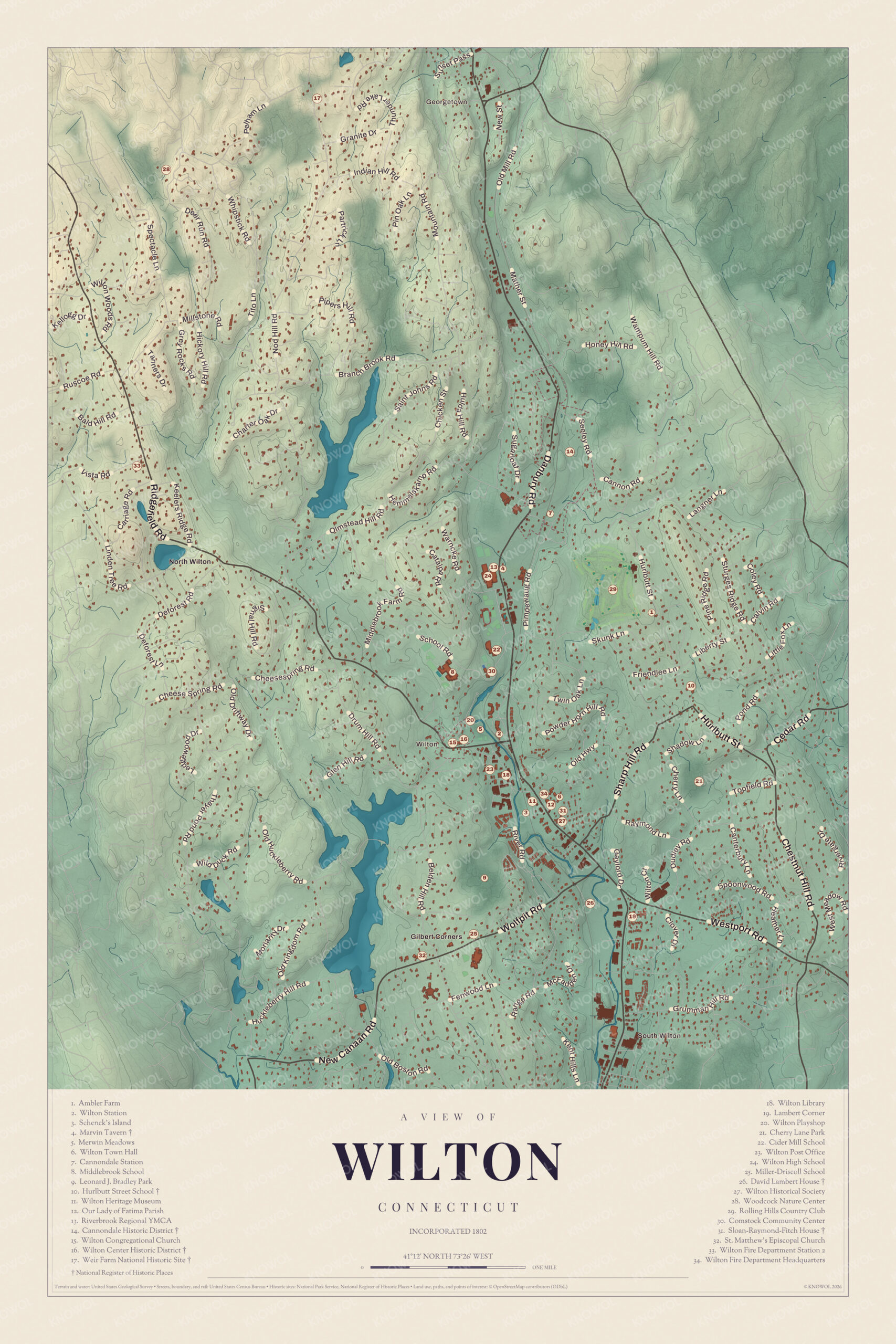
Wilton on the map
Click the map to look closer.
Wilton today
By KNOWOL
Shaded hills from Georgetown in the north down the Norwalk River valley, every street from Belden Hill Road to Hurlbutt Street, North Wilton, South Wilton and Cannondale by name, and a guide of 34 numbered landmarks with the National Register sites marked.4
The story of Wilton
The king's horse in a Wilton dooryard
In 1776 New Yorkers pulled down the gilded lead statue of George III on Bowling Green, and much of it was melted into bullets for the army. Not all of it, though. An 1881 county history says the lead went by sloop to Norwalk, and Wilton kept turning up pieces for years. Workmen tearing down Aunt Nabby Sloan's old house found bits in the cellar. William Comstock, digging a ditch near the Episcopal church, dug up about 125 pounds, part of the saddle. Then Peter S. Coley, plowing the old dooryard, hit what he took for a tree root. It was the horse's tail, the marks of the hair still plain once it was cleaned. Three more pieces came up with it, about 300 pounds in all, and he sold them to the New-York Historical Society.2
The silver mine and the state of his mind
Up in the north of Wilton, about an eighth of a mile east of the old Danbury turnpike, there was once a silver mine. Shares were sold and it was worked for a short time before the Revolution, until the overseer sent off all the ore to be examined and left town between two days. The shareholders kept their losses and their share of the rocks. Later the mine belonged to Capt. Azar Belden, an artillery officer of the Revolution who first brought merino sheep to this part of the state. When some Englishmen called to ask the state of his mine, he heard mind and flew into a rage. Once that was cleared up, they dug about 150 feet down, coined bullion at night in a shanty in the woods, and then vanished with their silver.5
A load of wood and a full schoolroom
Wilton began as the upper parish of Norwalk. In 1726 the colony let the farm families of Kent, Belden Hill and Chestnut Hill form their own parish, and that December every man was told to bring Rev. Robert Sturgeon a load of wood within fourteen days or pay three shillings. Their third meetinghouse, raised in 1790 on Ridgefield Road, was dedicated with a sermon by Timothy Dwight, and it still stands as the Congregational church. In 1816 Hawley Olmstead, the top scholar of his Yale class, opened the Wilton Academy. He later taught for thirteen years in the upper room of the town hall without a single advertisement, and by the time he left in 1839 he'd had pupils from nearly every state in the Union.1678
Through the years
23 moments from 1640 to today.
- 1640Roger Ludlow buys the land between the Norwalk and Saugatuck Rivers, a day's walk into the country.1
- 1722David Lambert buys land on what's now Danbury Road. He's credited with naming Wilton.9
- 1726The colony makes Wilton a parish of Norwalk, and every man is told to bring the new minister a load of wood.6
- 1765A lease to dig ore near Azar Belden's farm is recorded, for the silver mine in the north of town.5
- 1777British troops coming back from Danbury fire a ball into Deacon Daniel Gregory's house and set a fire that a neighbor puts out with a pail of water.10
- 1779Wilton's Jesse St. John volunteers for the forlorn hope that leads the night attack on Stony Point.6
- 1780Moses Stuart, later a famous Hebrew scholar at Andover, is born in Wilton.11
- 1790The third meetinghouse goes up on Ridgefield Road and is dedicated in December with a sermon by Timothy Dwight.6
- 1792The parish is split into nine school districts, among them Nod, Bald Hill, Drum Hill, Kent and Pimpewaug.12
- 1802Wilton becomes a town, and St. Matthew's Episcopal parish is organized at the Pimpewaug schoolhouse.13
- 1810St. Matthew's asks the General Assembly for a lottery to raise $1,000 to finish its church.13
- 1816Hawley Olmstead opens the Wilton Academy in a small building later used as a store.7
- 1818Benjamin Gilbert of Georgetown starts weaving cattle hair into sieves, the start of Gilbert and Bennett.14
- 1834Local people build the Hurlbutt Street School at no cost to the town.15
- 1837The Georgetown firm weaves fine wire on a neighbor's carpet loom, which it called the first wire cloth made in America.14
- 1839Olmstead leaves for New Haven after teaching pupils from nearly every state in the Union.7
- 1844The Zion's Hill Methodist church is dedicated near Cannon's Station.16
- 1852The railroad comes through Wilton.1
- 1874Fire destroys the Gilbert and Bennett wire works in Georgetown in an hour and twenty minutes.14
- 1882J. Alden Weir trades ten dollars and a painting for the farm that becomes Weir Farm.17
- 1892The Cannondale station is built on Cannon Road.18
- 1935The last district schools close and Wilton's schools are consolidated.15
- 1990Weir Farm becomes a National Historic Site.17
Places to see
The numbers match the landmark guide printed on the 2026 map.
- 4Marvin TavernDanbury Road. House of about 1760, fancy porch.
- 7Cannondale StationCannon Road. Station of 1892 with big brackets.
- 10Hurlbutt Street SchoolHurlbutt Street. One-room schoolhouse of 1834.
- 14Cannondale Historic DistrictCannondale. The old village around Cannon's Station.
- 15Wilton Congregational ChurchRidgefield Road. The meetinghouse of 1790.Visit their website
- 16Wilton Center Historic DistrictWilton Center. Grew up around the 1726 meetinghouse.
- 17Weir Farm National Historic SiteNorth Wilton. J. Alden Weir's painting farm.Visit their website
- 26David Lambert House150 Danbury Road. Home of the man who named Wilton.Visit their website
- 27Wilton Historical Society224 Danbury Road. The town's history museum complex.Visit their website
- 31Sloan-Raymond-Fitch House224 Danbury Road. Center-chimney house, moved to the museum.Visit their website
On the National Register
All 7 places in Wilton on the National Register of Historic Places that still stand today, oldest first, and why each one matters.3
-
David Lambert House
Built by David Lambert, one of Wilton's early settlers, who kept a tavern here and is credited with naming the town after his father's English birthplace. The Wilton Historical Society uses it as a museum and office.9
-
Marvin Tavern
A center-chimney house next to Wilton High School, best known for the porch added about 1880 with turned posts and jigsawn brackets. Its flared eaves were rare in the region before the 1800s.19
-
Sloan-Raymond-Fitch House
A well-preserved center-chimney house with an ell thought to be even older. It was moved from its first site and is now part of the Wilton Historical Society's museum complex.20
-
Wilton Center Historic District
The town center that grew up around the first meetinghouse of 1726. Its heart is the Congregational church of 1790, the oldest church building in Fairfield County, with the Old Town Hall and parsonage of 1832 and the Deodate Davenport House of 1791 nearby.8
-
Hurlbutt Street School
Wilton's best-preserved district schoolhouse, built by local people at no cost to the town. It taught children until the schools were consolidated in 1935 and is now a small museum.15
-
Cannondale Historic District
A small farm and commercial village of 202 acres around the Cannondale station, with the station of 1892, the Charles Gregory Store that held the first Cannondale post office, the Cannon Grange Hall of 1899 and the Cannondale School of 1872.18
-
Weir Farm National Historic Site
The farm the painter J. Alden Weir got in 1882 for ten dollars and a painting, where Childe Hassam, John Singer Sargent and other artists stayed and worked. It's one of two National Park Service sites devoted to the visual arts.17
In their words
“The educational interests of Wilton from the beginning kept abreast with the rapid strides of progress”
History of Fairfield County, Connecticut, 18817
“he had had pupils from nearly, or quite, every State in the Union, and from several foreign countries.”
History of Fairfield County, Connecticut, 1881, on Hawley Olmstead's Wilton school7
“The harmony thus early existing between the two parishes has happily continued to this day.”
History of Fairfield County, Connecticut, 1881, on Wilton and Norwalk21
Nearby towns
Sources
- Wilton, Connecticut, Wikipedia
- History of Fairfield County, Connecticut (1881), on the statue of George III, Internet Archive
- National Register of Historic Places listings in Fairfield County, Connecticut, Wikipedia
- Map of Wilton, Connecticut in 2026, KNOWOL (USGS elevation, Census Bureau roads)
- History of Fairfield County, Connecticut (1881), on the Wilton silver mine, Internet Archive
- History of Fairfield County, Connecticut (1881), on the Congregational church of Wilton, Internet Archive
- History of Fairfield County, Connecticut (1881), on the Wilton Academy, Internet Archive
- Wilton Center Historic District, Wikipedia
- David Lambert House, Wikipedia
- History of Fairfield County, Connecticut (1881), on the British march through Wilton, Internet Archive
- History of Fairfield County, Connecticut (1881), on Moses Stuart, Internet Archive
- History of Fairfield County, Connecticut (1881), on Wilton's school districts, Internet Archive
- History of Fairfield County, Connecticut (1881), on St. Matthew's Church, Internet Archive
- The History of Redding, Connecticut (1906), on the Gilbert and Bennett Manufacturing Company, Internet Archive
- Hurlbutt Street School, Wikipedia
- History of Fairfield County, Connecticut (1881), on Zion's Hill Church near Cannon's Station, Internet Archive
- Weir Farm National Historical Park, Wikipedia
- Cannondale Historic District, Wikipedia
- Marvin Tavern, Wikipedia
- Sloan-Raymond-Fitch House, Wikipedia
- History of Fairfield County, Connecticut (1881), on the new parish and Norwalk, Internet Archive