
A hilltop town that began as Farmingbury parish on the line between Waterbury and Farmington, where Bronson Alcott grew up on Spindle Hill, Seth Thomas learned his trade, and dozens of young men went out peddling clocks and Yankee notions across the South.
Wolcott on the map
Click the map to look closer.
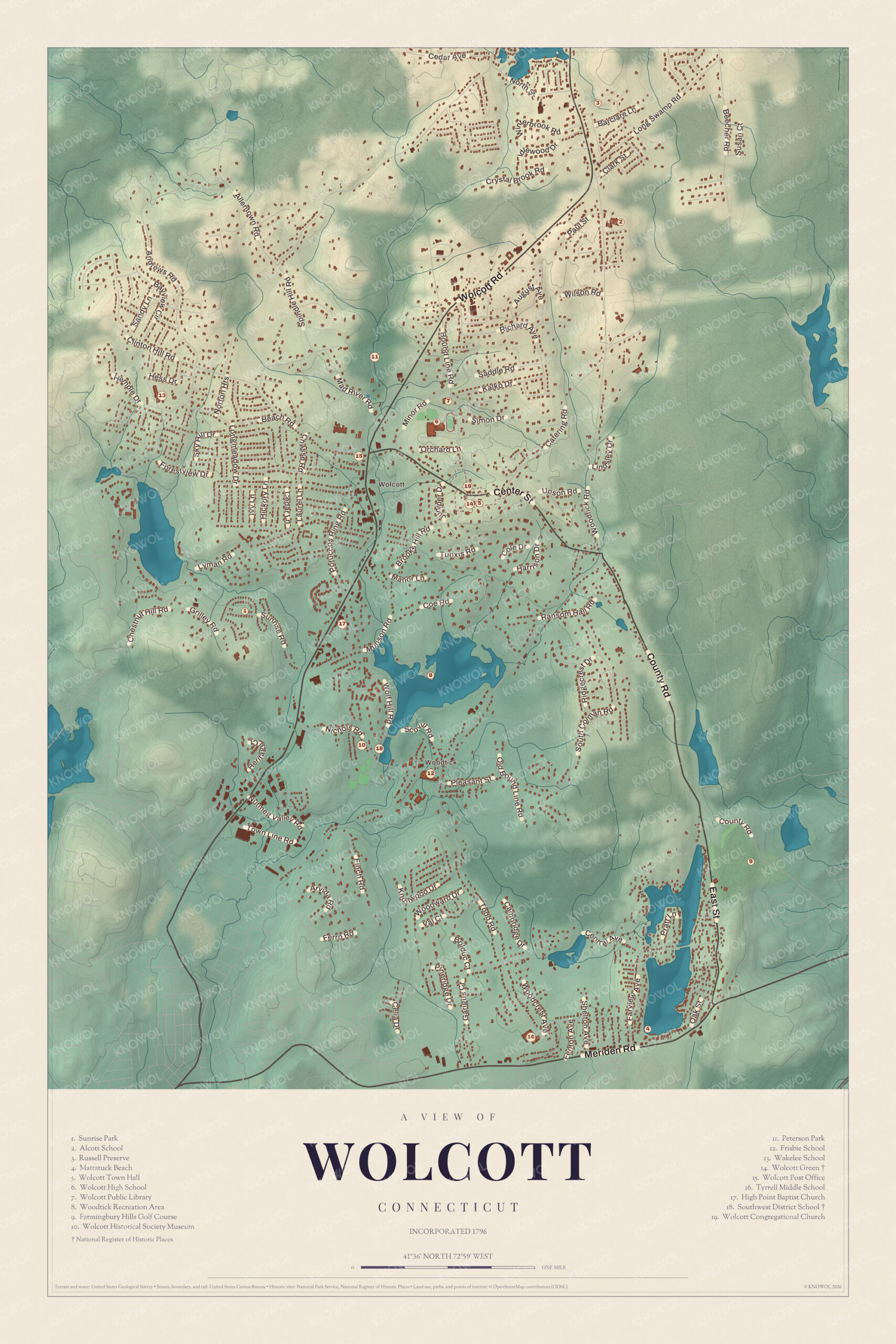
Wolcott today
By KNOWOL
Shaded hills from the town green down to Woodtick and the Scovill Reservoir, every street and the town line, and a guide of 19 numbered landmarks with the National Register sites marked.4
The story of Wolcott
Clocks, cords and Yankee notions
Seth Thomas grew up in Wolcott, a cooper's son who went to learn carpentry from Daniel Tuttle of Plymouth. He was so quiet that the wild lads of town called him Daniel Tuttle's fool. When Eli Terry took on a contract for four thousand clocks around 1810, Thomas helped make them, Wolcott women spun the cords from Wolcott flax, and much of the inside woodwork was cut from Wolcott laurel. Thomas once offered to buy a mill seat in Wolcott if the town would build him a road to Cheshire. The road never came, so he went to Plymouth Hollow, now Thomaston. Meanwhile thirty to forty Wolcott men went out as Yankee peddlers between 1810 and 1840, carrying clocks, tinware and notions through the Middle and Southern states.52
The farmer boy of Spindle Hill
Amos Bronson Alcott was born on Spindle Hill on November 29, 1799, the eldest of eight children, in the farm neighborhood his great-grandfather John Alcox had settled. He learned to write with chalk on his mother's kitchen floor, and his first teaching job was running a writing school. At fourteen he worked for a while making clocks in Plymouth. From the fall of 1818 he went peddling in Virginia and the Carolinas, once with his cousin William, and he read in the libraries of the big houses along the way. In 1828 he left for Boston. He became a famous teacher and reformer and the father of Louisa May Alcott, and he came home to speak at the church's centenary in 1873.671
A parish on the line
Wolcott began as a borderland. The line between Waterbury and Farmington ran right through it, and the first meetinghouse, where meetings started in October 1772, was said to stand half in one town and half in the other. A mountain to the east made the trip to town business hard, and in 1787 the parish told Waterbury that nature had formed it so that it was very inconvenient to be annexed to any other town. It took nine years of asking. In 1796 the Assembly vote was tied, and Lieutenant Governor Oliver Wolcott broke it. The town would have been Farmingbury, but it took his name instead. Four years later Lucius Tuttle brought in the first wagon, and people called it a wonder.891011
Through the years
22 moments from 1731 to today.
- 1731John Alcox of New Haven moves to Spindle Hill, the first resident of the Waterbury part of the future town.12
- 1760About this year Joseph Atkins builds a grist mill on the Mad River, the parish's only one for twenty years or more.13
- 1770The borderland between Waterbury and Farmington becomes the First Ecclesiastical Society of Farmingbury.1
- 1772Meetings begin in the new meetinghouse, said to stand half in Waterbury and half in Farmington.8
- 1773Judah Frisbie buys land at Woodtick, its first settler.13
- 1787Farmingbury asks Waterbury's consent to become a separate town.9
- 1796Farmingbury becomes the town of Wolcott, named for Lieutenant Governor Oliver Wolcott, who broke a tie vote in its favor.1
- 1799Amos Bronson Alcott is born on Spindle Hill.6
- 1800Lucius Tuttle brings the first wagon into Wolcott.11
- 1800A town meeting lets Dr. John Potter inoculate against smallpox.14
- 1810Wolcott men start out as Yankee peddlers, selling tinware, notions and clocks across the South for the next thirty years.2
- 1820The wooden school on Nichols Road burns, and a granite schoolhouse goes up in its place in the early 1820s.15
- 1828Bronson Alcott leaves his family's Spindle Hill house for Boston.6
- 1839On the night of December 11 the meetinghouse burns, the eve of a planned antislavery meeting, which goes ahead the next day beside the ashes.16
- 1842The Congregational Church is finished on the site of the old meetinghouse.17
- 1874Samuel Orcutt's history counts three reservoirs on the Mad River, built to power Waterbury's factories.18
- 1913A trolley line opens from Waterbury to near Hitchcock Lake.17
- 1916The Kenea Soldier's Monument is dedicated on the green, honoring the 75 Wolcott men of the Civil War.17
- 1917The Mad River is dammed to make the Scovill Reservoir for the Scovill brass company.1
- 1923The first part of the town hall is built at the south end of the green.17
- 1962On May 24 a tornado tears through town, killing one person and injuring 50.1
- 1963The historical society takes over the Southwest District School as a museum.15
Places to see
The numbers match the landmark guide printed on the 2026 map.
- 2Alcott SchoolWolcott. Named for the Alcott family.
- 3Russell PreserveNorth, toward Bristol. Open land near the Bristol line.
- 4Mattatuck BeachFar south. Summer swimming in the south.
- 5Wolcott Town HallSouth end of the green. First part built in 1923.
- 8Woodtick Recreation AreaWoodtick. Town lake on the Scovill Reservoir.
- 9Farmingbury Hills Golf CourseSoutheast. Keeps the old parish name.
- 10Wolcott Historical Society MuseumNichols Road. Beside the old granite school.Visit their website
- 14Wolcott GreenTown center. A small triangle laid out in 1772.
- 18Southwest District SchoolNichols Road. Granite schoolhouse of the early 1820s.
- 19Wolcott Congregational ChurchNorth side of the green. Doric portico, finished 1842.
On the National Register
All 2 places in Wolcott on the National Register of Historic Places that still stand today, oldest first, and why each one matters.3
-
Wolcott Green Historic District
The town center on its hilltop: the green laid out in 1772, the Congregational Church of 1842 on the site of the first meetinghouse, the Farmingbury Burying Ground of about 1764, and houses from the late 1700s around them. The Kenea Soldier's Monument of 1916 stands in the middle of the green.17
-
Southwest District School
Built after the wooden school on the site burned in 1820, it is the oldest of Wolcott's surviving district schoolhouses and the only 19th century building in town known to be made entirely of local granite. It was a school until 1930, and the historical society has kept it as a museum since 1963.15
In their words
“There have existed in natural character and disposition of the people too much musical talent and good nature to allow disturbances of any serious kind to obtain a place of recognition among the people”
Samuel Orcutt, History of the town of Wolcott, 187419
“I see now why the Lord wants the Wolcott church kept up; it is to supply Waterbury with deacons.”
A Wolcott pastor, as told in The churches of Mattatuck, 189220
“I would not exchange either Wolcott or Prospect for a whole State of such places as this.”
A Connecticut guardsman at Yorktown, Virginia, 188121
Nearby towns
Sources
- Wolcott, Connecticut, Wikipedia
- History of the town of Wolcott (Connecticut) from 1731 to 1874 (1874), on the Yankee peddlers, Internet Archive
- National Register of Historic Places listings in New Haven County, Connecticut, Wikipedia
- Map of Wolcott, Connecticut in 2026, KNOWOL (USGS elevation, Census Bureau roads)
- History of the town of Wolcott (Connecticut) from 1731 to 1874 (1874), on Seth Thomas, Internet Archive
- History of the town of Wolcott (Connecticut) from 1731 to 1874 (1874), on A. Bronson Alcott, Internet Archive
- History of the town of Wolcott (Connecticut) from 1731 to 1874 (1874), on the centenary meeting, Internet Archive
- History of the town of Wolcott (Connecticut) from 1731 to 1874 (1874), on the first meetinghouse, Internet Archive
- The town and city of Waterbury, Connecticut (1896), Internet Archive
- History of the town of Wolcott (Connecticut) from 1731 to 1874 (1874), on the act of incorporation, Internet Archive
- History of the town of Wolcott (Connecticut) from 1731 to 1874 (1874), on the first wagon, Internet Archive
- History of the town of Wolcott (Connecticut) from 1731 to 1874, Samuel Orcutt (1874), on the first settlers, Internet Archive
- History of the town of Wolcott (Connecticut) from 1731 to 1874 (1874), on the mills and Woodtick, Internet Archive
- History of the town of Wolcott (Connecticut) from 1731 to 1874 (1874), on smallpox inoculation, Internet Archive
- Southwest District School (Wolcott, Connecticut), Wikipedia
- History of the town of Wolcott (Connecticut) from 1731 to 1874 (1874), on the meetinghouse fire of 1839, Internet Archive
- Wolcott Green Historic District, National Register nomination, National Park Service
- History of the town of Wolcott (Connecticut) from 1731 to 1874 (1874), on the hills and streams, Internet Archive
- History of the town of Wolcott (Connecticut) from 1731 to 1874 (1874), on law in Wolcott, Internet Archive
- The churches of Mattatuck (1892), Internet Archive
- Trip of the First Regiment C.N.G., to Yorktown, Va. and Charleston, S.C., October 17-28, 1881 (1882), Internet Archive