
A New England village on a ridge in the foothills of the Berkshires, on the New York state line, where a Revolutionary War cannonball is still lodged in a tavern post on Main Street.
Then and now
The same town 159 years apart. Click either map to look closer.
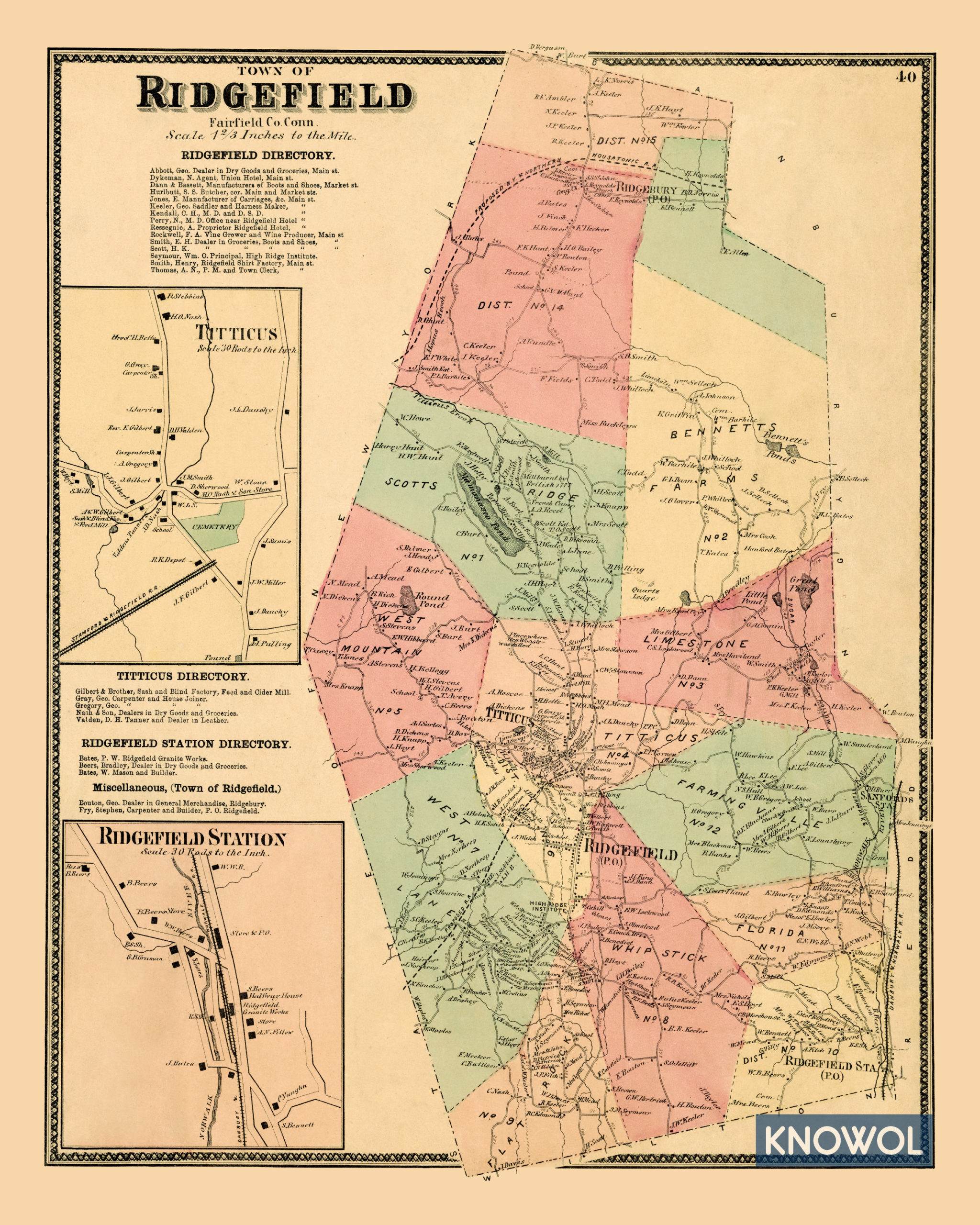
The landowners map
By F.W. Beers, A.D. Ellis and G.G. Soule of New York
Every farm is labeled with the name of the family that owned it, across 15 districts including Farmingville, Florida, Whip Stick, Flat Rock and Ridgefield Station. Look for the Ridgefield Granite Works, the shirt factory and Rockwell's vineyard.5
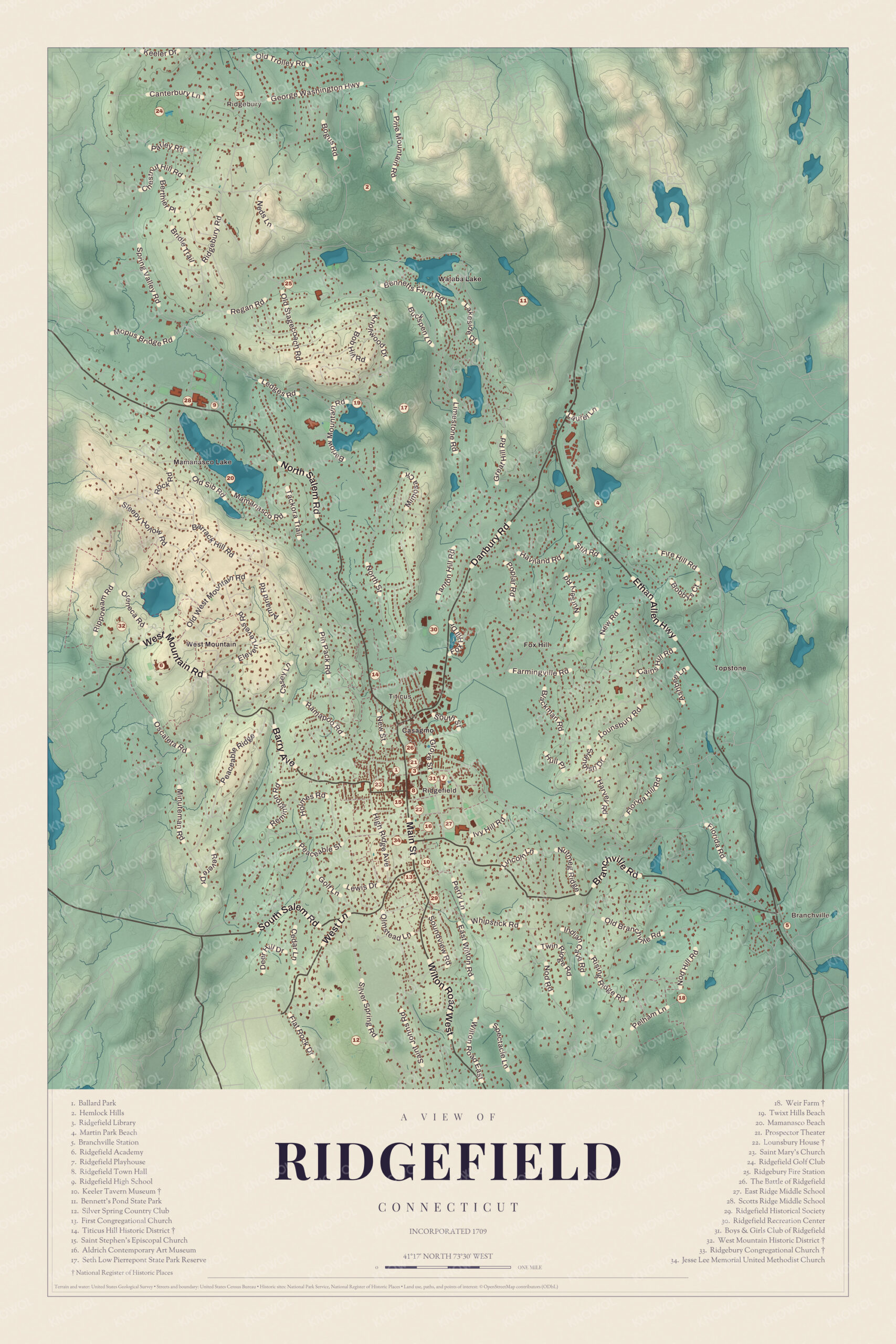
Ridgefield today
By KNOWOL
Shaded hills from Pine Mountain down to Branchville, every street, Mamanasco and Wataba Lakes, and a guide of 34 numbered landmarks with the National Register sites marked.2
The story of Ridgefield
A village on the ridge
This is the ancestral homeland of the Ramapough, Munsee Lenape and Wiechquasegeck peoples. In 1708 a group of families from Norwalk bought the land from Chief Catoonah and laid out home lots of 7.5 acres along the main road, and the town's name simply describes the place. The Indian name, Caudatowa, meant high land. For most of its history Ridgefield was a farming town. Late in the 1800s the railroad arrived, and wealthy New Yorkers drawn by hills that rise to 1,000 feet built estates and summer houses on the high ground. Careful zoning has kept the look of those years along Main Street.16
The north wind on Main Street
On April 27, 1777, about five hundred Americans under Benedict Arnold threw up a barricade of earth and rocks across the north end of Ridgefield's street to stop the British marching back from Danbury. The British broke through, Arnold's horse was shot under him, and the Stebbins house became a hospital. The British had heard that cartridges were being made at Timothy Keeler's tavern, so they fired cannonballs into it, and one is still in the corner post at 152 Main Street. Then they set it on fire. A Tory neighbor, afraid for his own roof, got leave to put the flames out. When Keeler came back from hiding, the neighbor said he could thank him that his house was safe. Keeler told him he'd thank the Lord for the north wind.78
A town of artists
Ridgefield drew artists for more than a century. J. Alden Weir and the painters he hosted, Childe Hassam, John Singer Sargent and John Twachtman among them, painted the countryside around his farm near Branchville, now one of only two National Park Service sites devoted to the visual arts. Frederic Remington made some of his finest work in the house he designed on Oak Knoll Road, and the architect Cass Gilbert spent his summers at Keeler Tavern. The Aldrich Contemporary Art Museum carries the tradition on today.910811
Through the years
25 moments from 1708 to today.
- 1708Families from Norwalk buy 20,000 acres from Chief Catoonah for 100 pounds sterling and lay out home lots along the main road.1
- 1709The Connecticut General Assembly incorporates the town of Ridgefield.1
- 1715About this year the Reverend Thomas Hawley House goes up on Main Street.12
- 1769Timothy Keeler buys his uncle's farmhouse and opens Keeler's Inn on the post road between Hartford and New York.8
- 1777On April 27 the Battle of Ridgefield is fought along Main Street. A cannonball fired that day is still lodged in the tavern's corner post.13
- 1777After the battle the selectmen report six houses, two barns and Isaac Keeler's grist and saw mills burned, and the General Assembly sends 250 pounds for relief.14
- 1781Rochambeau's French army camps in Ridgebury in the summer.1
- 1793Samuel Griswold Goodrich, the author known as Peter Parley, is born in Ridgefield, son of the Congregational minister.7
- 1797Amos Smith builds a second tavern, where the town's first Masonic lodge is organized. Its site later goes to the library.7
- 1804About this year Jerome Bonaparte, Napoleon's brother, stops at Keeler Tavern with his American bride while young Goodrich peers in the window.7
- 1810Sarah Bishop, the hermit who lived in a cave on the mountain toward the New York line, is found frozen near her spring.715
- 1836The village is one street of about 60 houses and three churches, with a carriage factory and a furniture factory.15
- 1852The railroad opens a station in the southeast corner of town, first called Ridgefield.16
- 1867Beers, Ellis and Soule publish a map naming the owner of every farm in town.5
- 1870A branch line reaches the village, and the old station takes the name Branchville.16
- 1882The painter J. Alden Weir gets a 153-acre farm for $10 and a work of art.9
- 1891The state register lists milk for New York as a specialty, along with quarrying and grinding feldspar and quartz.17
- 1895A fire on Main Street leads to a new Town Hall, and Governor Phineas Lounsbury builds his house at 316 Main Street.18
- 1907The architect Cass Gilbert buys Keeler Tavern as his family's summer home.8
- 1908Ridgefield celebrates its 200th birthday with two days of exercises in the Town Hall.7
- 1909Frederic Remington and his wife Eva design their house on Oak Knoll Road.10
- 1964Larry Aldrich opens a museum of contemporary art in Old Hundred, a building of 1783.11
- 1966Keeler Tavern becomes a museum.8
- 2000The Ridgefield Playhouse opens in the auditorium of the old high school.19
- 2021Weir Farm becomes a National Historical Park.9
Places to see
The numbers match the landmark guide printed on the 2026 map.
- 5Branchville StationBranchville. Station house of 1905.
- 7Ridgefield PlayhouseEast of Main Street. In the old high school auditorium.
- 8Ridgefield Town HallMain Street. Rebuilt after the fire of 1895.
- 10Keeler Tavern MuseumMain Street. The tavern with the 1777 cannonball.
- 16Aldrich Contemporary Art MuseumMain Street. In Old Hundred, a building of 1783.
- 17Seth Low Pierrepont State Park ReserveNorth. 305 acres around Lake Naraneka.
- 18Weir Farm National Historical ParkBranchville. Where the Impressionists painted.
- 22Lounsbury HouseMain Street. A governor's house of 1895.
- 32West Mountain Historic DistrictWest Mountain. Country estates of the early 1900s.
- 33Ridgebury Congregational ChurchRidgebury. Founded in 1760.
On the National Register
All 14 places in Ridgefield on the National Register of Historic Places that still stand today, oldest first, and why each one matters.4
-
Ridgefield Center Historic District
The village itself: 395 acres with 241 contributing buildings, from the Reverend Thomas Hawley House of about 1715 to the houses and shops along Main Street. It's why Ridgefield still looks the way it does.12
-
Thomas Hyatt House
One of the oldest and best-preserved houses in town, with much of its original layout and features still in place.20
-
Benedict House and Shop
Among the oldest buildings in Ridgefield. The shop is a rare surviving cobbler's workshop of the 1800s, and the architect Cass Gilbert restored the pair with care.21
-
Keeler Tavern
The inn at the center of the Battle of Ridgefield in 1777, with a British cannonball still lodged in its corner post. Cass Gilbert made it his summer home in 1907, and it's a museum today.8
-
Hugh Cain Fulling Mill and Elias Glover Woolen Mill Archeological Site
The site of an early fulling mill, where woven wool was finished, that started in 1770 and stayed in industrial use until about 1900. It's protected as an archaeological site.22
-
March Route of Rochambeau's Army: Ridgebury Road
A 1,600-foot stretch of Ridgebury Road between old stone walls, marched by Rochambeau's French army in 1781 and looking much as it did then.23
-
Ridgebury Congregational Church
A small Greek Revival church on an older foundation, home to a congregation founded in 1760, with a square tower and corner pinnacles.24
-
Branchville Railroad Tenement
Built in stages as housing for railroad workers, it's a reminder of how the railroad shaped Branchville. It still has homes and shops today.25
-
Lewis June House
The best-preserved and most elaborate of Ridgefield's few Second Empire houses.26
-
Weir Farm
The farm where J. Alden Weir and his friends painted the countryside, now a National Historical Park and one of only two National Park Service sites devoted to the visual arts.9
-
Lounsbury House
Governor Phineas Lounsbury's house, modeled on the Connecticut State Building at the 1893 Columbian Exposition. The town bought it in 1945, and it hosts weddings and festivals now.18
-
Titicus Hill Historic District
A neighborhood just northwest of the village, named for the Titicus River that runs through it.274
-
West Mountain Historic District
425 acres with five large country estates of the early 1900s, the grandest of them Orenica, a stone Georgian Revival house of 1932.28
-
Frederic Remington House
National Historic Landmark
The house the painter and sculptor of the American West designed with his wife Eva, where he made some of his finest work, including The Stampede, in the last months of his life.10
In their words
“I will not thank a Tory for anything. I thank the Lord for the north wind.”
Timothy Keeler of Keeler Tavern in 1777, as told in the town's bicentennial book, 19087
“Embowered in trees of a century's growth, with walks and lawns well kept, it is one of the prettiest streets in Connecticut.”
The bicentennial book, 1908, on Main Street7
“Wal, mister, its eight miles as the crow flies, but its twelve the way you've got to go, first up nigh to Heaven an then descendin' into the pit.”
A Ridgefield livery man asked the way to Redding, The history of Redding, 190629
Nearby towns
Sources
- Ridgefield, Connecticut, Wikipedia
- Map of Ridgefield, Connecticut in 2026, KNOWOL (USGS elevation, Census Bureau roads)
- Connecticut Geological and Natural History Survey, Bulletin (1904), Internet Archive
- National Register of Historic Places listings in Fairfield County, Connecticut, Wikipedia
- Landowners map of Ridgefield, 1867, restored by KNOWOL
- A Gazetteer of the States of Connecticut and Rhode Island (1819), Internet Archive
- 1708, Ridgefield, Connecticut, 1908: Bi-centennial celebration, report of the proceedings (1908), Internet Archive
- Keeler Tavern, Wikipedia
- Weir Farm National Historical Park, Wikipedia
- Frederic Remington House, Wikipedia
- The Aldrich Contemporary Art Museum, Wikipedia
- Ridgefield Center Historic District, Wikipedia
- Battle of Ridgefield, Wikipedia
- A historical collection, from official records, of the part sustained by Connecticut during the war of the Revolution, Royal R. Hinman (1842), Internet Archive
- Connecticut Historical Collections, John Warner Barber (1836), Internet Archive
- Branchville station, Wikipedia
- Register and manual of the state of Connecticut (1891), Internet Archive
- Phineas Chapman Lounsbury House, Wikipedia
- Ridgefield Playhouse, Wikipedia
- Thomas Hyatt House, Wikipedia
- Benedict House and Shop, Wikipedia
- Hugh Cain Fulling Mill and Elias Glover Woolen Mill Archeological Site, Wikipedia
- March Route of Rochambeau's Army: Ridgebury Road, Wikipedia
- Ridgebury Congregational Church, Wikipedia
- Branchville Railroad Tenement, Wikipedia
- Lewis June House, Wikipedia
- Titicus, Ridgefield Historical Society
- West Mountain Historic District, Wikipedia
- The history of Redding, Connecticut, Charles Burr Todd (1906), Internet Archive