
A hat town that grew out of Danbury's old Bethel parish, where fifteen shops were making hats by 1835, the railroad bent its route to stop, and P. T. Barnum was born and later came home to give the town a fountain.
Then and now
The same town 159 years apart. Click either map to look closer.
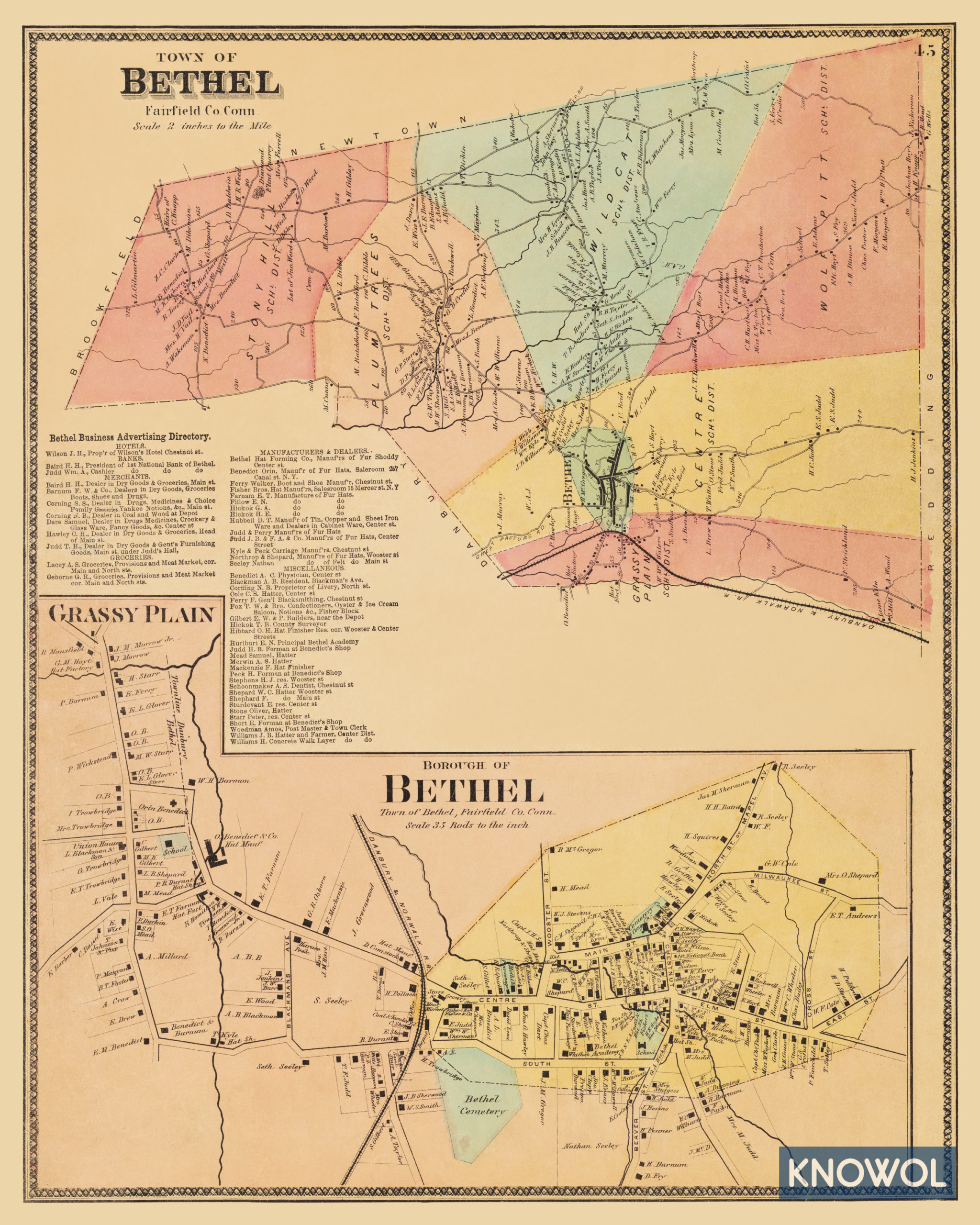
The landowners map
By F.W. Beers, A.D. Ellis and G.G. Soule
Every plot carries its owner's name, and the town is split into six school districts: Stony Hill, Plum Trees, Wild Cat, Wolf Pitt, Grassy Plains and Centre. Look for Bethel Academy, Northrup and Shepard Hats, the Kyle and Peck Carriage Company, the Diamond Flint Quarry and Fox Brothers Oyster and Ice Cream Saloon.4
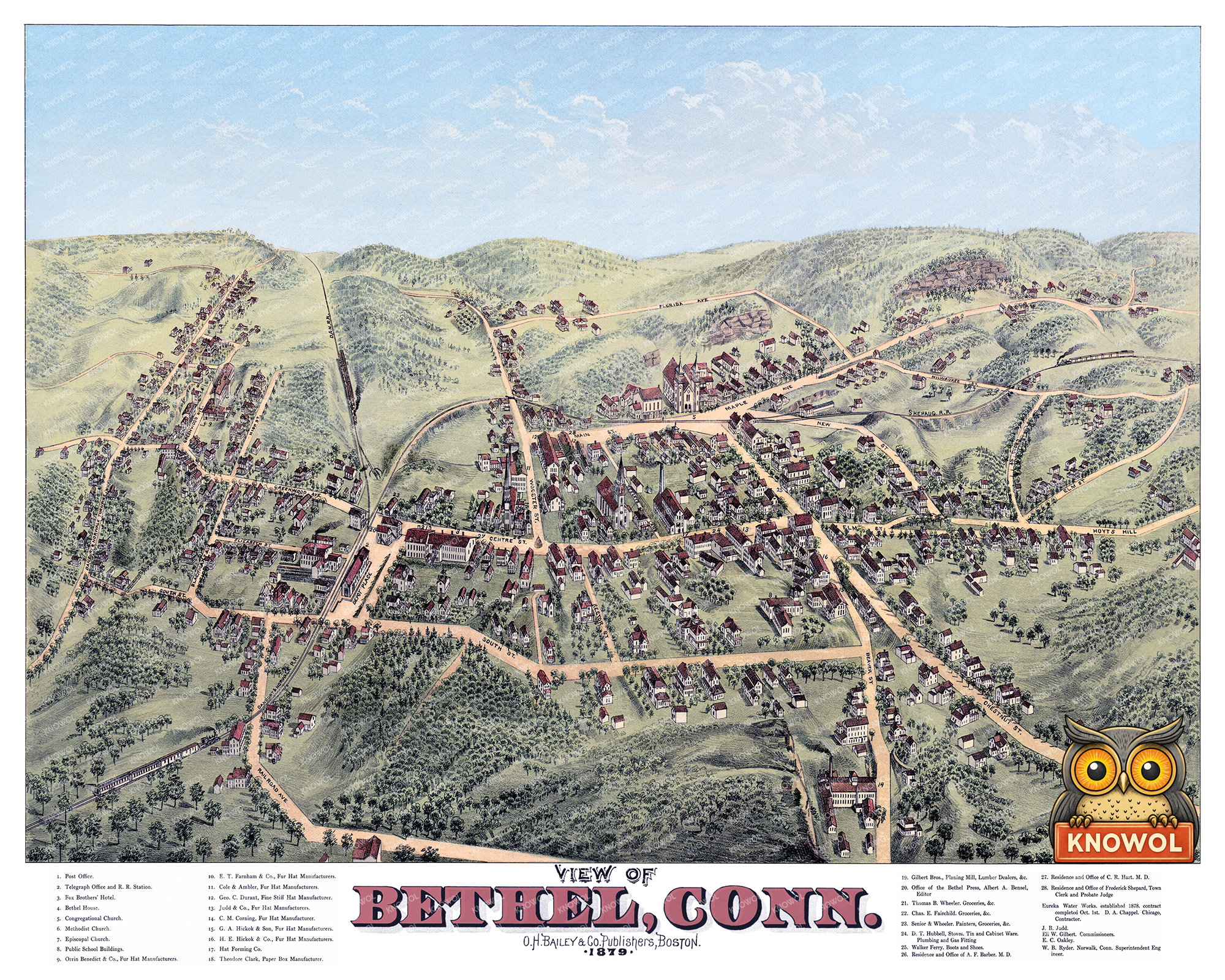
The bird's-eye view
By O.H. Bailey
Bethel drawn as if from the sky, in color, with the Danbury and Norwalk Railroad running through town past E.T. Farnham and Co. and Cole and Ambler fur hat makers, Clark Paper Box, Gilbert Bros. Planing Mill, Eureka Water Works, Bethel House, Fox Brothers' Hotel and the depot.5
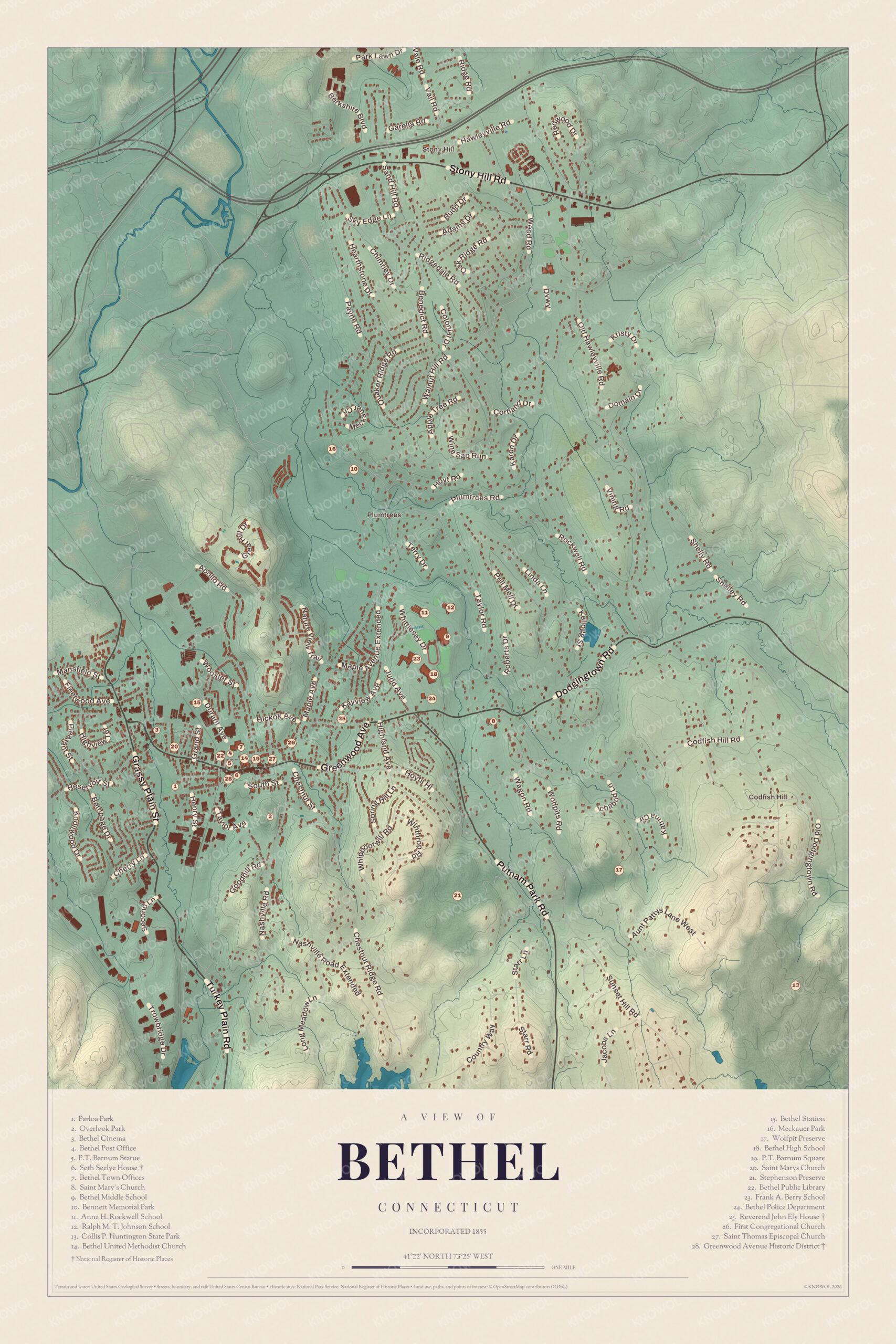
Bethel today
By KNOWOL
Shaded hills from downtown out to Codfish Hill and Stony Hill, every street from Greenwood Avenue to Plumtrees Road, and a guide of 28 numbered landmarks with the National Register sites marked.6
The story of Bethel
Fifteen hat shops and a dozen comb makers
In 1835 Bethel was still a village inside Danbury, with about fifty houses, fifteen hat shops and about twelve comb makers. The hat shops employed 200 people, women included, and made about 125,000 hats a year. Combs may have mattered even more back then, a county history said in 1881, but by that year the comb makers were "among the things that were." One old comb shop in Plumtrees had become a saw and cider mill. Hats carried on. O. Benedict and Co.'s brick factory on Grassy Plain could make 150 dozen hats a day. The hat makers formed Union No. 1 in 1856 and the finishers followed in 1860. The makers won a Saturday half holiday and liked to say of Bethel, "No Card, No Work."278910
Barnum comes home
P. T. Barnum was born in Bethel in 1810. In 1829 he ran a fruit and confectionery store in his grandfather's carriage house, and in 1831 he opened a country store and started a newspaper, the Herald of Freedom. It soon got him sixty days in the county jail for libel. He kept editing from a good room there, and when he got out, a coach drawn by six horses, forty horsemen, sixty carriages and a band brought him home to Bethel, where the band played "Home, Sweet Home." Fifty years later he gave his birthplace a park and a bronze fountain made in Germany. At the dedication he remembered the old meeting house "without steeple or bell." The fountain cracked in a freeze in 1921, and a Doughboy statue took its place.111126
The railroad that almost passed Bethel by
When the railroad up from Norwalk was first surveyed, the plan left Bethel out and ran the line along Simpaug Brook instead. The engineer, Mr. Twining, suggested bending east through Grassy Plain into Bethel to gain an important station for only a little more distance, and the change was made. Not everyone believed in the route. The flat below the village was a bog, and one citizen claimed two twelve-foot rails could be pushed into it without touching bottom. The trains came anyway in 1852. Greenwood Avenue, then called Center Street, grew up between the depot and the hat shops, and three years later Bethel became a town of its own with 1,711 people.13614
Through the years
24 moments from 1700 to today.
- 1700Bethel is first settled, around this year, as an outlying part of Danbury.1
- 1759Bethel is made its own church society in October.2
- 1760The first meeting house goes up, with Rev. Noah Wetmore as minister.2
- 1763Ministers meet at Bethel to hear charges of false doctrine against Rev. Wetmore.15
- 1777General Wooster's militia reaches Bethel at eleven at night in a storm, chasing the British raiders.16
- 1792The house for Rev. John Ely, the parish's second minister, is built.17
- 1806Oliver Shepard, later Bethel's first postmaster, opens his own hat shop on Fountain Place.18
- 1810P. T. Barnum is born in Bethel.1
- 1823Orris S. Ferry, a hat maker's son and later a U.S. senator, is born here.19
- 1831Barnum opens a country store and starts his newspaper, the Herald of Freedom.11
- 1835Fifteen hat shops make about 125,000 hats a year, and about twelve comb makers employ 180 people.2
- 1835St. Thomas's Episcopal church is built southwest of the Congregational church.2
- 1842The Seth Seelye House goes up on Greenwood Avenue.20
- 1852The railroad arrives, after a first survey that would have skipped Bethel.13
- 1855Bethel becomes a town of its own, with 1,711 people.14
- 1856Hat Makers Union No. 1 of Bethel is organized.9
- 1860Hat Finishers Union No. 2 is organized in July.10
- 1867Beers, Ellis and Soule map every landowner in town.4
- 1874W. E. Mallory starts the Bethel Press on June 26.21
- 1879O.H. Bailey draws his bird's-eye view of Bethel.5
- 1880The June census counts 2,726 people, and the comb business is gone.14
- 1881Barnum gives the town a park and a bronze fountain made in Germany.12
- 1928A Doughboy statue replaces the cracked fountain, and the park becomes P.T. Barnum Square.6
- 1934Rudolph Kunett starts the first vodka distillery in the United States here.1
Places to see
The numbers match the landmark guide printed on the 2026 map.
- 3Bethel CinemaDowntown. The downtown movie house.
- 13Collis P. Huntington State ParkFar southeast corner. State park reaching into town.Visit their website
- 14Bethel United Methodist ChurchGreenwood Avenue. Built in 1861, the district's only church.
- 15Bethel StationDowntown. The depot on the old railroad line.
- 19P.T. Barnum SquareEast end of downtown. Barnum's gift to his hometown, 1881.
- 22Bethel Public LibraryGreenwood Avenue. The Seth Seelye House of about 1842.Visit their website
- 25Reverend John Ely HouseMilwaukee Avenue. The minister's house of about 1792.
- 26First Congregational ChurchMain Street. Where the 1760 meetinghouse stood.Visit their website
- 28Greenwood Avenue Historic DistrictDowntown. The old hat town's main street.
On the National Register
All 3 places in Bethel on the National Register of Historic Places that still stand today, oldest first, and why each one matters.3
-
Rev. John Ely House
Built for Rev. John Ely, the second minister of Bethel parish while it was still part of Danbury, it keeps much of its 18th century woodwork. Later owners included Oliver Shepard, who helped make Bethel a separate town in 1855.17
-
Seth Seelye House
A Greek Revival house with four slender Doric columns holding up its front gable, built for a leading Bethel family before the town split from Danbury. It's now the Bethel Public Library.20
-
Greenwood Avenue Historic District
Bethel's old commercial center, where small hat factories stood and stores spread out after the railroad came in 1852. It includes P.T. Barnum Square, the Doughboy statue, the old depot and the Bethel Opera House of about 1848.22
In their words
“The old village meeting house, without steeple or bell, where in the square family pew I sweltered in summer and shivered through my Sunday-school lessons in winter.”
P. T. Barnum at the dedication of his fountain in 1881, from the Commemorative Biographical Record of Fairfield County, 189912
“Truly, can it be said of Bethel, 'No Card, No Work.'”
Hat Makers Union No. 1 of Bethel, in a report of the Connecticut Bureau of Labor Statistics9
“Within the last thirty-five years it has made wonderful strides towards metropolitan dignity.”
History of Fairfield County, 1881, on Grassy Plain8
Nearby towns
Sources
- Bethel, Connecticut, Wikipedia
- Connecticut historical collections, John Warner Barber (1837), on Bethel, Internet Archive
- National Register of Historic Places listings in Fairfield County, Connecticut, Wikipedia
- Landowners map of Bethel, Connecticut from 1867, restored by KNOWOL
- Bird's-eye view of Bethel, Connecticut from 1879, restored and colored by KNOWOL
- Map of Bethel, Connecticut in 2026, KNOWOL (USGS elevation, Census Bureau roads)
- History of Fairfield County, Connecticut (1881), on the comb makers, Internet Archive
- History of Fairfield County, Connecticut (1881), on Grassy Plain, Internet Archive
- Annual report of the Bureau of Labor Statistics of the State of Connecticut, on Hat Makers Union No. 1, Internet Archive
- Annual report of the Bureau of Labor Statistics of the State of Connecticut, on Hat Finishers Union No. 2, Internet Archive
- Genealogical and Family History of the State of Connecticut (1911), on P. T. Barnum, Internet Archive
- Commemorative Biographical Record of Fairfield County, Connecticut (1899), on Barnum's fountain, Internet Archive
- History of Fairfield County, Connecticut (1881), on the railroad survey, Internet Archive
- History of Fairfield County, Connecticut (1881), on Bethel's water, population and soldiers, Internet Archive
- Contributions to the ecclesiastical history of Connecticut (1861), Internet Archive
- Battle of Ridgefield, Wikipedia
- Rev. John Ely House, Wikipedia
- Commemorative Biographical Record of Fairfield County, Connecticut (1899), on Oliver Shepard, Internet Archive
- Memorial addresses on the life and character of Orris S. Ferry (1876), Internet Archive
- Seth Seelye House, Wikipedia
- History of Connecticut in Monographic Form, Volume Two (1925), on Bethel's newspapers, Internet Archive
- Greenwood Avenue Historic District, Wikipedia