
A hill town halfway between Hartford and New London that began as Jeremiah's Farme, where Pierpont Bacon's academy has taught since 1803, Nathaniel Hayward's rubber works once sent its freight out by mule team, and a buried iron trestle still carries the Air Line Trail.
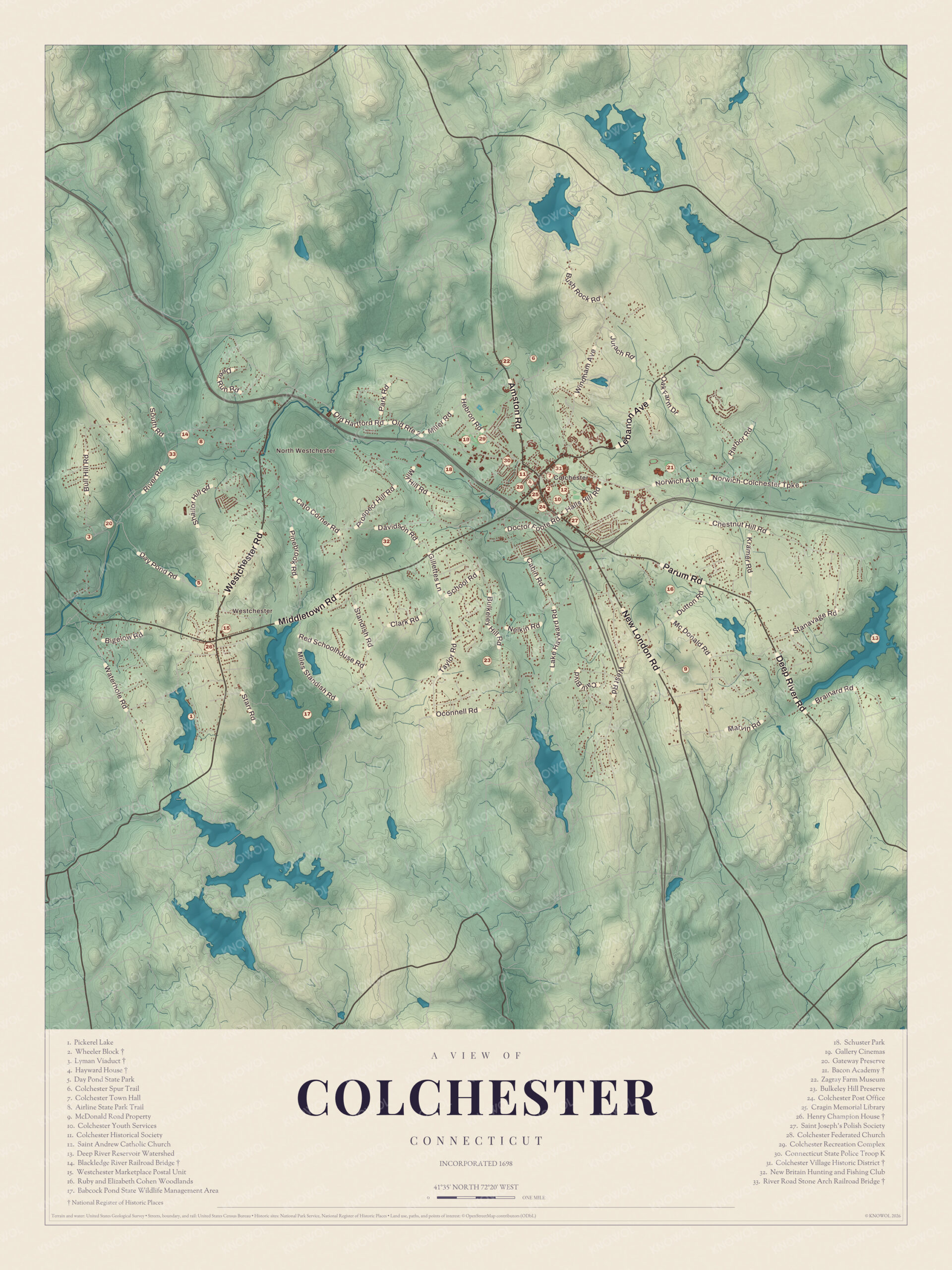
Colchester on the map
Click the map to look closer.
Colchester today
By KNOWOL
Shaded hills from Westchester across to the village green, every road from Old Hartford Road to Parum Road, the Air Line Trail bridges, and a guide of 33 numbered landmarks with the National Register sites marked.5
The story of Colchester
Two pence a rattlesnake
Michael Taintor kept Colchester's town records for its first thirty years, and they show a frontier settlement getting to work. In 1704 Nathaniel Kellogg and Samuel Gillett won the right to run a sawmill on Governors Brook, and in 1708 three men were granted the right to run iron works on Jeremy's River. That spring the town offered two pence for every rattlesnake killed, and in May 1716 Josiah Grate killed eighteen. In 1705 the town even moved Thanksgiving back a week, and the story handed down was that there wasn't enough molasses. By 1771 Colchester had a new meetinghouse that people counted the finest in the colony.678910
Rubber shoes by mule team
Nathaniel Hayward was an associate of Charles Goodyear, and in 1847 he organized the Hayward Rubber Company in Colchester. A 1904 history says the plant was the largest of its kind in the country, able to make 10,000 pairs a day. Before the railroad came, its freight went by mule teams hauling big covered wagons over the Norwich road. Starting small, the company grew until its output reached $2,000,000 a year. The Colchester branch railroad opened in 1877 and put the mules out of work. The works closed in 1885. Hayward's house still faces the green.271112
Pierpont Bacon's gift
Pierpont Bacon worked hard, saved, and bought land until he owned four large farms, more than anyone else in Colchester's first society. When he died childless in 1800, he left nearly everything to keep a school near the meetinghouse. A writer in 1895 said the news was like the reading of Caesar's will in Rome. Bacon Academy opened in 1803 in a three-story brick building, and local children went free. In 1806 Noah Webster named it among the academies of the first reputation, and Stephen F. Austin and Lyman Trumbull were among its students. The old brick academy still stands on Main Street.13145151
Through the years
24 moments from 1661 to today.
- 1661Jeremy Adams settles on 340 acres given to him by Uncas, known as Jeremiah's Farme.1
- 1698Michael Taintor II, Samuel Northam and Nathaniel Foote III apply to settle the town.1
- 1699The court at Hartford approves the town and the name Colchester.1
- 1703The First Church is organized on December 20, with Rev. John Bulkley as its first pastor.16
- 1704Nathaniel Kellogg and Samuel Gillett win the right to run a sawmill on Governors Brook.7
- 1705The town votes to put off Thanksgiving by a week. Tradition says there wasn't enough molasses.9
- 1708Three men are granted the right to run iron works on Jeremy's River.7
- 1708The town offers two pence for every rattlesnake killed. In 1716 Josiah Grate kills eighteen.8
- 1728The Westchester parish is formed, and its church is organized the next year.17
- 1771A new meetinghouse goes up that is counted the finest in the colony.10
- 1775Abel Amos builds the house on the green that's now the Hayward House, for the tavern keeper Dudley Wright.12
- 1778Washington, short of food at Valley Forge, turns to Colonel Henry Champion, and the first relief comes from his land.9
- 1787Samuel Loomis is granted land near Skinner's iron works for one of the earliest textile mill projects in America.18
- 1790The Henry Champion House is built in Westchester to a design by William Sprat.19
- 1803Bacon Academy opens, paid for by the estate of the farmer Pierpont Bacon.14
- 1806Rev. E. Washburn brings Methodism to Colchester.20
- 1847Nathaniel Hayward organizes the Hayward Rubber Company in Colchester.2
- 1847The Westchester church of 1791 burns on March 28. A new one is dedicated the next year.17
- 1872Joshua Wheeler builds the Wheeler Block, with stores below and the Masonic lodge above.21
- 1873The Air Line railroad is finished, crossing Dickinson Creek on the Lyman Viaduct.3
- 1877The Colchester branch railroad opens, and the stage to Turnerville is withdrawn.7
- 1885The Hayward Rubber Company closes its works.2
- 1887The stone arch railroad bridge over River Road is built, each arch stone numbered.22
- 1938The great hurricane floods the town green and topples elms planted in 1850.1
Places to see
The numbers match the landmark guide printed on the 2026 map.
- 2Wheeler BlockNorwich Avenue. Second Empire block, the original town hall.
- 3Lyman ViaductNorthwest Colchester. Buried iron trestle of 1873.
- 4Hayward HouseHayward Avenue. Tavern of about 1775, later Hayward's home.
- 5Day Pond State ParkWest of the village. Sawmill pond and a 40 foot waterfall.Visit their website
- 14Blackledge River Railroad BridgeSalmon River State Forest. Steel truss of about 1912.
- 21Bacon AcademyColchester. Pierpont Bacon's school, opened 1803.
- 26Henry Champion HouseWestchester. Federal house of 1790.
- 28Colchester Federated ChurchThe town green. Greek Revival church on the green.Visit their website
- 31Colchester Village Historic DistrictColchester village. The old borough around the green.
- 33River Road Stone Arch Railroad BridgeRiver Road. Brownstone arch of 1887.
On the National Register
All 8 places in Colchester on the National Register of Historic Places that still stand today, oldest first, and why each one matters.4
-
Colchester Village Historic District
Most of the village center around the town green, which grew up beside the first meetinghouse and burying ground and became a crossroads of turnpikes in the early 1800s. The Federated Church and Bacon Academy are its main buildings.23
-
Hayward House
Built by Abel Amos for Dudley Wright, who kept a tavern here and hosted the Masonic lodge in a ballroom across the back of the second floor. In 1842 it was bought by Nathaniel Hayward, founder of the Hayward Rubber Company.12
-
Henry Champion House
A gambrel-roofed Federal house designed by William Sprat. Colonel Henry Champion, a commissary leader in the Revolution, built it for his son Henry.19
-
Bacon Academy
The original Bacon Academy, a three-story Flemish bond brick building paid for by Pierpont Bacon's estate and built for $7,000. Its students included Lyman Trumbull and Morrison Waite.14
-
Wheeler Block
Joshua Wheeler built it with stores below and the Masonic lodge above. His daughter gave it to the town in 1910, and it served as a school and then as town hall until 1991.21
-
Lyman Viaduct
A wrought iron trestle 1,112 feet long and 137 feet high, later buried in sand to carry heavier trains. That burial kept it whole, and it's one of the only first-generation iron trestles believed to be in good condition.3
-
River Road Stone Arch Railroad Bridge
A brownstone arch built when the state ordered railroads to get rid of grade crossings. Its arch stones are each numbered, a sign they were cut elsewhere and shipped here.22
-
Blackledge River Railroad Bridge
A riveted steel deck truss that replaced an earlier bridge on the same abutments, raised five feet higher above the river. A wooden walkway now carries the Air Line Trail across it.24
In their words
“Colchester is a beautiful village. In its appearance, as a place of residence, in the culture of its families, and the moral tone of its citizens, it will come close to first place when compared with any village in the United States.”
The Connecticut quarterly, 189525
“How the news of this bequest gladdened the hearts of the fathers and mothers then living in that society!”
The Connecticut quarterly, 1895, on Pierpont Bacon's will13
“The first relief to the starving army, came from his land.”
Connecticut Historical Collections, 1836, on Colonel Henry Champion and Valley Forge9
Nearby towns
Sources
- Colchester, Connecticut, Wikipedia
- Connecticut as a colony and as a state (1904), on the Hayward Rubber Company, Internet Archive
- Lyman Viaduct, Wikipedia
- National Register of Historic Places listings in New London County, Connecticut, Wikipedia
- Map of Colchester, Connecticut in 2026, KNOWOL (USGS elevation, Census Bureau roads)
- An historical address, two hundredth anniversary of the First Church of Christ in Colchester (1903), on Michael Taintor, Internet Archive
- A modern history of New London County, Connecticut (1922), on Colchester's stages, freight and mills, Internet Archive
- Proceedings of the Connecticut Medical Society (1892), on Colchester's rattlesnake bounty, Internet Archive
- Connecticut Historical Collections, John Warner Barber (1836), on Colchester, Internet Archive
- A modern history of New London County, Connecticut (1922), on the First Church of Colchester, Internet Archive
- A Modern History of New London County, Connecticut (1922), on the Hayward Rubber Company, Internet Archive
- Hayward House (Colchester, Connecticut), Wikipedia
- The Connecticut quarterly (1895), on Pierpont Bacon's will, Internet Archive
- Old Bacon Academy, Wikipedia
- A history of Connecticut (1914), on Bacon Academy, Internet Archive
- An historical address, two hundredth anniversary of the First Church of Christ in Colchester (1903), on the founding, Internet Archive
- History of New London County, Connecticut (1882), on the Westchester church, Internet Archive
- The public records of the State of Connecticut (1894), on Samuel Loomis's manufactory, Internet Archive
- Henry Champion House, Wikipedia
- History of New London County, Connecticut (1882), on Colchester's Methodists, Internet Archive
- Wheeler Block (Colchester, Connecticut), Wikipedia
- River Road Stone Arch Railroad Bridge, Wikipedia
- Colchester Village Historic District, Wikipedia
- Blackledge River Railroad Bridge, Wikipedia
- The Connecticut quarterly (1895), on the village of Colchester, Internet Archive