
The east bank of the Connecticut across from Hartford, part of that town until 1783, where the falls of the Hockanum at Burnside turned mills from 1639, the main street was known for its elms, and Pratt & Whitney arrived in 1929.
East Hartford on the map
Click the map to look closer.
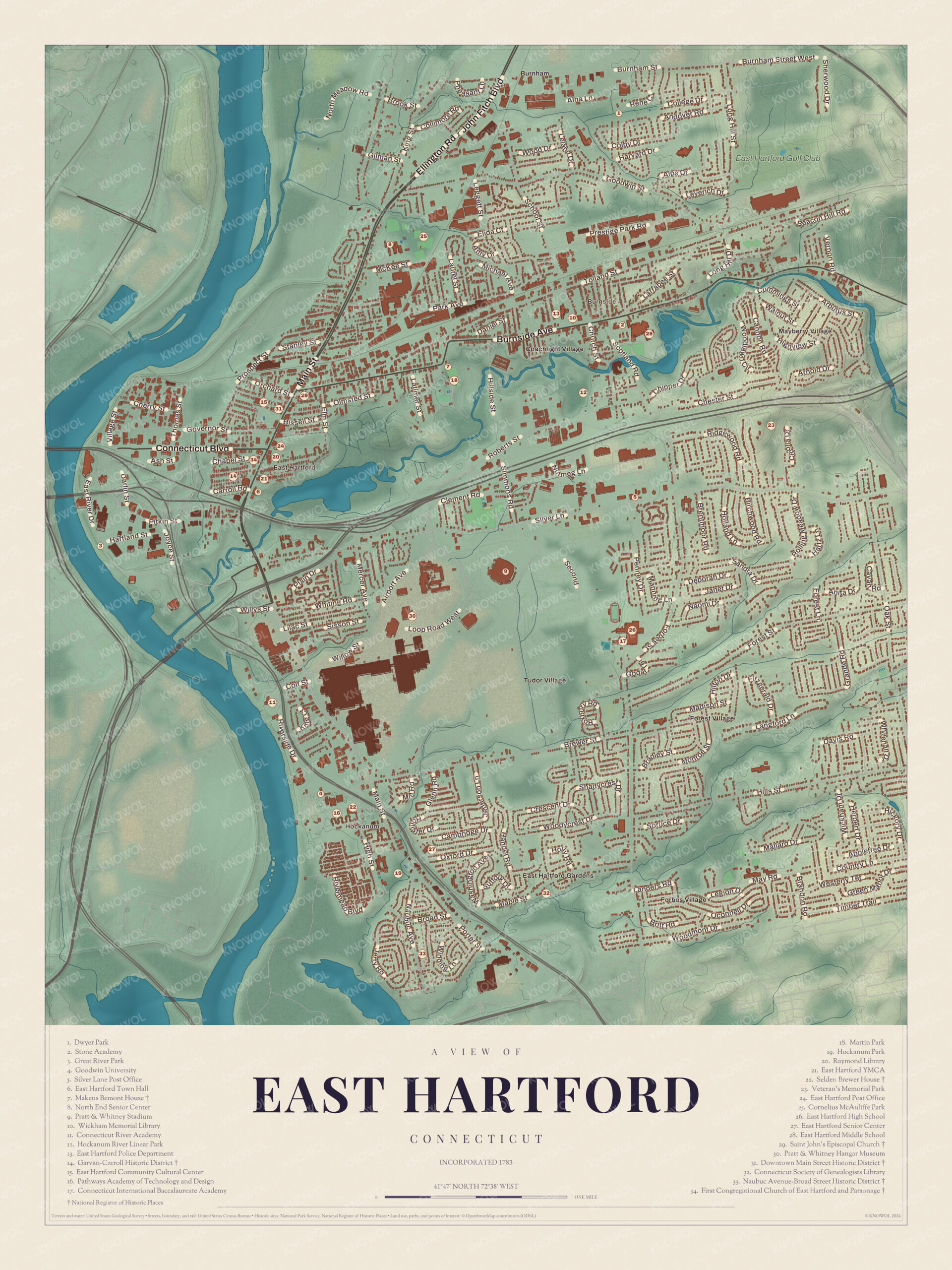
East Hartford today
By KNOWOL
Shaded ground from the Connecticut River meadows to Forbes Village, every street down to small roads like Burnham Street, the Hockanum River, and a guide of 34 numbered landmarks with the National Register sites marked.4
The story of East Hartford
How Silver Lane got its name
In June 1781 the Comte de Rochambeau's French army, marching from Newport to join George Washington on the Hudson, stopped in East Hartford and camped on the field north of Silver Lane. An 1886 town history says the stay was marked with much good feeling, and that the French paid in hard money, which gave Silver Lane its name. Rochambeau lodged at the house of Elisha Pitkin, his officers stayed in other homes, and the meetinghouse served as a hospital. The French came back through in the fall of 1782 and camped again. The town's own soldiers weren't always so polished. At some musters men turned up barefoot with bandaged toes and cornstalks for muskets, and earned the nickname East Hartford Rag-toes.51
Paper, hats and watches on the Hockanum
The Hockanum River drops over falls at Burnside, and East Hartford put them to work early. In 1639 William Goodwin and John Crow set up the first saw and grist mill at the lower fall, a spot later called Pitkin's Falls. By 1784 paper was being made at the middle falls. Hudson & Goodwin, printers of the Connecticut Courant, built mills there for their own paper, and around 1848 the middle mill made bank note paper for this and several other countries. On Main Street the Pitkins made hats for the Southern market, and in 1834 Henry and James F. Pitkin began making watches by hand. An 1886 history called theirs the first watch made in America. The old shop burned in 1880.2678910
Main Street under the elms
For two centuries East Hartford lived along one long street, set on a terrace above the river meadows. In 1819 a gazetteer described a stately row of elms down the middle of it, running two miles from the meetinghouse, and called it one of the most beautiful and pleasant places in Connecticut. The church that stands there now went up in 1835, and people came to call it the Old White Church, which gave its name to Church Corner. To reach Hartford you crossed the meadows on a causeway about a mile long to the toll bridge. That bridge burned in 1895, and in 1908 the great stone bridge took its place. With trolleys running from 1892, farmland like Patrick Garvan's turned into streets of new houses.11121314151617
Through the years
25 moments from 1638 to today.
- 1638John Sadler keeps East Hartford's first tavern, at Hockanum.18
- 1639William Goodwin and John Crow set up the first saw and grist mill at the lower fall in Burnside.2
- 1653Settlers on the east side of the river are ordered to train together under William Hill, the first training day on this side.5
- 1659Thomas Burnham buys the land of East Hartford and South Windsor from Tantinomo, chief sachem of the Podunks.1
- 1694The people of the east side petition the General Court for a minister of their own.14
- 1699The congregation of the First Congregational Church is founded about this year.19
- 1761Edmond Bemont builds the house later known as the Huguenot House.20
- 1775After Lexington, a company of 49 under Lieutenant Colonel George Pitkin marches to Roxbury.5
- 1781Rochambeau's French army camps on the field north of Silver Lane on its way to join Washington.5
- 1783East Hartford is incorporated as a separate town in October.1
- 1784Paper is being made at the mill at the middle falls of the Hockanum.6
- 1818The Hartford Toll Bridge, a covered bridge, opens across the river.16
- 1823Manchester, then Orford Parish, separates from East Hartford.1
- 1832Wells Hall is built as a private academy. It's now the town hall.21
- 1834Henry and James F. Pitkin begin making the American Lever Watch by hand.10
- 1835The Congregational church on Main Street, later called the Old White Church, is built.13
- 1865The village of Scotland is renamed Burnside.22
- 1867Saint John's Episcopal Church, designed by Edward T. Potter, is built of brownstone.23
- 1876The Hockanum Congregational Church is formed.24
- 1880The Pitkins' old watch and silverware shop on Main Street burns.9
- 1892Trolley service to Hartford begins, and Patrick Garvan lays out Garvan Street on farmland.17
- 1895The old toll bridge burns while a crowd watches from both banks.16
- 1908The stone arch bridge later named for Morgan Bulkeley opens to Hartford.16
- 1929Pratt & Whitney moves its production from Hartford to East Hartford.1
- 2003Pratt & Whitney Stadium opens on the old Rentschler airfield.4
Places to see
The numbers match the landmark guide printed on the 2026 map.
- 3Great River ParkConnecticut River bank. Riverside park facing Hartford.Visit their website
- 6East Hartford Town HallMain Street. Wells Hall, a private academy of 1832.
- 7Makens Bemont HouseMartin Park, Burnside Avenue. The Huguenot House of 1761.
- 9Pratt & Whitney StadiumRentschler Field. UConn football on the old airfield.
- 14Garvan-Carroll Historic DistrictSouthwest of downtown. Trolley era streets of family houses.
- 20Raymond LibraryMain Street. Library in Albert Raymond's park.
- 22Selden Brewer HouseMain Street and Naubuc Avenue. Tobacco growers' brick house, about 1827.
- 29Saint John's Episcopal ChurchMain Street and Burnside Avenue. Brownstone Gothic Revival church of 1867.
- 30Pratt & Whitney Hangar MuseumNear the stadium. Close by the old airfield.
- 34First Congregational Church of East Hartford and ParsonageMain Street and Connecticut Boulevard. The Old White Church at Church Corner.Visit their website
On the National Register
All 10 places in East Hartford on the National Register of Historic Places that still stand today, oldest first, and why each one matters.3
-
Central Avenue-Center Cemetery Historic District
Center Cemetery, whose oldest parcels were acquired in 1710, is the town's oldest surviving property and holds the grave of Governor William Pitkin. The district also takes in the Romanesque library of 1889, set in a park given by Albert Raymond, the 1939 post office and the houses along Central Avenue.11
-
Makens Bemont House
Often called the Huguenot House, it's one of the town's few surviving 18th century buildings. Makens Bemont made saddles, owned shares in the local bridge and was one of the few people in town to own a carriage. Moved to Martin Park in 1971 to save it, it's now a house museum of the Historical Society of East Hartford.20
-
Naubuc Avenue-Broad Street Historic District
A farm village in the southwest of town where tobacco for cigars was grown from the 1830s. Its oldest house was built about 1780 by John Kentfield, one of the area's first permanent residents, and the 1855 Dudley Fox Silver Factory stands among the houses.25
-
Gilman-Hayden House
A Georgian house built by George Gilman, whose family once owned land to the river and ran a ferry. Edward Hayden, who bought it in 1867, kept an unusual Civil War diary, part of it written in a diary he recovered from a Confederate soldier.26
-
Selden Brewer House
A brick late Federal house of a leading tobacco-growing family, the oldest Brewer home to survive. It first stood on High Street and was moved to its present corner in the 1980s, where it holds offices of the local historical society.27
-
Downtown Main Street Historic District
Most of its buildings went up between about 1890 and 1945, as trolleys and the Bulkeley Bridge turned the farm town into a suburb of Hartford. Its oldest include the Comstock House of about 1830 and Wells Hall, built in 1832 as a private academy and now the town hall.21
-
First Congregational Church of East Hartford and Parsonage
The congregation dates from about 1699. After a fire in 1834 the church was rebuilt in 1835 with charred timbers from the old one, which can still be seen in the attic, behind a Greek temple front of six Ionic columns. The parsonage next door was built in 1850.19
-
St. John's Episcopal Church
A High Gothic Revival church of brownstone designed by Edward T. Potter, one of his few works in Connecticut. Its first minister, John James McCook, served the parish for 61 years.23
-
Garvan-Carroll Historic District
After trolley service to Hartford began in 1892, Patrick Garvan bought farmland here and laid out Garvan Street for local business people and commuters. The one and two family houses, from Queen Anne to Craftsman, went up mainly between 1890 and the 1920s.17
-
Bulkeley Bridge
Nine stone arches of grey and pink granite carry Interstate 84 between Hartford and East Hartford. Opened in 1908 to replace the covered toll bridge that burned in 1895, it's the largest and one of the last major stone arch bridges built in New England.16
In their words
“The most striking feature in the appearance of East Hartford street, is the long row of large spreading elms situated in the center of the street”
John Warner Barber, Connecticut historical collections, 183713
“One of the most beautiful and pleasant situations in Connecticut.”
A gazetteer of the states of Connecticut and Rhode-Island, 1819, on East Hartford's street of elms12
“The meadows in this town, adjoining the Connecticut, contain an extensive range of some of the best land in the State.”
John Warner Barber, Connecticut historical collections, 183615
Nearby towns
Sources
- East Hartford, Connecticut, Wikipedia
- The memorial history of Hartford County, Connecticut, 1633-1884 (1886), on the mills of the Hockanum, Internet Archive
- National Register of Historic Places listings in Hartford County, Connecticut, Wikipedia
- Map of East Hartford, Connecticut in 2026, KNOWOL (USGS elevation, Census Bureau roads)
- The memorial history of Hartford County, Connecticut, 1633-1884 (1886), on East Hartford's soldiers and the French army, Internet Archive
- Historic towns of the Connecticut River Valley (1906), on the Burnside mills, Internet Archive
- Genealogical and family history of the state of Connecticut (1911), on Hudson & Goodwin's paper mills, Internet Archive
- Genealogical and biographical record of New London County, Connecticut (1905), on the Burnside middle mill, Internet Archive
- The memorial history of Hartford County, Connecticut, 1633-1884 (1886), on hats and the Pitkin watches, Internet Archive
- History of Connecticut in monographic form (1925), on the Pitkin watches, Internet Archive
- Central Avenue-Center Cemetery Historic District, Wikipedia
- A gazetteer of the states of Connecticut and Rhode-Island (1819), on East Hartford, Internet Archive
- Connecticut historical collections, John Warner Barber (1837), on East Hartford street, Internet Archive
- Some old time meeting houses of the Connecticut Valley (1911), on the First Congregational Church of East Hartford, Internet Archive
- Connecticut Historical Collections, John Warner Barber (1836), on East Hartford, Internet Archive
- Bulkeley Bridge, Wikipedia
- Garvan-Carroll Historic District, Wikipedia
- Historic towns of the Connecticut River Valley (1906), on East Hartford's taverns, Internet Archive
- First Congregational Church of East Hartford and Parsonage, Wikipedia
- Makens Bemont House, Wikipedia
- Downtown Main Street Historic District (East Hartford, Connecticut), Wikipedia
- Commemorative biographical record of Hartford County, Connecticut (1901), on the Forbes family of Scotland, now Burnside, Internet Archive
- St. John's Episcopal Church (East Hartford, Connecticut), Wikipedia
- Commemorative biographical record of Hartford County, Connecticut (1901), on Deacon Ashbel Brewer, Internet Archive
- Naubuc Avenue-Broad Street Historic District, Wikipedia
- Gilman-Hayden House, Wikipedia
- Selden Brewer House, Wikipedia