
A farm town around a mile-long green, where Governor Jonathan Trumbull ran Connecticut's Revolution from his family's old store, French hussars wintered in 1780 and 1781, and book lovers kept a shared library as early as 1739.
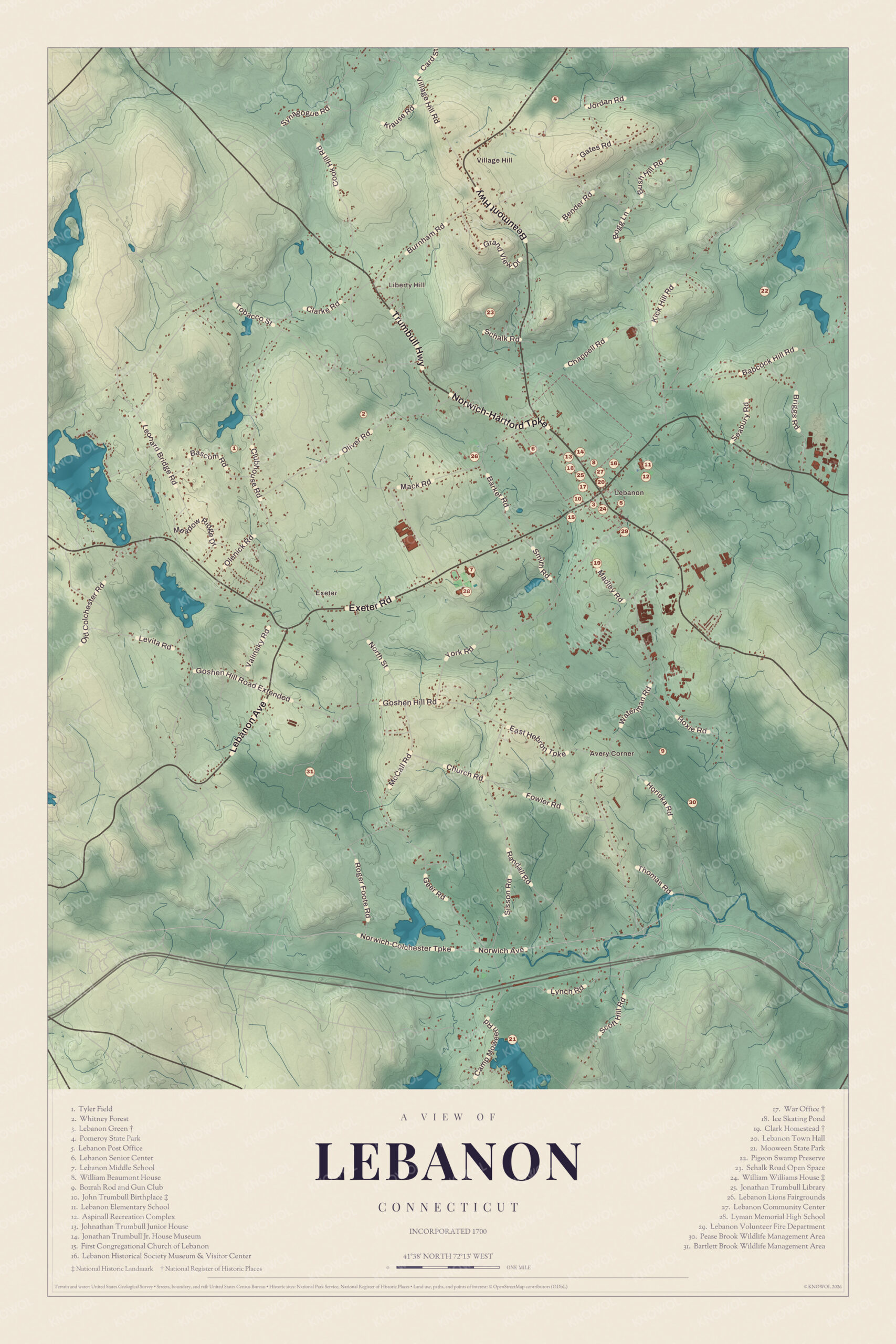
Lebanon on the map
Click the map to look closer.
Lebanon today
By KNOWOL
Shaded hills from Babcock Hill and Liberty Hill across the farm country to Exeter and Avery Corner, every road down to Kick Hill Road, the mile-long green with the Trumbull houses and the War Office, and a guide of 31 numbered landmarks.4
The story of Lebanon
French hussars on the green
In the winter of 1780 and 1781, about five hundred mounted hussars of the Duke de Lauzun's legion were quartered in Lebanon. A 1916 book pictures them galloping in over muddy country roads in tall black caps and braided jackets. Their barracks stood on the slope west of the Trumbull house, and in 1922 a spot on Lebanon Commons was still called the Barracks, with traces of their brick ovens. David Trumbull gave up his own house to the duke. On March 5, 1781, George Washington reviewed the legion here and spent three days in conference with Governor Trumbull. That June, Rochambeau's regiments camped in town for about three weeks on their way to join the Americans on the Hudson.567
Ninety-four books from England
Long before the Revolution, Lebanon was a reading town. In 1738 the minister of the first parish, Rev. Solomon Williams, joined with doctors, merchants, lawyers and ministers from nearby towns in a legal covenant to start a library. Each man agreed to put in fifty pounds for books. They named it the Philogrammatican Library and called each other Covenanters. Williams kept the books, and he made two or three trips to Boston on horseback for the latest literary news before sending to England for most of the volumes. Ninety-four books were recorded in 1739. The secretary, called the Scribe, was a young Jonathan Trumbull, the man who'd later run Connecticut's war from this same green.8910
Saving the War Office
The small building on West Town Street began about 1732 as Joseph Trumbull's store, and during the Revolution his son, Governor Jonathan Trumbull, held his councils of war there. A century later it was decaying. In the winter of 1890 and 1891 its owner, Mrs. Wattles, then ninety-one, gave it to the Connecticut Sons of the American Revolution on one condition, that it be kept in repair. Workers laid a new stone foundation and found the oak frame still sound. Old stone fireplaces came from Lebanon buildings that had fallen down, and Miss Dutton gave andirons made by a Lebanon blacksmith in Revolutionary days. In old rat nests under the floor they found scraps of muster rolls and a note in the governor's hand. It was rededicated on June 15, 1891.1112131415
Through the years
23 moments from 1663 to today.
- 1663The first grant here goes to Major John Mason, deputy governor of the colony.1
- 1692Owaneco, son of Uncas, sells the 25 square miles called the Five Mile Square.1
- 1695Lots are laid out and real settlement begins, with about fifty grants that November.16
- 1700The General Assembly incorporates Lebanon on October 10.1
- 1700The church is gathered on November 27, with Joseph Parsons as minister of the town.17
- 1704Joseph Trumbull brings livestock farming to Lebanon.1
- 1729The Goshen church is organized as a friendly branch of the first church.18
- 1732About this year Joseph Trumbull builds the store that becomes the War Office.11
- 1735Joseph Trumbull builds a house on the green as a wedding present for his son Jonathan.19
- 1739Ninety-four books are recorded for the new Philogrammatican Library.10
- 1756The painter John Trumbull is born in his father's house on the green.19
- 1777Meeting in Lebanon, the Council of Safety orders 300 barrels of pork and 100 of beef for the state.20
- 1780About five hundred of Lauzun's hussars arrive to spend the winter.5
- 1781On March 5, George Washington reviews Lauzun's legion in Lebanon.5
- 1781In June, Rochambeau's regiments camp here about three weeks on the march to the Hudson.5
- 1792Exeter becomes the first parish formed in the new Episcopal Diocese of Connecticut.21
- 1826Lebanon moves from Windham County back to New London County.1
- 1829Capt. Stowell builds a stone gristmill at Chestnut Hill.22
- 1830The Trumbull house is moved several hundred feet to where it stands now.19
- 1850Lebanon has 1,901 people, no lawyer and no tavern.23
- 1891The restored War Office is rededicated on June 15, the Flag Day anniversary.15
- 1928Twelve families from the village of Karlswalde have settled around Village Hill.1
- 1979The Lebanon Green Historic District is listed on the National Register.24
Places to see
The numbers match the landmark guide printed on the 2026 map.
- 3Lebanon GreenTown center. The mile-long green, still partly farmed.
- 4Pomeroy State ParkNorth, near Willimantic. Woods on the top of Bush Hill.
- 8William Beaumont HouseLebanon Green. The surgeon William Beaumont's home.
- 10John Trumbull BirthplaceLebanon Green. The governor's house of 1735.
- 14Jonathan Trumbull Jr. House MuseumLebanon Green. Home of Washington's secretary.Visit their website
- 15First Congregational Church of LebanonSouth end of the green. The church on the green.
- 17War OfficeWest Town Street. Trumbull's store and wartime headquarters.
- 19Clark HomesteadMadley and Goshen Hill Roads. Believed to be Lebanon's oldest building.
- 21Mooween State ParkFar south. 577 acres around Red Cedar Lake.Visit their website
- 24William Williams HouseLebanon Green. Home of a Declaration signer.
On the National Register
All 5 places in Lebanon on the National Register of Historic Places that still stand today, oldest first, and why each one matters.3
-
Clark Homestead
Moses Clark built its oldest part soon after he got the land in 1708, and it's believed to be Lebanon's oldest building. About 1750 it was widened into a classic saltbox. James Clark, who owned it later, fought at Bunker Hill and White Plains and lived to see the Bunker Hill Monument dedicated.25
-
War Office
Built as Joseph Trumbull's store and office, it's where Governor Jonathan Trumbull carried on Connecticut's military business during the Revolution. The Connecticut Sons of the American Revolution have kept it since 1891.11
-
John Trumbull Birthplace
National Historic Landmark
Joseph Trumbull built this house as a wedding present for his son Jonathan, Connecticut's Revolutionary governor, and many wartime meetings were held here. The painter John Trumbull was born in it in 1756. It was moved several hundred feet in 1830 and is now a house museum.19
-
William Williams House
National Historic Landmark
Home from 1755 until his death of William Williams, Trumbull's son-in-law and a signer of the Declaration of Independence. In the winter of 1780 and 1781 it was given over to Robert Dillon, second in command of Lauzun's Legion.26
-
Lebanon Green Historic District
Takes in the mile-long green and the buildings around it, including the Trumbull house, the Williams house and the War Office. The green's grassy meadows are a rare surviving example of an 18th-century Connecticut town common.24
In their words
“Quiet, beautiful, dignified Lebanon! with its broad street like a continued park, and its fertile farms”
History of Norwich, Connecticut, 186616
“A gay June for Lebanon was there when these six brilliant French regiments, with their martial bands and gorgeous banners, were daily displayed on the spacious and lovely village green.”
History of New London County, 1882, on the summer of 17815
“a town so little altered from the Lebanon of 1776, when the sessions of the Council of Safety in the War Office made it the delegated capital of our State.”
Said at the War Office rededication, The Lebanon war office, 189127
Nearby towns
Sources
- Lebanon, Connecticut, Wikipedia
- History of New London County, Connecticut (1882), on Lebanon's governors, Internet Archive
- National Register of Historic Places listings in New London County, Connecticut, Wikipedia
- Map of Lebanon, Connecticut in 2026, KNOWOL (USGS elevation, Census Bureau roads)
- History of New London County, Connecticut (1882), on the French troops at Lebanon, Internet Archive
- Once upon a time in Connecticut (1916), Internet Archive
- A modern history of New London County, Connecticut (1922), on Lauzun's hussars, Internet Archive
- The Connecticut magazine (1906), on the Philogrammatican Library, Internet Archive
- The Connecticut magazine (1906), on the library covenant, Internet Archive
- The Connecticut magazine (1906), on the library's first books, Internet Archive
- War Office (Lebanon, Connecticut), Wikipedia
- The Lebanon war office (1891), on the gift of the building, Internet Archive
- The Lebanon war office (1891), on the restoration, Internet Archive
- The Lebanon war office (1891), on papers found in the building, Internet Archive
- The Lebanon war office (1891), on the Flag Day celebration, Internet Archive
- History of Norwich, Connecticut (1866), on the settling and naming of Lebanon, Internet Archive
- History of New London County, Connecticut (1882), on the town's first church, Internet Archive
- Articles of faith and historical sketch of the Congregational Church in Lebanon, Goshen, Connecticut (1847), Internet Archive
- John Trumbull Birthplace, Wikipedia
- The public records of the State of Connecticut (1894), Council of Safety at Lebanon, December 1777, Internet Archive
- The Episcopal church and early ecclesiastical laws of Connecticut (1908), Internet Archive
- Genealogical and biographical record of New London County, Connecticut (1905), on the Chestnut Hill gristmill, Internet Archive
- History of Norwich, Connecticut (1866), on Lebanon in 1850, Internet Archive
- Lebanon Green Historic District, Wikipedia
- Clark Homestead, Wikipedia
- William Williams House (Lebanon, Connecticut), Wikipedia
- The Lebanon war office (1891), dedication address, Internet Archive