
A ridge-top town on the Quinnipiac, settled in 1670 by planters from New Haven, where the Yales, Robert Wallace and Samuel Simpson turned Britannia ware, German silver and silver plate into the work of a whole town.
Then and now
The same town 145 years apart. Click either map to look closer.
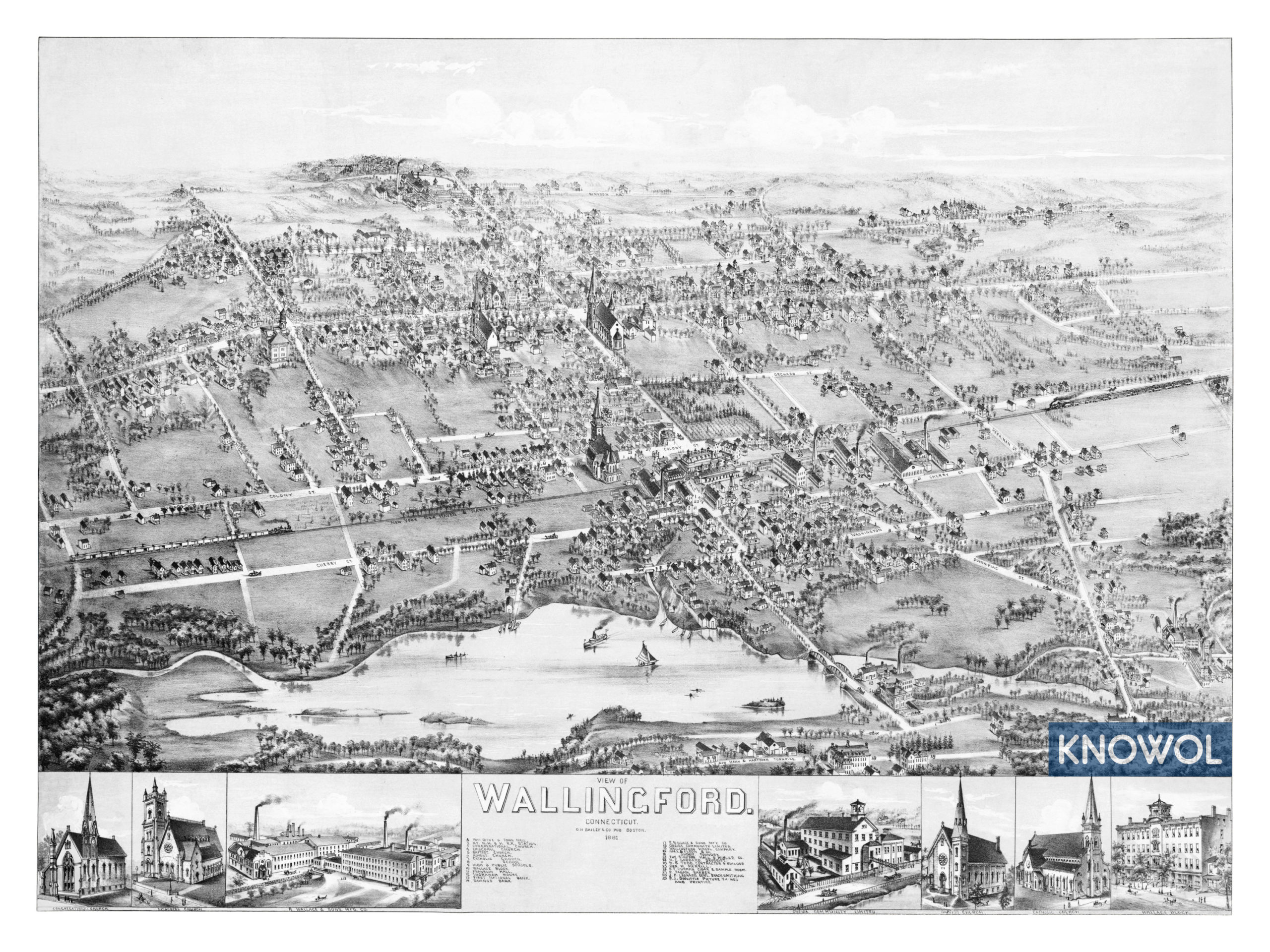
The bird's-eye view
By O.H. Bailey
Wallingford drawn as if from the sky in 1881, with the railroad station, Franklin Hall, the Oneida Community, the Wallingford Wheel Company, Doolittle Picture Frames and Printing, Leonard Blacksmithing, the Ingraham House and the churches.4
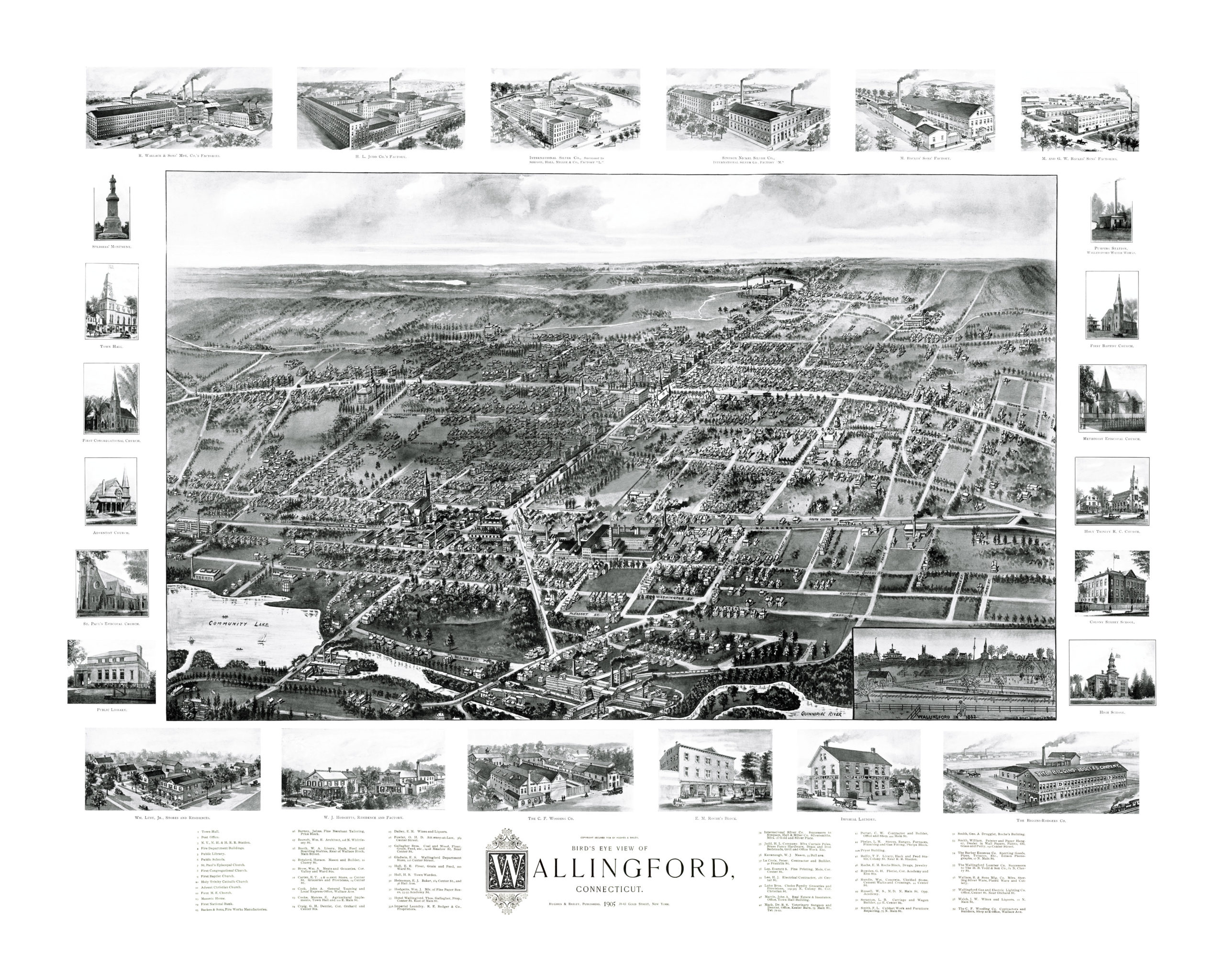
The town in 1905
By Hughes & Bailey
A detailed bird's-eye view with street names, showing Community Lake, the Wallingford Public Library, International Silver, the Masonic Home, the First National Bank, Hotel Wallingford, the Pryor Building and Scranton Carriages and Wagons.5
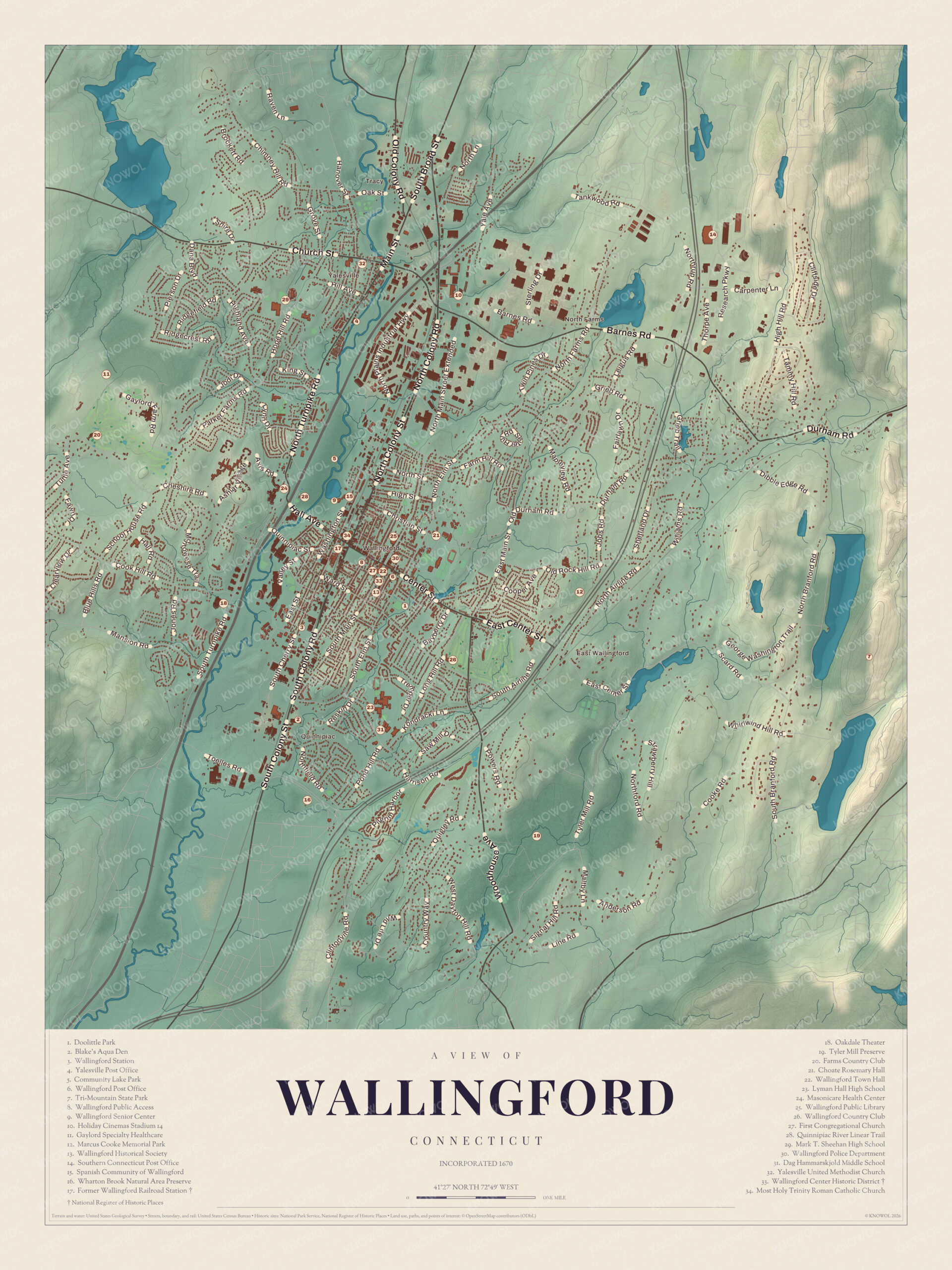
Wallingford today
By KNOWOL
Shaded hills from Tracy in the north to Tri-Mountain in the east, every street with names like Old Colony Road, the villages of Yalesville, Tracy, East Wallingford and Quinnipiac, and a guide of 34 numbered landmarks with the National Register sites marked.6
The story of Wallingford
Spoons, Britannia and German silver
About 1815 Charles Yale and his brother Hiram, who had been selling tinware in the South, brought skilled workmen over from England and began making Britannia ware, a metal harder than pewter that took a bright polish. Their works were believed to be the largest of the kind in the country. Robert Wallace had worked for the Yales, and in 1836 he bought nickel and other metals in New York, melted a few pounds and had them rolled at a mill in Waterbury. A county history says his were the first German silver spoons made in the United States. In 1847 Samuel Simpson, a Yale apprentice, began making electro-plated hollow ware, the first in America. By 1895 R. Wallace and Sons had 450 hands, and the town's 250th birthday in 1920 had a Dance of the Spoons.728910
The mill at the first falls
The planters' first mill for grinding corn stood on Wharton's Brook, south of the village, and was ready in December 1674. The spot wasn't a good one, so in 1678 the mill moved up to the natural falls on the Quinnipiac. Most settlers lived across the river, so the town kept a public canoe from 1688, and in 1694 it built a bridge, thought to be the first across the Quinnipiac in the county. Early in the 1700s the mill passed to William Tyler, and for about a hundred years the place was Tyler's Mills. In 1748 Samuel Tyler leased out his fulling mill on the condition that his two sons be taught the clothier's trade. Charles Yale later bought the mills, and in 1808 the village took his name, Yalesville.111213146
The evening of August 9, 1878
Just after six on the evening of August 9, 1878, a tornado formed over Community Lake and tore through the town. It killed about 34 people, and it is still the deadliest tornado in Connecticut's history. A little earlier the Oneida Community had seen the storm coming and sent the girls from its spoon factory home ahead of the rain, and that night its members nursed the injured. Samuel Simpson lost $5,000 in property and gave $500 for the sufferers. The next morning the Methodist minister, J. H. Beale, stood on a platform at the depot with his hat held out and collected $202.96 from the visitors. That same morning, about sixty-five miles east in Peacedale, Rhode Island, a man out walking picked up a receipt written in Wallingford.15116171819
Through the years
24 moments from 1667 to today.
- 1667On October 10 the General Assembly sets up the plantation of Wallingford for 38 planters and freemen.1
- 1670By May 12 there are 126 settlers near the Quinnipiac, where Main Street runs today.1
- 1673Rev. Samuel Street comes from New Haven to be the first settled minister, and serves 42 years.20
- 1674The town's first corn mill, on Wharton's Brook, is ready in December.11
- 1678The mill moves up to the falls on the Quinnipiac, the start of what will be Yalesville.11
- 1694The town bridges the Quinnipiac to reach the mill, probably the first bridge across the river in the county.12
- 1697Winifred Benham and her daughter face Connecticut's last witchcraft trial.1
- 1707John Moss, one of the founders, dies at the age of 103.21
- 1718The frame of a new meetinghouse goes up; its nails and glass are paid for in barrel staves.22
- 1724Lyman Hall, later a signer of the Declaration of Independence for Georgia, is born here.1
- 1735A Baptist church is organized, the third in the colony of Connecticut.23
- 1748Samuel Tyler leases his fulling mill at Tyler's Mills so his two sons can learn the clothier's trade.13
- 1758James Dana is ordained in defiance of the county's ministers, starting the Wallingford Controversy.24
- 1815About this year Charles and Hiram Yale bring workmen from England to make Britannia ware.7
- 1836Robert Wallace makes what are said to be the first German silver spoons in the United States.2
- 1839The Hartford and New Haven Railroad opens a station on the Plains.25
- 1847Samuel Simpson begins making electro-plated hollow ware, the first in America.8
- 1851Henry Allen's family starts the Wallingford branch of the Oneida Community.26
- 1871The brick depot is built, and Hall's electric railway signals are first put in use here.27
- 1878On August 9 a tornado kills about 34 people, the deadliest in Connecticut's history.1
- 1882Water from spring-fed Lake Pistapaug first flows to the borough.28
- 1890Mary Atwater Choate founds Rosemary Hall, a school for girls; the Choate School follows in 1896.6
- 1920The town turns 250 with a pageant that includes a Dance of the Spoons.10
- 1954Ben Segal opens the Oakdale as an open-air theater in an alfalfa field.6
Places to see
The numbers match the landmark guide printed on the 2026 map.
- 5Community Lake ParkWest of the center. Where the 1878 tornado began.
- 7Tri-Mountain State ParkOn the Durham line. Reached only on foot by trail.Visit their website
- 13Wallingford Historical SocietySouth of the center. Keeper of the town's history.Visit their website
- 17Former Wallingford Railroad StationDown the hill from Center Street. French Second Empire depot of 1871.
- 18Oakdale TheaterWest of the center. Opened in an alfalfa field in 1954.
- 21Choate Rosemary HallEast of Main Street. Schools founded in 1890 and 1896.Visit their website
- 22Wallingford Town HallSouth Main Street. Beaux-Arts building of 1916, once a high school.
- 27First Congregational ChurchMain and Center Streets. Brick Gothic Revival church of 1868.
- 32Yalesville United Methodist ChurchYalesville. In the village once called First Falls.
- 33Wallingford Center Historic DistrictMain Street. The old center along the ridge.
On the National Register
All 9 places in Wallingford on the National Register of Historic Places that still stand today, oldest first, and why each one matters.3
-
Center Street Cemetery
The town's oldest burying ground, with an Egyptian Revival gateway and paths lined with sycamores. Its stones span more than three centuries, from the first settlers to soldiers of every war, and Lyman Hall and Moses Yale Beach are memorialized here.29
-
Nehemiah Royce House
A saltbox built by Nehemiah Royce, a carpenter, joiner and blacksmith who was one of the town's 38 original proprietors. George Washington visited in 1775 and again in 1789. It was moved to this spot in 1924 and given to the Wallingford Historic Preservation Trust in 1999.30
-
Theophilus Jones House
One of the town's oldest buildings, it stayed in the Jones family until 1914. Charles F. Montgomery, a leading authority on American decorative arts, bought it in 1937 and restored it to its 18th-century look.31
-
Wallingford Center Historic District
The old town center along a north and south ridge, with 66 historic buildings from the mid-1700s to the early 1900s. It holds houses from Georgian to Queen Anne, three churches built between 1868 and 1870, and the business blocks of the silver families.32
-
John Barker House
Built for a prosperous farmer, it is one of the oldest brick houses in Connecticut and one of the few of its time with a gambrel roof. It looks a good deal like Connecticut Hall at Yale, built a few years earlier.33
-
Samuel Parsons House
A well-kept Georgian house with a gambrel roof, probably built by John Parsons and named for his grandson Samuel. It has been the home of the local historical society since 1919.34
-
Samuel Simpson House
The home of the silver maker Samuel Simpson, remodeled about 1867 by the New Haven architect Henry Austin. It first stood on North Main Street, and in 1987 it was sold for one dollar and moved to Scard Road to save it.35
-
Franklin Johnson House
A distinctive Italianate house with a square cupola, built for Franklin Johnson, who dealt in real estate. It is now the American Silver Museum.36
-
Wallingford Railroad Station
The brick depot the Hartford and New Haven Railroad built in the French Second Empire style. It closed to passengers in 1994 and now holds adult education and a model railroad club.37
In their words
“Wallingford thus passing down in history as the first town in the Union to make German silver ware from material prepared in this country.”
Souvenir History of Wallingford, 1895, on Robert Wallace38
“The walks and drives in and about the town are much appreciated by visitors, and the place is a most popular place for summer residents, the hospitality of Wallingford people being equal to that of the South.”
Souvenir History of Wallingford, 189539
“There have been many, very many, grand and noble deeds of self-denial and mercy which assure one that this is not a very bad world after all.”
John B. Kendrick, History of the Wallingford Disaster, 187840
Nearby towns
Sources
- Wallingford, Connecticut, Wikipedia
- History of New Haven County, Connecticut (1892), on Robert Wallace and German silver, Internet Archive
- National Register of Historic Places listings in New Haven County, Connecticut, Wikipedia
- Bird's-eye view of Wallingford, Connecticut from 1881, restored by KNOWOL
- Bird's-eye view of Wallingford, Connecticut from 1905, restored by KNOWOL
- Map of Wallingford, Connecticut in 2026, KNOWOL (USGS elevation, Census Bureau roads)
- The Brass Industry in Connecticut (1909), on the Yales' Britannia works, Internet Archive
- History of New Haven County, Connecticut (1892), on Samuel Simpson, Internet Archive
- Souvenir History of Wallingford, Connecticut (1895), on the factories, Internet Archive
- Two hundred and fiftieth birthday anniversary of Wallingford, Connecticut, official program (1920), Internet Archive
- History of New Haven County, Connecticut (1892), on the first mill, Internet Archive
- History of New Haven County, Connecticut (1892), on the canoe, the bridge and Tyler's Mills, Internet Archive
- An historic record and pictorial description of the town of Meriden, Connecticut (1906), on Tyler's Mills, Internet Archive
- History of New Haven County, Connecticut (1892), on Yalesville, Internet Archive
- 1878 Wallingford tornado, Wikipedia
- History of the Wallingford disaster (1878), on the Wallingford Community, Internet Archive
- History of the Wallingford disaster (1878), on Samuel Simpson's gift, Internet Archive
- History of the Wallingford disaster (1878), on Rev. J. H. Beale, Internet Archive
- History of the Wallingford disaster (1878), on the receipt found in Peacedale, Internet Archive
- History of New Haven County, Connecticut (1892), on Rev. Samuel Street, Internet Archive
- History of New Haven County, Connecticut (1892), on the old headstones, Internet Archive
- History of New Haven County, Connecticut (1892), on the meetinghouse of 1718, Internet Archive
- History of New Haven County, Connecticut (1892), on the Baptist church of 1735, Internet Archive
- History of New Haven County, Connecticut (1892), on the Wallingford Controversy, Internet Archive
- History of New Haven County, Connecticut (1892), on the railroad station, Internet Archive
- History of New Haven County, Connecticut (1892), on the Wallingford Community, Internet Archive
- History of New Haven County, Connecticut (1892), on Hall's railway signals, Internet Archive
- History of New Haven County, Connecticut (1892), on the water works, Internet Archive
- Center Street Cemetery (Wallingford, Connecticut), Wikipedia
- Nehemiah Royce House, Wikipedia
- Theophilus Jones House, Wikipedia
- Wallingford Center Historic District, Wikipedia
- John Barker House, Wikipedia
- Samuel Parsons House, Wikipedia
- Samuel Simpson House, Wikipedia
- Franklin Johnson House, Wikipedia
- Wallingford station (Connecticut), Wikipedia
- Souvenir History of Wallingford, Connecticut (1895), on Robert Wallace, Internet Archive
- Souvenir History of Wallingford, Connecticut (1895), on the town, Internet Archive
- History of the Wallingford disaster (1878), preface, Internet Archive