
A coastal town on Ipswich Bay, settled as Agawam in 1633, known for its clam flats and the dunes of Castle Neck, for the women who made its lace and the mills that made its stockings, and for old houses like the one John Whipple began in 1677.
Then and now
The same town 133 years apart. Click either map to look closer.
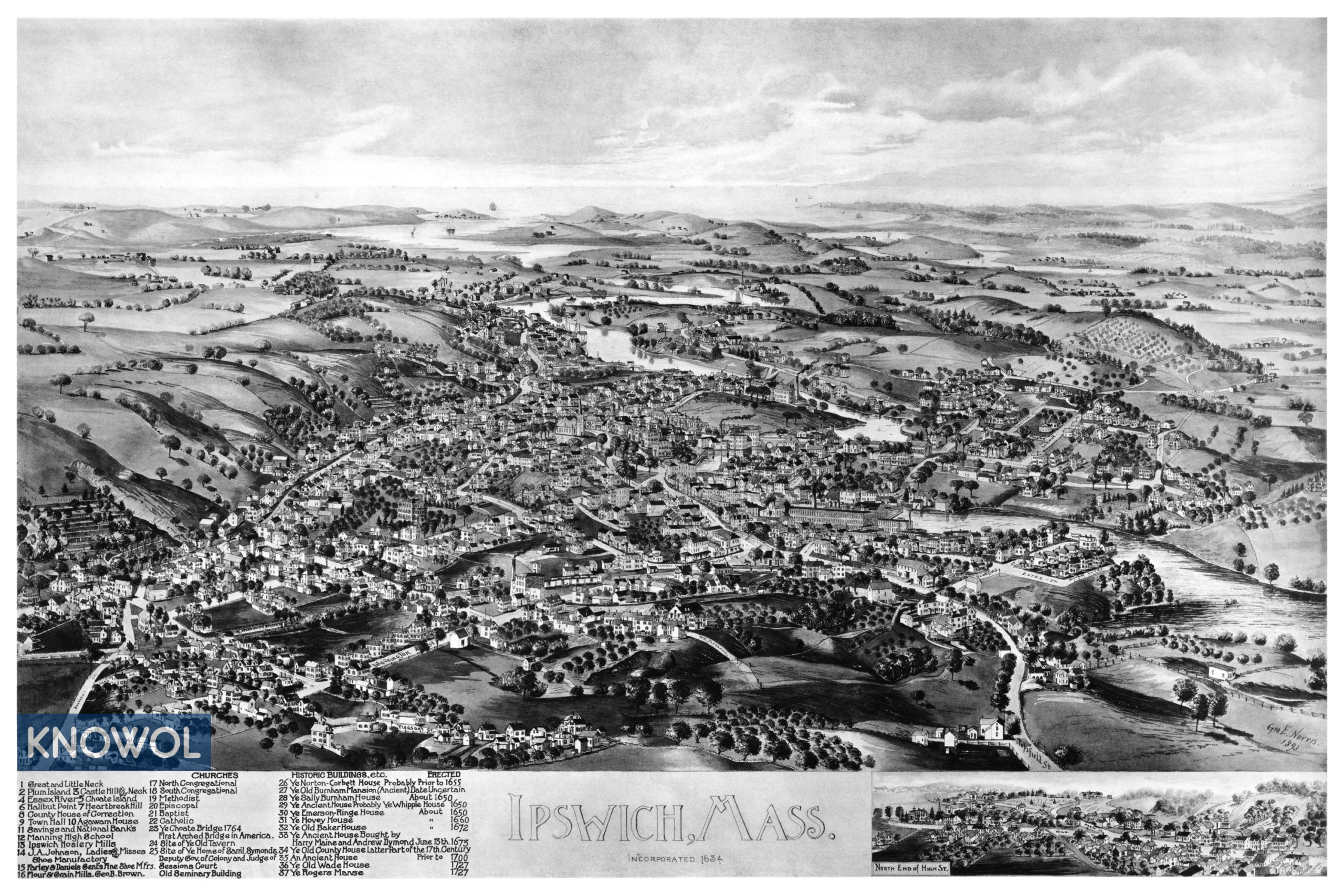
The bird's-eye view
By George Norris
Ipswich drawn as if from the sky in 1893, with Great and Little Neck, Plum Island, the Essex River, Choate Island, Heartbreak Hill, the Town Hall, Manning High School, the Ipswich Hosiery Mills, the Old Seminary Building and Ye Old Baker House.5
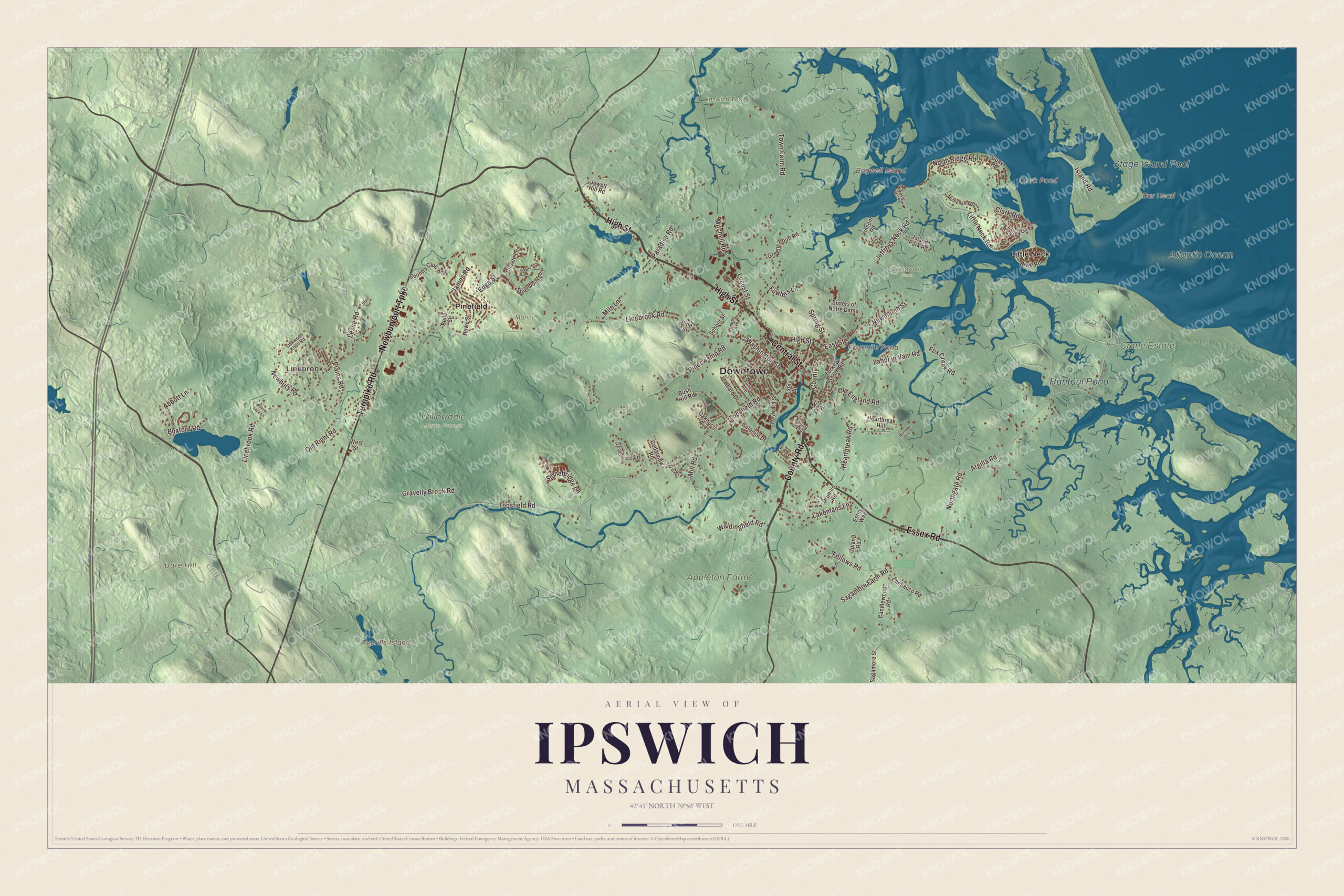
Ipswich today
By KNOWOL
Shaded relief from Willowdale State Forest in the west to the dunes of Crane Beach, with County Road, Central Street, High Street and the Newburyport Turnpike, Little Neck, Averills Island, Bagwell Island, Stage Island Pool, Clark Pond and Bare Hill.6
The story of Ipswich
Lace in the butter pots
Ipswich women made lace long before there were factories. A writer in 1692 said silk and thread lace was made here in large quantities by women and children, for use and for sale abroad, and one count put the town's output at 42,000 yards of silk lace and edgings in a year. Britain fined anyone who shipped stocking and lace machines to America, and the story went that the needles and bobbins came into Boston hidden in pots of Yorkshire butter. A stocking machine reached Ipswich in 1822, and Benjamin Fewkes wove its first pair in a kitchen where the South Congregational Church later stood. A lace factory ran here until 1832, when a British duty on thread ruined it, and the lace makers went back to stockings.3789
Clams, dunes and a sparrow
People in Ipswich have looked after the clam flats for a long time. In 1763 the commoners who owned the flats passed what the town historian Thomas Franklin Waters called the first rule he knew of: dig only for your own use, and a fishing crew bound for the Banks could take one barrel of clams a man. The naturalist Charles Townsend wrote in 1913 that the clam had made Ipswich famous, with shells thin, white and clean from the sand. He also checked the dunes at Castle Neck against a map drawn in 1786 and found they'd grown eleven hundred feet toward the sea in 124 years. The dunes even gave a bird its name: the Ipswich Sparrow, which a 1905 book says walks and runs instead of hopping.10111213
Firetown, Heartbreak Hill and Harry Main
Old Ipswich had a name and a story for every corner. Linebrook, out in the western part of town, was once called Firetown for the fires in its woods, and a 1921 writer said the people there rejected the name, though it beat Flytown, Hogtown and Pudd'n Street. Heartbreak Hill has a legend Celia Thaxter put into verse, of a Native woman who watched from the hilltop for a sailor who never came back. A children's book of 1892 told how a rock on the church green held the devil's footprint, left when George Whitefield preached. And out at Ipswich Bar, the old verses say, Harry Main is chained for a thousand years, so when the sea cries he's growling at his work.14151617
Through the years
25 moments from 1633 to today.
- 1633John Winthrop the Younger and 12 men sail into Ipswich harbor and settle at Agawam.1
- 1634Agawam is incorporated as Ipswich on August 5.1
- 1634The ship Elizabeth sails from Ipswich in England on April 30, bringing the founders of many Ipswich families.18
- 1635About this year the town keeps two rods along each bank of the river as a common, so the whole river stays free for fishing.19
- 1641The colony orders quarter courts to sit by turns at Ipswich and Salem.20
- 1650John Cross gives ten shillings a year forever to the free school of Ipswich.21
- 1677Captain John Whipple begins the house that's now the Whipple House museum.22
- 1687Rev. John Wise leads the town's protest against Governor Andros's tax.1
- 1692A writer notes that women and children here make silk and thread lace in large quantities.3
- 1746The western parts of Ipswich and Rowley become a parish, later named Linebrook.23
- 1763The commoners pass the town's first known rule on digging clams.10
- 1764The two-arched stone Choate Bridge is built over the Ipswich River.24
- 1817A brick fireproof building goes up for the county's probate records.25
- 1822A smuggled stocking machine reaches Ipswich, and lace machines start work in a factory on the South Side.78
- 1825An academy building is put up, and Zilpah Grant takes charge of the school there.26
- 1828The Ipswich Female Seminary is founded.1
- 1832The lace factory closes after Britain puts a heavy export duty on thread.9
- 1854The Court of Common Pleas sits in Ipswich for the last time.27
- 1868Amos A. Lawrence starts the Ipswich Hosiery Mills beside the river.1
- 1884Ipswich celebrates its 250th anniversary.28
- 1893George Norris publishes his bird's-eye view of Ipswich.5
- 1907Harry B. Brown's Brown Stocking Company is incorporated and builds a mill village.29
- 1910Richard T. Crane Jr. of Chicago buys Castle Hill.1
- 1928The 59-room Great House is finished on top of Castle Hill.30
- 1949The Crane estate goes to The Trustees of Reservations.1
On the National Register
All 31 places in Ipswich on the National Register of Historic Places that still stand today, oldest first, and why each one matters.4
-
High Street Historic District
The oldest part of High Street, laid out when Ipswich was founded, where the inns and the circuit courts once were. It holds more than thirty buildings from before 1750, including a house of about 1660 on the site of Governor Simon Bradstreet's first house.31
-
Meetinghouse Green Historic District
The green was laid out in 1634 and was for years the heart of the town, with the meeting house, the jail, the pound and the stocks. Churches and the public library still stand around it among about thirty houses.32
-
East End Historic District
The part of town near the Town Wharf where the first houses were built, once busy with shipbuilding, fishing, lumber, pottery and tanning. It now has more than sixty houses from the First Period through the 1800s.33
-
Giddings-Burnham House
Probably built in the 1640s by George Giddings, who sold it to his brother-in-law Thomas Burnham in 1667, the earliest deed for the property.34
-
Nathaniel Rust Mansion
A house with First Period origins, first recorded when Deacon William Goodhue sold it to the tanner Nathaniel Rust in 1665. It stood on the South Green until Asa Brown moved it to County Street in 1837.35
-
Dr. John Calef House
Built by Deacon Thomas Knowlton on South Main Street and given Georgian styling in the 1700s. John Heard moved it to its present spot after 1777 to make room for a grander house.36
-
James Burnham House
Probably the house James Burnham bought from Samuel Poad in 1677. Its large rooms, joist spacing and steep roof show it was built well before 1700, though later changes hide that inside.37
-
John Whipple House
National Historic Landmark
Captain John Whipple began it in 1677, a date confirmed by tree-ring dating in 2002. The Ipswich Historical Society opened it as a museum in 1899, it was moved across the river to the South Green in 1927, and it became a National Historic Landmark in 1960.22
-
Ross Tavern
A house of about 1680 that stood beside the Choate Bridge as the Ross Tavern. In 1940 Daniel Stone Wendel took it apart, moved it to Jeffrey's Neck and joined it to the Lord-Collins House.38
-
South Green Historic District
The town voted to lay out the South Green in 1686 for grazing and militia training, and early schools stood here. The Whipple House anchors a group of houses from the 1600s to the 1800s.39
-
Shoreborne Wilson House
Built between 1685 and 1692 by Shoreborne Wilson, a cooper. Captain Samuel Appleton bought it in 1702 and probably finished the other half.40
-
Paine-Dodge House
A saltbox built by Robert Paine Jr. on his family's farm on Jeffreys Neck, dated by tree rings to 1694. The farm, now Greenwood Farm, is cared for by The Trustees of Reservations.41
-
Isaac Goodale House
A First Period house probably built by Isaac Goodale near what is now Peabody. His descendant Dr. Robert Goodale moved it to Ipswich in 1928 and restored it.42
-
Thomas Low House
First named in a 1708 deed from John Low to his brother Thorndike. It began as a two-room house and was restyled in the Federal period.43
-
Howe Barn
One of the few First Period barn frames left in Essex County, built by family tradition by Abraham Howe, an early settler on Linebrook Road. It was made into a house in 1948.44
-
Smith House
A late First Period house, perhaps built by Abraham Tilton Jr. Badly burned in 1998, it was carefully restored with period methods.45
-
House on Labor-in-Vain Road
The center of a marshland estate of more than 600 acres, with First Period and early Georgian work inside and a wing added about 1810.46
-
Burnham-Patch House
Built on land Thomas Burnham bought in 1667, reusing beams from an older house. Colonel John Patch, a Revolutionary War leader, owned it from 1795, and Abner Day kept a tavern here from 1814.47
-
Benjamin Grant House
A well-kept early Georgian house built by Benjamin Grant, who was killed in the French and Indian War. The Ross family owned it well into the 1900s.48
-
Choate Bridge
A two-arched stone bridge built under Colonel John Choate with town and county money, widened in 1838. It is one of the oldest surviving bridges in North America and probably the oldest in Massachusetts.24
-
Heard-Lakeman House
Built by Nathaniel and John Heard and sold in 1795 to Richard Lakeman III of a seafaring family. Its huge chimney stands on an arched foundation more than 11 feet long.49
-
Merrifield House
Also called Rosebank, built by Francis Merrifield Jr., a Revolutionary War veteran. It has rambling additions and an unusual second cooking fireplace upstairs.50
-
Wade House
A gambrel-roofed house built by Francis Merrifield Jr. Mary Wade, daughter of the Revolutionary soldier Nathaniel Wade, bought it in 1827, and it has stayed in the Wade family since.51
-
Ipswich Mills Historic District
Amos Adams Lawrence's Ipswich Mill Company bought this old mill site in 1868 and grew into the world's largest hosiery maker from 1916 to 1919. Two mill buildings, including the 1880 yarn mill, survive among streets of company-built worker houses.52
-
Caldwell Block
Built by Luther Caldwell on the site of a burned woolen mill, it is the oldest surviving building in Ipswich made for shops and offices. John Updike kept his writing office here from 1961 to 1974.53
-
Brown's Manor
A brick Second Empire house with a mansard roof, probably built by George Brown, from a family known locally for building houses.54
-
Bailey House
Home and office of Doctor Bailey, a leading local physician, on a hill above downtown. It is one of the most elaborate Queen Anne and Colonial Revival houses in central Ipswich.55
-
Turner Hill
A country estate designed by William Rantoul for Charles and Ann Rice after the estates they saw in Europe. It later became a retreat of the Missionaries of La Salette and is now a golf club.56
-
Brown Stocking Mill Historic District
Worker housing built by Harry S. Brown, a supervisor at the Ipswich Mills who started his own stocking company in 1906. The mill itself is gone, but the houses of his village remain.57
-
Benjamin Stickney Cable Memorial Hospital
A Georgian Revival hospital paid for largely by Richard T. Crane Jr. in memory of his friend Benjamin Stickney Cable. It closed in 1980 and became apartments.58
-
Castle Hill
National Historic Landmark
Richard T. Crane Jr.'s summer estate on a drumlin above Ipswich Bay, with the Great House by David Adler and a Grand Allee laid out by the Olmsted Brothers and Arthur Shurcliff. A National Historic Landmark since 1998, it belongs to The Trustees of Reservations and is open to the public.30
In their words
“"Young man, go West," said Horace Greeley; but Mr. Greeley had never visited Ipswich, or he would have said, "Young man, go to Ipswich."”
A speaker at the town's 250th anniversary celebration, 188428
“From under the low rafters of these gambrel roofs which lean toward the street, generations of the salt of the earth have been sifted throughout the States”
Old paths and legends of New England, 190359
“But after all the most famous bivalve of these shores, one which in its turn has made Ipswich famous, is the clam”
Charles W. Townsend, Sand dunes and salt marshes, 191311
Nearby towns
Sources
- Ipswich, Massachusetts, Wikipedia
- A gazetteer of Massachusetts, by John Hayward (1849), Internet Archive
- Ipswich in the Massachusetts Bay Colony, by Thomas Franklin Waters (1905), on hand-made lace, Internet Archive
- National Register of Historic Places listings in Ipswich, Massachusetts, Wikipedia
- Restored map of Ipswich, Massachusetts from 1893, KNOWOL
- Map of Ipswich, Massachusetts in 2026, KNOWOL (USGS elevation, Census Bureau roads)
- Municipal history of Essex County in Massachusetts (1922), on the first stocking machine, Internet Archive
- Ipswich in the Massachusetts Bay Colony, by Thomas Franklin Waters (1905), on the lace factory, Internet Archive
- Ipswich in the Massachusetts Bay Colony, by Thomas Franklin Waters (1905), on the end of lace weaving, Internet Archive
- Ipswich in the Massachusetts Bay Colony, by Thomas Franklin Waters (1905), on the clam flats, Internet Archive
- Sand dunes and salt marshes, by Charles W. Townsend (1913), on the Ipswich clam, Internet Archive
- Sand dunes and salt marshes, by Charles W. Townsend (1913), on the growth of the dunes, Internet Archive
- The Birds of Essex County, Massachusetts, by Charles W. Townsend (1905), on the Ipswich Sparrow, Internet Archive
- Historical Collections of the Topsfield Historical Society (1921), on Linebrook and Firetown, Internet Archive
- Essex Institute Historical Collections, vol. 81 (series begun 1859), on Heartbreak Hill, Internet Archive
- Stories of Massachusetts (1892), on the footprint on the church green, Internet Archive
- Sand dunes and salt marshes, by Charles W. Townsend (1913), on Harry Main, Internet Archive
- Publications of the Colonial Society of Massachusetts (1892), on the ship Elizabeth, Internet Archive
- Suffolk deeds, liber I to XIV (1880), deposition of Ralph Dix, Internet Archive
- Municipal history of Essex County in Massachusetts (1922), on the quarter courts, Internet Archive
- Records and files of the Quarterly Courts of Essex County, Massachusetts (1914), on John Cross's gift to the free school, Internet Archive
- John Whipple House, Wikipedia
- Essex Institute Historical Collections, vol. 54 (series begun 1859), on Linebrook Parish, Internet Archive
- Choate Bridge, Wikipedia
- Essex Institute Historical Collections, vol. 4 (series begun 1859), on the probate office, Internet Archive
- Essex Institute Historical Collections, vol. 88 (series begun 1859), on Zilpah Grant, Internet Archive
- Ipswich in the Massachusetts Bay Colony, by Thomas Franklin Waters (1905), on the courts leaving Ipswich, Internet Archive
- The celebration of the two hundred and fiftieth anniversary of the town of Ipswich, Massachusetts (1884), Internet Archive
- Genealogical and personal memoirs relating to the families of Boston and eastern Massachusetts (1908), on the Brown Stocking Company, Internet Archive
- Castle Hill (Ipswich, Massachusetts), Wikipedia
- High Street Historic District (Ipswich, Massachusetts), Wikipedia
- Meetinghouse Green Historic District, Wikipedia
- East End Historic District (Ipswich, Massachusetts), Wikipedia
- Giddings-Burnham House, Wikipedia
- Nathaniel Rust Mansion, Wikipedia
- Dr. John Calef House, Wikipedia
- James Burnham House, Wikipedia
- Ross Tavern, Wikipedia
- South Green Historic District (Ipswich, Massachusetts), Wikipedia
- Shoreborne Wilson House, Wikipedia
- Greenwood Farm (Ipswich, Massachusetts), on the Paine-Dodge House, Wikipedia
- Isaac Goodale House, Wikipedia
- Thomas Low House, Wikipedia
- Howe Barn, Wikipedia
- Smith House (Ipswich, Massachusetts), Wikipedia
- House on Labor-in-Vain Road, Wikipedia
- Burnham-Patch House, Wikipedia
- Benjamin Grant House, Wikipedia
- Heard-Lakeman House, Wikipedia
- Merrifield House, Wikipedia
- Wade House (Ipswich, Massachusetts), Wikipedia
- Ipswich Mills Historic District, Wikipedia
- Caldwell Block, Wikipedia
- Brown's Manor, Wikipedia
- Bailey House (Ipswich, Massachusetts), Wikipedia
- Turner Hill, Wikipedia
- Brown Stocking Mill Historic District, Wikipedia
- Benjamin Stickney Cable Memorial Hospital, Wikipedia
- Old paths and legends of New England (1903), Internet Archive