
A Route 9 village between Lake Lashaway and Quaboag Pond, where a mill dam, an iron furnace and a brickyard came long before the town did, and which became the newest town in Massachusetts in 1920.
East Brookfield on the map
Click the map to look closer.
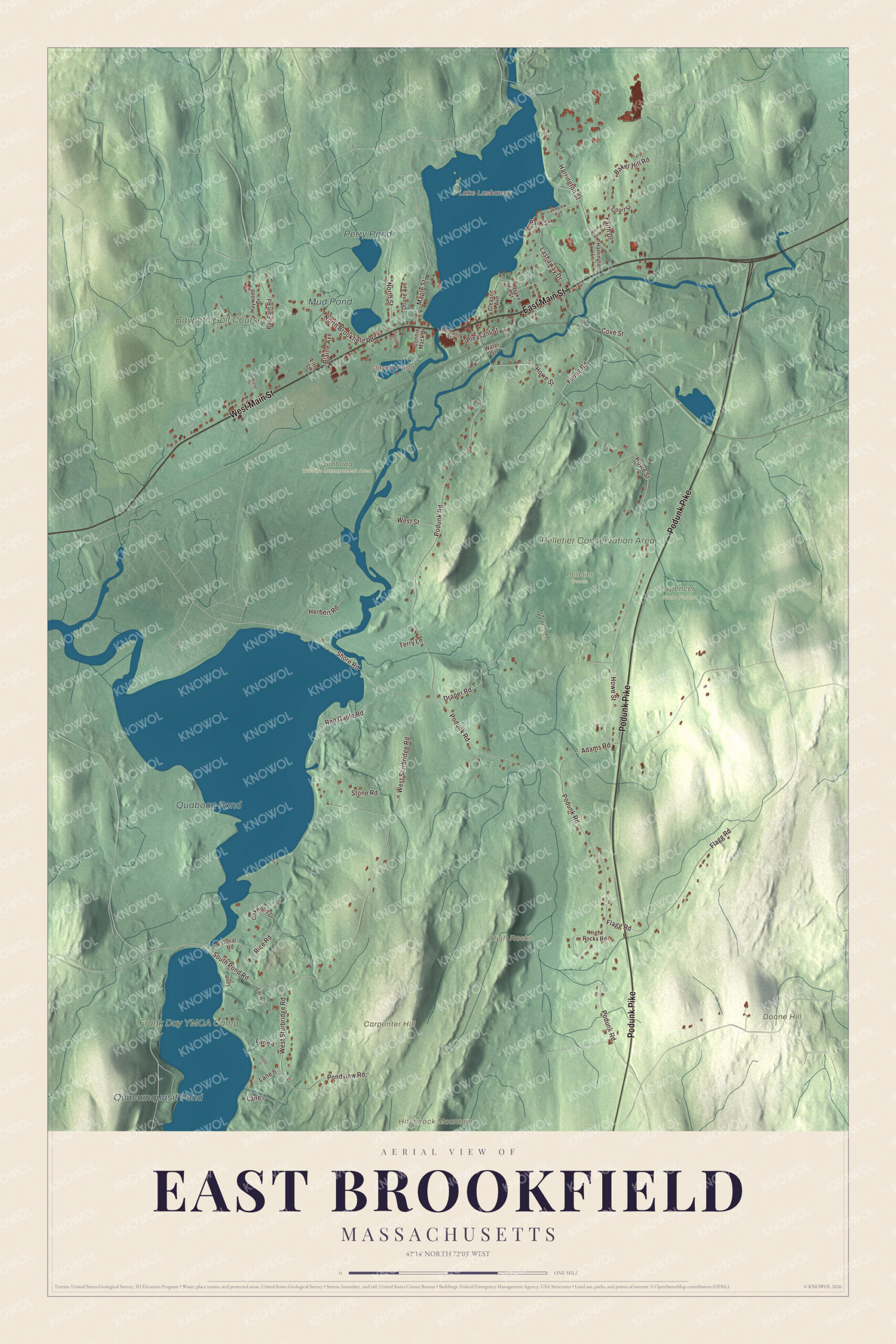
East Brookfield today
By KNOWOL
Shaded relief from Lake Lashaway down to Quaboag, Quacumquasit and Claypit ponds, with Carpenter Hill, Doane Hill and High Rocks, and roads like East Main Street, Podunk Road, Shore Road and North Brookfield Road.6
The story of East Brookfield
Iron, brick and wool by the mill dam
East Brookfield grew up around water power. An 1899 county biography calls Jeduthan Stevens the first settler on the site of the village, and says he built the dam and an iron foundry said to be the first in Worcester County. The 1879 county history remembers a furnace here that smelted iron ore brought from Wickaboag Pond, and a bed of fine clay near the village where pottery was once made. In 1845 Freeman Walker and his brother Amasa bought the water privilege and built a furnace, a brick factory, a store and a saw mill, and in 1848 they added a reservoir dam at Brooks Pond. In the 1890s the Parmenter brickworks hired about 125 men in the busy season, and in 1897 the Mann & Stevens Woollen Company moved all its work here.789410
Connie Mack's town team
Cornelius McGillicuddy was born on December 22, 1862, in what is now East Brookfield, then still part of Brookfield. He went to school here and started working summers in the local cotton mills at age 9 to help support his family. He played ball with the local boys, and in 1879 he made East Brookfield's town team, which took on the other town teams nearby. He was several years younger than his teammates, but he was their catcher and, in practice, their captain. The world came to know him as Connie Mack, manager and longtime owner of the Philadelphia Athletics. The town also tells how George M. Cohan spent boyhood summers with relatives in Podunk, its old village, and made the name famous on the vaudeville stage.11112
Fort Hill and the depot
Two rivers meet at East Brookfield village. The 1887 History of North Brookfield says the Five-mile and Seven-mile rivers unite here and run into the northeast corner of Quaboag Pond, which was once called Podunk Pond. In the fork of those streams there once stood a steep, cone-shaped hill called Fort Hill. Its top had been leveled and ringed with a rough earthwork, and the book thought it was probably a Native fort first. When the railroad came, the hill's earth was dug away to fill the meadows, and the East Brookfield station and freight yard took much of the site. By 1846 the village sat on the Western Railroad, sixty-four miles from Boston, and on January 1, 1876, the North Brookfield Railroad opened its four and a half miles of track to the East Brookfield depot.1314151617
Through the years
20 moments from 1664 to today.
- 1664English settlement begins here as part of the Quaboag Plantation lands.1
- 1673The land becomes part of the new town of Brookfield.1
- 1786Eleven people sign a compact that starts the Baptist society later based at East Brookfield.18
- 1795The Baptist society puts up its meetinghouse.18
- 1825About this year Jeduthan Stevens begins the dam that makes Lake Lashaway, to run grist and saw mills.3
- 1844Samuel Belyea leaves East Brookfield to oversee the woodwork of the Lancaster Mills in Clinton.19
- 1845Freeman and Amasa Walker buy the water privilege and build a furnace, a brick factory, a store and a saw mill.9
- 1846A state gazetteer places the village on the Western Railroad, sixty-four miles from Boston.16
- 1848The Walkers build a reservoir dam at Brooks Pond to add to the village's water power.9
- 1862Cornelius McGillicuddy, later known as Connie Mack, is born on December 22.11
- 1876On January 1 the North Brookfield Railroad opens its line to the East Brookfield depot.17
- 1879Connie Mack joins East Brookfield's town team as its catcher.11
- 1879The county history notes the village foundry and new works on the old clay bed.8
- 1882The Hodgkins School opens.20
- 1897The Mann & Stevens Woollen Company moves all its work to East Brookfield.10
- 1916The West Suburban YMCA begins running Camp Frank A. Day on Quacumquasit Pond.21
- 1920East Brookfield becomes a town on March 24, the newest in Massachusetts.2
- 1921The public library is established.1
- 1967Lake Lashaway and its dam are deeded to the town.3
- 2002The Hodgkins School closes; the old building now houses the Historical Museum.20
Places to see
Places worth a visit in East Brookfield today.
- Lake LashawayNorth of Route 9. Jeduthan Stevens's mill pond, now 293 acres.
- Quaboag PondSouth of the village. Once called Podunk Pond.
- Quacumquasit PondSouthwest of the center. Also known as South Pond.
- Camp Frank A. DayQuacumquasit Pond. YMCA summer camp since 1916.Visit their website
- Hodgkins SchoolSchool Street. Now the East Brookfield Historical Museum.
- Depot SquareTown center. Triangular crossroads by the town offices.
- Redmans HallDepot Square. Senior center and some town meetings.
- High RocksSouth of the marshes. Hilly woods near old Podunk.
- Podunk RoadToward the Sturbridge line. Small cemetery of the vanished village.
- Carpenter HillEast Brookfield. One of the town's hills.
On the National Register
All 1 places in East Brookfield on the National Register of Historic Places that still stand today, oldest first, and why each one matters.5
In their words
“In 1848 built the reservoir dam at what is known as Brooks Pond, thereby adding greatly to the water-power at East Brookfield, and thus laying the foundation of all the business and improvements that exist on the premises at the present day.”
Freeman Walker, in the History of North Brookfield, 18879
“Formerly there was a furnace in this village, and the smelting of iron-ore was quite a business.”
History of Worcester County, 1879, on East Brookfield8
“Near the east village is a bed of clay of superior quality, and at one time pottery was manufactured in considerable quantities.”
History of Worcester County, 18798
Nearby towns
Sources
- East Brookfield, Massachusetts, Wikipedia
- City and Town Incorporation and Settlement Dates, Secretary of the Commonwealth of Massachusetts (archived copy)
- Lake Lashaway, Wikipedia
- Biographical review of leading citizens of Worcester County, Massachusetts (1899), on the Parmenter Manufacturing Company, Internet Archive
- National Register of Historic Places listings in Worcester County, Massachusetts, Wikipedia
- Map of East Brookfield, Massachusetts in 2026, KNOWOL (USGS elevation, Census Bureau roads)
- Biographical review of leading citizens of Worcester County, Massachusetts (1899), on Pliny S. Doane and Jeduthan Stevens, Internet Archive
- History of Worcester County, Massachusetts (1879), on the Town of Brookfield, Internet Archive
- History of North Brookfield, Massachusetts (1887), Freeman Walker on the East Brookfield water privilege, Internet Archive
- Biographical review of leading citizens of Worcester County, Massachusetts (1899), on George Mann, Internet Archive
- Connie Mack, Wikipedia
- George M. Cohan, Wikipedia
- History of North Brookfield, Massachusetts (1887), on the Quabaug River, Internet Archive
- History of North Brookfield, Massachusetts (1887), on Fort Hill, Internet Archive
- Quaboag Pond, Wikipedia
- A gazetteer of Massachusetts (1846), Internet Archive
- History of Worcester County, Massachusetts (1879), on the North Brookfield Railroad, Internet Archive
- History of North Brookfield, Massachusetts (1887), on the Baptist Society, Internet Archive
- History of the origin of the town of Clinton, Massachusetts, 1653-1865 (1896), Internet Archive
- Hodgkins School, Wikipedia
- Camp Frank A. Day, West Suburban YMCA
- 1767 Milestones, Wikipedia