
The first Springfield in the New World, planted by William Pynchon in 1636 on the bluffs above the Connecticut River, where the nation's first federal armory, the first American gasoline car and the game of basketball all got their start.
Springfield, Massachusetts on the map
Click the map to look closer.
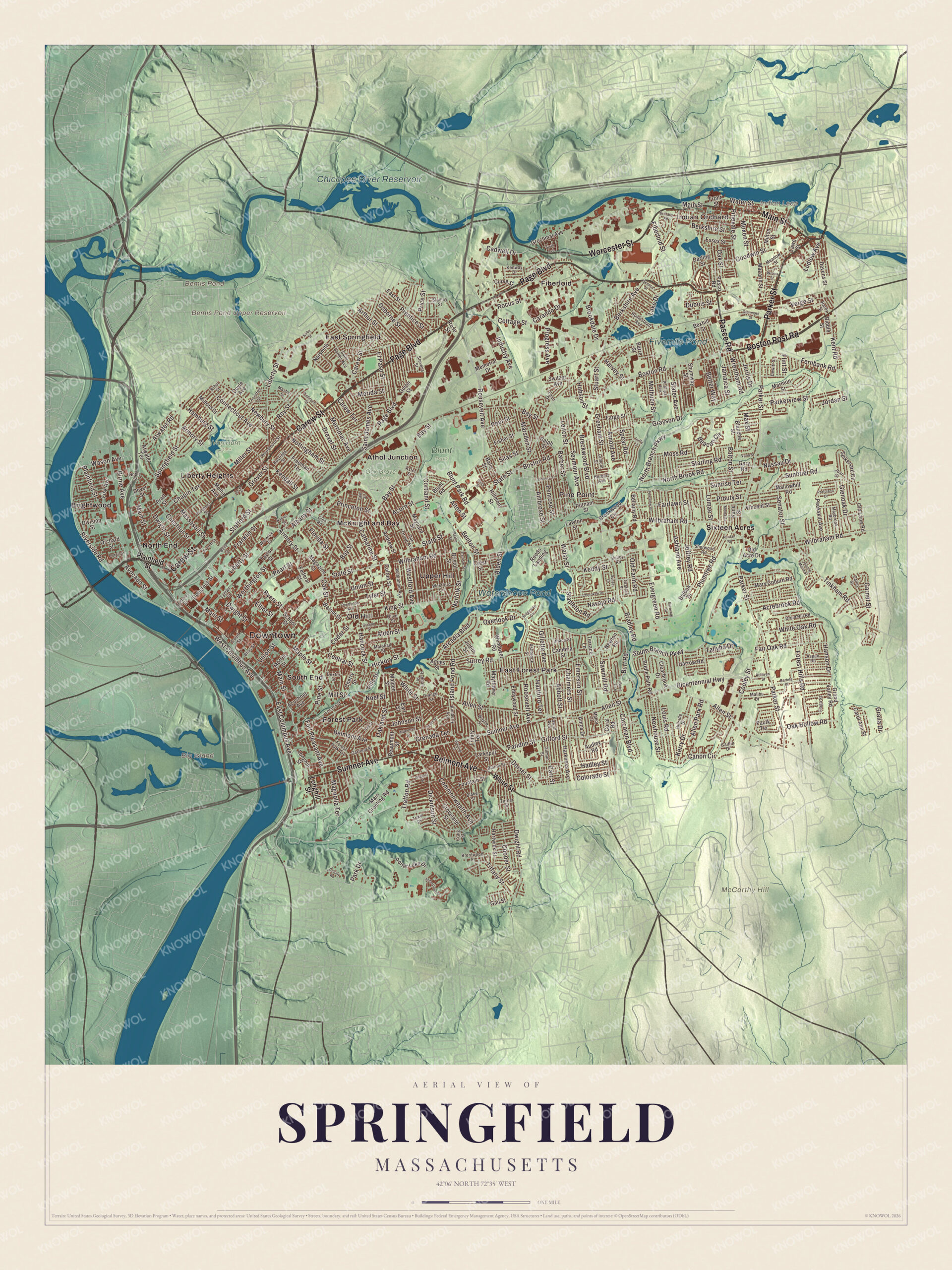
Springfield today
By KNOWOL
The whole city on the east bank of the Connecticut River, from Indian Orchard on the Chicopee River to East Forest Park, tied together by Main Street, Page Boulevard, Carew Street and the Boston Post Road, with Watershops Pond, Bemis Pond and McCarthy Hill.2
The history of Springfield, Massachusetts
The toll Springfield never paid
When Saybrook Fort was built at the mouth of the Connecticut River, every boat going up the river was told to pay a toll for its upkeep. The Connecticut towns paid. Springfield wouldn't. Josiah Holland's 1855 history of western Massachusetts calls what followed the most serious quarrel ever between the two colonies. Connecticut bought the fort in 1644, and with it the claim for Springfield's unpaid tolls. When the commissioners of the United Colonies ruled for Connecticut, Springfield refused again, and Massachusetts answered by charging tolls on ships from the other colonies entering Boston Harbor. The fight nearly broke up the union of the colonies before bigger troubles pushed it aside. Two hundred years later, Holland wrote, the bill was still unpaid.45
The red house that named Brightwood
Dr. J. G. Holland gave up medicine for writing in Springfield. He worked for the Springfield Republican and wrote his History of Western Massachusetts here. On the bluff in the north part of the city he built a fine house, painted it a glowing Venetian red and called it Brightwood, and the name spread to the whole neighborhood. When Holland left to edit Scribner's magazine in New York, George C. Fisk, president of the Wason railroad car company, bought the house. In 1885 Fisk built the Casino at Brightwood, a hall where neighbors put on their own shows. By 1890 the Wason company's great car works made Brightwood one of the busiest villages inside the city.6789
Indian Orchard, the mill village
Indian Orchard grew up as a planned mill village on the Chicopee River. Rev. Samuel Osgood and Charles Stearns bought land on both banks for the water power, and in 1839 they formed the Indian Orchard Canal Company. Work on a dam began in 1845, and in 1847 Rev. F. A. Barton, a minister and engineer from Chicopee, took charge. He graded the streets and built the Number 1 Mill, a machine shop and a branch railroad to the Western Railroad. Later came the Hodges Fiber Carpet Company, which claimed to be the first maker of fiber carpets, and the Fiberloid Corporation. In 1921 a local booklet said the village had grown from about 1,500 people to about 9,000 in thirty years. Where the name came from, an 1879 history admits, nobody knows.10111213
Springfield, Massachusetts through the years
19 moments from 1636 to today.
- 1636William Pynchon founds the settlement as Agawam Plantation.2
- 1641The plantation is renamed for Pynchon's hometown of Springfield in Essex, England.2
- 1644Connecticut buys Saybrook Fort and its claim for river tolls that Springfield has refused to pay. Springfield refuses again.4
- 1675In King Philip's War most of the settlement burns, and many people survive in John Pynchon's brick house.1
- 1777George Washington approves the site of the Springfield Armory, the country's first federal armory.2
- 1787Shays' Rebellion nearly captures the armory.1
- 1794The armory makes the first American musket.2
- 1836Gunn's Block goes up at State and Walnut Streets for a West India goods business that sends wagons east to Charlton.14
- 1839The Indian Orchard Canal Company is formed to use the water power of the Chicopee River.10
- 1847Rev. F. A. Barton takes charge at Indian Orchard, grades its streets and builds the Number 1 Mill.10
- 1852Springfield is incorporated as a city.2
- 1860George Ashmun of Springfield presides over the Republican convention that nominates Abraham Lincoln.15
- 1880Charles and Edward Bellamy start the Daily News, a one-cent paper.16
- 1885George C. Fisk builds the Casino at Brightwood, a hall for neighborhood shows.8
- 1891Dr. James Naismith invents basketball in Springfield.2
- 1893The Duryea brothers build the first American gasoline-powered car here.2
- 1901The Indian Motocycle company is founded in Springfield.2
- 1968The armory closes, and the Basketball Hall of Fame opens its first building in the city.2
- 2011A tornado strikes the city on June 1, killing three people and leaving more than 500 homeless.1
Places to see in Springfield, Massachusetts
Places worth a visit in Springfield today.
- Court SquareDowntown, Main Street. The city's civic heart since 1636.
- Springfield Armory National Historic SiteArmory Square. The first federal armory, closed 1968.Visit their website
- Naismith Basketball Hall of FameConnecticut riverfront. Basketball was invented here in 1891.Visit their website
- Dr. Seuss National Memorial Sculpture GardenThe Quadrangle. Bronze Seuss figures among five museums.Visit their website
- St. John's Congregational ChurchOld Hill. John Brown's church, 1846 to 1850.
- Forest ParkSouthwest corner of the city. 735 acres ringed by Victorian houses.
- Watershops PondMill River. 186 acres, first called Lake Massasoit.
- Indian OrchardChicopee River. Mill village begun in the 1840s.
- First Congregational ChurchIndian Orchard. The city's third-oldest church, 1863.
Springfield on the National Register of Historic Places
20 of the 82 places in Springfield on the National Register of Historic Places that still stand today, oldest first, and why each one matters. See the full list of National Register places in Springfield.3
-
Court Square Historic District
The city's central plaza and its one topographical constant since its founding in 1636. The Old First Church, the Hampden County Courthouse and the Municipal Group stand around it.17
-
Springfield Armory National Historic Site
The first federal armory, it made the country's military firearms from 1777 until it closed in 1968 and saw a confrontation in Shays' Rebellion. Its shops pioneered interchangeable parts and assembly-line production, and the national historic site holds the world's largest collection of historic American firearms.18
-
First Church of Christ, Congregational
Old First Church, gathered in 1637, the year after Springfield was founded. The present building of 1819, the fourth on the site, faces Court Square, and Daniel Webster and John Brown both visited it.19
-
Mills-Stebbins Villa
Described as the "best work" of architect Henry A. Sykes, this Italian style villa was built between 1849 and 1851 for John Mills, a prominent Springfield attorney.20
-
Water Shops Armory
The armory's heavy manufacturing complex, built beginning in 1857 on the Mill River below the dam that holds Watershops Pond, where water power drove the forging, machining and gunstock shaping.21
-
Republican Block
Built in 1858, it heralded the northward expansion of the downtown north of Court Square, and was the first permanent home of the Springfield Republican, one of the state's oldest newspapers. It was listed on the National Register of Historic Places in 1978.22
-
McKnight District
One of the first planned residential neighborhoods in the United States, begun in 1870 by John and William McKnight, who set building rules and built and landscaped many of its mostly Queen Anne houses.23
-
Hampden County Courthouse
Henry Hobson Richardson designed it in gray Monson granite after a grand jury indicted the county commissioners in 1869 because the old courthouse had no fireproof storage for records. Begun in 1871 and dedicated in 1874, it was called the most impressive Springfield building of its period.24
-
South Congregational Church
William Appleton Potter's High Victorian Gothic church of 1875, built of Longmeadow stone with gifts from Daniel B. Wesson and Charles and George Merriam. A writer of the day called it a rather bold departure in church design.25
-
Milton-Bradley Company
Milton Bradley moved his toy and game company into this factory in 1882, and it grew to fill a whole city block, with its own lithographic print shop, until manufacturing moved to East Longmeadow in the late 1960s.26
-
Forest Park Heights Historic District
About 600 houses built between 1890 and 1910 near the 735-acre Forest Park, in Colonial Revival, Tudor Revival, Queen Anne and shingle styles.27
-
Bicycle Club Building
The first permanent home, from 1891, of the internationally famous Springfield Bicycle Club, which was influential in the development of competitive cycling.28
-
Stacy Building
Charles and Frank Duryea built the first American gasoline-powered car here and road-tested it in Springfield on September 20, 1893. Their first Duryea Motor Wagons were all built by hand in this building.29
-
Union Trust Company Building
Built in 1907, it is one of the city's best examples of Beaux arts architecture, and one of only a few designs in the city by the noted architectural firm Peabody & Stearns. It is particularly noted for its facade, which resembles a triumphal arch.30
-
Indian Orchard Branch Library
The Classic Revival building was constructed in 1909 to a design by John W. Donohue, and was the first permanent branch library building in the Springfield public library system; it was funded in part by a grant from Andrew Carnegie.31
-
St. John's Congregational Church & Parsonage-Parish for Working Girls
The church was built in 1911 for an African-American congregation founded in 1889, and the parsonage in 1913. Both are important in the history of Springfield's African-American community.32
-
Julia Sanderson Theater
Now the Paramount Theater, it was built in 1926 out of part of the grand Massasoit House hotel and was the most ornate picture palace in western Massachusetts. For a time it was named for Julia Sanderson, a famous actress from Springfield.33
-
Quadrangle-Mattoon Street Historic District
Restored red-brick Victorian row houses line both sides of tree-shaded Mattoon Street, and the district holds one of H. H. Richardson's first churches in his Romanesque style.34
-
Downtown Springfield Railroad District
Union Station, the old freight house, brick warehouses and a retaining wall and bridge designed in part by H. H. Richardson, from the years when the railroads made Springfield a crossroads. Union Station was rehabilitated in 2016 and 2017 and is a transportation hub again.35
-
Federal Square Historic District
Part of the old armory grounds across Federal Street, it held a Continental Army magazine during the Revolution and saw a brief clash in Shays' Rebellion. Its later buildings date from 1880 to the 1940s.36
Springfield in their words
“Springfield would do no such thing, and out of this refusal grew the most serious controversy that ever occurred between the two Colonies.”
History of western Massachusetts, 1855, on the Saybrook Fort toll4
“William Pynchon founded Roxbury, mother of fourteen towns, and Springfield, mother of thirteen New England towns, and god-mother to quite as many more.”
Western Massachusetts: a history, 1636-1925, 192637
“Brightwood, while a part of the city of Springfield, is one of the handsomest and most prosperous villages in New England”
Massachusetts of today, 18928
Towns near Springfield, Massachusetts
Sources for the history of Springfield
- Springfield, Massachusetts, Wikipedia
- Map of Springfield, Massachusetts in 2026, KNOWOL
- National Register of Historic Places listings in Springfield, Massachusetts, Wikipedia
- History of western Massachusetts (1855), on the Saybrook Fort toll, Internet Archive
- History of Western Massachusetts (1855), on the unpaid toll claim, Internet Archive
- The Poets and Poetry of Springfield in Massachusetts (1907), on Dr. Holland and Brightwood, Internet Archive
- Massachusetts of today (1892), on George C. Fisk, Internet Archive
- Massachusetts of today (1892), on the Casino at Brightwood, Internet Archive
- Inland Massachusetts illustrated (1890), on Brightwood, Internet Archive
- Highland Community, Springfield, Massachusetts (1921), on the Indian Orchard Canal Company, Internet Archive
- Highland Community, Springfield, Massachusetts (1921), on the Hodges Fiber Carpet Company, Internet Archive
- Highland Community, Springfield, Massachusetts (1921), on the growth of Indian Orchard, Internet Archive
- History of the Connecticut Valley in Massachusetts (1879), on Indian Orchard, Internet Archive
- King's handbook of Springfield, Massachusetts (1884), on river-men and stagecoaches, Internet Archive
- The history of Springfield in Massachusetts, for the young (1921), Internet Archive
- Inland Massachusetts illustrated (1890), on the Daily News, Internet Archive
- Court Square Historic District, Wikipedia
- Springfield Armory National Historic Site, Wikipedia
- First Church of Christ, Congregational, Wikipedia
- Mills-Stebbins Villa, Wikipedia
- Water Shops Armory, Wikipedia
- Republican Block, Wikipedia
- McKnight District, Wikipedia
- Hampden County Courthouse, Wikipedia
- South Congregational Church, Wikipedia
- Milton-Bradley Company, Wikipedia
- Forest Park Heights Historic District, Wikipedia
- Bicycle Club Building, Wikipedia
- Stacy Building, Wikipedia
- Union Trust Company Building, Wikipedia
- Indian Orchard Branch Library, Wikipedia
- St. John's Congregational Church & Parsonage-Parish for Working Girls, Wikipedia
- Julia Sanderson Theater, Wikipedia
- Quadrangle-Mattoon Street Historic District, Wikipedia
- Downtown Springfield Railroad District, Wikipedia
- Federal Square Historic District, Wikipedia
- Western Massachusetts: a history, 1636-1925 (1926), on William Pynchon, Internet Archive