
The old North Parish of Bridgewater that grew into the Shoe City, where Thomas Edison lit the streets from underground wires in 1883 and two champion boxers made it the City of Champions.
Then and now
The same town 144 years apart. Click either map to look closer.
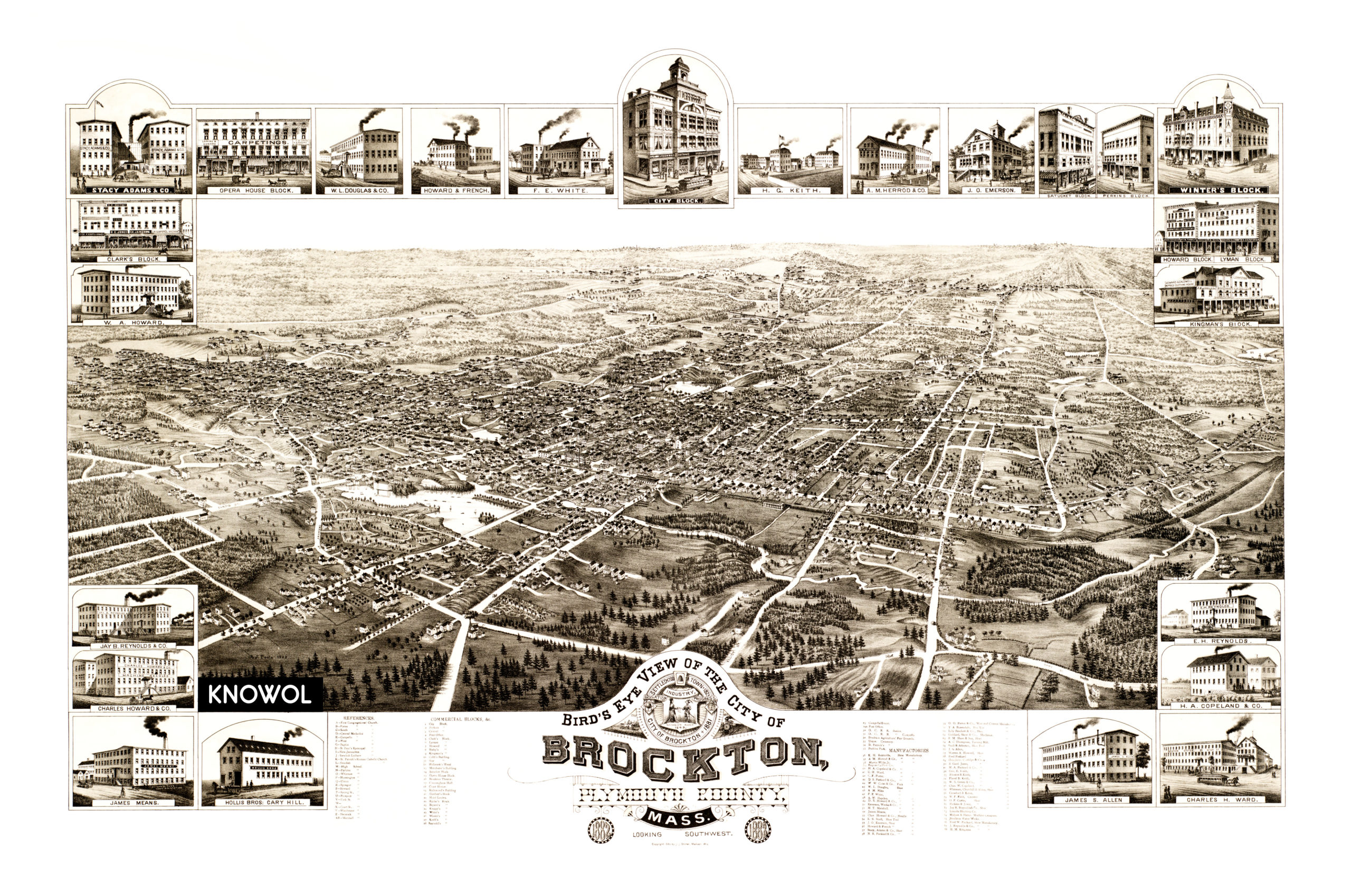
The bird's-eye view
By Albert Poole
Brockton drawn from the sky by Albert Poole, a Brockton native, a year after it became a city. Of the 53 manufacturing establishments in the legend, at least 45 made shoes, and 16 of the 23 buildings drawn around the border are shoe factories.2
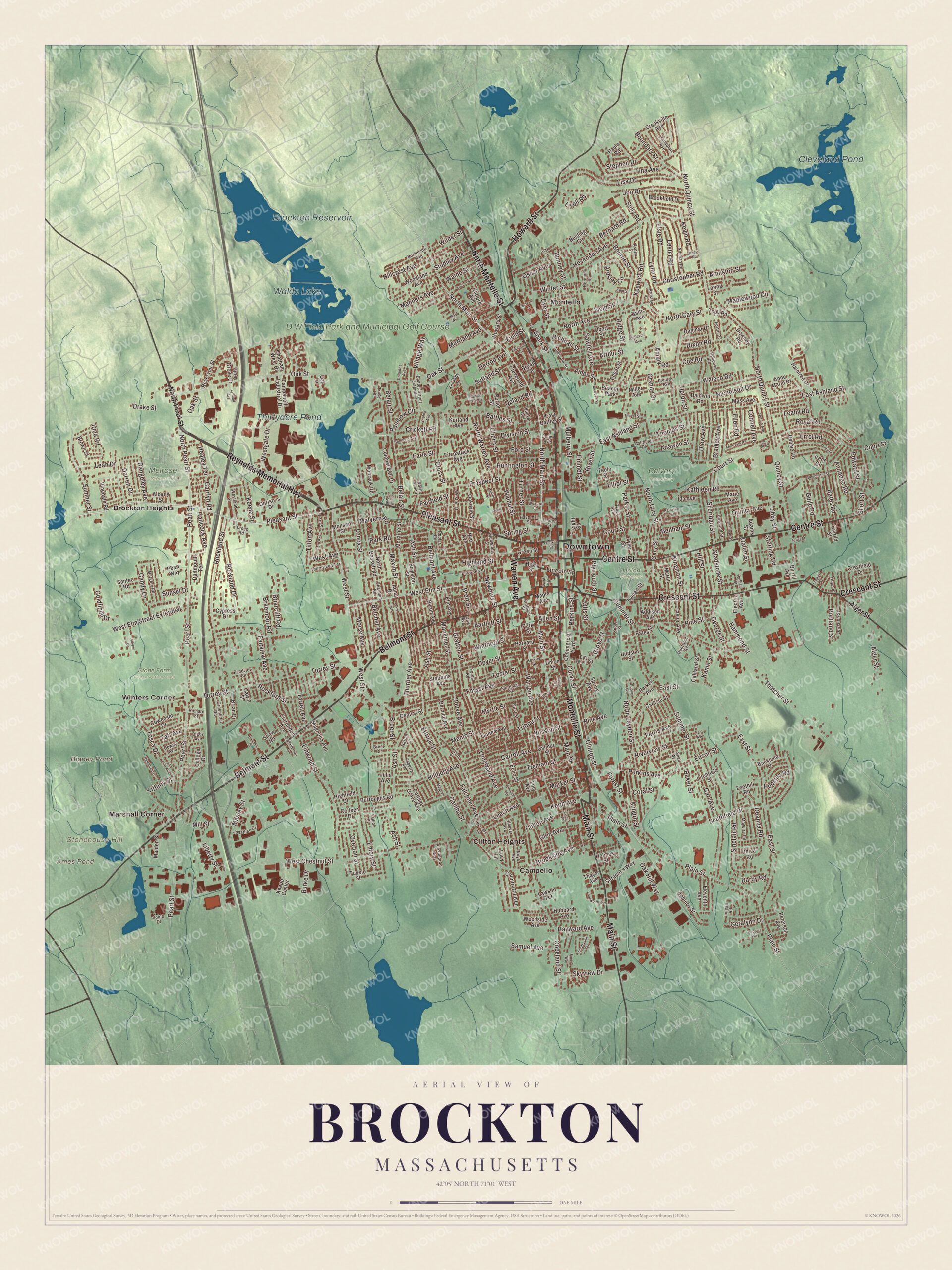
Brockton today
By KNOWOL
Shaded relief from USGS elevation data with Main Street, Montello Street, Pleasant Street, Warren Avenue and Reynolds Memorial Highway, plus Waldo Lake, Ames Pond, Cleveland Pond, Bigney Pond and Stonehouse Hill.4
The story of Brockton
The week Edison came to town
In 1883 Thomas Edison came to Brockton and stayed a week. He was there for October 1, when the Edison Electric Lighting Station opened the first three-wire underground lighting system ever installed. The city's centennial book says the buried wires were especially welcome because big, beautiful trees shaded the main streets. Brockton could also claim the first theater lit from a central station, and a fire-engine house wired to light every lamp at night and turn the horses loose when the alarm struck. For two years it was the Edison company's show plant, and other cities came to look and copy it. Edison also came to Brockton to see the first car run on its electric street railway, the first built for electric power.5678
Norwood, Standish, Allerton or Avon
By 1870 plenty of people in North Bridgewater were tired of a long name that got mixed up with other towns. At a meeting in January 1871 they floated Standish, Madison, Pyrola, Oriole, Langdon, Gaston, Aberdale, Alden, Montello and Norwood, and Norwood came out ahead. A few weeks later the town voted to ask the Legislature for Standish instead. It took until 1874 to settle. The act that finally passed let the town pick Brockton, Allerton or Avon. Ira Copeland had suggested Brockton after hearing a Canadian conductor call out Brockville, Ontario, and Brockton won 1,081 votes, about 72 percent. North Bridgewater became Brockton on May 5, 1874.9101
Shoes, a fair and a Swedish song
During the Civil War Brockton was America's largest producer of shoes, and the trade shaped everything. On Albert Poole's 1882 view, at least 45 of the 53 factories in the legend made shoes. A federal report quoted in 1921 said Brockton's employees owned 90 percent of the homes in the city. In the fall there was the Brockton Fair, which a 1928 county history called the only fair in America that printed its own daily newspaper. Shoe work drew newcomers too. In 1870 the famous Swedish singer Christine Nilsson gave a concert for the Bethesda Lutheran Church at Campello, and when she sang Old Folks at Home many of her countrymen in the audience cried.12111213
Through the years
25 moments from 1649 to today.
- 1649Ousamequin, known as Massasoit, sells the land called Saughtucket to Myles Standish, and the English rename it Bridgewater.1
- 1821On June 15 the northern part of Bridgewater becomes the town of North Bridgewater.1
- 1865In a fire engine contest for a silver trumpet, the engine Protector wins by throwing water 220 feet.14
- 1870The Swedish singer Christine Nilsson gives a concert in town for the Bethesda Lutheran Church at Campello.13
- 1871After weighing names from Norwood to Pyrola, the town votes to ask the Legislature to rename it Standish.9
- 1874The Legislature lets North Bridgewater choose Brockton, Allerton or Avon. Brockton wins, and the new name takes effect May 5.10
- 1874The Brockton Fair is held for the first time.15
- 1875Brockton trades slices of land with South Abington and East Bridgewater, redrawing the town line.15
- 1876The Howard and Lyman Blocks go up across Main Street from today's City Hall.16
- 1877Brockton's first telephone wire is strung on February 1, from a photographer's studio at Main and Centre Streets.15
- 1880Montello, empty land until now, gets its first house lots west of the railroad.17
- 1881Brockton becomes a city on April 9.1
- 1882Albert Poole draws his bird's-eye view of the city.2
- 1883Thomas Edison spends a week in Brockton and opens the world's first three-wire underground lighting system on October 1.5
- 1884The Central Fire Station goes up on Pleasant Street, the first electrified firehouse in the nation.18
- 1892Work starts on City Hall, finished in 1894 with Civil War murals in its grand hall.19
- 1895The city's new history describes Marshall's Corner as an old factory district near the Indian cave at Stone House Hill.20
- 1896Brockton becomes the first city in the country to abolish its railroad grade crossings.1
- 1898W. B. Mason is founded here to supply the shoe industry.1
- 1902George G. Snow gives the city its fountain and four-faced clock.21
- 1925Daniel W. Field gives the city the land for D.W. Field Park.22
- 1928The fieldstone tower on Tower Hill is built from stones gathered in the park.23
- 1941Thirteen Brockton firefighters die when the roof of the burning Strand Theatre collapses on March 10.1
- 1953The Brockton VA hospital opens, then the largest and most expensive VA hospital in the country.24
- 2020Brockton becomes the first city in New England with a majority-Black population.1
Places to see
Places worth a visit in Brockton today.
- Brockton Edison power station70 School Street. Edison's 1883 underground lighting plant.
- Central Fire Station40 Pleasant Street. The nation's first electrified firehouse.
- City Hall45 School Street. Romanesque Revival, with Civil War murals.
- Snow Fountain and ClockNorth Main and East Main Streets. George G. Snow's gift of 1902.
- Fuller Craft MuseumOak Street. Contemporary craft, founded 1946.Visit their website
- D.W. Field ParkNorthern Brockton. 650 acres and seven ponds.Visit their website
- Tower on Tower HillD.W. Field Park. Fieldstone tower of 1928, opens at Towerfest.
- Waldo LakeD.W. Field Park. Made in the 1930s for the park.
- Stonehouse HillSouthwest of Marshall's Corner. Site of the old Indian cave.
- Campello stationCampello. Campello was Plain Village until 1850.
On the National Register
All 24 places in Brockton on the National Register of Historic Places that still stand today, oldest first, and why each one matters.3
-
South Street Historic District
South Street was a fashionable address from about 1850 to 1915, with houses in many styles, most of them Colonial Revival. The South Street Methodist Church of 1880 is now homes; the South Congregational Church of 1854 was torn down in the early 1990s.25
-
Curtis Building
The three-story brick building was built in 1870, and is a fine local example of Romanesque styling. It features panel brick pilasters on the corners, and panel brick decoration in the cornices.26
-
Forest Avenue School
A one-room schoolhouse built in 1875 on Forest Avenue and used until 1963. It was moved within the city in 1969 to the Brockton High School grounds, where it's the Little Red Schoolhouse Museum.27
-
Howard Block
Built in 1876, it forms (along with the adjacent Lyman Block), an important nexus of commercial development of the post-Civil War era in Brockton. The block listed on the National Register of Historic Places in 1982.28
-
Lyman Block
Built in 1876 for a local business group, it is a fine local example of Italianate style, and one of the elements of a group of four well-preserved 19th-century commercial buildings in the city. The block was listed on the National Register of Historic Places in 1982.16
-
Brockton Edison Electric Illuminating Company Power Station
One of the earliest power plants built by Thomas Edison. It opened on October 1, 1883, with three dynamos for about 1,600 lamps.8
-
Central Fire Station
The city's first brick firehouse and the nation's first electrified one, fed by an underground cable from the nearby power plant built under Thomas Edison's supervision. It's a three-story Second Empire building with a mansard roof.18
-
Dr. Edgar Everett Dean House
A Queen Anne house built in 1884 for Dr. Edgar Everett Dean, a prominent local physician. It's one of the few surviving houses by Wesley Lyng Minor, the architect of City Hall.29
-
Gardner J. Kingman House
The first brick house built in the city, designed by Wesley Lyng Minor for Gardner Kingman, a businessman prominent in the shoe industry and civic affairs. A large terra cotta floral panel fills its front gable.30
-
Franklin Block
The three-story brick Romanesque Revival-style building was built in 1888. Its construction marked the high point in the economic recovery of the city's Campello neighborhood, which had been devastated by fire in 1853, and is one of two 19th-century buildings in the area.31
-
Brockton City Hall
Designed by local architect Wesley Lyng Minor, it was the first building made to house the city's offices, and it fills a whole block. Its grand hall has Civil War murals painted by Richard Holland and Mortimer Lamb in 1893.19
-
Goldthwaite Block
Built in 1892, it forms part of one of the city's best-preserved assemblages of 19th-century commercial architecture, alongside the Lyman Block and Howard Block. The building was listed on the National Register of Historic Places in 1982.32
-
Moses Packard House
Built in 1897 by Moses Packard, a prominent local shoemaker, it's one of the city's finest Queen Anne houses, with a stone first floor and a three-story turret.33
-
Old Post Office Building
The two story brick Colonial Revival-style post office was built in 1898 and expanded in 1932. It was designed under the auspices of the federal government's supervising architect, James Knox Taylor, as a copy of Independence Hall in Philadelphia.34
-
Snow Fountain and Clock
Given to the city in 1902 by George G. Snow, who lived nearby. A four-faced clock by E. Howard and Co. stands on a 15-foot column over a fountain and horse trough of Quincy granite.21
-
New England Telephone and Telegraph Engineering Office
A Classical Revival building by Brockton architect Charles Olson that housed support services for the telephone company's main exchange until about 1950. It was listed for its architecture and the telephone company's part in Brockton's 20th-century growth.35
-
Howard Home for Aged Men
Built in 1924, it was one of two institutions in the city specifically for the care of elderly men. It was taken over by the VA in 1949, and is being rehabilitated for use as veteran housing.36
-
D.W. Field Park
Daniel W. Field's 1925 gift to the city: 650 acres of fields, woods and a chain of seven ponds and lakes along Beaver Brook, reaching into Avon. Its fieldstone observation tower on Tower Hill was built in 1928 from stones gathered in the park.23
-
Rocky Marciano House
The two-family house facing James Edgar Park where Rocky Marciano lived with his parents and five siblings from 1943 to 1953. It was listed on the National Register in August 2025.37
-
Brockton VA Hospital Historic District
Ground was broken in 1950 on land the city bought and gave to the federal government, and the hospital opened in 1953. At the time it was the largest and most expensive VA facility in the country, with more than 20 buildings on over 140 acres.24
-
Centre and Montello Streets Historic District
Well-kept brick and brownstone commercial blocks along Centre and Montello Streets, listed to preserve Brockton's past as the Shoe City. The Lily, Brackett and Co. shoe factory at 124 to 126 Montello Street is believed to be the city's oldest brick shoe factory.38
-
North Downtown Historic District
The northern blocks of downtown along Main and North Main Streets, from Linden Street south to Legion Parkway and west to Warren Avenue, nominated with the Historic Resources of Downtown Brockton and listed in 2024.39
-
Blanchard Plat Historic District
A residential district on parts of Carleton, Ellsworth, Highland, Montgomery, Newbury, North Arlington and West Elm Streets, added to the National Register on February 13, 2025.40
-
School Street-Main Street Historic District
The blocks around City Hall, between Main, School and East Elm Streets, listed in August 2025 among the downtown places that date to the height of Brockton's shoe industry, 1840 to 1946.41
In their words
“Its shoes and the most wonderful fair in America.”
History of Plymouth, Norfolk and Barnstable counties, 1928, on what Brockton is famous for42
“The greatest shoe city in the world.”
Congressman Louis A. Frothingham, in Brockton and its centennial, 192143
“They did not make Brockton but Brockton made them what they are.”
History of Plymouth, Norfolk and Barnstable counties, 1928, on the shoes and the fair44
Nearby towns
Sources
- Brockton, Massachusetts, Wikipedia
- Bird's eye view of Brockton, Massachusetts in 1882, restored by KNOWOL
- National Register of Historic Places listings in Plymouth County, Massachusetts, Wikipedia
- Map of Brockton, Massachusetts in 2026, KNOWOL (USGS elevation, Census Bureau roads)
- Brockton and its centennial, chief events as town and city 1821-1921 (1922), on Edison's visit, Internet Archive
- Brockton and its centennial, chief events as town and city 1821-1921 (1921), on the Edison lighting system, Internet Archive
- History of Plymouth, Norfolk and Barnstable counties, Massachusetts (1928), on Brockton's firsts, Internet Archive
- Brockton Edison Electric Illuminating Company Power Station, Wikipedia
- History of Plymouth County, Massachusetts (1884), on changing the town's name, Internet Archive
- History of Plymouth County, Massachusetts (1884), on the act of 1874, Internet Archive
- Brockton and its centennial, chief events as town and city 1821-1921 (1922), on shoe workers' homes, Internet Archive
- History of Plymouth, Norfolk and Barnstable counties, Massachusetts (1928), on the Brockton Fair's newspaper, Internet Archive
- Brockton and its centennial, chief events as town and city 1821-1921 (1921), on Christine Nilsson's visit, Internet Archive
- History of Plymouth County, Massachusetts (1884), on the fire department, Internet Archive
- History of Plymouth, Norfolk and Barnstable counties, Massachusetts (1928), on the 1870s in Brockton, Internet Archive
- Lyman Block, Wikipedia
- Biographical review … of leading citizens of Plymouth County, Massachusetts (1897), on the father of Montello, Internet Archive
- Central Fire Station, Wikipedia
- Brockton City Hall, Wikipedia
- History of Brockton, Plymouth County, Massachusetts, 1656-1894 (1895), on parks, hills and corners, Internet Archive
- Snow Fountain and Clock, Wikipedia
- History of Plymouth, Norfolk and Barnstable counties, Massachusetts (1928), on Daniel W. Field, Internet Archive
- D.W. Field Park, Wikipedia
- Brockton VA Hospital Historic District, Wikipedia
- South Street Historic District, Wikipedia
- Curtis Building, Wikipedia
- Forest Avenue School, Wikipedia
- Howard Block, Wikipedia
- Dr. Edgar Everett Dean House, Wikipedia
- Gardner J. Kingman House, Wikipedia
- Franklin Block, Wikipedia
- Goldthwaite Block, Wikipedia
- Moses Packard House, Wikipedia
- Old Post Office Building, Wikipedia
- New England Telephone and Telegraph Engineering Office, Wikipedia
- Howard Home for Aged Men, Wikipedia
- Rocky Marciano house is a shrine to boxing champ, The Enterprise (Brockton), via AOL
- Centre and Montello Streets Historic District, Wikipedia
- Pending list, July 2024 (North Downtown Historic District, Historic Resources of Downtown Brockton), National Park Service
- Weekly list of actions taken on properties, February 2025 (Blanchard Plat Historic District listed 2/13/2025), National Park Service
- Weekly list of actions taken on properties, August 18 to 21, 2025 (School Street-Main Street Historic District and Rocky Marciano House listed), National Park Service
- History of Plymouth, Norfolk and Barnstable counties, Massachusetts (1928), on the Brockton Agricultural Society, Internet Archive
- Brockton and its centennial, chief events as town and city 1821-1921 (1921), centennial greetings, Internet Archive
- History of Plymouth, Norfolk and Barnstable counties, Massachusetts (1928), on the county's only city, Internet Archive